Remove the confusion and frustration surrounding task ownership and accountability by incorporating a RACI chart into your project planning practice.
How leading PMOs balance portfolio strategy and delivery

Key Takeaways
PPM focuses on project delivery, while SPM focuses on strategic investment decisions.
PPM manages projects, while SPM manages the portfolio's alignment to business strategy.
Organizations typically need PPM first and add SPM as portfolio complexity increases.
SPM extends PPM with capabilities such as scenario planning, investment planning, and strategy-to-work alignment.
A common sign that a PMO needs SPM is when leadership can see project status but cannot explain how work supports strategic goals.
You can be highly effective at delivering projects – but that doesn’t mean you and your teams are experts in executing strategy. Priorities always change, budgets shift, and opportunities emerge that make it difficult to keep resources focused on the work that matters most.
This brings us to Strategic Portfolio Management (SPM) and Project Portfolio Management (PPM). Both help organizations govern investments and prioritize work, but they solve different problems and operate at different levels of decision-making.
This guide explains what SPM and PPM are, how they differ, and the signals that indicate your PMO may need one, the other, or both.
PPM is the practice of planning, prioritizing, and overseeing a portfolio of projects to ensure they are delivered on time, on budget, and with the available resources.
SPM is the practice of aligning investments, initiatives, and resources with business strategy to ensure the organization is funding the right work. Many of these principles overlap with lean portfolio management (LPM).
Here are key differences at a glance:
Criteria | SPM | PPM |
Primary question | Are we building/funding the right work? | Are projects on track? |
Core focus | Strategic alignment and investment decisions | Project delivery and execution |
Decision level | Portfolio and executive leadership | Project and program management |
Time horizon | Continuous strategic alignment and portfolio reprioritization | Sprint to quarterly planning |
Key metrics | Initiative-to-strategy alignment, ROI delivery rate, capacity availability | Schedule variance, budget burn, resource utilization |
Typical roles | Head of PMO, CPO, executive leadership | Project manager, PMO analyst |
Primary outcome | Better strategic investment decisions | Better project delivery outcomes |
The two disciplines depend on each other. PPM provides the execution data needed to assess portfolio performance, while SPM ensures that execution effort remains focused on strategic priorities.
Without SPM, organizations risk delivering the wrong work efficiently. Without PPM, they risk making strategic decisions based on unreliable delivery data.
What PPM can't tell leadership is whether the funded work still connects to the strategy set at the last planning cycle.
That distinction becomes most visible during planning and portfolio reviews. While project status is continuously reported, strategic alignment is often assessed separately. As priorities change, organizations can continue executing projects successfully while experiencing strategic drift, where delivered work no longer reflects the outcomes the business is trying to achieve.
The consequences show up in two ways:
Strategic misalignment: The 2026 State of SPM report estimates that organizations lose $260M annually for every $880M of strategic spend due to misalignment, delays, and low-value work. Roughly $75-$85M is considered recoverable. The report also found that more than one-third of projects are cancelled or stopped early because they no longer align with priorities or expected ROI.
Capacity constraints: Effective capacity planning requires more than knowing who is assigned to each project. PPM tools can show resource assignments, but they don't necessarily reveal whether teams have enough capacity to deliver all committed work. Unplanned operational work, competing priorities, and cross-functional dependencies can leave portfolios overcommitted before new initiatives even begin. These underlying resource constraints are easy to miss.
Both problems stem from the same issue: Organizations can see project execution but lack a continuous view of how strategy, funding, capacity, and delivery connect across the portfolio.
For a closer look at the business leaders, PMO leaders, program managers, and change leaders responsible for maintaining that connection, see The people behind the portfolio.
Portfolio management sits above program and project management in the governance hierarchy. Each level answers a different question and requires different data.
Level | Manages | Primary question | Who owns it |
Project | Delivery work | Is this project on schedule? | Project manager |
Program | Related projects | Are dependent projects delivering together? | Program manager |
Portfolio | Active initiatives | Are we allocating resources well? | PMO |
Strategy | Investment direction | Are we investing in the right work? | Executive leadership and PMO |
SPM sits above the delivery layers. While project, program, and portfolio management focus on executing and coordinating work, SPM focuses on whether the portfolio itself supports strategic objectives.
The executive question is simple: Are we investing in the right work?
Cross-functional alignment is where the hierarchy often breaks down in practice. Finance tracks investments in one system, delivery teams track work in another, and the PMO spends time reconciling the two. When planning and execution data are disconnected, leaders struggle to connect spending, capacity, and outcomes.
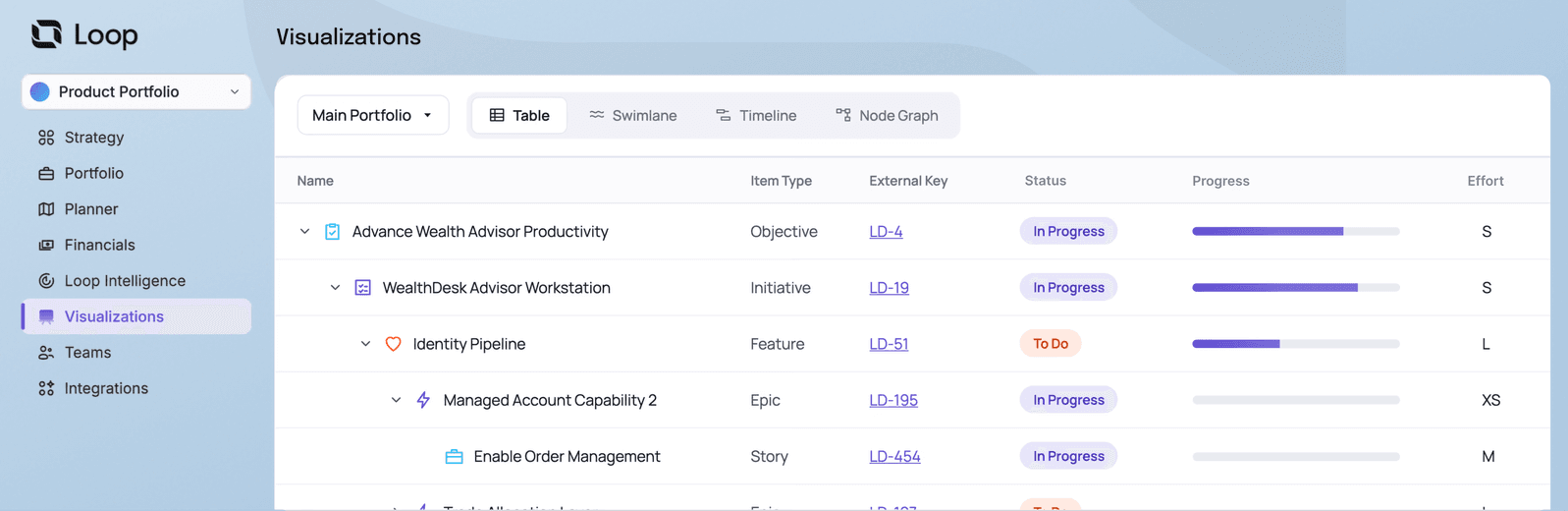
A shared portfolio view helps close that distance. Tempo Loop’s Visibility capability brings work, time, and capacity from connected systems into a continuously updated view, allowing finance and delivery leaders to work from the same portfolio picture.
See how organizations worldwide are connecting strategy, planning, and execution in the 2026 State of Strategic Portfolio Management report.
PPM is the right starting point when project visibility and delivery execution are the primary challenges. If teams can't reliably answer which projects are on track, where resources are allocated, or why work is delayed, better portfolio execution should come before broader strategic planning.
SPM becomes necessary when leadership can see project status but can't determine whether the portfolio still reflects business priorities. At that point, the challenge is no longer execution, but investment and planning decisions.
The decision signals differ by failure mode:
Signal | Likely cause | What it points to |
Projects are late, over budget, or blocked | Delivery execution is unclear | PPM |
Leadership can't see which initiatives support which goals | Strategy and delivery are disconnected | SPM |
Teams are overcommitted before new work is approved | Capacity isn't visible at portfolio level | SPM |
Priorities change but the plan doesn't | The portfolio lacks a mechanism to replan | SPM |
Finance and delivery report different numbers | Portfolio data is fragmented across systems | SPM |
Organizations often need both. PPM improves execution visibility, while SPM connects investment decisions to delivery reality.
The common thread across all five signals is a disconnect between strategy, capacity, and execution. Projects may be managed effectively, but leaders still struggle to see whether resources are funding the highest-priority outcomes.
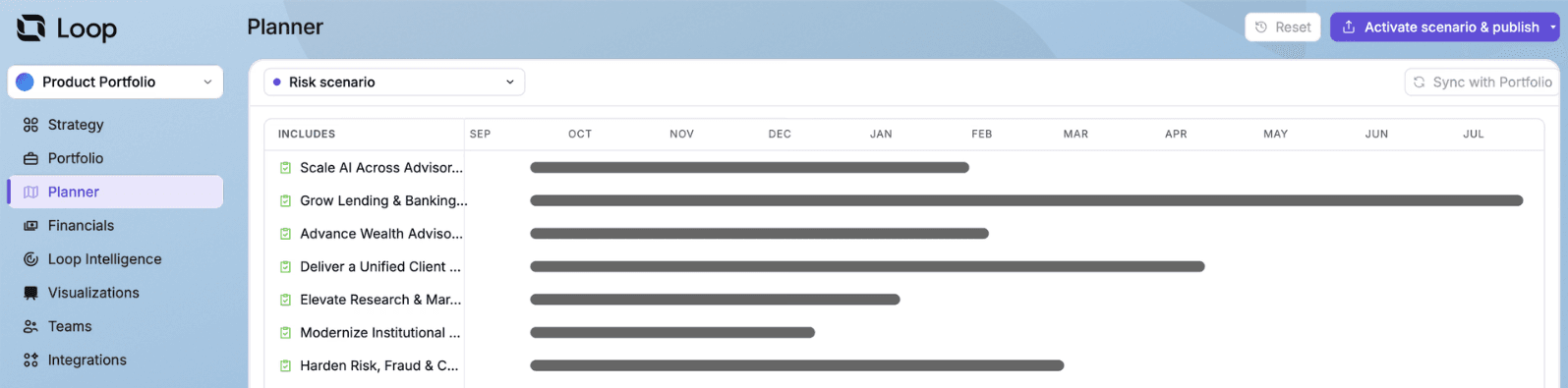
Scenario planning is where SPM becomes actionable. It allows PMO leaders to test funding, capacity, and timing decisions before committing to them, compare alternatives, and continuously adjust the portfolio as priorities change.
Tempo Loop’s Planning supports this process by helping organizations evaluate trade-offs before work enters delivery.
The biggest difference is that PPM tools primarily help teams execute approved work, while SPM platforms help leadership decide which work should be approved, funded, reprioritized, or stopped.
Key capabilities commonly found in SPM platforms:
Capability | Traditional PPM | SPM |
Project tracking and reporting | ✓ | ✓ |
Budget and resource reporting | ✓ | ✓ |
Project prioritization | ✓ | ✓ |
Strategy-to-investment alignment | Limited | ✓ |
Scenario planning | — | ✓ |
Portfolio investment planning | — | ✓ |
Investment-versus-actuals tracking | Limited | ✓ |
Portfolio capacity modeling | Limited | ✓ |
Cross-portfolio funding decisions | — | ✓ |
Continuous strategy alignment monitoring | — | ✓ |
Executive portfolio governance | Limited | ✓ |
The distinction isn't always absolute. Many modern platforms today combine elements of both, but the capabilities above are typically associated with SPM rather than traditional PPM.
PPM focuses on delivery. SPM focuses on investment and alignment. Most organizations need both, plus a way to connect them. Tempo Loop, an AI-native Intelligent Portfolio Orchestration (IPO) platform, brings strategy, planning, capacity, and delivery into a unified portfolio view. Teams can see what's happening across systems, evaluate trade-offs before committing resources, coordinate decisions across portfolios, and adjust plans as priorities change.
Book a demo to see how Tempo Loop helps organizations connect SPM and PPM in practice.
Structure PPM
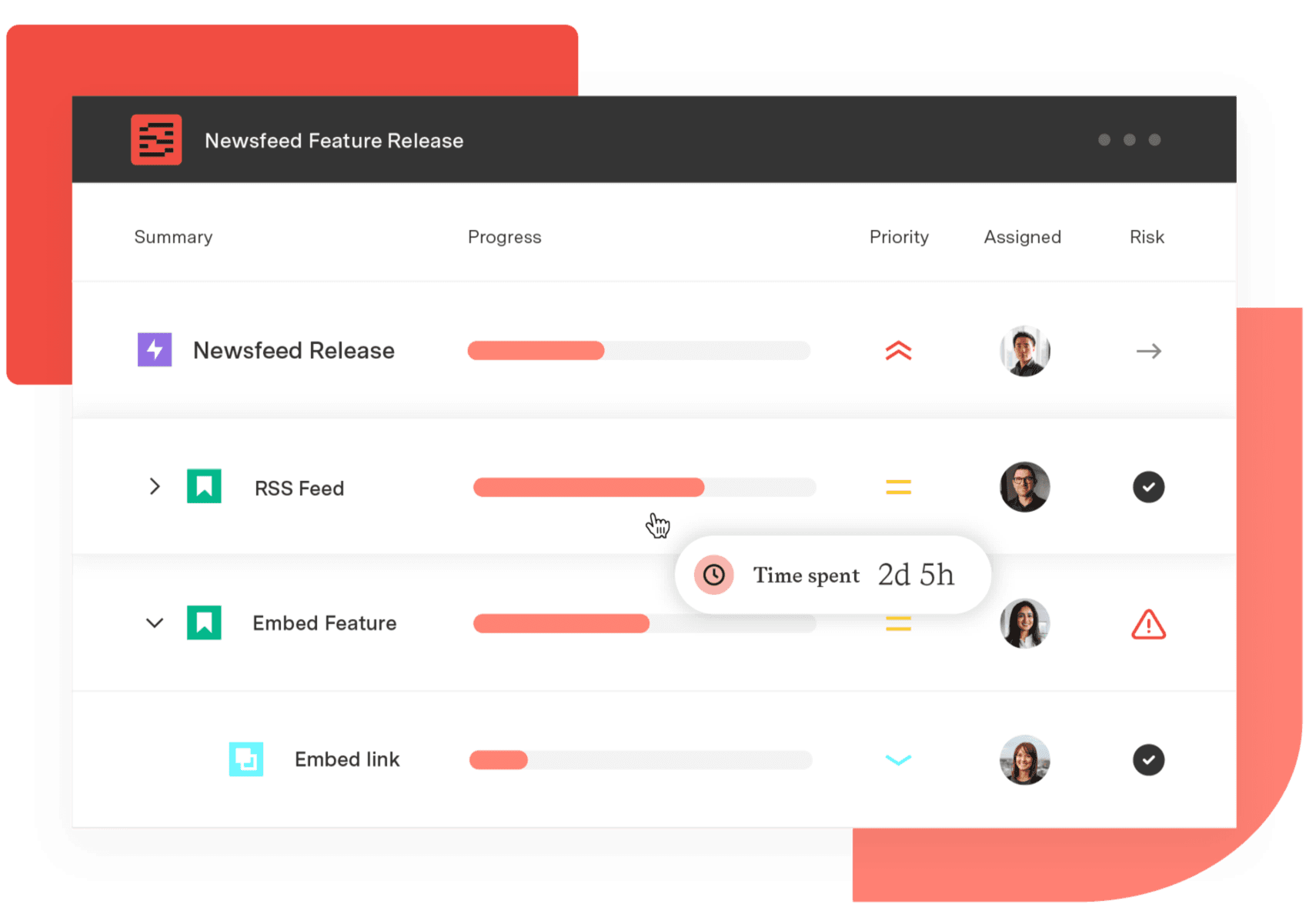
Manage products, projects, and programs in a single spreadsheet-like view. By providing a clear, real-time view of project progress and resource allocation, Structure helps teams meet deadlines and adapt swiftly to changing priorities.
Start a Free TrialCouldn't find what you need?Go to our documentation
No. SPM builds on top of PPM rather than replacing it. PPM provides execution data, while SPM uses that data to make portfolio-level investment and prioritization decisions.
Technically yes, but it is difficult to make good portfolio decisions without reliable delivery data. Most organizations use PPM and SPM together.
A PMO should consider SPM when it can reliably answer delivery questions but struggles to answer strategy and investment questions such as which initiatives create the most value or whether resources are allocated to the highest-priority outcomes.
SPM improves strategic alignment, investment decisions, resource allocation, scenario planning, and portfolio visibility while helping organizations adapt to changing priorities.
SPM is commonly used in technology, financial services, healthcare, manufacturing, telecommunications, government, and other organizations managing large portfolios of strategic initiatives.
Remove the confusion and frustration surrounding task ownership and accountability by incorporating a RACI chart into your project planning practice.

Learn about five ways to improve teamwork and run a more efficient and profitable business by hitting your goals together.

See how Custom Charts for Jira lets you build cross-project dashboards, story-point breakdowns, and control charts that native Jira reports can't.

In this article, we will define what is a data source, examine data source types, and provide examples of how they can be used in different contexts.

Group issues by version fields (including custom fields) and keep items with the same version name together, even across different projects.

Measure how long Jira issues take to close, broken down by status. The resolution time report turns workflow drift into a number you can act on.
This Q&A is set up to help you create a mission and vision statement that can turbocharge your career goals and aspirations.

Tempo makes it really simple to choose which kind of project to create and switch between using EVM and traditional project management techniques.

Understanding disruptive technology helps you identify innovations that serve your interests and reap the benefits of early adoption.