Powerful and flexible filtering has never been easier for azure devOps thanks to Work Item Query Language support.
Why organizations lose the thread between what leadership decides and what actually gets done, and why AI didn't fix that. It sped it up.

Key Takeaways
What is strategic drift, and why is a management theory from 1988 suddenly urgent again?
AI adoption is nearly universal among portfolio leaders. Why doesn't it show up as an advantage yet?
What happens once an organization isn't running one AI agent, but hundreds?
Strategic drift has a name in the academic literature, but most portfolio leaders already know it by feel: The plan made sense in January, and by August the team can't say with confidence it's still the plan. For decades that was a slow-moving risk. A leadership team could drift for years before anyone felt pressure to act on it.
AI changed the timeline. Every agent an organization deploys is a new actor optimizing for whatever narrow objective it was given, with no built-in sense of whether that objective still serves the strategy above it. Looked at one at a time, each one looks like progress.
Add them up, and they compound into something faster and far more expensive. The research, from McKinsey to MIT, keeps landing on the same point, stated a dozen different ways: drift is a visibility problem.
We put a number on it ourselves. Tempo's 2026 State of AI in Portfolio Management report surveyed 300 senior planning leaders, and 91% of them are already piloting or actively using AI in project delivery. The "using AI" group shows no measurable advantage over peers who are still piloting, or who haven't started at all.
On a few friction measures, it actually does worse. Drift isn't anyone's fault, and it isn't a competitor either. It's a condition. But it compounds against every organization that can't see it happening, and right now, most can't.
This is the first of two posts on the concept and the research behind it: what strategic drift is, why AI is accelerating it, and how one misaligned agent turns into a portfolio-wide problem. Part two covers how Tempo Loop, built on the attribution foundation Tempo Workforce Intelligence lays down, is built to close that distance.
The term comes from strategic management, most closely tied to Gerry Johnson, Kevan Scholes, and Richard Whittington's textbook Exploring Corporate Strategy. Johnson's original research, back in 1988, described a specific pattern: a company's strategy stays put while the world around it keeps moving, until the mismatch is too big to ignore.
"Strategic drift is a gradual deterioration of competitive action that results in the failure of an organization to acknowledge and respond to changes in the business environment."
Sammut-Bonnici, Wiley Encyclopedia of Management
Drift is rarely one bad decision. It builds up through a long run of choices that each made sense at the time, and that slowly pull the organization away from what its environment now needs. The literature keeps coming back to four symptoms:
A homogeneous mindset at the management and board level. Everyone reasoning from the same assumptions.
Preservation of the status quo. Change gets resisted because the known-broken thing feels safer than the unproven alternative.
Diminished focus on the external environment. Attention turns inward, toward process and activity instead of the market.
A gradual decline in performance. Often visible only in hindsight, once the distance has become expensive to close.
Johnson and Scholes didn't soften where this ends: drift far enough, for long enough, and an organization is left choosing between a painful transformation or a slow decline. None of this means drift should be eliminated entirely. Some drift is normal, even healthy. The goal has always been to catch it early, while the fix is still cheap.
Long before anyone talked about agentic AI, the distance between strategy and execution was already one of the most studied problems in management research:
McKinsey research has found that even high-performing companies deliver roughly 30% less value than their strategy promises.
McKinsey's State of Organizations research puts the number even higher at the leadership level: a majority of executives report their organizations cannot reliably execute their own strategy.
Research summarized across McKinsey, BCG, and Bain places the failure rate of strategic transformations at execution, not strategy formulation, at roughly 70%, with Bain's own analysis putting the figure closer to 88% for major transformations.
The Economist Intelligence Unit has separately found that a majority of firms struggle specifically to connect strategy formulation to day-to-day implementation.
Read enough of this research and one thing becomes clear: the strategy is rarely the problem. What's missing is a mechanism connecting that strategy to what people, teams, and now machines are doing on a given Tuesday.
The instinct says AI should shrink the distance. Faster execution should mean less room for the plan to wander. The research says the opposite is happening:
Larridin's 2025 State of Enterprise AI found that 89% of enterprises have adopted AI tools, but only 23% can accurately measure the return on that investment.
MIT's widely cited 2025 study of enterprise AI found that 95% of generative AI pilots delivered no measurable return, despite tens of billions of dollars in enterprise spend.
Gartner projects that more than 40% of agentic AI projects will be canceled by the end of 2027, citing escalating costs, unclear business value, and inadequate risk controls, and separately projects that AI agent adoption will surge from under 5% of enterprise apps in 2025 to 40% by the end of 2026.
Forrester's 2026 research on agentic AI concludes the technology is real, but most enterprises remain unprepared to operationalize it, framing the core problem as orchestration, control, and trust, not model capability.
CIO.com's 2026 State of the CIO survey (n=662) found that only 19% of CIOs say their AI initiatives met or exceeded business goals.
A 2026 survey by DoiT and Sapio (n=500 finance leaders) found that 79% of enterprises overspent on AI in the past year, while only 15% of finance leaders can calculate AI ROI without significant friction, even though 83% expect a clear ROI answer within 12 months.
We saw the same pattern from inside the portfolio. Tempo's 2026 State of AI in Portfolio Management report found 91% are already piloting or actively using AI in project delivery. At this point, using AI isn't a differentiator. It's the baseline.
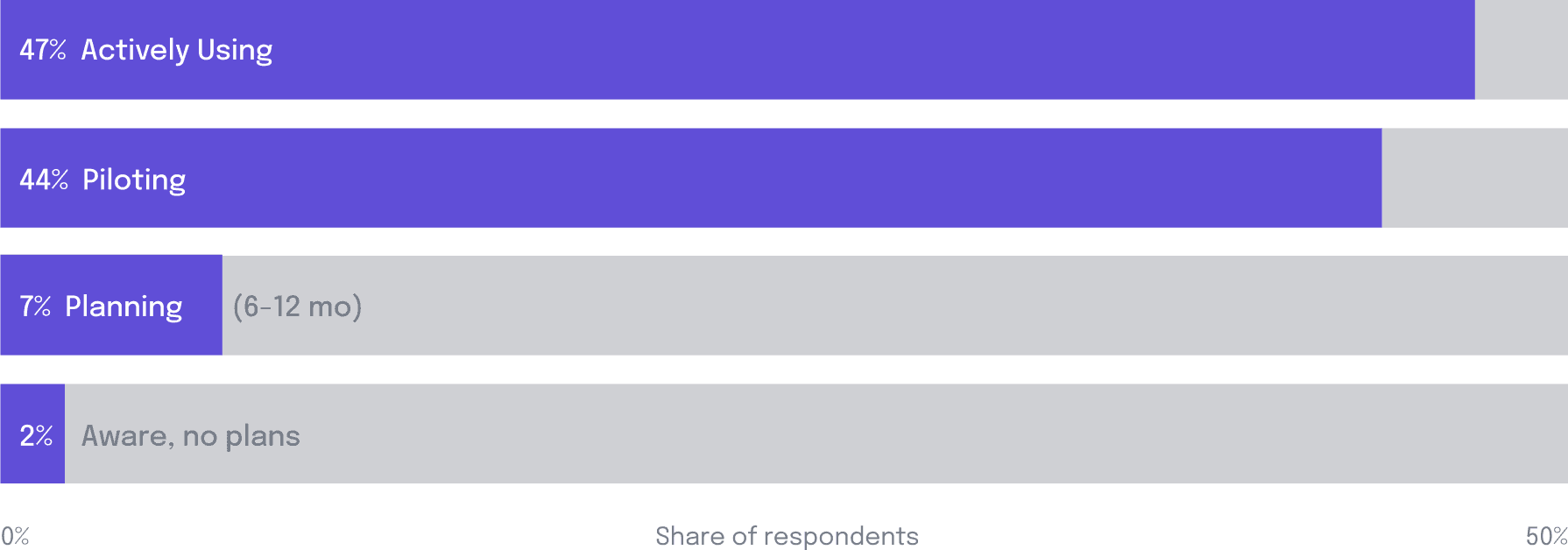
AI usage among senior planning leaders. Tempo, 2026 State of AI in Portfolio Management.
Using AI, on its own, buys nothing. Teams that call themselves "actively using AI" show no measurable edge over peers who are still piloting, or who haven't started, and on a few friction measures, the "using AI" group does worse.
The advantage only shows up once an organization stops treating AI as a productivity aid and starts delegating real delivery work to it: writing code, producing documentation, running QA. Today that's a third of the market. 56% are still piloting that handoff, 33% have deployed it into production, and the rest haven't started.
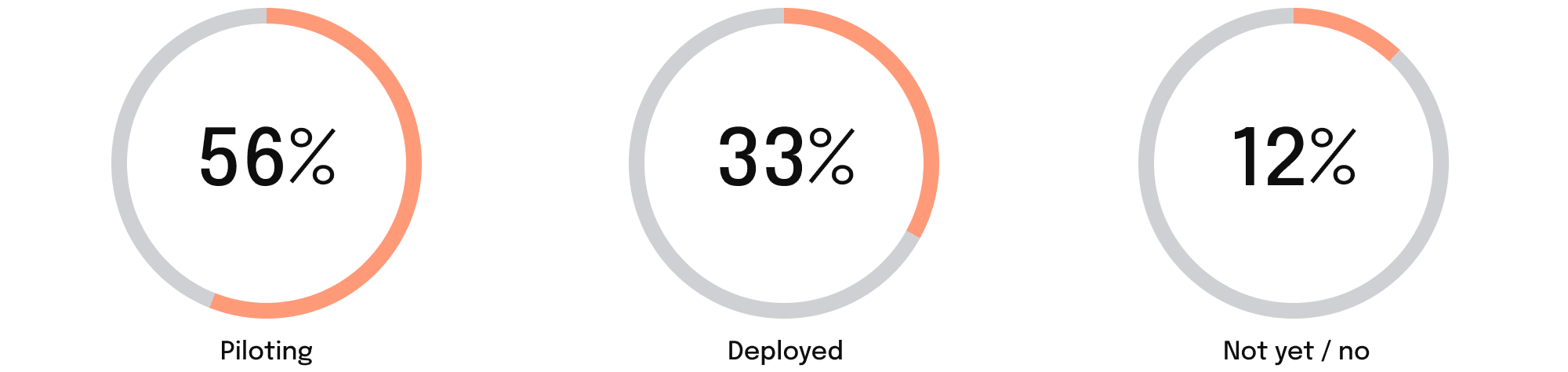
Share of organizations delegating real delivery work to AI agents. Tempo, 2026 State of AI in Portfolio Management.
And that production cohort isn't dabbling. 40% say AI is already handling 26 to 50% of their organization's project delivery work, and nearly a quarter have crossed 50%.
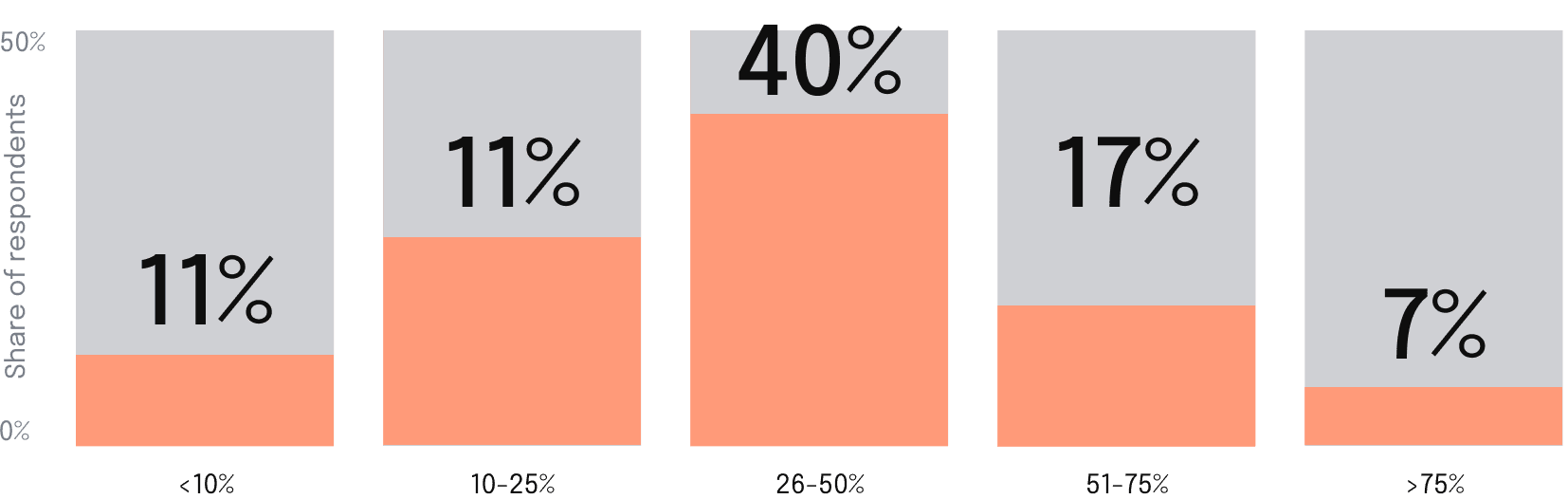
Share of delivery work that currently runs on AI. Tempo, 2026 State of AI in Portfolio Management.
It comes with a cost, though: 46% of leaders say their teams are duplicating AI work, 42% can't tie AI spend to ROI, 41% say their planning and delivery tools don't talk to each other, and 39% can't see AI costs or tell AI work apart from human work at all.
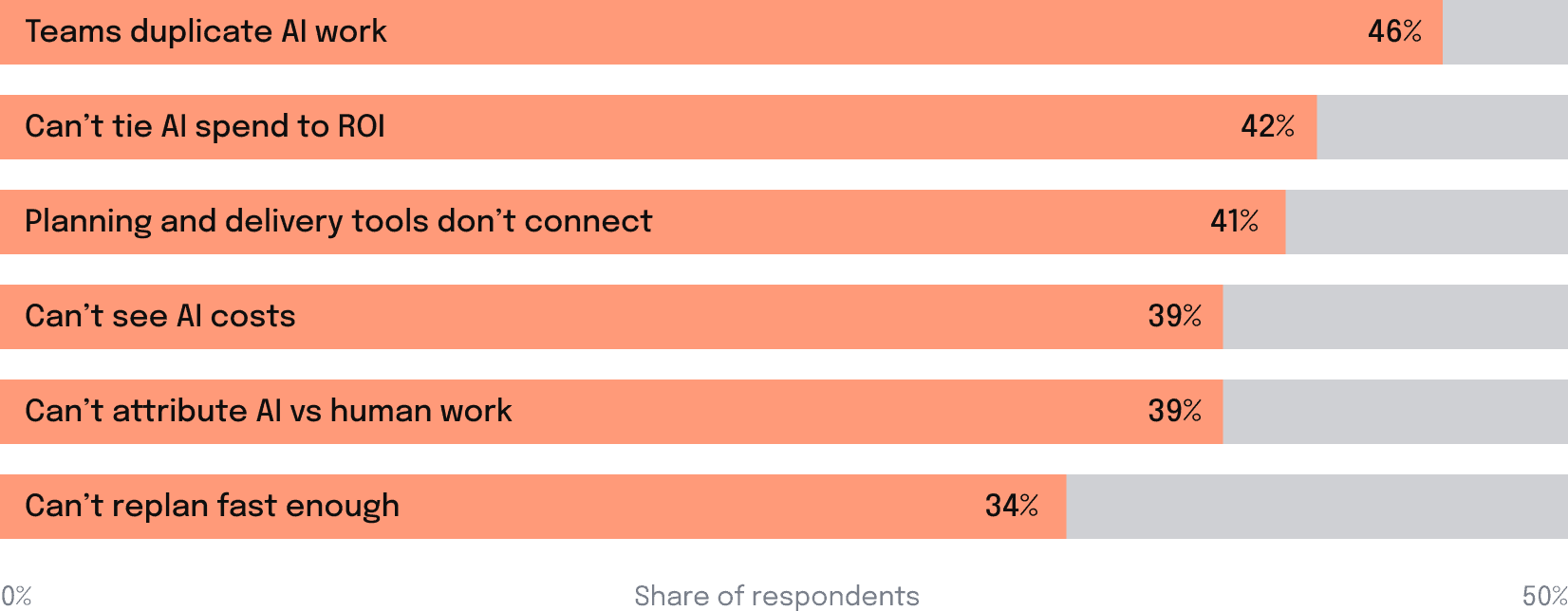
The friction leaders report. Tempo, 2026 State of AI in Portfolio Management.
That's drift, showing up in a survey before anyone in the room has used the word: real activity, no connected view of whether it's producing anything strategic, at a cost most teams can't yet explain.
A few older ideas from economics, cybernetics, and AI safety explain why AI speeds up drift instead of curing it:
Goodhart's Law (economics). Once a measure becomes a target, it stops being a good measure. Optimize for token usage, and an organization gets more tokens, not necessarily more of whatever the tokens were supposed to produce.
Norbert Wiener's warning (cybernetics, 1960). The field's founder cautioned in the journal Science that if a machine's operation can't easily be interrupted, its designers had better be certain the purpose given to it is the purpose actually intended. Every autonomous agent deployed today reopens that same question, at a scale Wiener could not have imagined.
The "King Midas problem" (AI safety, Stuart Russell, UC Berkeley). A system that pursues the wrong objective flawlessly isn't malfunctioning. It's succeeding, which is precisely the danger. An agent optimizing a narrow local goal has no innate sense of the broader intent it was meant to serve.
The principal-agent problem (economics). The classic risk that the party doing the work develops goals that diverge from the party who set the objective. Deploying AI agents at scale reproduces this structural problem across the enterprise, at machine speed and by the thousands.
None of this is new thinking. What's new is the speed: an organization can now rack up years' worth of drift in a matter of months.
A single misaligned agent is a manageable, local problem.
A recruiting agent optimized purely for time-to-hire can lower the bar on candidate quality. A procurement agent squeezing costs can erode supplier relationships the business needs next year. A support agent rewarded for fast ticket closure can close cases instead of solving problems.
Individually, none of these breaks anything. The risk shows up once an organization is running dozens or hundreds of these agents at the same time, each working from local context, none of them seeing the whole board. Misalignments don't just stack up. They start interacting with each other, and the complexity grows exponentially, not linearly. That's what Tempo calls the misalignment multiplier: AI doesn't invent strategic drift. It multiplies how fast it happens and what it costs.
Every portfolio drifts a little. That's normal.
What separates resilient organizations from everyone else, per the research above, isn't the absence of drift. It's how fast they catch it and fix it. Agents make that harder by design: they drift confidently, and faster than any human review cycle was built to catch.
Our own report makes the multiplier visible. Among teams that have moved AI agents into production, every friction measure drops off sharply compared to teams still piloting, or just using AI without deploying it. The distance between the two lines in the chart below is the deployment effect itself: teams running agents in production are far less likely to lose track of AI ROI, AI-versus-human attribution, or AI costs generally.
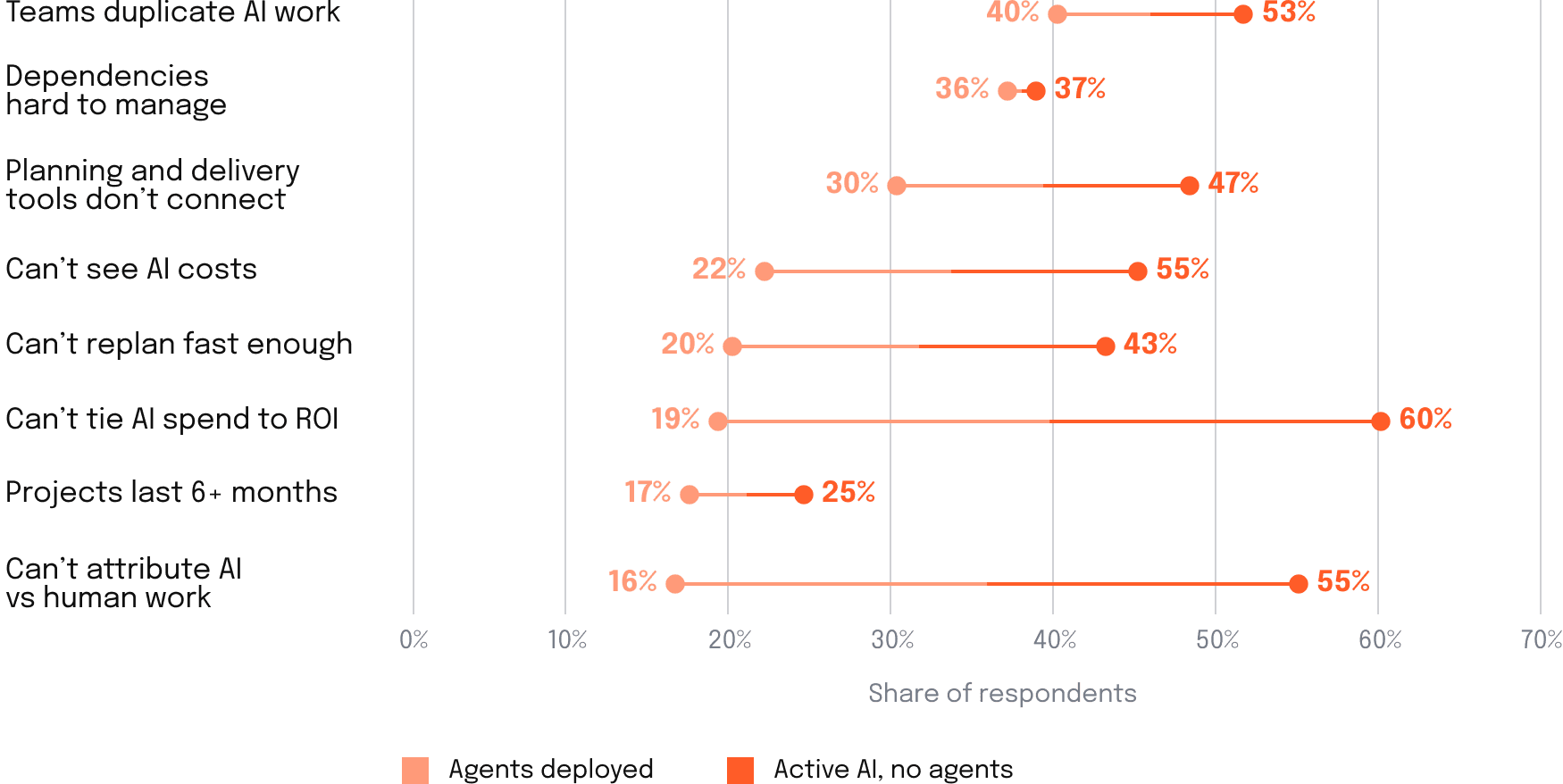
Difficulty coordinating AI work eases sharply once agents reach production. Tempo, 2026 State of AI in Portfolio Management.
The same pattern holds at the far edge of AI maturity.
Only 18 of the 300 organizations we surveyed have all seven core AI capabilities, from scenario planning to autonomous PM agents, live and running in production. Call this cohort the AI-enabled planning leaders. For them, the operational friction that defines everyone else's day has nearly disappeared: just 6% can't attribute AI versus human work, against 39% for the full sample. Just 17% can't tie AI spend to ROI, against 42%. Just 28% report duplicated AI work, against 46%.
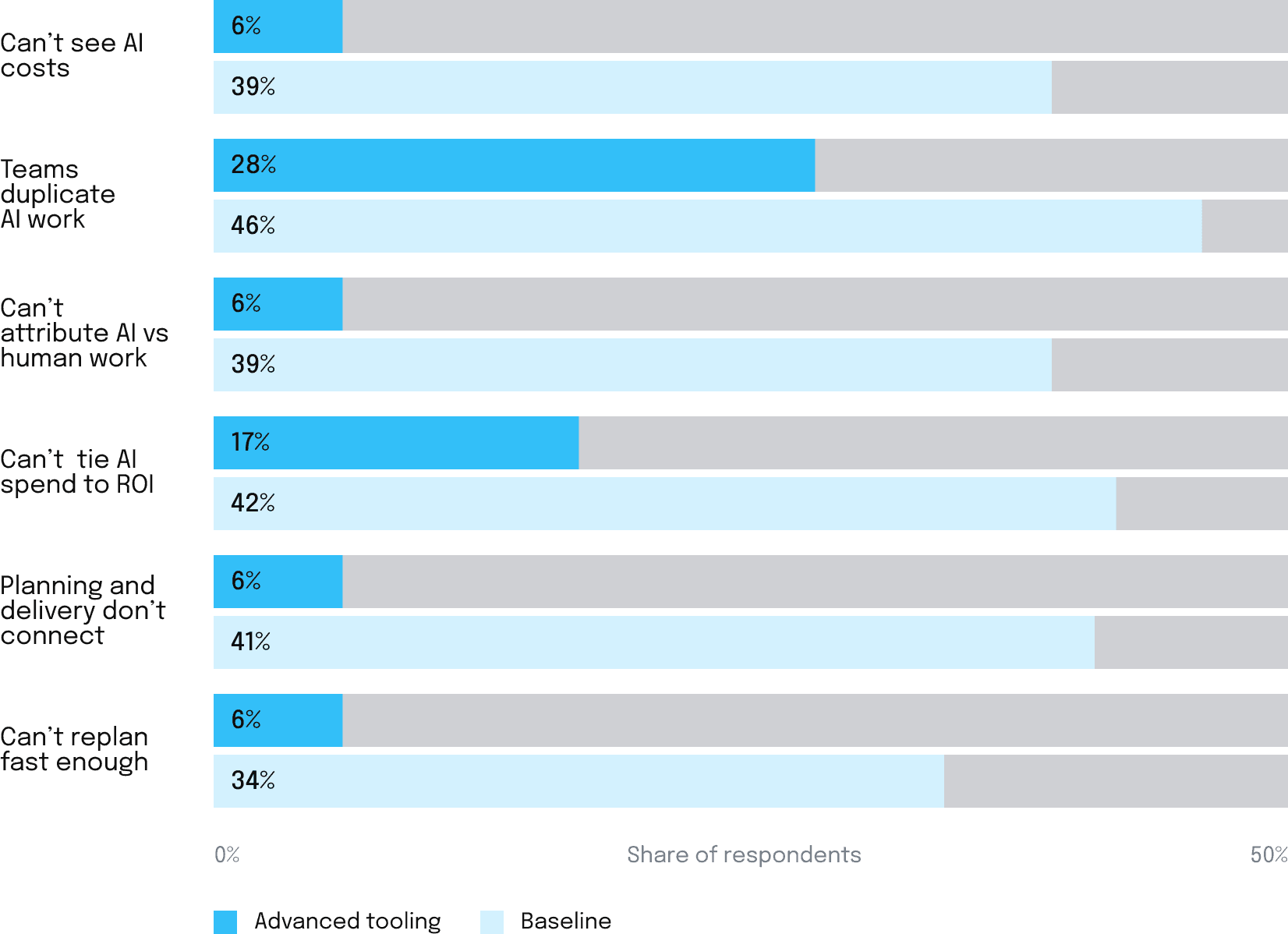
AI friction: AI-enabled planning leaders versus the full-sample baseline. Tempo, 2026 State of AI in Portfolio Management.
"Every PMO we work with wants prescriptive guidance, not another red flag on a dashboard. They're trying to do more than catch strategic drift. They need a tool that helps a portfolio leader course-correct in real time."
Parth Patel, Senior Director AI Transformation and Enterprise Solutions, Cprime
That same cohort ships faster, too: a 7-point advantage in projects that finish under six months, and far less trouble managing cross-project dependencies. The distance between drifting and staying aligned turns out to be measurable, and it grows every cycle.
That's the shape of the problem: near-universal AI adoption, most of it not yet paying off, and misalignment that compounds faster than any review cycle was built to catch. Part two covers how Tempo and Loop are built to close that distance, and what a growing number of PMOs are already doing about it.
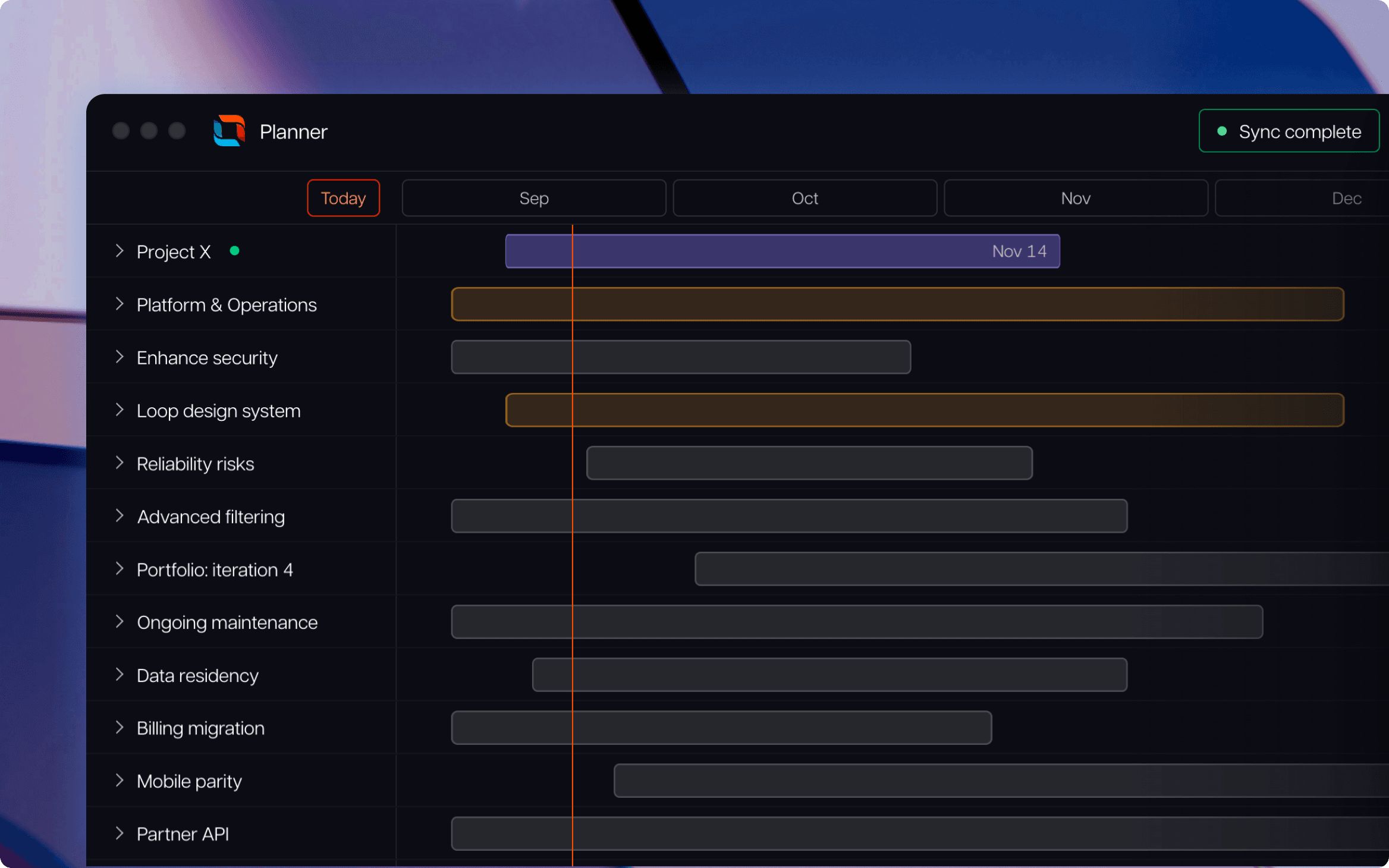
Tempo Loop
Direct every human, every agent, and every dollar to the work that matters most.
Book a demoPowerful and flexible filtering has never been easier for azure devOps thanks to Work Item Query Language support.

See where shared capacity actually went. Team timesheets roll up Jira worklogs by person, project, and account so managers spot overload fast.

Take control of your project management tasks by implementing project planning tools to foster collaboration and increase team productivity.

Learn effective IT project management strategies to optimize resources, manage scope, and keep projects on track for successful outcomes.
Explore our guide on how to write a SWOT analysis, see how it looks in practice with a real-world example, and discover this tool’s benefits.

Looking for the difference between Structure, Jira Plans and BigPicture? This guide breaks down the major tools on the market

Financial oversight ensures you have the assets needed to successfully deliver project outcomes. Here’s how to establish a oversight methodology.

A Business Impact Analysis (BIA) provides a framework for planning and managing unexpected events and challenges that could impact an organization.

You have a great idea. You’re ready to implement it. You need to get your boss’s approval. Here are 5 tips to getting to yes with your manager.