The people behind the portfolio
Discover the key roles that make Strategic Portfolio Management work


Key Takeaways
Strategic Portfolio Management runs on four roles – business leader, PMO leader, program manager, and change leader – and skipping any one of them leaves a gap no software closes on its own.
Each role hits a distinct kind of friction: Unclear value and budget misalignment for business leaders, fragmented visibility for PMO leaders, constant context-switching for program managers, and adoption resistance for change leaders.
Only about 13% of organizations have fully adopted a Strategic Portfolio Management approach, according to Gartner, and those organizations are twice as likely to outperform their competitors than the rest.
Strategy doesn't execute itself. People do.
Every Strategic Portfolio Management practice runs on four people who rarely sit in the same room: A business leader setting direction, a PMO leader turning that direction into governance, a program manager turning governance into delivery, and a change leader making sure the whole system holds together once real teams touch it. Skip any one of them and the software underneath the portfolio doesn't matter much. Gartner research finds that only about 13% of organizations have fully adopted a Strategic Portfolio Management approach – and those organizations are twice as likely to outperform their competitors than the rest. The gap between that 13% and everyone else isn't the tooling. It's role clarity.
This guide is a companion to The SPM journey: From silos to seamless execution, which walks through the six stages organizations pass through as their planning matures. That guide covers the what and the how of Strategic Portfolio Management (SPM). This one covers the who: The four roles that carry a portfolio from strategy to delivered work, the friction specific to each one, and what changes once an organization staffs and supports all four instead of the one or two that happen to have budget.
The four roles behind Strategic Portfolio Management
Ask ten people what "strategic portfolio management roles" means and you'll get ten different org charts. Titles shift by company size, industry, and how recently the PMO got reorganized. Underneath the title soup, though, the same four functions show up wherever SPM is working: Someone sets strategic direction, someone governs the portfolio against that direction, someone delivers the work inside it, and someone makes sure teams can adopt the process without drowning in it.
Business leader
Also shows up as: CIO, CTO, CPO, SVP of delivery, head of product.
Business leaders answer for outcomes, not activity. They need to improve customer experience, ship faster, and fund innovation, all while keeping a lid on cost. Most of their week is spent negotiating between market change, internal alignment, and a growth plan that stretches well past the current fiscal year.
Business leaders rarely struggle to set strategy. Proving that strategy is landing, six months later, is the harder problem:
Work gets funded and nobody can say why it's still running or what it delivered.
Budgets and delivery plans drift apart until finance and engineering are arguing over numbers that were never built from the same data.
Teams buy overlapping tools to solve the same problem because no one above them can see the duplication.
SPM closes that gap by giving business leaders real-time visibility into where capacity is going, so investment tracks strategic priority instead of whoever asked loudest in the last planning meeting:
Budgeting by time range and portfolio commitment makes financial planning something you can defend in a board meeting rather than reconstruct after the fact.
Tempo Custom Charts and Tempo BI Connector turn that data into executive dashboards that link initiatives directly to measurable value.
Built-in forecasting and scenario-planning tools give business leaders a way to pressure-test an investment decision before committing budget to it, not after.
PMO leader / head of portfolio
Also shows up as: PMO director, EPMO lead, head of PMO.
PMO leaders build the systems that make delivery predictable. That means governance, process consistency, and enough delivery capability to support agile teams, waterfall teams, and hybrid teams under one roof, none of which naturally agree on how to report progress.
The job gets hard fast without portfolio-wide visibility, and the PMO ends up running as a reporting factory instead of a governance function:
Dependencies get missed because no one has a single view across teams, so problems surface as fires instead of forecasts.
Reporting lags reality, which means every steering committee is reacting to numbers that were already stale by the time someone printed them.
Reconciling agile sprints with waterfall milestones by hand eats hours that should go to governance instead of spreadsheet cleanup.
Tool fragmentation forces manual tracking onto a team that's already stretched thin.
This is where PMO roles and responsibilities move from paperwork to real influence over delivery:
Team-level utilization tied directly to timesheets and actual deliverables replaces guesswork with a number finance can trust.
Program-level visualization surfaces dependencies before they become blockers instead of after.
Investment-versus-actuals reporting turns capacity allocation into a decision backed by data rather than politics.
Tempo Structure PPM lets every team keep working inside Jira the way they already do, while connectors roll the detail up into the portfolio view the PMO needs, without asking anyone to learn a second system.
Project and program manager
Also shows up as: Program manager, delivery lead, Scrum master.
Program and project managers own the day-to-day: Work delivered on time, inside scope, without last-minute surprises for the people above them. That means surfacing blockers early, sequencing dependencies correctly, and keeping everyone from the team to the steering committee informed on where things stand.
The friction here is constant, not occasional:
Work arrives with no clear line back to the strategy that funded it, so it's hard to know which fires matter.
Context-switching between five tools and a dozen stakeholders eats hours that should go to delivery.
Priorities shift mid-sprint, plans get rewritten, and the team loses the thread of what "done" was even supposed to look like.
Risks that should have been flagged weeks earlier only show up once they've already cost a deadline.
Strategic Portfolio Management gives this role a map instead of a to-do list:
Visualizing how individual work items connect to the objectives that justify them turns "why are we doing this" into a question with an obvious answer.
Treating dependencies as explicit agreements between teams, rather than assumptions everyone hopes hold, cuts the number of surprises that reach a steering committee.
Program views give a team-of-teams picture of commitments instead of a dozen disconnected sprint boards.
Tempo Timesheets surfaces real progress without chasing status updates, and Tempo Capacity Planner shows where capacity is going before a plan slips, not after the retro.
Change leader / admin / agile coach
Also shows up as: Agile coach, transformation lead, Jira administrator.
Change leaders are the ones who make adoption real. Their job is making sure tools and practices work for teams on the ground while carrying top-down transformation goals into daily habits, without piling on the admin overhead that kills adoption before it starts.
Resistance is the constant here:
Teams that were never asked whether a new process fits their work tend to route around it.
Inconsistent tooling across departments makes training a moving target instead of a one-time investment.
Finding the specific inefficiency dragging down delivery, and then removing it, takes more visibility than most change leaders are handed.
Manual processes stall transformation goals that were supposed to move fast.
A modular approach to Strategic Portfolio Management solves for exactly this: Teams adopt one product at a time instead of absorbing a big-bang rollout, which is usually the difference between a transformation that sticks and one that quietly dies in eighteen months.
Tracking the percentage of completed work that aligns to organizational goals gives change leaders a number to point to instead of a feeling.
A live roadmap that reflects progress as it happens, rather than a slide deck that's out of date by the next planning cycle, keeps stakeholders looking at reality.
Dependency maps spanning every level of the organization, paired with fast access to financial data, mean decisions don't wait on someone to build a report first.
Aligning the four roles into one portfolio operating model
For a PMO director, these four roles aren't four separate problems to solve. They're one operating model that has to hold together, and the PMO is usually the only seat in the room with visibility into all four at once. The business leader sets the destination. The PMO leader builds the roads. The program manager drives the vehicle. The change leader makes sure the rest of the organization gets in the car willingly instead of being dragged along behind it.
The organizations in Gartner's 13% didn't get there by hiring more people or buying more software. They got there by making sure someone owned each of these four functions, and by picking tools that let those four people work from the same data instead of four separate versions of the truth. That's the practical test for any PMO director evaluating Strategic Portfolio Management roles inside their own organization: Not "do we have enough headcount," but "does every one of these four functions have an owner, and can that owner see what the other three are doing." Tempo is trusted by more than 30,000 companies building that kind of alignment, including Cisco, Slack, Oracle, Airbnb, Airbus, and Netflix. Visit Tempo's SPM platform to see how it supports every one of these roles, or read The SPM journey for the maturity model behind the roles.
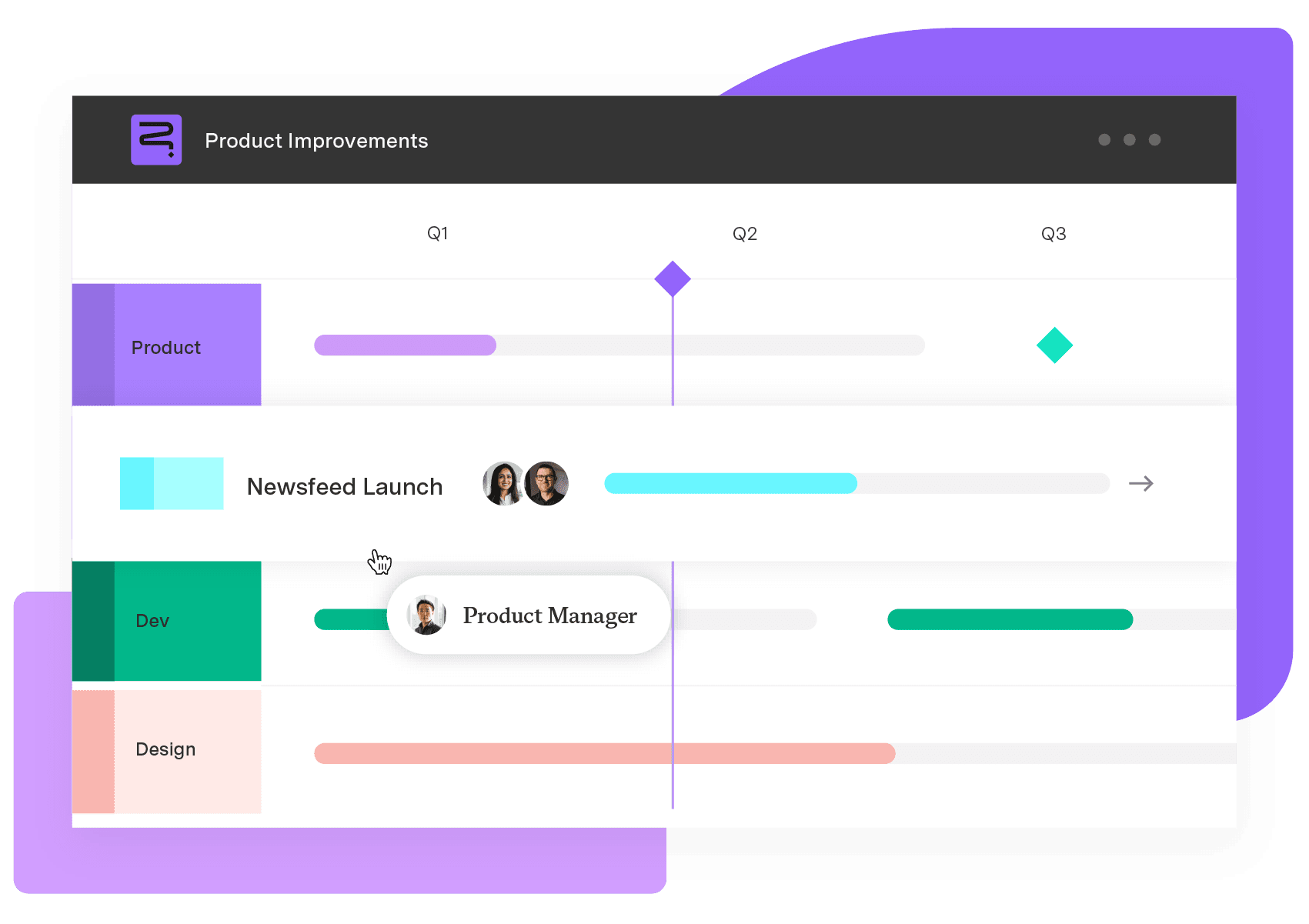
Strategic Roadmaps
Strategic roadmapping
Build your portfolio vision with Strategic Roadmaps. With powerful visualization capabilities, you can communicate strategy to the entire organization and gain alignment around strategic objectives, product goals, and milestones.
Start a Free TrialFrequently Asked Questions
Couldn't find what you need?Go to our documentation
The two roles overlap but aren't identical. A PMO director typically owns governance, standards, and process consistency across the whole portfolio, while a portfolio manager focuses more narrowly on the mix of projects and programs itself: Which to fund, which to pause, and how resources move between them. In smaller organizations, one person often carries both titles; in larger ones, the portfolio manager usually reports into the PMO director.
There's no single certification that covers all four roles, and that split is part of the point. Program and project managers most often hold a PMP or PRINCE2 credential; change leaders and agile coaches lean toward SAFe, ICAgile, or Scrum Alliance certifications. PMO leaders benefit less from a single credential than from a mix of governance experience and growing financial literacy, since PMOs are increasingly asked to justify portfolio spend the way a business leader would. Business leaders themselves rarely hold portfolio-specific certifications at all; their credibility comes from P&L accountability, not a credential.
No. Strategic Portfolio Management is a practice, not a mandate for a specific org chart. Companies without a formal PMO can still practice it if a business leader and a program manager split the governance work between them, though a dedicated PMO makes portfolio-wide visibility and consistent reporting far easier to sustain at scale.
A project manager delivers one defined piece of work: A single project, with its own scope, budget, and timeline. A program manager oversees a group of related projects that share a goal, coordinating the dependencies and resourcing between them. In a Strategic Portfolio Management context, program managers are the ones translating portfolio-level priorities into a coordinated delivery plan across multiple teams.