
LinearB vs Jellyfish: Which engineering intelligence platform fits your org

Key Takeaways
LinearB is stronger on pre-merge workflow automation. Jellyfish is stronger on org-level investment reporting.
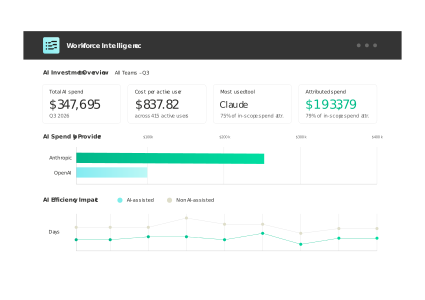
Neither vendor attributes AI cost to a single Jira issue. Tempo Workforce Intelligence records it against the work item.
Decide whether you're solving for delivery speed, investment reporting, or cost per work item before you shortlist.
You've narrowed it to LinearB and Jellyfish. Both will show you far more about your engineering organization than you can see today, which is why they often end up on the same shortlist.
Underneath, they're very different tools, built to answer different questions. LinearB was built to answer whether the team is shipping predictably, and that’s where it excels. Jellyfish was built to answer where the engineering investment went and goes deeper on reporting.
The one you choose usually comes down to whether the finance team needs to be involved. Once they are, a third question becomes more pertinent: What do specific tasks cost? Neither platform answers this at the level of an individual Jira issue. That’s why we’ve added a third tool to your shortlist.
This guide covers what Jellyfish and LinearB measure, what each costs, how to tell which question matters most to your org, and where to look if it turns out you need more granular costing.
LinearB vs Jellyfish at a glance
| LinearB | Jellyfish |
Best for | Teams fixing delivery throughput and review friction | Orgs reporting R&D investment to finance and the board |
Key differentiator | Automates pull request routing and merge policy before code lands | Allocation model that produces audit-ready capitalization |
Measurement basis | Git activity and workflow data | Activity allocated to business initiatives |
Delivery workflow automation | gitStream policy engine and PR routing | None |
AI cost depth | AI dashboards plus label-based PR attribution via gitStream | Token spend by tool, team, and initiative |
Architecture | Standalone, reads Git | Standalone, reads Git, Jira, and HR data |
Jira integration | Enterprise tier only | Core input to the allocation model |
Financial output | R&D cost capitalization, Enterprise tier | DevFinOps module, SOC 1 Type II |
Starting price | $29 per user/month, 50-user minimum | Quote only, seats plus modules |
Free trial | 45 days, no card required | Demo and quote only |
Capabilities, pricing, and certifications were checked against each vendor's own pricing, security, and product documentation in September 2026. Confirm against the live pages before an evaluation.
LinearB and Jellyfish read the same raw material: Git activity and Jira issue data. What they do with it is where they diverge.
LinearB intervenes in the delivery workflow. It routes pull requests to the right reviewer, enforces merge policies, and flags work that has stalled, all through its gitStream automation. The change happens while the pull request is still open rather than showing up in a report afterward.
Jellyfish allocates engineering effort to business initiatives. Its data model maps activity to the projects it belongs to, which produces investment distribution reports and R&D capitalization output certified to SOC 1 Type II.
Each has since added some of what the other does. The original purpose still shows in the depth, so LinearB goes further on delivery workflow, and Jellyfish goes further on investment reporting.
LinearB
Best for: Engineering organizations where the pressure is delivery throughput, review latency, and merge workflow friction.
Not for you if: Audit-ready capitalization is the reason you're evaluating. Where LinearB targets the delivery workflow, Jellyfish targets the investment report.
LinearB is an engineering productivity platform for mid-market and enterprise software organizations. Its automations act on pull requests while they are still open, so the intervention lands before the merge rather than in a report afterward.
Key features
Pre-merge workflow automation: gitStream routes each pull request to the right reviewer and applies merge policies without anyone assigning them. Review queues stop being a daily coordination job for your team leads.
Independent AI code review: A review agent checks pull requests before merge, separate from whichever assistant wrote the code. The first pass over AI-written code is automated, so reviewers spend their time on the changes that need judgment.
DORA metrics at every level: Cycle time, deployment frequency, and delivery data roll up from contributor to VP in one dashboard. The number you take into a board meeting is the same one your team leads work from, so nobody spends the meeting reconciling two versions of the truth.
Developer surveys: In-platform developer experience surveys are included at both pricing tiers, which lets you put sentiment next to cycle time and see whether a slow quarter was process or morale.
Metadata-only architecture: LinearB takes a shallow clone to read Git metadata, then deletes it. No code is scanned or stored, which usually shortens the security review.
Pricing
Unlike Jellyfish, LinearB publishes its prices. Essentials is $29 per user/month with a 50-user minimum, and Enterprise is $59 per user/month with a 100-user minimum. Both bill annually, and the 45-day trial needs no card. Billing counts contributors, meaning developers whose work generates metrics, and viewers are free.
The tier boundary matters more than the headline number. Jira, R&D cost capitalization, resource allocation, and forecasting all sit at Enterprise, and Essentials connects to GitHub Cloud only. If your teams record work in Jira, your real starting price is $59 per user/month.
Pros
Automation acts on pull requests in flight rather than reporting after they land.
Published pricing gives finance a number to model before a sales conversation.
SOC 1 Type II, SOC 2 Type II, ISO 27001, and GDPR compliance, with no code stored.
Cons
Jira access requires the Enterprise tier, which doubles the entry price for Jira-first teams.
Financial reporting is lighter than the platforms built around that job.
Seat minimums of 50 and 100 users put a floor under smaller pilots.
Jellyfish
Best for: Organizations where the forcing function is R&D investment reporting, software capitalization, or a board-level question about engineering spend.
Not for you if: You want the platform to change the delivery workflow. Where Jellyfish targets the investment report, LinearB targets the pull request.
Jellyfish is a software engineering intelligence platform organized into five areas: AI Impact, Operational Effectiveness, Business Alignment, DevEx, and DevFinOps. Its allocation model turns engineering activity into financial categories your finance team can work with directly.
Key features
Patented allocation model: Git and Jira signals map to business initiatives through a documented model rather than a spreadsheet built by hand each quarter. When someone asks what a strategic initiative actually consumed, the answer comes from the system rather than a reconstruction.
DevFinOps module: Automated work categorization and audit-ready R&D capitalization reports, certified to SOC 1 Type II, plus R&D tax credit support. This is the module that lets you hand finance a report they can defend in an audit without rebuilding it.
AI token spend tracking: Spend and usage by tool, team, or initiative, tied to throughput and quality outcomes. You can see whether the teams spending most on AI are the ones shipping more.
DevEx alongside financials: Developer experience data sits in the same platform as investment allocation, so the engineering conversation and the finance conversation draw on one dataset instead of two.
Broad signal ingestion: Git, Jira, and HR data feed the allocation model, which is what makes cost-per-initiative possible and also what makes onboarding longer.
Pricing
Jellyfish doesn't publish prices. Quotes are built from seat count plus the modules you select, and DevFinOps is priced on top of the base platform. Ask for the total monthly bill for the specific modules you need, so the number you budget is the number you're billed.
Pros
Capitalization output is certified to SOC 1 Type II for audit defensibility.
The allocation model connects engineering activity to initiatives at a granularity finance can use.
Developer experience and investment data sit in one platform, removing a reconciliation step.
Cons
Quote-only pricing means you can't model cost before a sales conversation.
The platform reports on delivery signals without acting on the workflow.
HR data imports and initiative mapping widen the deployment surface, and third-party comparisons cite slower onboarding as a result.
A third option for Jira-native teams: Tempo Workforce Intelligence
Best for: Engineering and finance leaders who need AI and human cost attributed to Jira work for capitalization and to prove ROI.
Not for you if: Your work does not live in Jira, or your pressing question is delivery flow rather than cost.
Both platforms above are Git-first, with Jira as an integration. At LinearB, that integration sits at Enterprise. Jellyfish derives allocation from connected engineering and business-system signals rather than from time engineers log against work items.
That model can satisfy an audit when its controls and methodology meet your requirements.
Tempo Workforce Intelligence starts from the opposite end. Engineers log effort inside Jira as a byproduct of the work through Tempo Timesheets.
Workforce Intelligence reads that effort alongside system-detected AI tool activity, so Cursor and Copilot usage maps to the issues and initiatives it supports rather than to a monthly vendor invoice.
Key features
Blended effort on the work item: Human hours and detected AI activity sit against the same Jira issue, so you can see what a sprint actually consumed rather than inferring it from commit volume.
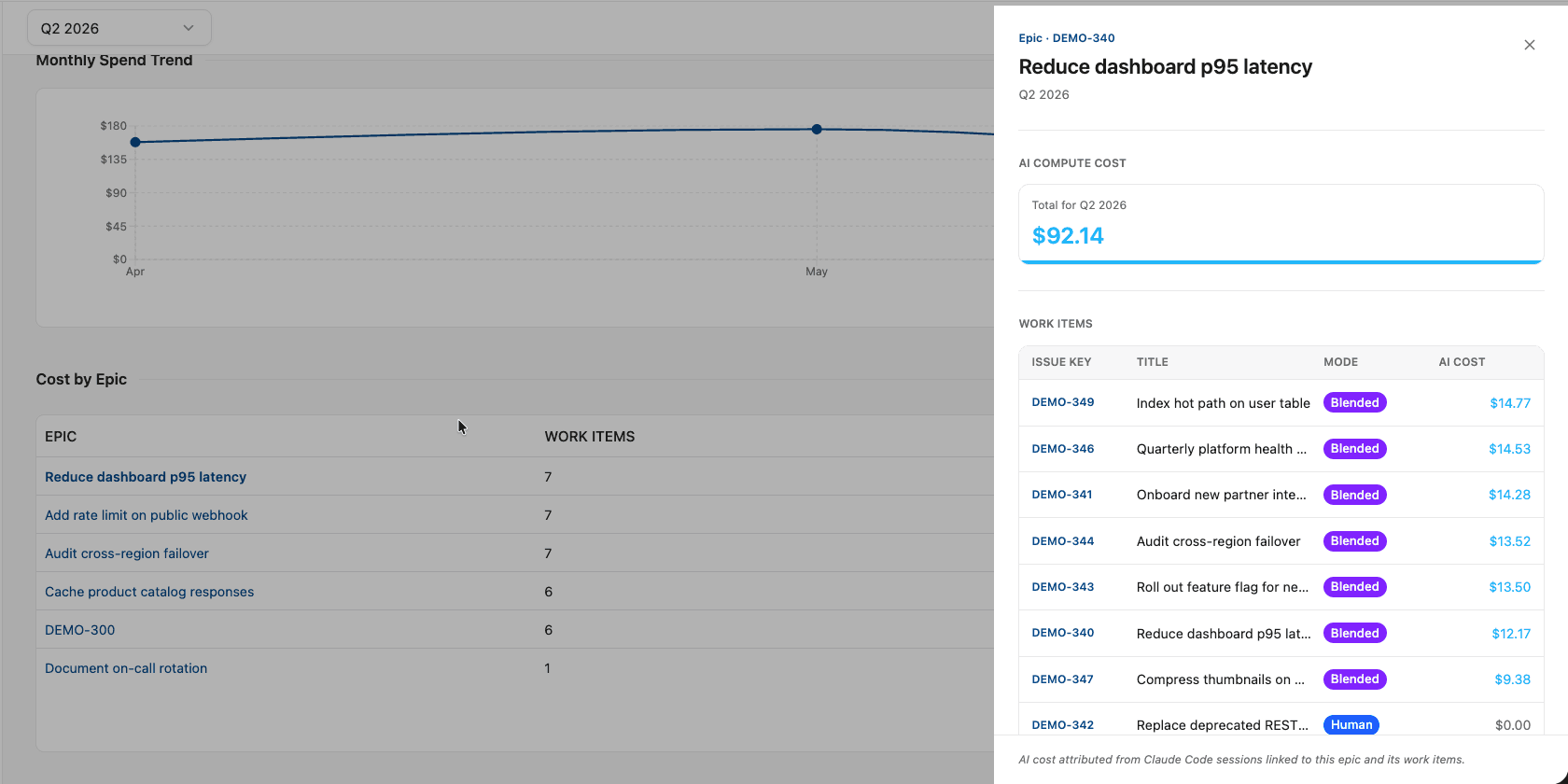
AI cost attribution: Tool activity ties to the issues and initiatives it supported, which turns a flat vendor invoice into spend you can defend line by line when finance asks what AI returned.
CapEx and OpEx output: Recorded effort feeds classification finance can use, and the same data supports the other ways teams track financials in Jira, from budgets to resource allocation.
Plan against actuals: Capacity Planner reconciles planned capacity with logged effort through two-way Jira sync, so next quarter's plan starts from what last quarter actually took.
Jira-native architecture: The measurement reads work where it already happens, with no separate system to sync, and nothing new for engineers to open.
Pricing
Priced per user through the Atlassian Marketplace, with a Marketplace trial. CapEx and OpEx classification output is available to customers who also run Timesheets, so budget it as a two-product commitment rather than one.
Pros
AI and human costs attach to the individual Jira issue rather than to a team or initiative total.
The effort record is a direct time entry, which suits capitalization policies that ask for one.
Nothing new to deploy alongside Jira, so the instrumentation burden is lower than a standalone platform.
Capacity planning and time tracking come from the same data, removing a reconciliation step.
Cons
No pre-merge workflow automation and no DORA benchmarking. Delivery flow problems need a different tool.
CapEx and OpEx output requires Timesheets running alongside Workforce Intelligence, so that’s two products you need.
The record is only as good as the logging discipline behind it, which is a real adoption cost.
Choose the question you need answered
If you want to know delivery throughput, choose LinearB. For investment reporting, turn to Jellyfish. If you need to tie cost to a specific Jira issue, Tempo fits the bill.
Pick the question you're asked most often, then test one platform against it for a quarter on a single portfolio.
That resolves faster than a full evaluation, and it tells you whether what you need next is a delivery tool, a reporting tool, or capacity planning software that reconciles the two.
Looking for more granular reporting? See how Workforce Intelligence attributes AI cost to each Jira issue.