Engineering intelligence platforms measure delivery, but 2026 buyers also weigh AI-effort attribution. Compare the tools and how to choose one.
Track blended human-and-AI effort at the Jira ticket level.

Key Takeaways
AI activity in engineering has no record in Jira: That makes AI ROI impossible to answer with delivery data.
Engineering workforce intelligence tracks blended human-and-AI effort per Jira ticket: That's what lets finance classify AI development costs as CapEx or OpEx with evidence.
FASB's ASU 2025-06 raises the bar for classifying AI work as CapEx: From December 2027, finance needs work-item-level attribution data to pass audit, since estimates won't clear it.
In a 2024 study of more than 4,000 developers, researchers found that those using Copilot completed 26% more pull requests per week. But the benefit wasn’t evenly distributed: Senior engineers showed no statistical significant productivity gain.
A much smaller 2025 METR study had 16 senior engineers use AI tools and found they were 19% slower when using them vs. without them. Despite being slower, the engineers in the METR believed they were 20% faster than they actually were.
What does all of this mean? Well, most engineering organizations simply can't answer whether AI is helping their engineers or slowing them down. They use AI tools every sprint, but that activity isn't in Jira or in any financial report finance can use for capitalization.
You build sprint estimates without knowing what AI contributed last cycle. So when the board asks about the ROI of investing in AI, the answer comes from vendor invoices because you don’t have delivery data to show.
Workforce intelligence for engineering organizations fixes that by making AI activity visible at the work-item level inside Jira. Below, we explain what workforce intelligence means for engineering organizations, and where Tempo Workforce Intelligence fits as a Jira-native option.
In HR, workforce intelligence means skills intelligence: who has which competencies and which roles carry succession risk. Tools like Visier, Phenom, Cornerstone, and Eightfold help HR leaders plan headcount and talent needs.
That's a different job from what engineering leaders need today. Engineering workforce intelligence focuses on four outputs:
Effort attribution: A record of which engineer and which AI tool contributed to a specific Jira ticket, so you know how the work got produced.
Cost classification: Whether a piece of work counts as CapEx (new product development treated as a future investment) or OpEx (maintenance and ongoing support treated as operating cost), and whether you can defend that classification to an auditor.
Performance evidence: Whether AI tools improved speed or throughput on a specific initiative, measured from delivery data rather than assumed from license counts.
Planning data: What blended human-and-AI effort led to at the last sprint, so the estimate for next sprint reflects reality.
HR analytics tools don't show task-level human and AI effort, and they don't produce accounting output.
Engineering analytics tools focused on delivery metrics measure delivery performance, not financial attribution. An engineering workforce intelligence tool sits between those two categories. Because the phrase sounds like HR software, most buyers start looking in the wrong place.
AI spending is rising faster than the systems that can explain it. 61% of senior leaders say they feel more pressure than a year ago to prove ROI from AI investments, according to Kyndryl's 2025 Readiness Report, which surveyed 3,700 senior leaders across 21 countries. That pressure exists because most organizations still can't connect AI costs to the work those tools supported.
The cost forecast problem is related but separate. 85% of enterprise organizations miss their AI infrastructure cost forecasts by more than 10%, according to Benchmarkit's 2025 State of AI Cost Management report, based on responses from 372 enterprise organizations.
You can see the invoice for an AI tool. Tying that invoice to a specific initiative or Jira epic is a different problem. The standard engineering stack wasn't designed to solve it.
Two things make this more urgent now.
First, companies still lack clear visibility into which AI tools employees are using and whether those tools are creating real value. The METR study reinforced that point by showing that AI productivity gains cannot be assumed; they have to be measured at the work-item level.
Second, the accounting rules have gotten stricter. Under FASB’s ASU 2025-06, AI-related development costs may need to be expensed until technical uncertainty is resolved, starting from December 15, 2027, which means finance teams need better evidence before classifying AI work as CapEx. And this is not mere blended rate estimates that work was done with AI in the loop; this is raw attribution data tied to specific Jira issues.
The answer to both problems is the same: Attribution data at the Jira work-item level, in a format your finance team can use. Here are the four capabilities that separate platforms built for that from those that aren’t.
The right platform for this problem is not a general workforce analytics tool. We believe they revolve around these four:
The platform has to track effort at the level of each Jira issue, not just at the team or license level. If a developer and an AI coding assistant help close a ticket, both contributions should be recorded against that ticket.
That requires native integration with the system where the work happens, not a weekly sync that tries to reconstruct effort after the fact. A rough team-level summary is not enough when the goal is financial attribution.
Time tracking for human effort is pretty straightforward. The harder part is capturing what AI tools contributed to the same work item.
Engineering workforce intelligence platforms need to detect AI tool activity at the task level, not just report how many licenses were used. This way, blended human-and-AI effort can be attributed directly instead of inferred from usage logs.
Manually classifying AI-assisted development costs from time logs is only an estimate. A better platform classifies work automatically based on the task type, project, epic, and component in Jira.
That produces more defensible accounting output and reduces the burden on finance. The classification rules should be visible and auditable, not hidden inside a summary report.
You already know what you spent on AI tools. Initiative-level reporting shows which projects benefited from AI and whether those projects performed differently compared to others with less AI involvement. Without that view, ROI cannot be answered with evidence.
Capability | What it answers | Who needs it |
Work-item-level effort capture | What produced this ticket? | Engineering team lead |
AI activity detection | What did the AI tools contribute? | VP of Engineering / CTO |
CapEx/OpEx classification | What's the accounting treatment? | CFO / Financial Controller |
AI ROI reporting | Is AI investment delivering? | CTO / Board |
Most platforms in the “workforce intelligence” category were built for HR, not engineering. To find the ones that actually fit engineering teams, ask whether they can do five things well:
Since issues and worklogs live in Jira, you need a direct connection to it to attribute work at the issue level. Platforms syncing on a schedule can lag behind what your team is working on. And that lag matters most when finance needs issue-level detail to support a capitalization decision.
Most time-tracking tools only record human worklogs. Ask how the platform captures AI tool activity and at what level of detail.
License counts, such as the number of active Copilot seats, tell you about adoption. They don't show which tickets AI contributed to or by how much. That attribution is what makes ROI measurable rather than assumed.
If finance has to classify AI-assisted development by hand, the result is only an estimate. To get output that finance can use under ASU 2025-06, you need a platform that classifies work automatically. It uses work type and Jira metadata to make that call
So, ask whether the classification rules are visible and auditable. For a robust audit review, the platform has to provide underlying details alongside a summary number.
Data quality depends on adoption, and adoption depends on friction. Engineers who have to log time or change tools to feed a workforce intelligence platform won't do it consistently. Platforms that live inside Jira capture better data because engineers produce it as part of the work itself.
Ask whether the platform's CapEx and OpEx reports include issue-level detail showing how each classification was made. Under ASU 2025-06, summary totals aren't enough. Finance needs the underlying attribution data to support audit review.
Tempo Workforce Intelligence is a Jira-native platform available on the Atlassian Marketplace. It captures human time and AI activity at the level of each Jira issue, so every piece of work shows both the effort engineers logged and the AI tools that were involved in getting it done.
For engineering leaders, that means you can see blended effort by team and by initiative. You can see which projects used AI most and whether that activity lined up with better throughput. You can also see which tools different teams used on which work. Rather than estimating ROI from invoices and headcount data, you measure it from what the work consumed.
By combining Workforce Intelligence with Timesheets, finance teams can accurately identify which initiatives are tied to CapEx or OpEx. The platform routes work to the right accounting category using work type and issue-level Jira data that supports audit review under ASU 2025-06. Finance reports from evidence instead of making manual estimates.
Workforce Intelligence builds on the same Jira integration that Tempo Timesheets already uses for human time tracking, extended to capture AI activity that previously had no record in the system of work. It runs inside Jira. Engineers don't have to change their workflow. Workforce Intelligence detects and attributes AI activity automatically from the work already happening.
HR workforce intelligence tools like Visier and Phenom aren't built for Jira-based engineering workflows or AI attribution at the issue level.
Engineering analytics platforms focused on delivery metrics measure delivery performance, not financial attribution. Tempo Workforce Intelligence sits between those two categories: It captures blended effort at the work-item level and classifies it for CapEx or OpEx inside a native Atlassian Marketplace app.
Your engineers are already working alongside AI tools. Most CTOs know that. What most don't have is any record of it in the systems they use to plan capacity, classify costs, and report to the board.
Start by auditing what you can connect today. Pull your AI vendor invoices for the last quarter. Then check your Jira worklogs for the same period. If you can't draw a line between an AI tool cost and a Jira epic, that's an attribution problem, and it's already affecting your capacity estimates and capitalization reporting.
Tempo Workforce Intelligence captures the blended effort that's already happening and puts it in Jira at the work-item level. Finance can use that output directly for CapEx/OpEx classification on the ASU 2025-06 timeline.
Stop reporting AI ROI from vendor invoices. Try Tempo Workforce Intelligence to see blended human-and-AI effort on the Jira issues your team is already working on.
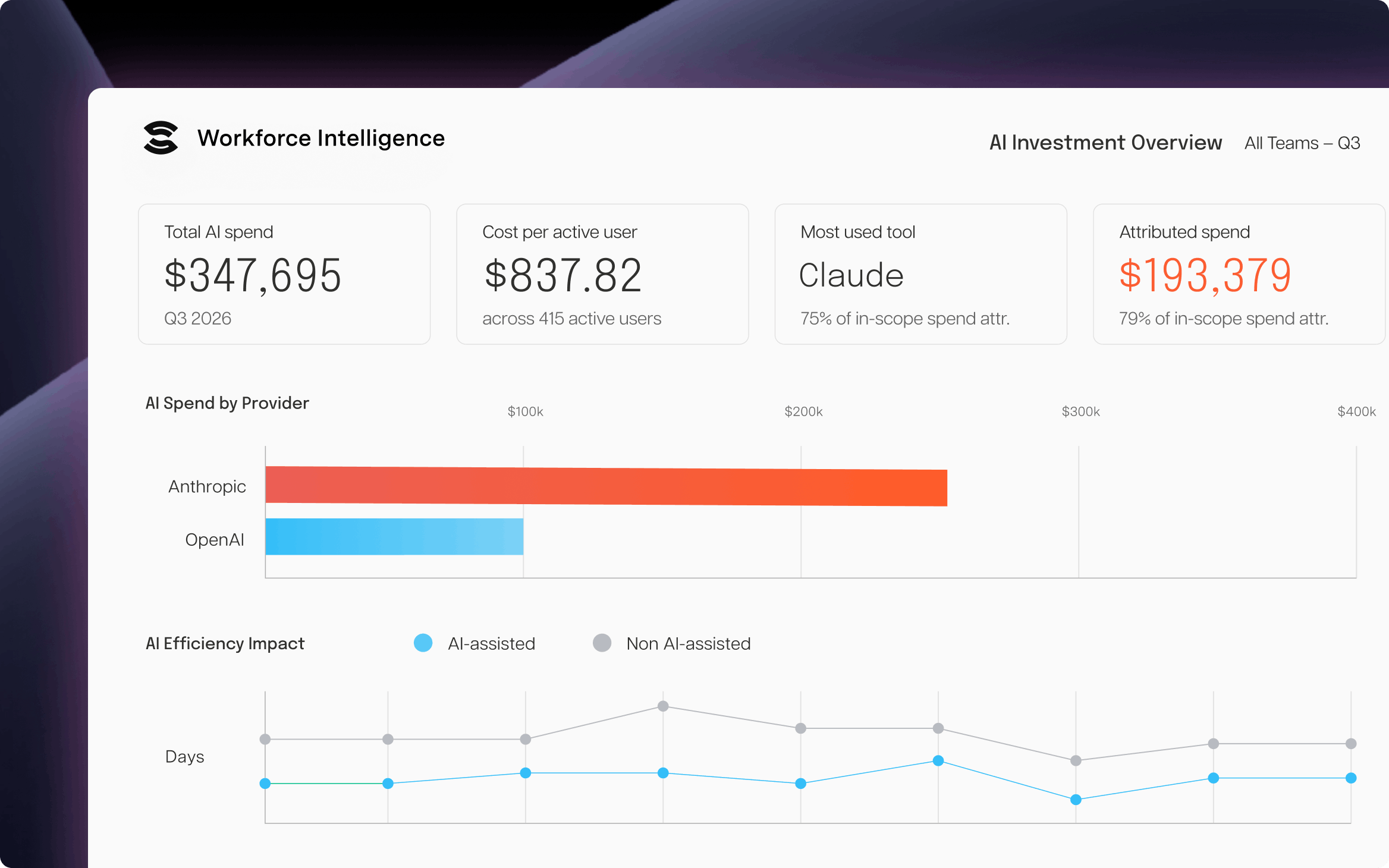
Workforce Intelligence
The only solution that ties AI vendor spend to the teams, epics, and Jira issues it supported.
Start a Free TrialCouldn't find what you need?Go to our documentation
People analytics focuses on the human workforce: Skills, performance, engagement, and talent mobility. Engineering workforce intelligence looks at blended human-and-AI effort. It answers different questions: What work was delivered, what it cost, and how it should be accounted for.
Measuring AI ROI requires two inputs most organizations don't have: Effort attribution tied to specific initiatives, and AI activity recorded at the work-item level. Vendor invoices cover the cost side. Connecting that cost to what the AI tool supported (which engineers, on which Jira issues, during which sprint) is the measurement problem workforce intelligence solves.
CapEx covers work that creates a future benefit, such as new product development. OpEx covers ongoing work such as maintenance, and ongoing support costs. AI complicates classification because AI-assisted development can be harder to categorize without detailed attribution at the work-item level. Under ASU 2025-06, organizations need work-level evidence before deciding how to classify that work.
The two products are designed to work together. If you already use Tempo Timesheets, Workforce Intelligence adds AI activity detection on top of the human time layer you're already capturing. If you don't use Timesheets yet, the products are built to be adopted as one system.
Either way, the combination gives finance a complete picture at the Jira work-item level: What engineers logged and what AI tools contributed alongside them.
Engineering intelligence platforms measure delivery, but 2026 buyers also weigh AI-effort attribution. Compare the tools and how to choose one.

Software engineering intelligence platforms read time logs, Jira, and Git as one dataset. See what they measure and where AI spend fits in.

Tempo Workforce Intelligence connects AI tool usage to Jira work items so leaders can see what their AI investment is really delivering.

Compare Swarmia and Jellyfish on DORA metrics, integrations, AI cost tracking, and capitalization to find the right fit.

Learn how to measure developer productivity beyond story points and velocity, with effort data and AI-contribution tracking for engineering leaders.

AI attribution should pair human effort and AI spend on the same Jira work item, tracing every dollar to the work it delivered. Learn how we built it.

Strategic workforce planning still runs on headcount. For CIOs planning human and AI-agent teams, here's how to understand real capacity and cost.

Learn what portfolio reporting contains, report types by audience, why cycles break, and how continuous reporting changes the executive conversation.

Discover how aligning strategy and execution with integrated roadmaps can enhance portfolio management and boost ROI, based on our latest study.