Six getdx alternatives compared. See what each measures, where each falls short, and which fits developer experience, DORA, or cost attribution.
What each platform measures, where it runs, and what its capitalization number is built from

Key Takeaways
Jellyfish covers DORA metrics, developer-level analytics, and R&D capitalization through its allocations model, and AI usage insights.
Swarmia, Waydev, and Haystack sit in the same category, reading Git and CI/CD signals and modeling effort from activity.
Tempo Workforce Intelligence works from the opposite direction, logging hours against Jira work items, which suits finance teams that need a time record rather than an allocation.
This blog covers all the strengths and weaknesses of Jellyfish – and how all the alternatives stack up so you can make a more informed decision.
The reason teams want an alternative to Jellyfish is usually cost at enterprise scale, the standalone platform footprint, or finance requirements the allocation model doesn't match.
That last one is where most evaluations stall, because an allocation model that mismatches financial requirements creates operational, strategic, and compliance risks. Nearly every platform in the SEI category advertises R&D capitalization, but not every platform calculates the capitalization number in the same way.
The calculation you need depends on your auditor.
The six platforms below take different positions on what evidence sits behind that number, and on where the tool runs, how much it costs, and whether engineers have to do anything to feed it.
Jellyfish ingests Git, Jira, and CI/CD data, then models where engineering effort went using four metrics:
DevOps research and assessment (DORA) metrics arrive out of the box.
Developer-level analytics cover commit patterns, code distribution, and pull request data.
DevFinOps produces R&D cost capitalization and tax credit support from a patented allocations model, with person-level and effort-level reporting.
AI insights show adoption and impact of coding assistants alongside project management tools and pull request data.
Jellyfish derives capitalizable effort from activity that already exists, so engineers don’t need to log their hours. This is positioned as removing manual time tracking.
The cracks can start to show when customers negotiate enterprise pricing, which is priced per contributor, so the bill compounds as the engineering organization grows.
Jellyfish also runs alongside Jira rather than inside it – which is a key consideration if your finance teams require time entry against a named ticket. Jellyfish's person-level reporting is still a modeled allocation, not a logged record, and for some auditors that distinction is the whole question.
The alternatives below address those problems, though there isn’t one platform that solves all three. Instead, you’ll have to decide which ones are most important to you to solve, and start from there. The list starts with the time-record requirement, because it rules out more options than the other two.
Tempo is a platform of modular apps that all use actual, not modeled, data, making it a more reliable option than Jellyfish.
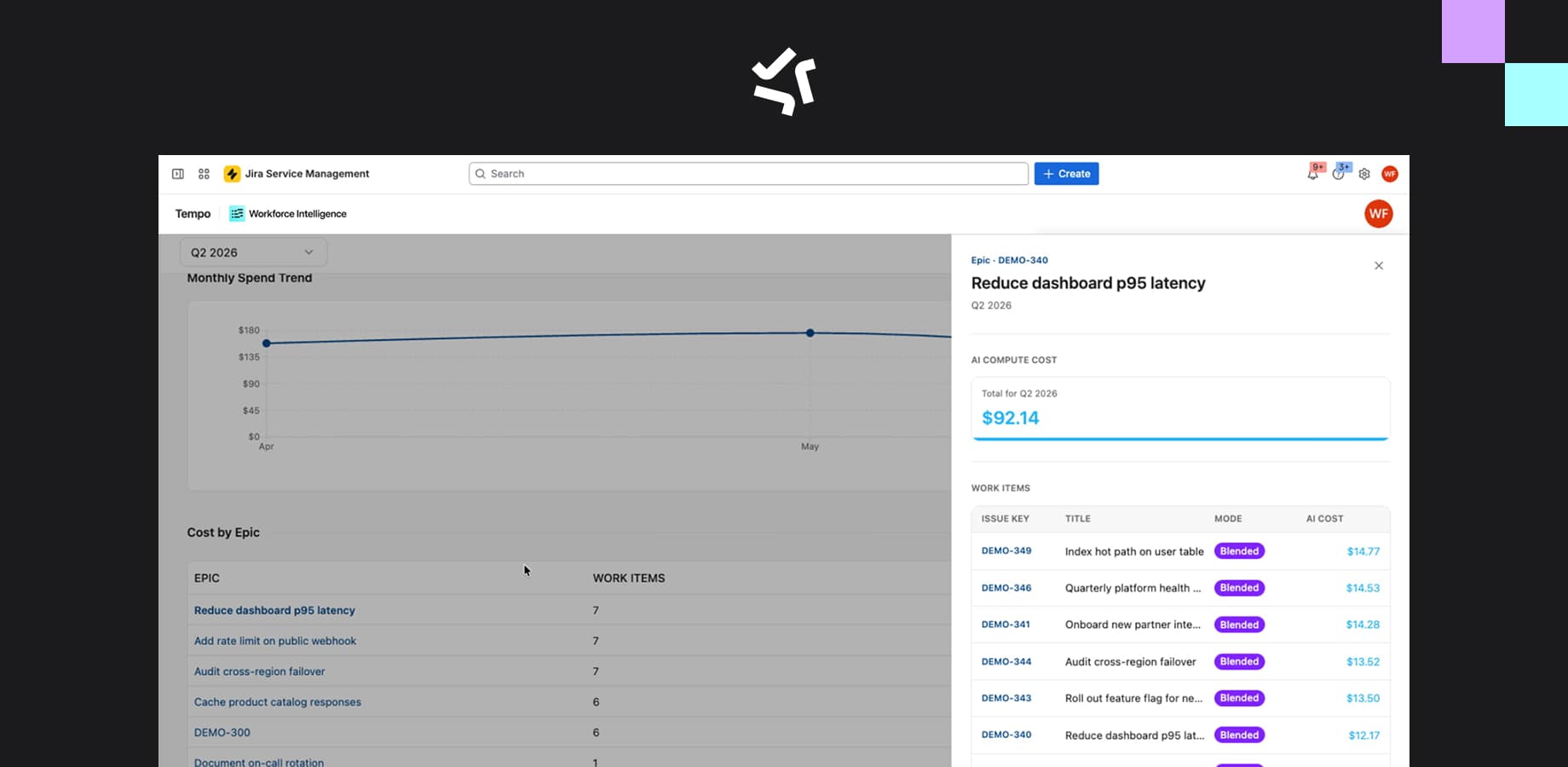
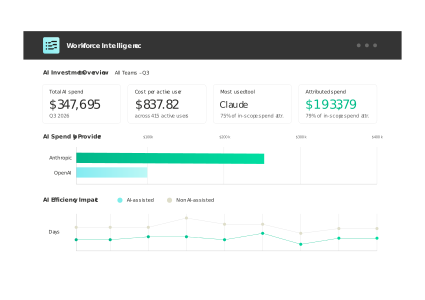
It also offers more comprehensive reporting on AI spend and actual costs through Tempo Workforce Intelligence.
Where Jellyfish models engineering effort from repository activity, Workforce Intelligence captures blended effort in real time. Both human effort and AI activity are captured on each Jira issue, giving engineering leadership and finance teams two things that Jellyfish can’t.
A capitalization figure that traces to a time entry, with its hours, classification, and period.
AI cost attributed per task rather than per developer, which helps the finance team understand how to categorize AI spend and how AI tools are delivering value. No other platform in this comparison attributes AI activity at this level.
To see whether you need that granularity, ask your finance team what they would hand an auditor questioning a single capitalized line item. If an effort allocation across a project satisfies them, any platform here works. If they need the time log behind it, only a time-logging tool produces one.
Workforce Intelligence sits on the Tempo suite of Jira-native Marketplace apps, and the human-effort record comes from Tempo Timesheets. It logs hours against individual Jira work items, with intelligent suggestions drawn from calendar and development tool activity, and tickets categorized by CapEx and OpEx.
Two more products extend the picture as requirements grow. Tempo Capacity Planner converts sprint data and story points into time-based capacity through a two-way Jira sync, then reconciles against logged actuals so plan-versus-actual variance surfaces during the quarter.
Tempo Structure PPM builds portfolio hierarchies that match how the organization plans, with formulas computing rollups directly in the grid.
Strengths
Work-item-level AI cost attribution, unique to Workforce Intelligence, so AI spend maps to the initiatives it supported.
CapEx and OpEx traceable to a time record, the strictest basis an auditor can ask for.
Runs inside Jira, so no second platform to administer.
Capacity reconciled against logged actuals during the quarter.
Modular, so you start with one product and add others as requirements grow.
Limitations
DORA metrics are not prebuilt. Custom Charts can build DORA-style views, and coverage depends on whether the underlying data lives in Jira, so deployment and incident data tracked outside Jira will not appear without work.
No repository-level developer analytics.
Time logging requires engineer adoption, which is a real change and the tradeoff Jellyfish's model is designed to avoid.
Best for: Atlassian-centred organizations whose finance team requires work-item-level time records, and any team that needs to show the ROI of its AI spend.
Not for you if: you need DORA and developer-level analytics out of the box, or engineer time entry is a rollout risk you would rather not take.
Swarmia is an engineering intelligence platform combining delivery metrics with developer experience surveys.
Swarmia is the closest match to Jellyfish's architecture. It covers DORA metrics, working agreements that teams set and track themselves, investment breakdowns showing where engineering effort goes across product areas, and software capitalization support for finance.
The developer experience component adds survey data alongside system metrics, which is a view neither Waydev nor a time-tracking tool produces.
Its integration surface is narrower than the rest of the category, centred on GitHub and Jira or Linear. For teams already on that stack, the setup is quick. For organizations running a wider tool estate, the coverage question needs asking early.
Strengths
Clean product with a strong developer experience angle.
Investment breakdowns are finance-legible.
Team-level working agreements land well with engineers.
Limitations
Narrower integration set.
Capitalization is allocation-based, like Jellyfish, so it does not resolve a time-record requirement.
Best for: GitHub and Jira teams wanting delivery metrics and developer experience data in one place, with capitalization support included.
Waydev has the broadest feature surface in the category, positioned as a software engineering intelligence platform.
Waydev covers more ground than anything else on this list. Over 200 integrations, more than 130 metrics, DORA and SPACE frameworks, and a cost capitalization module with flexible rules and exportable reports.
Its AI reporting is the most developed among the alternatives. Separate modules cover AI adoption, AI impact, and AI ROI, and a conversational layer arrived in late 2025.
Breadth is the tradeoff. A platform with 130 metrics needs someone to decide which ones the organization will manage, and teams without that clarity tend to use a fraction of what they bought.
Strengths
Widest integration coverage.
Most developed AI reporting of the three SEI alternatives. Cost capitalization with configurable rules.
Limitations
Feature volume creates a real onboarding cost.
Enterprise pricing runs higher than the category median at roughly $59 per contributor per month.
AI reporting sits at developer and team level rather than per work item.
Best for: Organizations with a heterogeneous toolchain that want one platform reading all of it, and teams that know which metrics they intend to manage.
LinearB is an engineering productivity platform that pairs delivery metrics with workflow automation that acts on them.
LinearB covers DORA metrics with industry benchmarks, developer experience surveys, and, on its Enterprise tier, resource allocation and cost capitalization with audit-ready reports.
What separates it from the rest of the SEI category is gitStream, a policy engine that automates the pull request pipeline: Routing reviews, enforcing checks, and auto-merging low-risk changes based on the same signals the metrics read. Its AI Insights dashboard tracks adoption across more than 50 AI coding tools and flags AI-involved pull requests, then correlates that usage with cycle time and throughput.
The capitalization basis is activity-derived allocation. LinearB determines which issues a developer touched each day from Git and issue activity, then divides the day equally across them, with no time tracking required.
That is the same family of evidence Jellyfish produces, so it does not resolve a time-record requirement.
Pricing is published, which is rare in this category. The “Essentials” tier runs $29 per user per month with a 30-user minimum but supports GitHub Cloud only. Multi-platform support, allocation, and capitalization sit in the “Enterprise” tier at $59 per user per month with a 50-user minimum.
Strengths
The only platform here that acts on the workflow as well as measuring it, through gitStream automation.
Published pricing with a self-serve entry tier.
AI adoption tracking across 50+ tools with pull-request-level detection.
Limitations
Capitalization is allocation-based and Enterprise-only.
Essentials tier supports GitHub Cloud only, which pushes mixed-platform organizations to the higher tier.
Automations consume monthly credits, which adds a second cost dimension to model.
Best for: Teams that want delivery metrics and automated PR workflows from one tool, and buyers who want a price on the website before the first sales call.
DX is a developer intelligence platform that combines system metrics with survey data, and it has been part of Atlassian since November 2025.
DX was built by the researchers behind the DX Core 4 framework, which measures engineering organizations across speed, effectiveness, quality, and business impact. The platform pairs those system metrics with rigorously designed developer surveys and benchmarks the results against industry peers.
Its AI measurement is the most granular of the SEI platforms here: Usage analytics by tool, team, and developer, plus AI Code Insights, which detects AI-authored versus human-authored code at the commit and pull request level without source code leaving the developer's machine.
R&D capitalization is a dedicated product, with work categorized automatically from project management data and reports built on CPA-reviewed formulas. Like the rest of the SEI category, it is an allocation, not a time record.
Pricing is negotiated rather than published, and the Atlassian acquisition is worth weighing directly: For Atlassian-centred organizations, it suggests deepening integration ahead, though as of mid-2026 DX still runs as a standalone platform.
Strengths
Research pedigree, with the Core 4 framework and survey instruments designed by the people who publish the field's reference studies.
Blends sentiment and system data, with commit-level AI code detection.
SQL-level access to the underlying data for teams that want to check the math.
Limitations
The survey program needs ongoing internal effort to sustain participation.
No published pricing, and custom reporting rewards SQL comfort.
Capitalization is allocation-based, so it does not resolve a time-record requirement.
Best for: Organizations that want developer experience and AI impact measured with research-grade rigor, and Atlassian shops betting on where the ecosystem is heading.
Haystack is a delivery analytics platform built on an explicit refusal to measure individuals.
It reports at team level only. No individual scorecards, no leaderboards, and engineers see the same dashboards leadership sees. That is a product philosophy rather than a missing feature, and it solves a specific problem: Engineering teams that have rejected a previous tool because it felt like surveillance.
It covers cycle time, DORA metrics, and delivery bottlenecks, with GitHub and Jira integration. The scope is narrower than Waydev or Jellyfish by design.
Strengths
The lowest-friction adoption in the category, because its offering is narrower by design.
Clear, focused metric set.
Transparent pricing, from around $20 per member per month.
Limitations
No capitalization or financial reporting.
No individual-level data, which limits you only if you need it.
Narrower integration coverage.
Best for: teams where engineering trust is the binding constraint, and leadership wants delivery visibility without an adoption fight.
Start with the requirement that is hardest to satisfy, and work outward from there.
Finance needs a time record: Only a time-logging tool produces one, which points to Tempo. An allocation model produces a different artifact, however defensible it is on its own terms.
Finance accepts an allocation: Jellyfish, Swarmia, and Waydev all produce it. Choose based on integration coverage and how much of the platform you want to own.
DORA and developer analytics are the priority: Stay in the SEI category. Waydev for breadth, Swarmia for a cleaner product with developer experience data, Haystack for the team-level-only position.
Engineers have rejected a tool before: Haystack removes the objection by design. Tempo's time entry is the opposite tradeoff, and worth being honest about internally before committing.
The board is asking what AI returned: Every platform here reports AI adoption at the developer level. Work-item-level attribution, which connects spend to specific initiatives for CapEx and OpEx classification, is currently unique to Tempo Workforce Intelligence.
Verify every capability against current vendor documentation before purchase. This category ships frequently, and the comparison above reflects what each vendor published as of July 2026.
Your auditor already knows which metrics they need. Book a demo with Tempo if you need to see work-item time records in Jira and show the ROI of your AI spend.
Workforce Intelligence
The only solution that ties AI vendor spend to the teams, epics, and Jira issues it supported.
Start a Free TrialCouldn't find what you need?Go to our documentation
Auditors test whether capitalized labor cost is supported by evidence they can follow back to a source. Two bases are common. A resource allocation distributes engineering activity across capitalizable and non-capitalizable work using commits, deployments, and team data, and platforms using this basis have customers who report passing audits with it.
A time record logs hours against a work item with its classification and time period. Which one your auditor requires is a question for them, and answering it before you shortlist saves an evaluation cycle.
Not as a like-for-like swap. Jellyfish covers DORA metrics, developer-level analytics, capitalization, and AI insights. A Jira-native time-tracking suite covers time records, capacity, portfolio rollup, and work-item AI attribution. The overlap is capitalization and AI reporting, approached from opposite directions.
Organizations that need both sets of capability sometimes run one of each, splitting engineering-leadership dashboards from finance exports so the two do not produce competing numbers.
Haystack publishes the lowest entry pricing at around $20 per member per month. Tempo prices per product on the Atlassian Marketplace, so cost depends on how many products you adopt. Waydev sits at the higher end at roughly $59 per contributor per month for enterprise.
Jellyfish and Swarmia negotiate enterprise pricing rather than publishing it. Compare total cost of ownership rather than license fees alone, since configuration, maintenance, and reconciliation overhead vary widely across these platforms.
All of them report on it to some degree. Jellyfish surfaces AI adoption and impact alongside Jira and pull request data. Waydev has dedicated AI adoption, impact, and ROI modules. Both operate at the developer and team level, which answers how widely the tools are used.
Tempo Workforce Intelligence attributes AI cost to individual Jira work items, which answers which initiatives the spend supported. That is the form finance needs for CapEx and OpEx classification.
Six getdx alternatives compared. See what each measures, where each falls short, and which fits developer experience, DORA, or cost attribution.

LinearB vs Jellyfish compared. See what each measures, where each falls short, and which fits delivery automation or investment reporting.

Compare the 7 best software development analytics tools of 2026 across delivery, developer experience, and R&D capitalization.

Compare Swarmia and Jellyfish on DORA metrics, integrations, AI cost tracking, and capitalization to find the right fit.

Tempo Workforce Intelligence connects AI tool usage to Jira work items so leaders can see what their AI investment is really delivering.

A guide for Tempo users weighing a switch. See which reasons to leave point to a lighter tracker, and which are better solved by adding to the suite.

The best developer productivity tools for 2026, compared by category, from AI coding assistants to real-capacity measurement.

Learn what portfolio reporting contains, report types by audience, why cycles break, and how continuous reporting changes the executive conversation.

This Q&A is set up to help you create a mission and vision statement that can turbocharge your career goals and aspirations.