Six Jellyfish alternatives compared: See what each one measures, where it runs, and which requirement it fits.
How developer experience, DORA, and AI cost measurement tools differ, and which one fits the problem you're solving

Key Takeaways
DX and the platforms below all pull data from similar sources, but they answer different questions. Developer sentiment, delivery pipeline health, and cost attribution each need a different measurement baseline.
DX built its reputation on developer experience surveys paired with DORA and SPACE metrics, and has since added AI code measurement. Teams look elsewhere when their core question shifts away from sentiment.
Nearly every platform now reports on AI coding tools. The depth varies from adoption counts to commit-level attribution, to cost mapped onto the work item. Finance only uses the last one.
Architecture is the difference buyers underestimate. Most of these platforms are standalone systems that ingest data from your stack. A Jira-native layer reads the work where it already sits.
Name the one question that matters most before you shortlist. Platforms in this category converge on similar feature lists, so the emphasis behind the features is what separates them.
Teams searching for getdx alternatives are usually asking a question DX wasn't built to answer.
DX measures developer sentiment about their work and how the delivery system performs. When you need to know which initiatives AI tools supported, and the ROI of these tools, you’ll need a different set of platforms.
This guide compares six DX alternatives, what each does best, and where each falls short. First, let’s take a look at the features you should look for in a DX alternative.
Platforms in this category offer similar features. The primary difference is how those features are prioritized. Consider these five features before finalizing your shortlist:
Measurement systems: Survey-based developer sentiment, system-metric DORA data, or effort and cost actuals. Each answers a different question, and few platforms lead with more than one.
AI cost and impact capabilities: Nearly every platform now measures AI, but metrics range from adoption counts to commit-level attribution to cost mapped onto the work item.
Financial attribution: Check whether the platform produces CapEx and OpEx output finance can use, or stops at engineering metrics.
Architecture: A standalone platform that pulls data from many tools, or a layer native to where the work already happens.
Automation: Whether the tool only reports, or also acts on what it finds through policy and workflow.
The first three features relate to the numbers. The last two help improve accuracy, and that's where the shortlist usually narrows.
The platforms below are ordered by measurement criteria, starting with those built around cost and effort actuals and moving to those built around delivery and developer experience metrics.
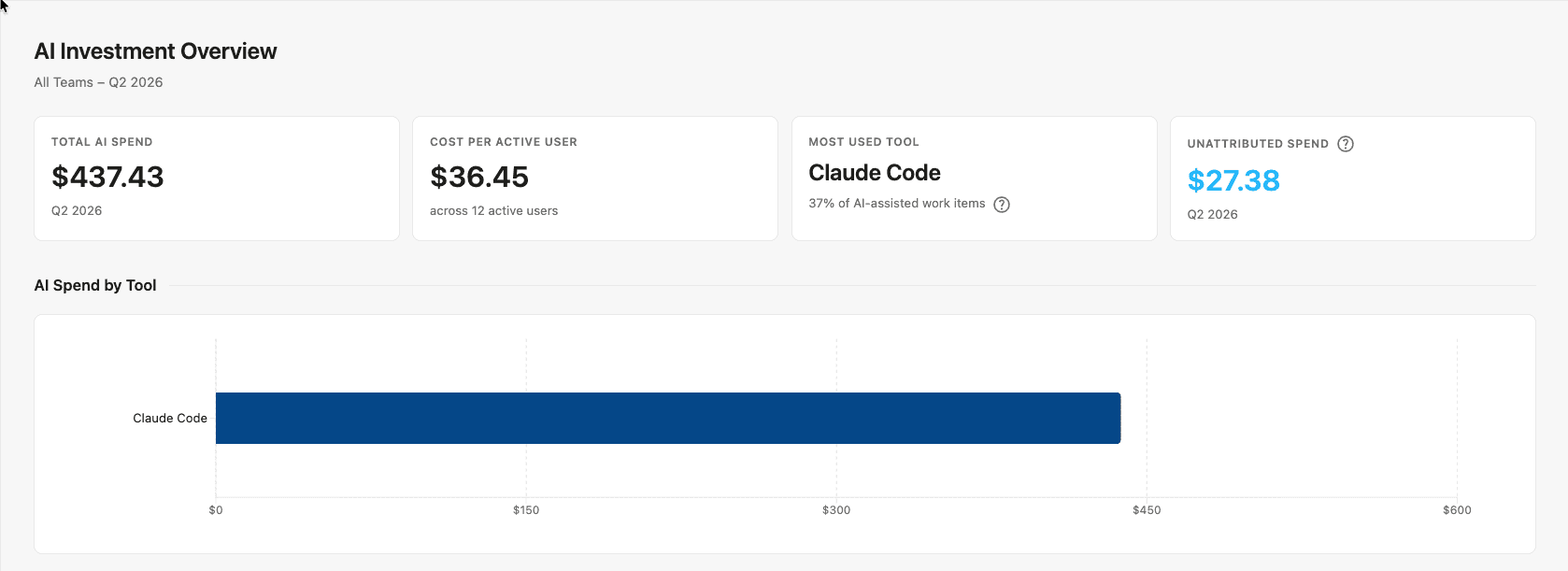
Tempo Workforce Intelligence captures human and AI efforts against the same Jira issue. Logged developer hours sit alongside AI coding tool activity, so Cursor and Copilot work maps to the specific issues and initiatives it supported, not just to a monthly vendor bill. For a leader who already knows what their AI tools cost in total but not what they went toward, that per-issue view is what DX was never built to produce.
Key features
Blended effort on the work item: Human hours and system-detected AI activity are captured together at the Jira issue level, so a sprint's real makeup is visible rather than inferred.
AI cost attribution: AI tool activity is tied to the issues and initiatives it supported, which turns a flat vendor invoice into spend you can trace to work.
CapEx and OpEx output: Effort data feeds work-item-level attribution finance can use to classify engineering spend on evidence rather than estimate.
Jira-native architecture: The measurement reads the work directly, with no separate system to sync or maintain.
Built on the Tempo suite: Timesheets and Capacity Planner supply the human-effort foundation the AI layer sits on, so the effort record is already there.
Best for: engineering and finance leaders who need AI and human cost attributed to Jira work for capitalization and ROI.
Not for you if: developer sentiment and DORA benchmarking are still your core question. Though if you're weighing DX alternatives because that question is shifting toward what the work cost, that shift is exactly what this measures.
Jellyfish is an engineering management platform centered on resource allocation and R&D cost reporting, with strong executive and board-level investment reporting. It translates engineering effort to initiatives and then to financial categories for capitalization, carrying DORA metrics alongside that financial layer.
The capitalization output is modeled from engineering activity rather than logged against each work item. Buyers whose auditors require a per-work-item time record should clarify this before a demo, because it limits the available options and determines the software category. Additionally, setup requires a significant commitment since HR data imports and initiative mapping make onboarding a multi-week commitment.
Best for: organizations focused on R&D cost allocation, resource planning, and executive investment reporting.
Not for you if: your auditor requires a time entry against a named ticket, or you want a short onboarding.
Faros AI is an enterprise-scale engineering intelligence platform built to stitch together data from a large, fragmented toolchain, with connectors across version control, issue tracking, CI/CD (continuous integration and continuous delivery), and incident management. Its signature is AI impact analysis, tracing AI tool spend to delivery outcomes rather than to raw activity counts, and it offers a modular R&D cost capitalization capability.
It's built for enterprise-scale operations, which is both its strength and its limit. Smaller teams tend to find the platform more complex than the problem they need to solve. Tempo captures blended human and AI effort natively on the Jira issue itself, whereas Faros AI correlates work items within an external data lake.
Best for: enterprises measuring AI coding ROI across a complex, multi-tool development stack.
Not for you if: you're a mid-market team, or you need attribution at the work-item level for the books.
LinearB pairs DORA metrics and engineering analytics with active workflow automation through its policy engine, which routes pull requests and enforces standards rather than only reporting on them. That combination suits teams addressing operational bottlenecks, such as slow reviews and inconsistent processes, alongside measurement requirements.
Its financial and capitalization reporting is lighter than the platforms built around that job, and the capitalization module sits on the top tier rather than the entry one. Teams buying LinearB for finance reporting should confirm which tier carries it.
Best for: engineering teams that want DORA benchmarking combined with automation that acts on the metrics.
Not for you if: finance-facing cost attribution is the priority rather than delivery workflow.
Swarmia focuses on engineering team effectiveness and developer experience, and deliberately avoids individual surveillance. It combines DORA-style delivery metrics, developer experience signals, and initiative tracking, and its working agreements let teams set and track their own targets. That’s what makes it land with engineers.
Its scope centers on engineering effectiveness rather than deep financial attribution, so its capitalization support is allocation-based and lighter than a dedicated tool. Its integration surface is also narrower than the rest of the category, centered on GitHub and Jira or Linear, so teams running a wider tool estate should ask about coverage early.
Best for: engineering organizations balancing delivery metrics with team-level developer experience measurement.
Not for you if: capitalization or AI cost mapping is what you need, or you run a wide tool estate.
Waydev reads Git activity to report on engineering output, delivery trends, and cost allocation across initiatives. It offers the broadest metric coverage in this group, spanning DORA and SPACE frameworks and specific modules for AI adoption, AI impact, and AI ROI. This makes it a practical solution for establishing delivery reporting.
The breadth involves certain trade-offs. A platform with an extensive range of metrics needs someone to decide which ones the organization will manage, and teams without that clarity use a fraction of what they bought. Its cost data is also modeled from Git activity rather than logged against individual work items, which means the figures are estimated rather than recorded. Whether an auditor accepts an estimate of that kind depends on the evidentiary standard the organization is held to, the same consideration that applies to any tool built on modeled activity.
Best for: teams that want Git-derived delivery reporting, broad metric coverage, and directional cost allocation.
Not for you if: you want a focused metric set, or audit-grade cost attribution at the work item.
Platform | Measurement basis | AI cost depth | Financial attribution | Architecture |
Tempo | Effort and cost actuals in Jira | AI activity attributed per work item | CapEx and OpEx from logged time | Native to Jira |
Jellyfish | Activity and effort allocation | AI adoption and impact | R&D cost, executive reporting | Standalone |
Faros AI | System metrics across a wide toolchain | AI spend traced to delivery outcomes | Modular R&D capitalization | Standalone |
LinearB | DORA and workflow data | AI adoption metrics | Lighter, top tier only | Standalone |
Swarmia | DORA and developer experience signals | AI adoption metrics | Lighter, allocation-based | Standalone |
Waydev | Git activity | Adoption, impact, and ROI modules | Git-derived allocation | Standalone |
Confirm current capabilities and pricing against each vendor's documentation before an evaluation.
Start from the question you need to answer rather than the feature list.
You want deeper engineering performance measurement: A like-for-like path exists. Faros AI covers AI impact across a complex toolchain, LinearB covers DORA plus automation, and Swarmia covers balanced team-level effectiveness. These keep you in the same world DX occupies, with different emphases.
The real question is financial: That's a different category. Jellyfish approaches it from executive resources and R&D reporting. Tempo approaches it from the work item, attributing AI and human cost inside Jira so finance can classify and defend it.
You can't decide between the two: Architecture usually breaks the tie. A standalone platform gives broad coverage across many tools and adds a synchronization layer. A Jira-native layer reads the work directly, which matters most for cost attribution.
Most teams find one of the five axes above dominates the decision. Identifying that axis first significantly speeds up the selection process.
If your primary focus is developer experience or delivery metrics, one of the five platforms above will work for you.
If your main focus is cost, DX was never designed for finance clarity. Tempo was.
See how Tempo Workforce Intelligence attributes AI and human cost to the Jira issue it supported.
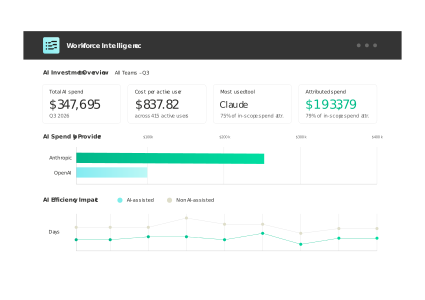
Workforce Intelligence
The only solution that ties AI vendor spend to the teams, epics, and Jira issues it supported.
Start a Free TrialCouldn't find what you need?Go to our documentation
It depends on the shape of the answer you need. Faros AI connects AI tool spend to delivery outcomes across a large toolchain, which suits enterprise engineering leaders. Tempo attributes AI coding activity to specific Jira issues alongside human hours and produces CapEx and OpEx output, which suits finance leaders who need to classify and defend the spend. One answers the engineering performance question, the other answers the accounting question.
Many of these tools work on different layers and can run side by side. A team might keep DX for developer experience surveys while adding Tempo for cost attribution in Jira, since the two answer different questions from different data. The consideration is cost and overlap rather than technical conflict. Deciding which platform owns which question, engineering experience or financial attribution, before deploying both prevents duplicated reporting.
Most engineering intelligence platforms are standalone systems that ingest data from your stack, which gives broad coverage and adds a synchronization layer between the tool and where work happens. A Jira-native approach reads the work directly. That matters most for cost attribution, because tying AI and human cost to a specific work item is more reliable when the measurement lives on the work item rather than in a copy of it. For developer experience surveys and cross-tool DORA metrics, a standalone platform is often the better fit.
Some are built with finance in mind and some aren't. Jellyfish and Tempo both produce finance-facing output, Jellyfish through executive R&D and resource reporting, Tempo through work-item-level CapEx and OpEx classification. The developer experience and DORA-focused platforms are built for engineering leaders and produce engineering metrics, so a finance team evaluating them should confirm the output maps to categories it can use before committing.
Six Jellyfish alternatives compared: See what each one measures, where it runs, and which requirement it fits.

LinearB vs Jellyfish compared. See what each measures, where each falls short, and which fits delivery automation or investment reporting.

Engineering intelligence platforms measure delivery, but 2026 buyers also weigh AI-effort attribution. Compare the tools and how to choose one.

Compare the 7 best software development analytics tools of 2026 across delivery, developer experience, and R&D capitalization.

Compare Swarmia and Jellyfish on DORA metrics, integrations, AI cost tracking, and capitalization to find the right fit.

A guide for Tempo users weighing a switch. See which reasons to leave point to a lighter tracker, and which are better solved by adding to the suite.

The best developer productivity tools for 2026, compared by category, from AI coding assistants to real-capacity measurement.

Learn how lead time vs cycle time reveals where work slows down, and why tracking both is essential for reliable delivery and strategic forecasting.

Why Intelligent Portfolio Orchestration (IPO) has become a category, why traditional SPM isn’t the answer, and why you should care.