Compare the best capacity planning software for engineering teams on Jira. See how six tools handle two-way sync, utilization, and plan vs. actual.
Here’s what to look for if you’re measuring delivery against capacity

Key Takeaways
Scenario planning software lives in three categories that rarely overlap: portfolio and delivery platforms, enterprise FP&A platforms, and equity or cap-table modelers.
This guide is mostly about the first, the portfolio and delivery platforms, where the scenario question is what a team can actually deliver against real capacity.
The core features to evaluate are multi-path modeling, capacity-aware inputs, probabilistic output, and how deeply the platform integrates with the system your work already lives in.
Tempo, Epicflow, Productive, Kantata, and Planview all sit in the portfolio and delivery category, with different strengths by team type.
The FP&A platforms and equity tools answer real but different questions, so they're covered briefly at the end rather than compared head to head.
Scenario planning software promises to model the future before you commit to it, but what that means depends entirely on which future you're modeling.
A CFO stress-testing a budget, a PMO deciding what's deliverable this quarter, and a founder modeling a funding round are three different jobs, and they map to three distinct categories of software that rarely overlap.
This guide covers all three, but focuses mainly on portfolio and delivery platforms, where the question is what a team can actually deliver, not what a budget can absorb.
Scenario planning software models multiple versions of the future side by side, so you can compare the trade-offs before committing to one. A conservative path, a balanced path, and a maximum-scope path, each run against the same constraints, so the differences between them are visible rather than assumed.
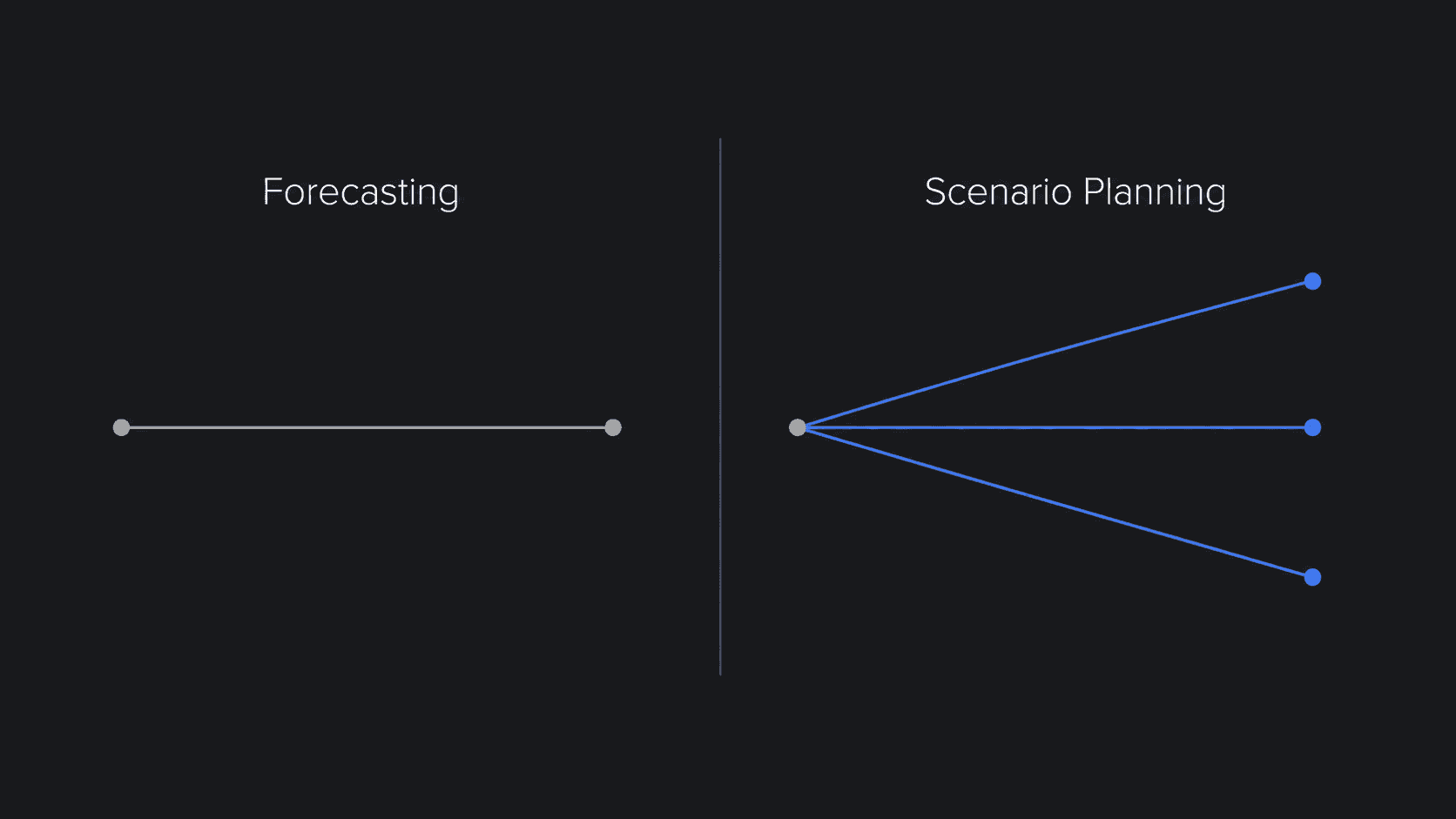
That's the line between scenario planning and forecasting, and the distinction often gets blurred. Forecasting is about projecting a single expected outcome and assumes the decision is made. Scenario planning is the decision-support layer that comes before the decision.
Here are three questions that will help you understand which scenario planning software you need before looking at a single product.
Is your primary variable delivery capacity or money? If the scenario you care about is what your teams can ship against real capacity, you want a portfolio and delivery platform. If it's which budget allocation across programs returns the most, you want FP&A. The two are built around different data, and few do both well.
Where does your source data already live? Portfolio and delivery platforms pull from your work-management system, Jira, sprint data, and time logs. FP&A platforms pull from the ERP and general ledger. A platform that reads where your work already lives saves you a sync layer that leaks lag and error every cycle.
Who reads the output? Engineering and delivery leadership read delivery scenarios. A board or CFO reads financial ones. Founders and investors read equity ones. The audience shapes the reporting the software has to produce.
These platforms model delivery rather than dollars; the question is what a team can commit to and complete against real capacity, accounting for skills, incident load, and competing priorities. The strongest ones read execution data directly and close the distance between the plan and the system where work actually happens.
Platform | Best-fit team | Scenario strength | Where data lives |
Tempo | Jira-native delivery teams | Live portfolio model in Jira | Jira issue and delivery data |
Epicflow | Multi-project, resource-constrained PMOs | Cross-portfolio what-if simulation | Jira, MS Project, SAP |
Productive | Agencies and services | Delivery-to-profitability forecasting | Native project and time data |
Kantata | Professional services | Resource-vs-demand scenarios | Native PSA data |
Planview | Enterprise PMOs | Governance-heavy portfolio planning | Enterprise PPM data |
Confirm current capabilities and pricing against each vendor's documentation before an evaluation.
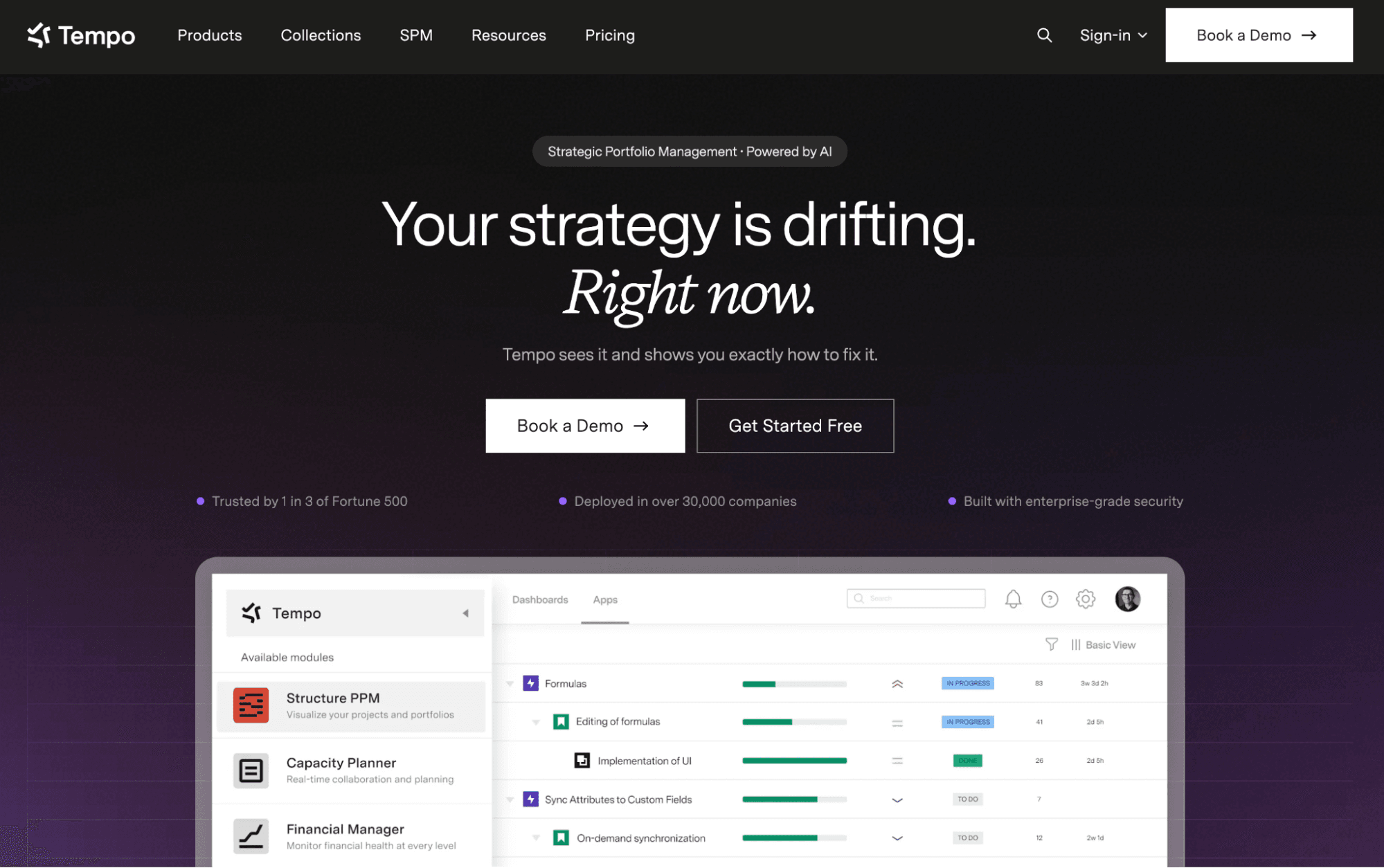
Tempo is the right fit when your work already lives in Jira, and the scenario question is what you can deliver against measured capacity. It reads sprint data, story points, and logged time and adds planning results to Jira, so there's no separate system to reconcile.
The portfolio picture comes together in Tempo Structure PPM, which builds your portfolio hierarchy inside Jira and reveals live issue data inside the structure your organization actually plans against. That gives you a scenario model that reflects where work stands today rather than where it stood at the last export.
Matthieu Beaufils, Corporate Application Manager at Rexel, describes how a live model benefits his teams. "With Structure, we have a cockpit for managing work."
Best for: Organizations whose delivery work runs through Jira and who want the portfolio model to stay current on its own.
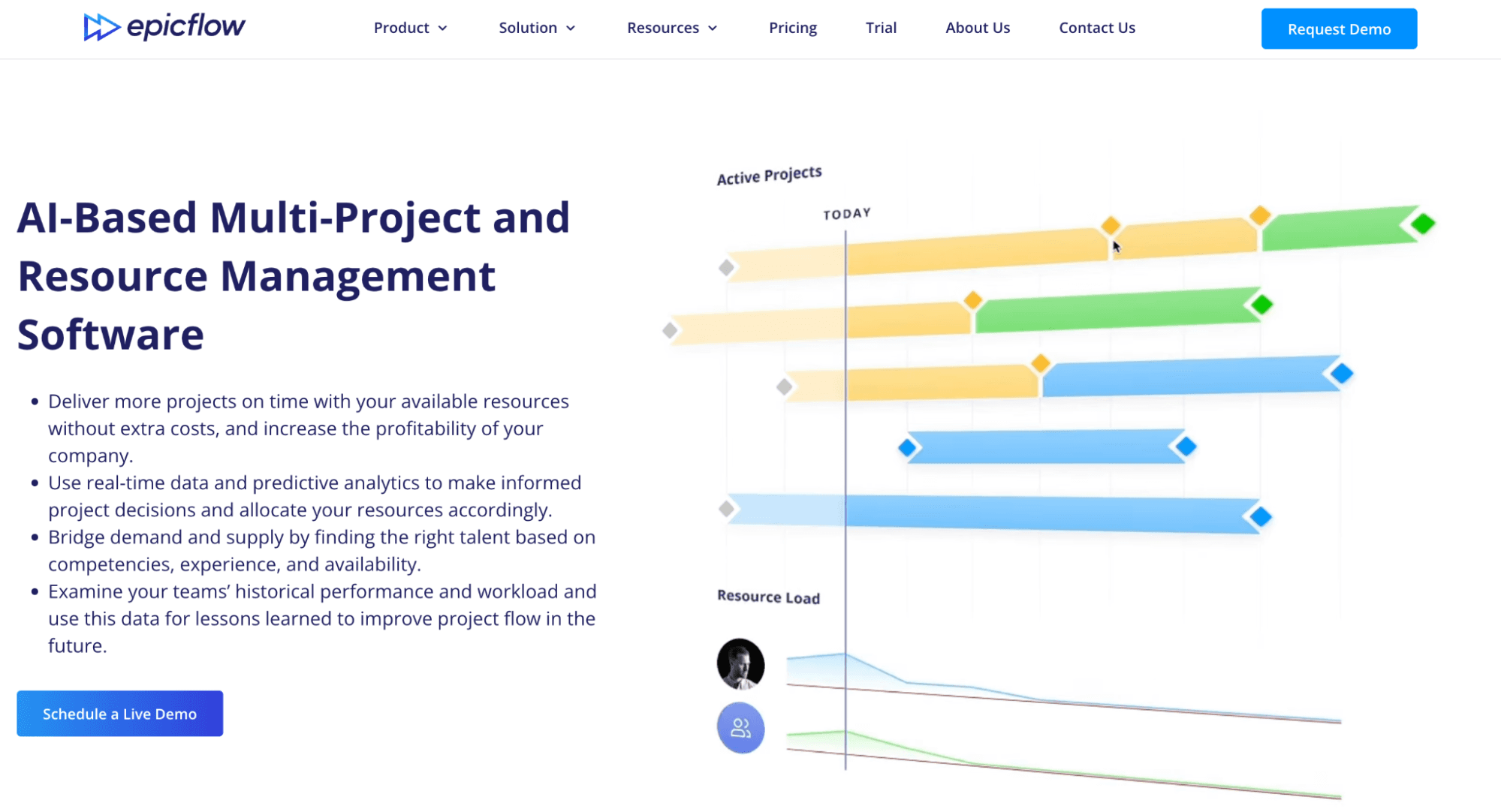
Epicflow is a multi-project resource and portfolio management platform built for resource-constrained environments, with what-if analysis at its core. Its simulation mode lets a portfolio manager reassign resources, move milestones, or add a project, then see the effect ripple across every other project sharing those people.
Because it models the whole portfolio at once rather than one project in isolation, it surfaces the second-order consequence that single-project tools miss, which is the new deal that quietly starves three existing programs of the same senior engineers.
It integrates with Jira, MS Project, Oracle Primavera, and SAP, so the shared resource pool can span tools rather than living in one. That cross-tool, cross-project view is what suits it to environments where the binding constraint is people spread thin across concurrent work.
Best for: PMOs managing many concurrent projects against shared, resource-constrained teams, common in aerospace, defense, and manufacturing.
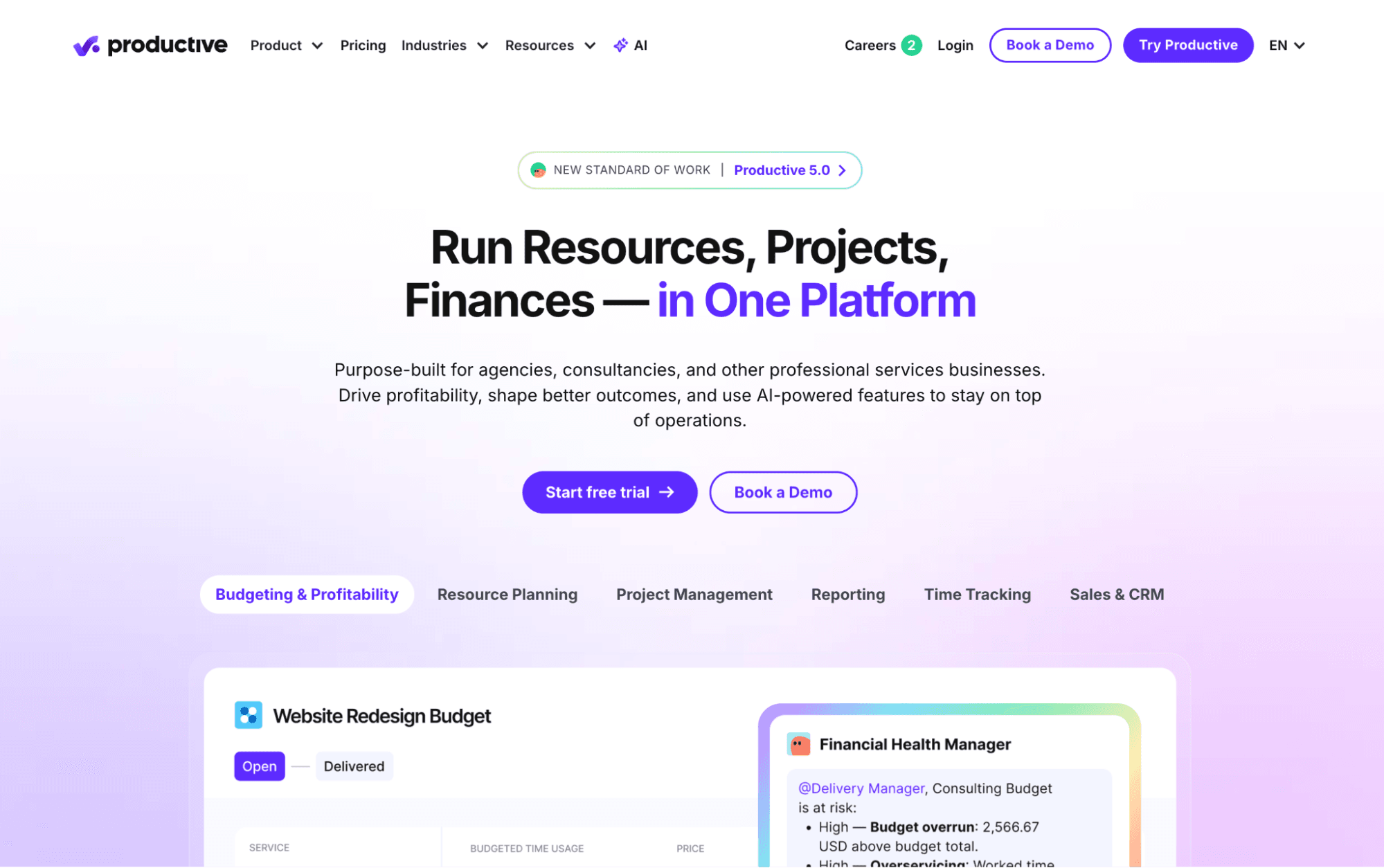
Productive is an all-in-one platform for agencies and service businesses, combining project management, resource planning, budgeting, and financial forecasting. Its scenario builder lets a team adjust who does the work, when they can start, and how much it costs, then compares the resulting best-case and worst-case outcomes side by side before a single hour is booked.
Approved scenario budgets can be directly converted into active projects without manual re-entry. That connects delivery to profitability, which is the planning question a services business actually asks.
Best for: Agencies and service businesses that plan delivery and profitability together.
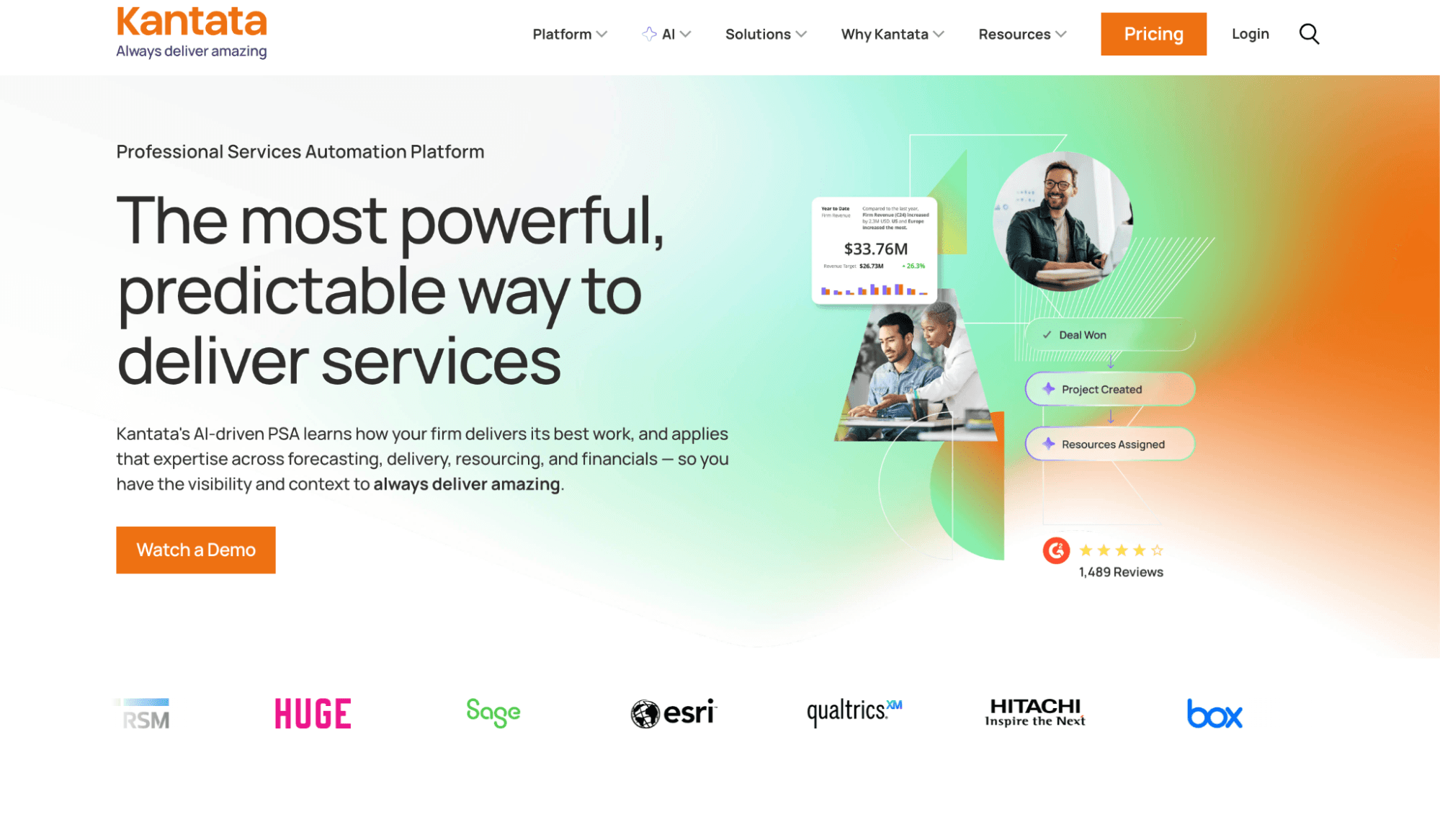
Kantata is a professional services platform that combines resourcing, scoping, and forecasting. Scenario views weigh resource demand against available capacity before a project is committed, so a services firm can see whether a new deal is staffable before signing it.
Beyond the initial scenario, Kantata tracks margin against a project's actuals as it runs, so a plan built at kickoff stays checked against real utilization and billing rather than going stale after the first week. It's a good fit for services organizations that need to forecast margin and capacity in the same model.
Best for: professional-services firms that plan projects, people, and profitability as one.
Planview Portfolios is an enterprise portfolio management platform that connects resource management to portfolio workflows, with scenario planning and capacity analysis aimed at large, governance-heavy organizations.
Its scenario modeling works at the investment level, letting a portfolio team compare funding and staffing paths across many programs at once and see which mix fits within capacity and budget constraints before committing.
Capacity analysis weighs demand against available resources across the portfolio, so leaders can test whether a proposed plan is deliverable with the people they have. The trade-off is weight. The modeling sits inside a broader governance and portfolio framework built for scale, which is an asset for organizations that need those controls and overhead for teams that don't.
Best for: Large enterprise PMOs that need portfolio-wide scenario planning with strong governance.
A portfolio and delivery platform earns its place in the stack by changing what happens at three specific moments: when priorities shift, when a leader has to commit to a date, and when the plan starts to drift from reality.
Replanning speed: When priorities shift mid-quarter, a team modeling scenarios in spreadsheets spends days rebuilding those models by hand. A platform running a live scenario against current sprint and capacity data turns that same rebuild into a same-day answer, which matters most when the pressure to reprioritize is highest.
Defensible commitments: A single delivery date isn't realistic. A probability curve gives leaders a number to stand behind and the specific scope or resource change that would move it.
Earlier drift detection: When the scenario model reconciles against actuals continuously, the divergence between plan and reality surfaces while there's still room to act, rather than at the quarter-end review when you've run out of good options.
For finance leaders whose primary variable is money rather than delivery capacity, or founders modeling ownership rather than sprint output, the software built for those questions looks different. That's covered next.
If your scenario is financial or equity-based rather than operational, you'll need to evaluate the two other categories of scenario planning that we mentioned earlier. Here they are in brief:
Enterprise FP&A platforms model budget, revenue, and headcount across the business, and scenario planning here means stress-testing financial assumptions for the board.
Anaplan is the enterprise standard, built for large, cross-functional models.
Workday Adaptive Planning suits organizations already inside the Workday ecosystem.
Pigment appeals to growth-stage finance teams that want flexible modeling.
Cube works through Excel and Google Sheets for leaner teams.
These platforms model financial ledgers rather than operational, sprint-level delivery capacity, so they're the right starting point only when the binding variable is financial.
Equity and fundraising tools model ownership and dilution rather than budgets or delivery.
Pulley is the representative option, used by founders to model how a funding round, option-pool expansion, or exit changes ownership before terms are signed. It's a narrow, deep use case that sits alongside the other categories rather than competing with them.
Start with one question. Does your work already run through a system like Jira, and does your scenario question turn on capacity rather than budget?
If you answered yes to both, choose a platform that reads that system natively, since every export step you avoid is lag and error you don't inherit.
From there, shortlist two platforms and run both through the same demo. Ask how many scenarios each platform models at once, where the input data comes from and how it updates, what the output looks like at a 75% confidence level, and what costs appear after signing.
Then validate each platform against your own data before committing, your real Jira instance or your real project history. That way you can watch the tools reproduce a result you already know before you trust it with future scenarios.
For teams whose work runs through Jira and whose question is delivery against real capacity, that validation starts with getting the portfolio picture straight. See how Tempo Structure PPM builds a live portfolio model from your Jira data.
Structure PPM
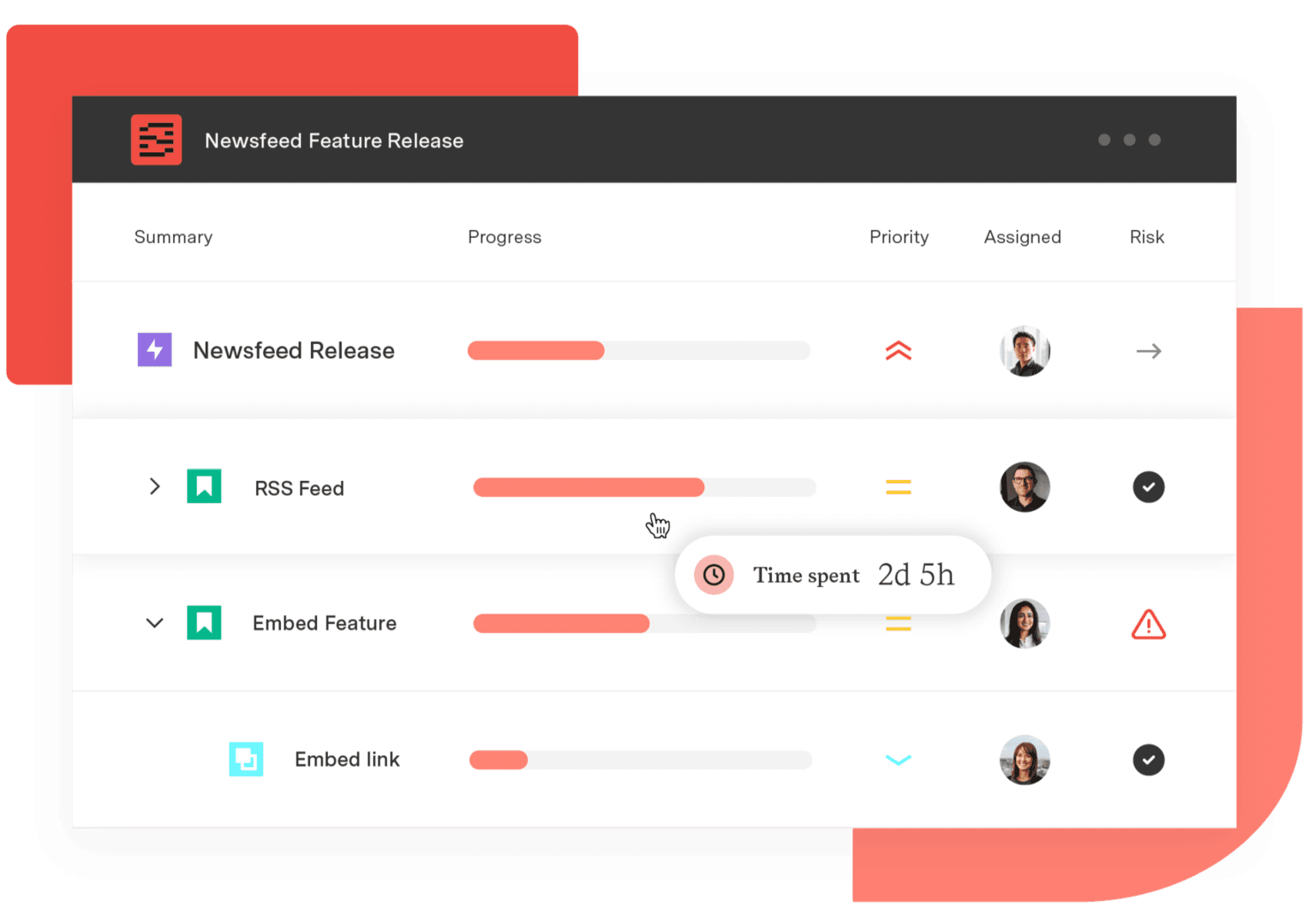
Manage products, projects, and programs in a single spreadsheet-like view. By providing a clear, real-time view of project progress and resource allocation, Structure helps teams meet deadlines and adapt swiftly to changing priorities.
Start a Free TrialCouldn't find what you need?Go to our documentation
Forecasting projects a single expected outcome, revenue, cost, or a delivery date, from one set of assumptions. Scenario planning models several possible outcomes side by side so you can compare trade-offs before committing. Forecasting assumes the decision is made. Scenario planning is the decision-support layer that comes before it. Many teams need both.
Rarely, and rarely well. Financial platforms read the general ledger and model money. Delivery platforms read execution data and model capacity. A few products claim both but tend to lead with one and treat the other as a secondary feature. Most organizations that need both run a finance platform and a delivery platform, and decide which number owns which audience so the two don't conflict in a review.
A spreadsheet model produces one output per scenario, a single date or figure from a single set of assumptions. Monte Carlo simulation runs thousands of variations across probability distributions for each input and returns a range with confidence levels. That lets a leader say there's a 75% probability of finishing by a given date, rather than simply targeting it, which is a far stronger position when a stakeholder challenges the assumptions.
No platform produces reliable output from unreliable input. For delivery platforms, a practical minimum is recent sprint velocity data and a headcount view that accounts for part-time work, contractors, and recurring ceremonies. For finance platforms, it's a clean ledger feed. If that data doesn't exist in structured form, capture it first, then layer scenario modeling on top.
The value tracks time saved on manual scenario assembly more than company size. A team spending significant time each cycle rebuilding scenarios in spreadsheets tends to see the strongest case, regardless of scale. Several platforms across all three categories are built specifically for lean and mid-market teams, so enterprise scale isn't a prerequisite.
Compare the best capacity planning software for engineering teams on Jira. See how six tools handle two-way sync, utilization, and plan vs. actual.

Compare the 7 best software development analytics tools of 2026 across delivery, developer experience, and R&D capitalization.

Portfolio prioritization is now a continuous discipline. Learn to rank, fund, and re-sequence initiatives against real capacity and delivery data

The best developer productivity tools for 2026, compared by category, from AI coding assistants to real-capacity measurement.

Headcount on paper rarely matches who's free for your roadmap. Build capacity plans from real hours and catch overbooking before it affects a sprint.

Take control of your project management tasks by implementing project planning tools to foster collaboration and increase team productivity.
Strategic workforce planning still runs on headcount. For CIOs planning human and AI-agent teams, here's how to understand real capacity and cost.

Learn about team capacity planning. Discover the various types, strategies, and best practices for improved deliverables.

Learn how a project post-mortem template in Jira can help your team reflect, capture lessons learned, & improve future projects with insights.