
Agentic AI governance: A framework for enterprise risk and oversight

Key Takeaways
Agentic AI governance has two jobs: Controlling what an agent can do, and proving whether its work and cost move towards a real outcome.
Security controls stop an agent from causing harm, but only portfolio governance shows whether its autonomy is worth the spend.
Match an agent’s autonomy to the risk of its actions. Give it more freedom for low‑consequence tasks, and require human approval for any decision that carries real risk.
Gartner predicts more than 40% of agentic AI projects will be canceled by end of 2027. The reason? Escalating costs and unclear business value.
Most companies think about agentic AI governance the same way: How to keep the agent from causing damage. But for a CIO watching AI spend climb across the portfolio, the harder question is whether the agent is doing work worth doing, and whether it delivers on ROI.
Good governance covers both: What an agent may do, and whether its work and spend are moving toward the outcome it was built for.
This article walks you through a framework to keep autonomous AI systems safe (link here), and the portfolio discipline that proves they're worth running.
What is agentic AI governance?
Agentic AI governance is the oversight of AI systems that plan multi-step work and take real actions, without a human approving each step.
Traditional AI governance asks whether a model's output is accurate and fair. Agentic governance asks a harder question, because the system doesn’t just answer. It acts.
That shift changes what you’re governing:
A chatbot that gives a wrong answer wastes a few minutes
An autonomous agent with delegated authority can reassign work, spin up cloud resources, or push a change into a live system before anyone reviews it
The risk moves from the quality of the output to the consequences of the action
So governing an agent workforce splits into two layers:
The control layer that governs what an agent is allowed to do, meaning its identity, its permissions, the actions it can take, and the point at which it has to stop and ask a human.
The portfolio layer that governs whether the work is worth doing, meaning who owns the agent, what outcome it was funded to move, what it costs to run, and whether that cost is paying off.
Here’s what these two layers looks like:
Control layer | Portfolio layer | |
The question it answers | Can this agent be trusted to act safely? | Is this agent's work worth what it costs? |
What it governs | Identity, permissions, guardrails, human approval | Ownership, outcomes, spend, capacity |
Example controls | Least-privilege access, action limits, audit logs, a stop control | One portfolio view of agent and human work, spend tied to outcomes, autonomy scaled to consequence, an audit-grade record |
Who owns it | Security, IT, risk | The PMO, finance, the CIO |
Why agent work outruns the governance built for humans
First, let’s start with the timing problem.
46 percent of organizations still update their plans only quarterly or annually, according to Tempo's 2026 State of SPM report, which surveyed 667 planning and PMO leaders.
Quarterly governance was already slow for human teams. For an agent workforce, it is blind.
A human team files status updates and shows up to a sprint review. An autonomous agent does none of that. It runs continuously, consuming compute budget around the clock without pausing to report what it did or why. That work happens between your review cycles, and the only record it leaves is in deployment logs that sit outside anyone's normal review. That is the visibility you give up the moment agents start executing on their own.
Secondly, strategic drift moves faster with agents. Strategic drift is the slow divergence between the plan you funded and the work being done. Tempo's research puts its cost at roughly $260 million a year for every $880 million of strategic spend. That's about thirty cents on every strategic dollar.
With humans, you can catch strategic drift at the quarterly review. With agents, by the time the quarterly review shows the problem, the agent has been executing the wrong work, or burning compute budget on a low-value task, for a full quarter. The options for course correction have narrowed, and the money is already spent.
When the board asks what the company is getting for its agentic AI investment, "we have agents running across the business" is not an answer. "These agents achieved these outcomes at this cost" is, but only a few enterprises can confidently say that today.
A framework for keeping the AI-agent workforce secure and worth the spend
A working framework for the AI-agent workforce keeps agents safe to operate, and keeps them accountable for results. The control layer is well documented, so this section covers it briefly and dives deeper into the portfolio layer, where the real money is leaking.
1. Start with the control layer
In a January 2026 Cloud Security Alliance survey of 418 IT and security leaders, 82% had found AI agents running in their environment that they did not know about. Yet 68% said they felt in control of their agent activity.
You cannot govern what you cannot see, so the first job is making every agent visible and owned. From there, a few controls carry most of the weight.
Treat every agent as a digital identity with its own credentials, not a borrowed human login. Give it least-privilege access, meaning it reaches only the systems and data its task requires and nothing more.
Put guardrails around the actions agents can take, and log every action so the trail is auditable.
Build in a stop control that suspends the agent the moment its behavior crosses a set risk threshold.
Human approval on the consequential actions is the control most enterprises skip. In the Cloud Security Alliance survey, only 11% automatically block an agent that exceeds its scope and 38% require sign-off, so most are left catching trouble after it happens.
None of this is new but it only governs how the agent behaves. It says nothing about whether the work is worth doing, which is what’s addressed in the next step of the framework.
2. Govern the work, not just the access
Organizations with mature, adaptive portfolio practices deliver measurable ROI on 81% of projects, versus 45% for the least mature, per the 2026 State of SPM report. The portfolio layer is what produces that difference, and it rests on four things you already apply to human work.
Put agent work in the same portfolio view as human work
The fastest way to lose control of an agent workforce is to govern it in a separate dashboard, because then no one sees which initiatives people are running and which agents are running, or where the two overlap.
This is the job a portfolio view already does. Tempo Structure PPM builds a real-time, user-defined hierarchy of all your Jira work, from individual projects up to the full portfolio, with rollups calculated in the grid instead of exported to a spreadsheet.
Today that view governs the work your teams do in Jira. The same view is where agent-executed work belongs, so human and agent contributions to an initiative sit in one place rather than in two systems that never reconcile.
Give every agent an owner and an outcome
An agent with no named owner is like a shadow IT team with a budget. Every agent should map to a person accountable for it and to the specific outcome it was funded to achieve, the same way a project maps to an objective. This is what closes the unclear business value Gartner warns about. An agent you cannot tie to an outcome is one you cannot defend.
Connect agent spend, including AI compute, to that outcome
Compute is a real cost; it scales with how hard an agent works, and it usually lands in a cloud bill disconnected from the initiative that drove it. Financial governance for an agent workforce means tracking that spend against the outcome at the initiative level, early enough to act on it.
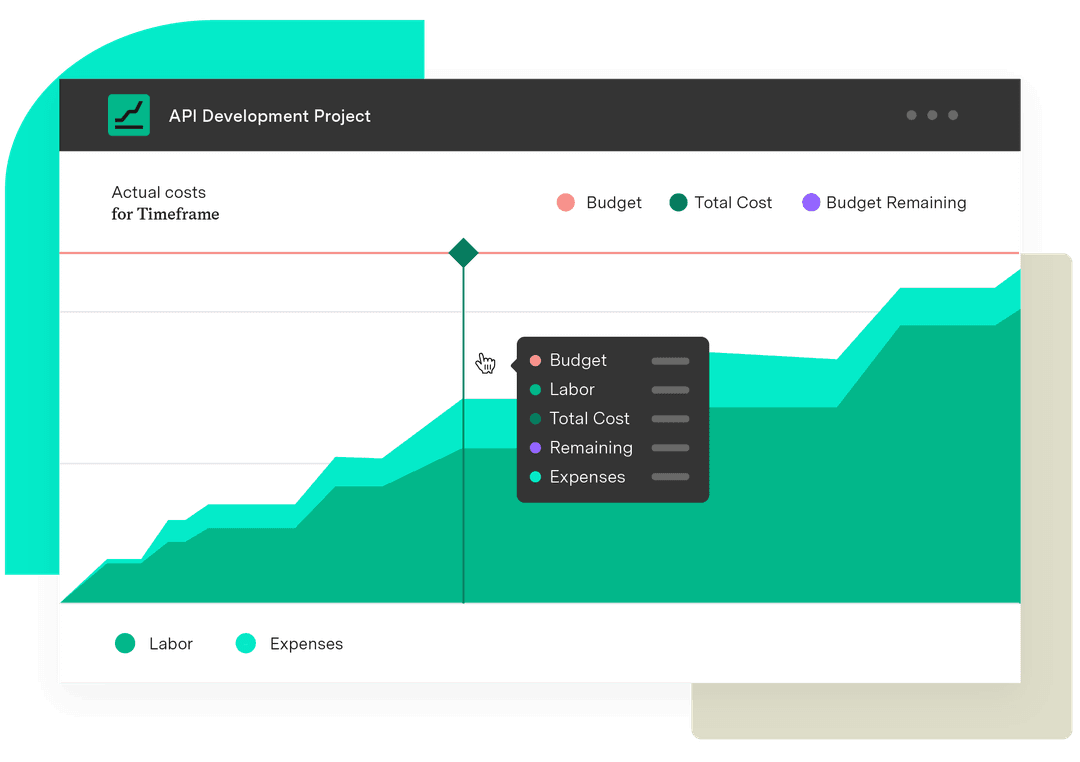
This is what Tempo Financial Manager already does for human delivery. It pulls real cost and effort data into budget-versus-actual and CapEx-versus-OpEx views at the project and portfolio level.
An AI-compute cost is a cost like any other, and it should answer to the same controls. Every dollar an agent spends on compute has to map to the initiative it serves and carry a CapEx-versus-OpEx classification, the way labor spend already does in Financial Manager.
Keep an audit-grade record of what was done and what it cost
Regulators and finance ask the same question after the fact: Who did this work, and how do we know? For human work, Tempo Timesheets captures effort at the work-item level, detailed enough for a financial audit and to classify capitalized versus operating cost. An agent workforce raises the same question with more urgency, because the work happened without a person in the loop. The record has to be there before anyone asks for it.
These four ways to better govern human and AI work are not separate products. Tempo offers an integrated, modular suite, so Structure PPM and Financial Manager operate as one connected governance layer on top of Jira. Timesheets adds the effort record that closes the financial audit. All three draw on the same Jira data. You start where your immediate need is and add the next piece as the agent workforce grows.
Sign up for a demo of Tempo Structure PPM today to get started.
3. Match autonomy to consequence
Not every agent action deserves the same level of human oversight, and treating them the same either strangles useful automation or rubber-stamps risky decisions. The practical model scales an agent's autonomy to the consequence of its actions, across three levels.
Level | What the agent does | Who decides | Use it for |
Observe | Surfaces signals and recommends, takes no action | A human decides everything | High-stakes, hard-to-reverse calls |
Assist | Proposes an action with its reasoning | A human approves before it runs | Decisions with real cost or tradeoffs |
Delegate | Acts within preset guardrails and logs what it did | A human sets the boundaries and reviews the logs | Low-risk, reversible, high-volume work |
A low-risk, reversible task can sit at delegate. A decision that moves real money, touches sensitive data, or cannot be undone stays at assist, with a human in the loop, no matter how confident the agent is.
The point is that autonomy is set per decision rather than per agent. And the threshold for human approval is not a nice-to-have. For a growing class of decisions, it is becoming the law.
What regulators now expect from human oversight
Human oversight of high-risk AI is moving from good practice to legal requirement. The EU AI Act requires meaningful human oversight of high-risk AI systems, so people can effectively oversee them and step in when needed.
Its human-oversight rule, Article 14, applies to a defined high-risk category that covers AI use in areas like employment and access to essential services, precisely where resource-allocating, work-assigning agents can land.
If your agents make or shape consequential decisions about people, a human-approval threshold is the thing an auditor will ask you to prove.
This is why the autonomy model and the portfolio record are not academic. Article 14 effectively mandates the assist level, a human in the loop, for high-risk decisions. The audit-grade record is how you show the oversight happened.
Putting an agentic AI governance framework into practice
An agentic AI governance framework that only secures agents is half a framework. The other half is the one your CFO and your board are already asking about: What is the autonomy worth, and how do you know?
You answer it the same way you answer it for human work, with one portfolio view and spend tied to outcomes.
That foundation is what you need, and you don’t have to build it from scratch. Tempo's Jira-native suite governs the human side of your portfolio today, which is the same foundation an agent workforce will be governed on.
Book a demo today to see how Tempo connects every project's spend to its outcome in one portfolio view.