Learn how to use a production schedule to monitor the production process, provide accurate completion predictions for products, and set shipment dates
Production planning establishes a company’s strategy for producing goods and services.

Delivering products and services to an eager market requires significant forethought and organization. It’s hard enough for a company to determine what it should produce; then, it has to make it happen. Even if the production process delivers finished goods, inadequate preparation leads to inefficiencies and redundancies that drain hard-earned profits.
The production planning process allows companies to map out and optimize business operations. Although they were once only feasible for large manufacturers, carefully coordinated production processes are now accessible to start-ups and mid-level enterprises, thanks to the development of technology solutions.
A comprehensive production plan is the best way to deliver high-quality products and services to customers while maximizing return on investment. Here’s how it works.
Production planning establishes a company’s strategy for producing goods and services. It outlines the manufacturing process, labor and raw material requirements, and expected market demand.
Production planning also identifies output goals, metrics, and a manufacturing schedule to ensure goods arrive on store shelves in time to meet demand. In addition, production planning covers
Production targets
Manufacturing processes
Material requirement planning (MRP)
Staffing and equipment requirements
Goals and KPIs
Production process schedules
Market analysis
Demand forecasting
A constructive production plan optimizes a company’s manufacturing process before investment or fabrication begins. It also safeguards product inventories, reducing the risk of overproduction and stockouts, and ensures a consistent supply of goods that meet customer expectations.
A well-planned production process has impacts that are felt across the organization. The following processes will see immediate and long-term benefits:
Supply chain management: Product planning reduces bottlenecks and costs while maintaining quality control standards and improving margins. Retailers receive goods faster, ensuring supply meets demand.
Production scheduling: Demand forecasts outlined in the production plan allow production managers to schedule manufacturing periods that meet market requirements while avoiding potential conflicts with other deliverables.
Material requirements planning: When production management understands the manufacturing requirements of a particular good, they can implement inventory control protocols to source and allocate resources while avoiding shortages that impact production lines.
Production lead time: An efficient production plan reduces the lead time between receiving and fulfilling an order, delivering products into clients’ hands faster.
Capacity planning: With a clear manufacturing production plan, management can determine whether systems, raw materials, and resource inventories are sufficient to meet demand. When capacity planning reveals issues, they know how to adjust the procurement and production schedule accordingly.
Production planning and scheduling are different phases of the manufacturing process.
Production planning constructs a high-level outline of how a company intends to produce a good or service, including goals and success metrics. Product scheduling is the action plan defining granular details like production time and labor allocation. Scheduling also establishes specific production times, dates, and deadlines while uncovering potential bottlenecks or interdependencies between manufacturing processes.
Sign up for a demo
Request DemoMargins are everything in manufacturing; it’s all about minimizing costs to maximize profit. When manufacturing production planning is grounded in accurate forecasts and data analysis, companies enjoy improved productivity and stable finances.
Here are several ways production planning benefits a business:
Production planning clearly describes existing manufacturing processes, the current inventory of raw materials, and any resources production management must procure. It also provides a high-level overview of company resources, financial health, and production capacity.
The production planning process proactively identifies inefficiencies, bottlenecks, and risks to the assembly line. These insights help production management refine the process or rethink its approach, reducing costs and increasing productivity before manufacturing begins.
A production plan based on accurate assessments of manufacturing capacity presents opportunities to reduce costs. This information helps leadership find ways to improve operational efficiency and maximize the procurement budget.
Planning optimizes processes and inventory controls, generating a more accurate understanding of production requirements. These insights identify wasteful operations and excess resources. By mitigating or eliminating these issues, production managers can reduce costs and boost the efficiency of the production process.
Adequate raw materials and a leaner, more efficient production process reduce lead time, meaning distributors and clients receive orders faster. In addition, increased efficiency empowers supply chain management to maintain inventory levels to meet demand.
Depending on the finished goods, manufacturers use one of five production planning methodologies:
Batch production follows a linear process, crafting similar items in groups or batches rather than manufacturing items individually. Once every item completes a production phase, goods proceed to the next step. For example, a baker mixes a batch of bread dough, lets the dough rise, and then places the entire batch in the oven to cook.
Batch production requires leadership to optimize resources without overproducing goods or generating excessive downtime. The production planner balances these factors by removing bottlenecks between batches and reducing wait times between each stage of the manufacturing process.
Job production planning addresses the manufacture of a unique item by a single craftsperson or team. It’s typically used to produce custom products like musical instruments or houses.
Production planning under this scenario focuses on capacity, ensuring sufficient human resources and raw material availability to produce the final good. The plan typically involves purchasing specialized resources, which demands precise inventory forecasting.
Flow production planning is a demand-based manufacturing process that optimizes production to decrease lead time. Production doesn’t begin until a work order arrives and doesn’t end until the final item leaves the assembly line.
Flow production manufactures similar and consistently in-demand items. The planning process aims to minimize inventories of work-in-process and finished goods. Production plans ensure efficiencies and cost reductions throughout the supply chain, benefiting the company, its suppliers, and clients.
This is the type of manufacturing most people envision: an assembly line of workers and machinery performing various assembly tasks. This form of production planning produces a continuous stream of identical products, similar to flow production but on a larger scale. Automation and optimization of the production line drive the most significant benefits.
A mass production planning process seeks to reduce changeover times between assembly steps, increasing total production output. Due to the large quantity of goods, a small improvement produces a compound effect, significantly impacting time or cost savings.
This production process leverages formulas or recipes to manufacture goods that aren’t measured in discrete units, such as plastics, pharmaceuticals, and cosmetics.
Due to long changeover periods and an increased risk of errors, process manufacturing planning focuses on reducing waste to compensate for the increased raw material requirements.
The production planning process requires accurate data and powerful tools to inform decision-making. Tempo has you covered with software solutions to manage every aspect of your manufacturing plan, including capacity planning, demand forecasting, and inventory management.
Start with Capacity Planner, our resource management and scheduling software that helps visualize teams, plans, and shared resources to avoid production bottlenecks. Next, try Tempo’s Financial Manager, which provides intuitive, real-time views of costs, budgets, and profits.
Finally, Custom Charts is an analytical software package that supports informed decision-making and accurate demand forecasting. It analyzes key delivery, capacity, and speed metrics and delivers the results directly to your dashboard.
No matter your production planning needs, Tempo has a solution.
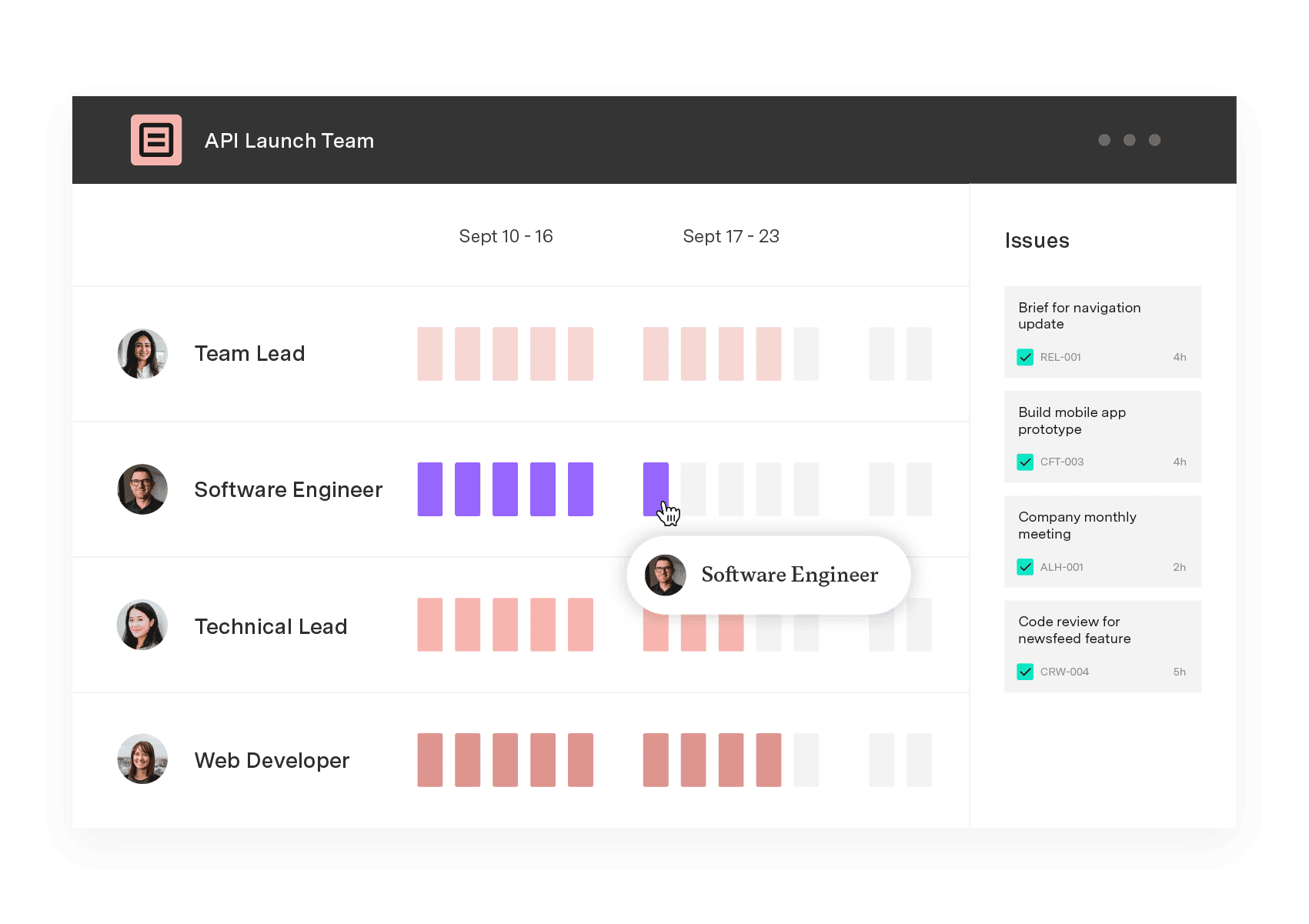
Capacity Planner
Capacity Planner is the only tool in the Atlassian Marketplace that allows planning for multiple resources on one issue. Users can customize the UI to include their existing Jira issues and projects.
Start a Free TrialCouldn't find what you need?Go to our documentation
Production planning proceeds through a five-step process: Forecasting: Demand forecasting estimates the number of units customers will purchase. Routing: This step outlines the sequence of manufacturing processes to produce the finished item. Scheduling: Production scheduling creates a timeline for each manufacturing step. Dispatching: Here, leadership outlines protocols for initiating the production process. Monitoring: Production managers continuously evaluate the production process for adjustments to reduce waste and improve efficiency.
Production planning covers the entire range of activities governing the manufacture and distribution of goods. Therefore, management must make initial decisions regarding the following elements: Type of production line used: Choose between batch, flow, process manufacturing, or mass production. Site selection: Factory location impacts supply chain and inventory management (e.g., proximity to rail lines, transportation hubs, and suppliers). Facility layout: How many production lines can the building accommodate? Is there warehousing capacity? The answer to these questions impacts production scheduling, inventory, and capacity management. Resource planning: The production plan determines whether to store resources on-site and how to maintain adequate supply to meet demand. It also determines how to efficiently allocate raw materials and time.
The production planner is responsible for planning and scheduling the manufacturing process to ensure operations flow smoothly and efficiently.
Learn how to use a production schedule to monitor the production process, provide accurate completion predictions for products, and set shipment dates
Transform your operations management for the better with this guide to aggregate planning. Learn how it can help your organization thrive.

Take control of spending, secure production inventory, and improve vendor relationships with a robust procurement management system.

Discover how a solid operations strategy drives growth and efficiency, aligning business goals with real-world execution.

What are operating expenses? How does tracking them improve a company’s bottom line? Here are the basics for understanding this type of expenditure.

Discover how operational data, such as sales transactions and system logs, empowers businesses to boost efficiency and effectively manage risk.
Build resiliency in your supply chain and keep customers happy by incorporating demand planning techniques into your inventory management practices.

Discover how to conduct a product audit and how it improves manufacturing productivity, quality assurance effectiveness, and customer satisfaction.

Understanding disruptive technology helps you identify innovations that serve your interests and reap the benefits of early adoption.