See where your team's hours actually went. Slice Jira time data by status, issue type, project, or label to align effort with priorities.
Individual timesheets answer one question: what did this person do? A team timesheet answers the harder one: where did our shared capacity actually go?

A team timesheet is a consolidated view of the hours logged by every member of a defined group, organized so a manager can see the team as a whole rather than as a stack of individual reports. It rolls up worklogs across people, projects, accounts, and issue types into one picture.
The point is not to add up hours. It is to answer the questions managers face week after week: Are we spending time on the right work? Is anyone overloaded? Are we on track against what we committed to?
A good rollup makes outliers obvious — the person carrying too much, the project quietly absorbing more hours than planned, the account drifting into non-billable work.
Faster reviews. Approvals and check-ins happen in one view instead of clicking through individual records.
Capacity at a glance. Over- and under-allocation surfaces immediately, which is the foundation of any honest staffing conversation.
Cleaner project costing. Hours roll up by project and account, so cost reporting reflects effort rather than estimates.
Better cross-project visibility. When people split time across initiatives, a team view keeps the picture coherent.
A repeatable rhythm looks like this:
1. Define the team. This sounds trivial, but most failure modes start here — stale rosters and missing contractors are the usual culprits. 2. Set the reporting period, usually a week or a sprint. 3. Review the rolled-up view by person, then by project or account, looking for imbalance. 4. Drill into outliers and confirm whether they are real (someone covering for a colleague) or data errors (missing or misclassified entries). 5. Approve the timesheet, and use the same view as input for capacity planning, billing, and stakeholder updates.
The discipline is making this a routine rather than a quarterly fire drill. Weekly reviews surface problems while they are still small.
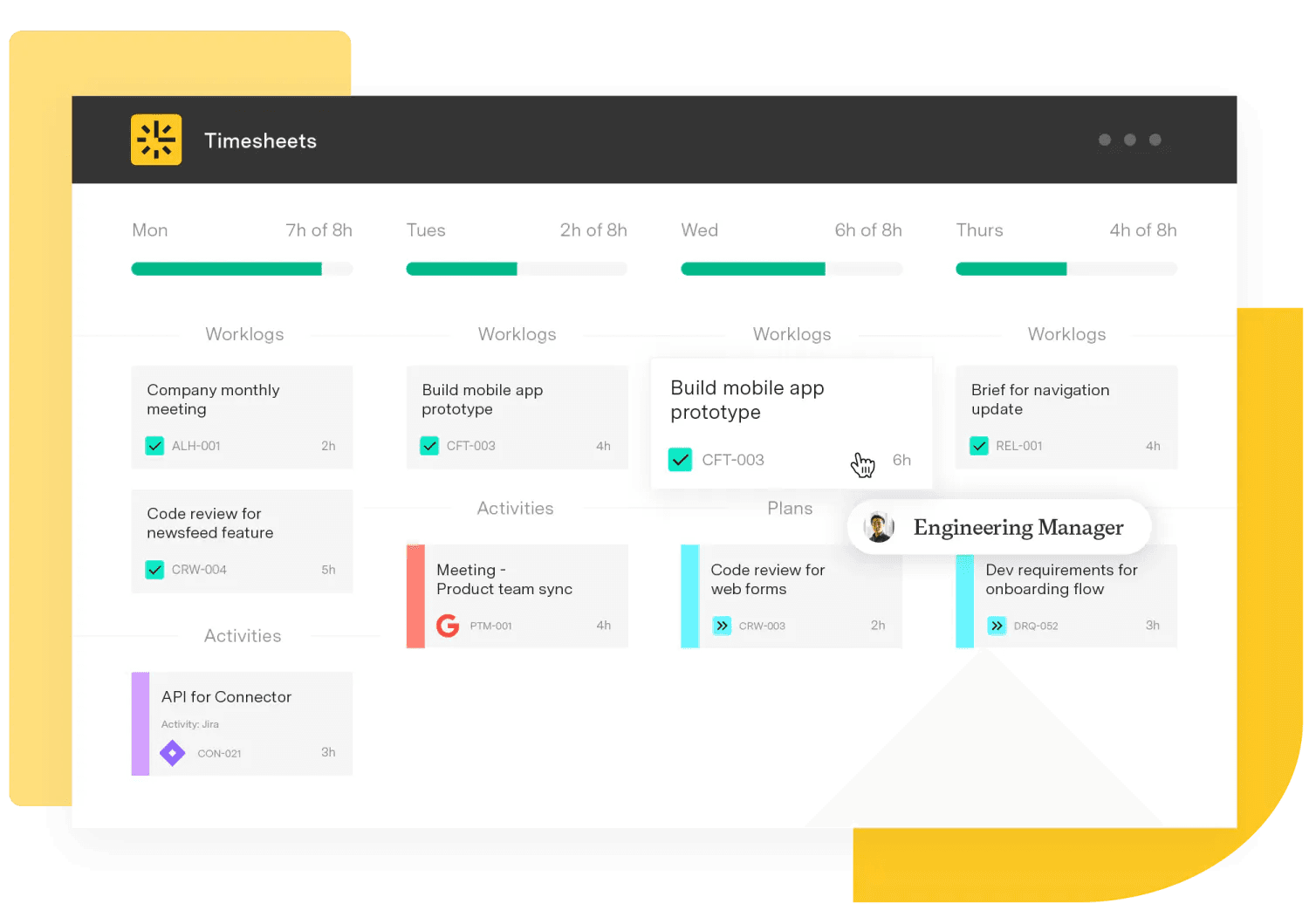
Timesheets gives managers a team view that pulls every member's worklogs against Jira issues into a single reviewable picture. Because each entry carries an account, an issue, and a billable status, the same data that powers a weekly approval also feeds billing, CapEx classification, and capacity reports downstream.
Approvals are part of the flow. Managers can review logged time, push back on missing or misclassified entries, and sign off — all without leaving the system the team is already working in.
For Jira-native organizations, that matters. The rollup is anchored to the same issues leadership is tracking, so manager reviews and executive reporting tell a consistent story.
A services firm running ten consultants across four client engagements uses the team view to spot when someone's billable utilization drops below 75 percent, and rebalances assignments before it shows up as a revenue miss.
A platform engineering team uses the same rollup to track how shared capacity splits between feature work, on-call response, and tech debt. The data drives a quarterly conversation about where time is going and whether that matches the roadmap.
A pharma R&D team uses it to separate capitalizable research effort from operational support work, producing the audit-ready breakdown finance needs without surveying scientists each quarter.
Timesheets
The #1 time-tracking app for Jira. Timesheets seamlessly integrates with Jira and your existing workflows to help you track time for accounting, CapEx tracking, client billing, compliance, and more.
Start a Free TrialCouldn't find what you need?Go to our documentation
A team timesheet is organized around people – it asks where this group's hours went. A project report is organized around work – it asks how much effort a particular initiative consumed. Most managers need both, but they answer different questions, and conflating them tends to produce reports that are confusing for everyone.
Weekly is the sweet spot for most teams. Daily creates fatigue and rarely surfaces anything actionable; monthly is too late to fix problems while they are still cheap. The exception is short-cycle services work where daily review aligns with billing rhythm.
This is one of the trickiest data problems in time tracking. The cleanest pattern is to let entries flow to whichever team owns the work being done, not the team the person formally belongs to. That way, a developer lent to another squad shows up correctly in the borrowing team's report, and capacity conversations stay honest.
Yes. Internal teams use the same view for capacity planning, sprint health, CapEx and OpEx classification, and surfacing where engineering effort actually lands versus where leadership thinks it does. Billing is one use case, not the only one.
See where your team's hours actually went. Slice Jira time data by status, issue type, project, or label to align effort with priorities.

Timesheets offers a variety of real-time business intelligence for executives, account managers, project managers, and team members
Capture worklogs as work happens. Automated time tracking in Jira gives finance and managers data they can trust without nagging the team.

Learn how to calculate sprint capacity per person and convert story points to hours, so your sprint plans match what your team can deliver.

Project managers and executives can combine Timesheets with Epic Sum Up to better use existing time reporting to save the company money
Capacity management works when you consider roadmap and operational load. See how engineering leaders plan real capacity in Jira.
See how Timesheets brings estimated vs actual time into Jira with real-time reporting, dashboards, and portfolio rollups built for delivery teams.

Tempo Timesheets features custom price tables where you can set different hourly price rates for team roles.

Knowing the status of work is just as important as knowing when it will finish. See an aggregate of how long work takes for future estimation.