BigPicture can't answer your CFO's CapEx question. Compare Structure PPM, Jira Plans, BigGantt, EazyBI, and Jira native on financial governance.

Key Takeaways
How each tool handles:
Hierarchies and views
Scheduling and capacity
Governance and risk
Licensing and hosting
Looking for the clearest difference between Structure, Jira Plans (formerly Advanced Roadmaps), and BigPicture?
This guide breaks down the major tools on the market, focusing on the practical needs of different customers and being straightforward at which you should be choosing.
Pick Structure if you need to visualize large amounts of issues and projects in a single view, create custom hierarchies, and perform advanced roll‑ups and calculations with Formulas – all inside Jira.
Pick Jira Plans if you want native, multi‑team roadmaps with team‑level capacity planning and configurable hierarchy above Epics.
Pick BigPicture if you want an all‑in‑one PPM suite and have teams working agile, waterfall, and hybrid and need a way to get all that work organized.
Capability | Structure | Jira Plans | BigPicture |
Primary view | Spreadsheet‑like structures that roll up any issues across projects, shareable, real‑time | Roadmap plans across boards, projects, filters | Gantt and multi‑module PPM workspace |
Hierarchy | Fully custom issue hierarchies, mix of agile, waterfall and hybrid | Additional levels above Epics via plan hierarchy config | Portfolio structures and multi‑level hierarchies |
Advanced roll‑ups | Sum‑ups and formulas for complex reporting (time in status built‑in) | Roll‑ups in plan, focused on roadmap fields | Roll‑ups across modules, KPI panels |
Dependencies and timelines | Gantt add-on for dependencies, baselines, and (DC) resource leveling | Dependencies on the roadmap | Gantt with critical path, baselines |
Capacity planning | Gantt add-on, plan by teams or roles (DC today, expanding on Cloud) | Team‑level capacity/velocity (Scrum/Kanban) | Resources module with per‑person allocation |
Risk / PI planning | SAFe visualization via custom hierarchies,reporting with formulas | Scenarios, releases, no built‑in risk matrix | Risk matrix module, SAFe PI planning artifacts |
Hosting and license | Jira Cloud and Data Center (app) | Included in Cloud premium and enterprise, bundled in Data Center | Jira Cloud and Data Center (app) |
Structure lets you create custom, reusable structures that pull issues from many projects and render them in a spreadsheet‑like view. Teams can group, filter, and aggregate in real time without exporting to Excel.
The formulas feature (unique to Structure) enables advanced calculations and visual formatting across thousands of issues. Time in status is built in for process insight.
Best for: Large, mixed‑method portfolios that need flexible roll‑ups, live reporting, and minimal admin overhead.
Add Gantt Charts for Structure when you want a single screen to plan dependencies, visualize timelines, and (DC) level resources, keeping the view in lockstep with Jira issues.
Plans combine work from boards, projects, and filters into a single roadmap, with custom hierarchy levels above epics, release targeting, and team‑level capacity for scenario planning. On Cloud, plans are part of Jira Premium/Enterprise, plans are included with Jira Software.
Best for: Organizations already on Jira Premium and wanting a native roadmap across multiple teams.
BigPicture packages Gantt, resources, risks, roadmaps, and SAFe‑oriented boards in one app. You get per‑person resource allocation, portfolio structures, and a risk matrix – plus guidance for SAFe® PI planning.
Best for: Teams wanting module‑rich PPM (especially risk management) inside Jira.
Structure (+ Gantt): Build program/portfolio schedules, drag‑drop dependencies, manage baselines, and (on DC) leverage resource leveling. A resources module enables capacity planning in context of the same live structure.
Jira Plans: Plan with team capacity/velocity (Scrum or Kanban), visualize load, and try scenarios without changing issue data until you commit. Capacity is modeled at the team level (you track per‑person availability indirectly via team membership/estimates).
BigPicture: Allocate at the individual level, visualize workloads across portfolios, and coordinate delivery via the Gantt and Resources modules.
Structure emphasizes live, portfolio‑wide reporting with sum‑ups, formulas, time in status, quick filters, and flex Items to annotate plans without adding Jira fields. Many orgs use it to model SAFe® while maintaining their preferred Jira configuration.
Jira Plans supports hierarchy above Epic and cross‑team dependency mapping/release targeting; it’s great for roadmap governance in Premium environments and can be embedded in Confluence for stakeholder visibility.
BigPicture adds a risk matrix and detailed PI‑planning constructs that resonate with SAFe® practitioners.
Structure PPM and Gantt Charts for Structure: Available on Jira Cloud and Data Center via the Atlassian Marketplace.
Jira Plans: included with Jira Cloud Premium/Enterprise and bundled in Jira Software Data Center 8.15+.
BigPicture: Separate Marketplace app for Cloud & Data Center, with modules for Gantt, Resources, Risks, and more.
Tempo’s collections let you scale from project execution to strategic delivery. Pairing Structure with these apps connects delivery, capacity, and cost – all inside Jira:
A discount combination of Structure, Gantt Charts, Capacity Planner and Custom Charts for Jira for clarity and control at scale. Roll up projects and resources into clear program views, manage dependencies, and keep stakeholders aligned in Jira.
It comes with:
Capacity Planner: Jira’s #1 capacity and team management software, enabling you to plan resources by role or skills, avoid overallocation, and compare plan vs. actual time (with Timesheets).
Custom Charts (Jira and Confluence): Publish executive dashboards and visualize your essential KPIs – no coding required.
Organize and manage complex programs with clear, consolidated views.
See the Program CollectionTempo’s entire suite of tools for everything a modern team needs to operate, execute, and flourish – from first plans to final delivery and analysis.
It comes with:
Timesheets: Jira’s #1 time-tracking add-on. Automate time capture, get accurate billing, CapEx/OpEx, and audit‑ready reporting.
Financial Manager: Jira #1 financial management add-on. Monitor projects and portfolios to get simple, clear, and real-time views of your costs, budgets, and profits.
Custom Charts (Jira and Confluence): Build charts and dashboards to evaluate delivery, capacity, and speed for all teams, from agile and ITSM to marketing and HR.
BI connectors: Connect Jira to Power BI, Tableau, BigQuery and other BI tools. Build custom Jira reports with standard, custom fields, filters, and templates.
Strategic Roadmaps: Roll up your portfolio into enterprise-ready roadmaps in minutes. Reduce silos and improve collaboration across Jira epics or portfolios.
Plan, govern, and measure strategic initiatives from the boardroom to delivery teams.
See the Portfolio Collection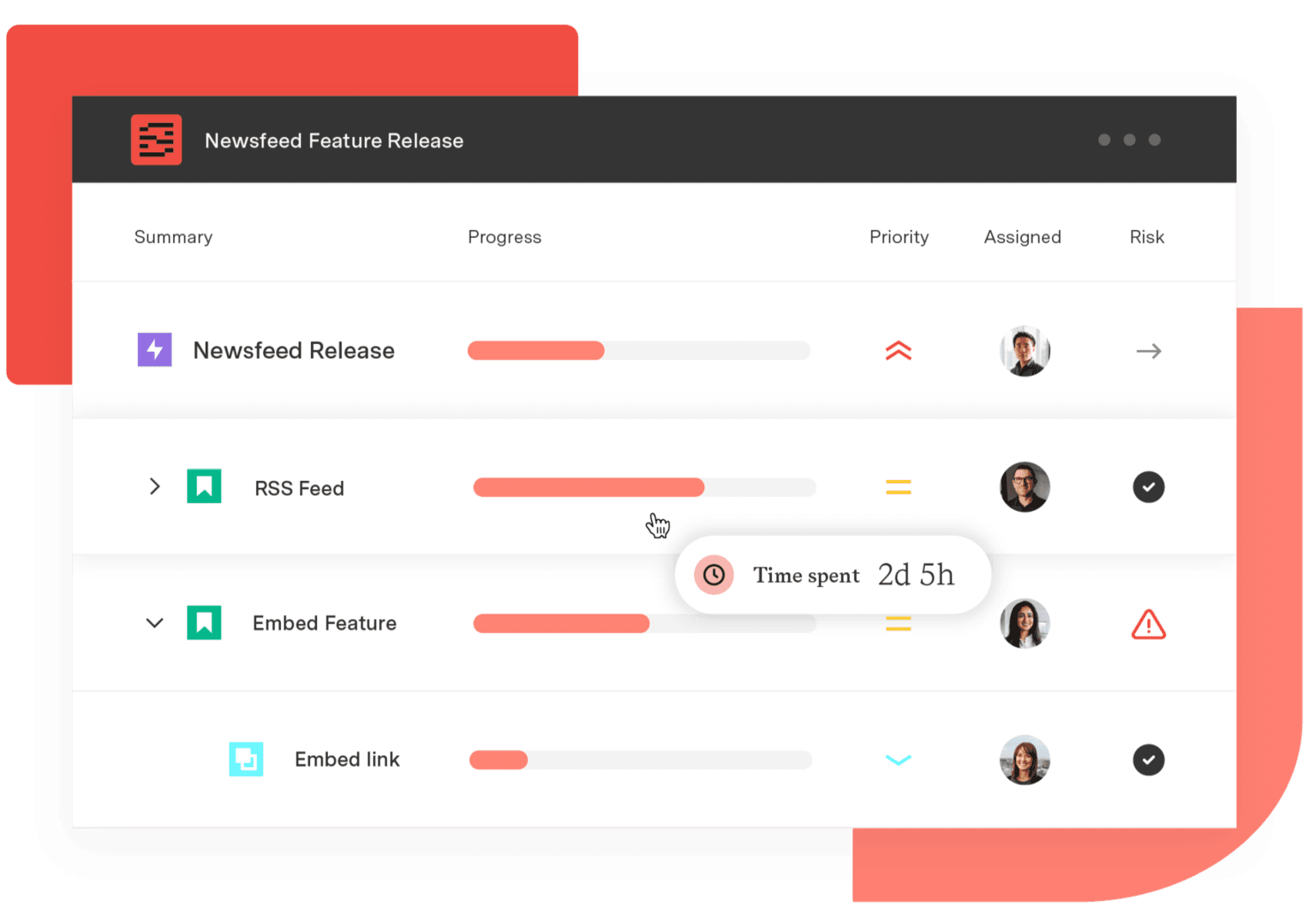
Structure PPM
Manage products, projects, and programs in a single spreadsheet-like view. By providing a clear, real-time view of project progress and resource allocation, Structure helps teams meet deadlines and adapt swiftly to changing priorities.
Start a Free TrialCouldn't find what you need?Go to our documentation
Cloud Premium/Enterprise include plans, Data Center 8.15+ also includes it as part of Jira Software.
They overlap on Gantt and portfolio views, but they optimize for different priorities. Structure focuses on flexible, spreadsheet‑like reporting and custom hierarchies (with formulas and time in status built‑in), whereas BigPicture bundles risks and SAFe‑oriented modules.
Yes. Teams commonly model Epic‑Feature‑Story (or Initiative‑Epic‑Story) hierarchies in Structure with minimal setup, keeping management and delivery aligned.
BigPicture can't answer your CFO's CapEx question. Compare Structure PPM, Jira Plans, BigGantt, EazyBI, and Jira native on financial governance.

Tempo's Structure PPM, Gantt Charts, and Timesheets close the gap between strategy and shipped outcomes at portfolio scale.

LinearB vs Jellyfish compared. See what each measures, where each falls short, and which fits delivery automation or investment reporting.

The AI in most project management tools reads a synced copy of your data. See which of eight platforms reach live portfolio data for 2026.

monday.com caps dashboards at 50 boards and has no CapEx/OpEx tracking. Five alternatives compared for enterprise PMO teams on Jira.

Roadmap or Gantt chart? Learn the differences, then compare Jira’s Advanced Roadmaps versus Structure from Tempo to discover which tool works for you.

Migrate to Jira Cloud with confidence. The software’s new features are exciting, and Atlassian provides resources to support a smooth transition.

Jira started purely as an issue tracking software targeting software developers, and quickly evolved into one of today’s biggest productivity tools.

Exalate Modules add extensibility. Easily minimize the details of advanced system interactions and simplify the integration into synchronization.