The 2026 State of AI in Portfolio Management Report
How AI is reshaping the way PMOs and portfolio leaders plan and execute


Key Takeaways
91% are piloting or actively using AI in project delivery
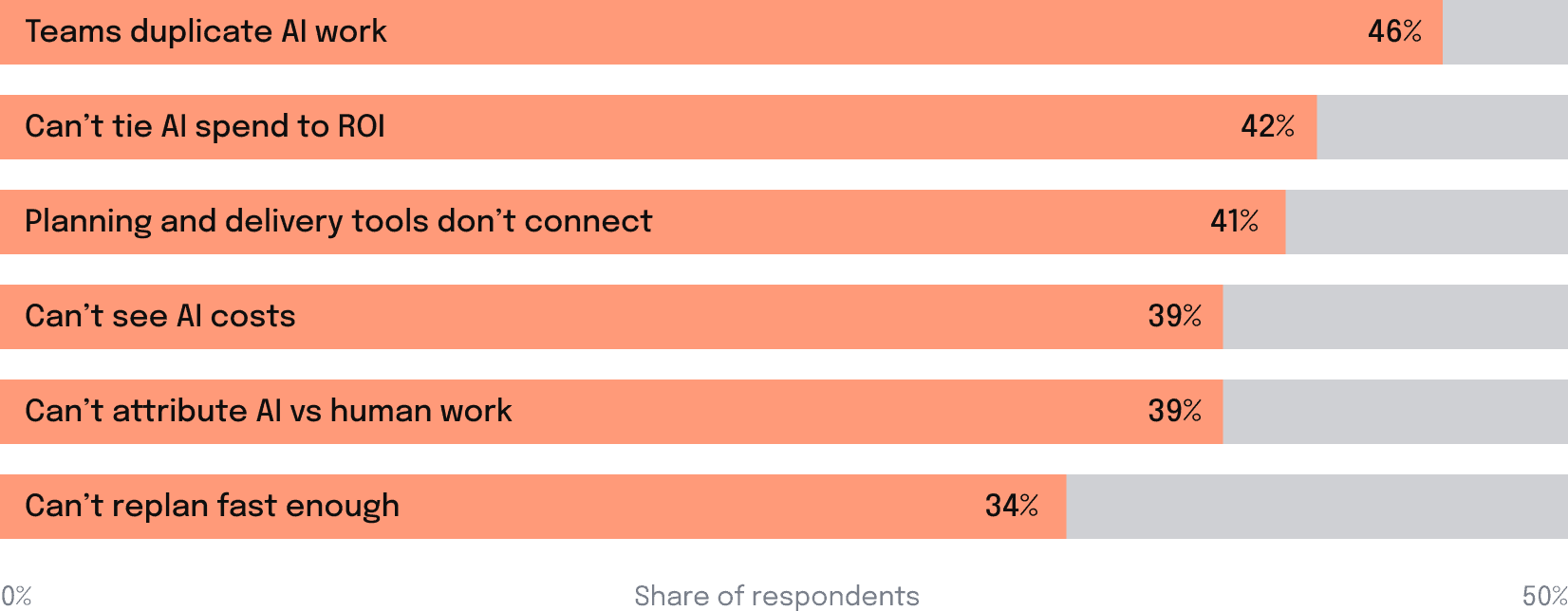
42% of teams struggle to tie AI spend to ROI
46% of teams are duplicating work with AI
55% of teams that are actively using AI struggle to attribute AI vs human work
That number drops to 16% of the teams that have deployed agents to production
Foreword from Vic Chynoweth, CEO at Tempo Software
Welcome to the 2026 State of AI report from Tempo.
"We wanted to hear from the people already using AI for portfolio management work at scale. So we were deliberate about who we asked: Senior leaders who plan and run portfolios with real complexity. If AI is changing how strategy becomes work, this is a close look at the leading edge.
"The results show that legacy SPM platforms built for a human workforce have already failed. Only a fraction of teams are using a full set of nextgeneration capabilities, and they are outperforming their peers by a remarkable margin."
This report draws on a survey of senior planning leaders at large enterprises. It shows that using AI is not, of itself, an advantage. The survey reveals what separates the best project and portfolio managers from the rest. And the data sheds light on how legacy SPM and PPM tools are failing to provide planning leaders the capabilities they need right now
Methodology
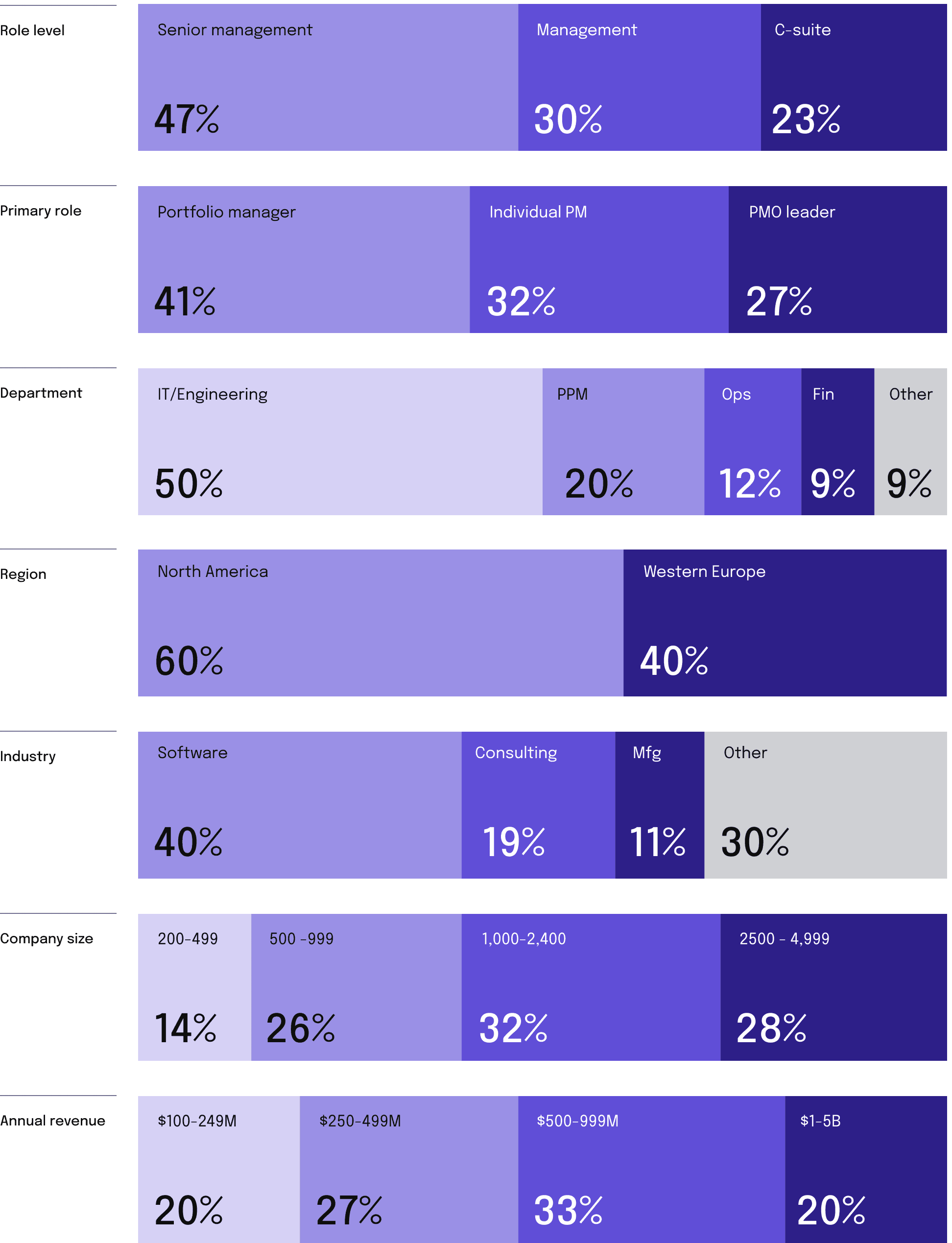
Tempo Software commissioned Potloc to survey 300 senior project, portfolio, and PMO leaders at enterprise organizations in North America and Western Europe. Every respondent personally leads or directly influences how portfolio work is planned and delivered. Fieldwork was conducted in June 2026, examining AI maturity, the current tooling stack, and the operational friction these leaders report day to day.
Chapter one: AI isn’t the real advantage

If it seems like everybody’s using AI these days, this report’s first finding won’t surprise you.
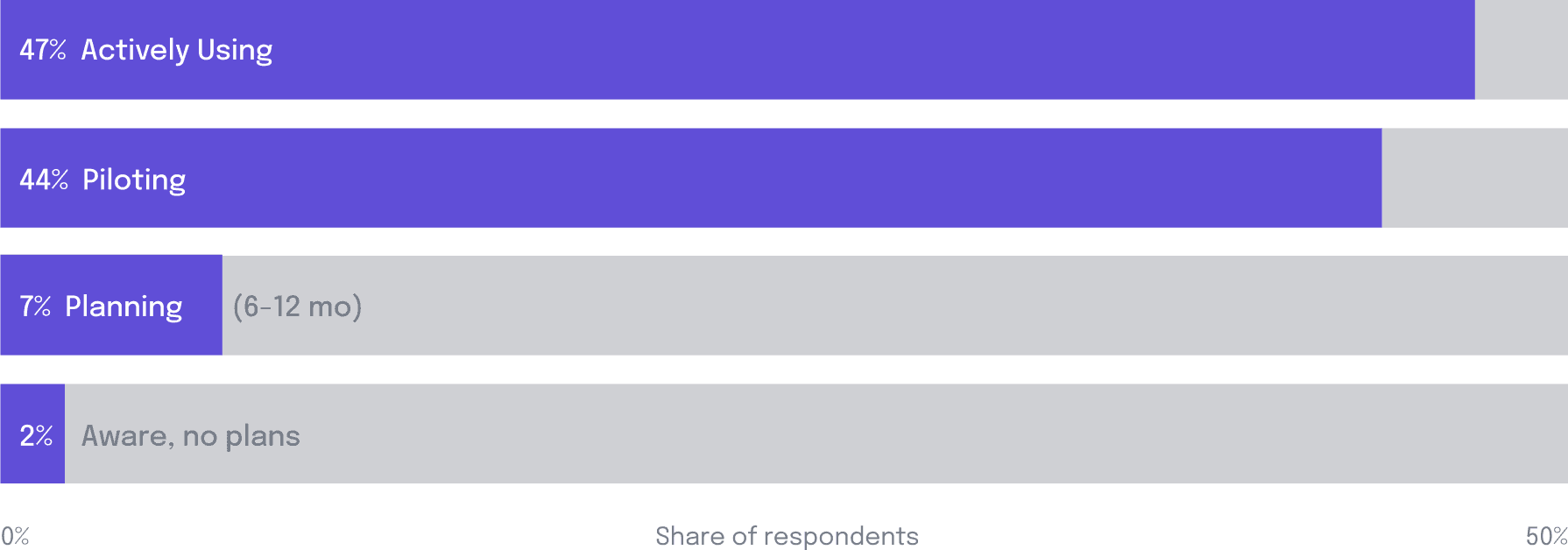
Nine in ten (91%) of respondents are piloting or actively using AI in project delivery. Another 7% have short-term plans to roll it out, and just 2% have no plans.
Which of the following are your organization’s top challenges in managing AI in project or service delivery today?
Using AI tools isn’t a difference maker – it’s the new normal in everyone’s processes. What matters is the way people are deploying it alongside their human workforce.
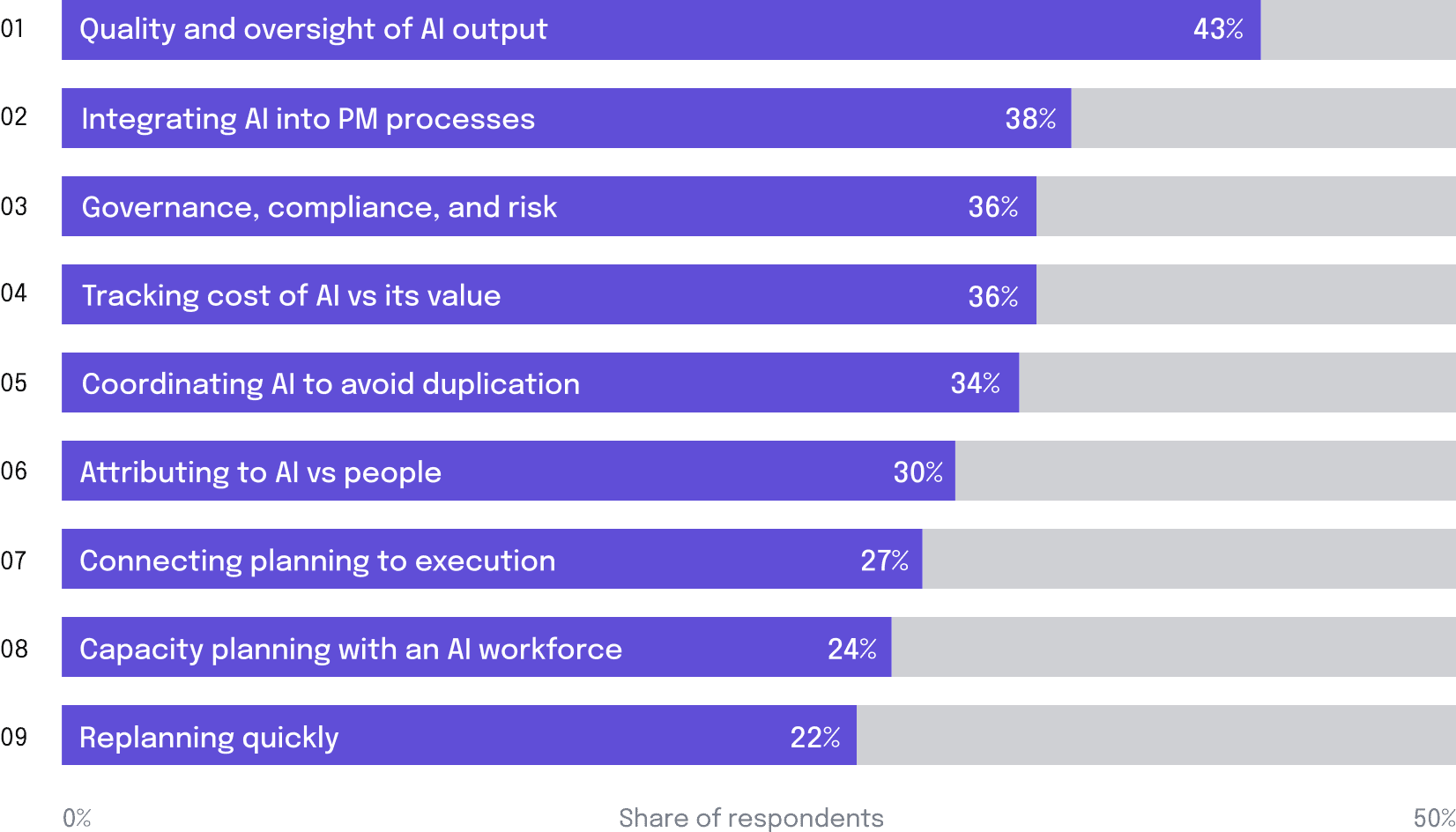
One important caveat: This survey excludes many highly regulated industries, where AI rollout has been slowed by security and other concerns. Indeed, governance, compliance, and risk (36%) is a top-three concern – just below quality and oversight of AI output (43%) and integrating AI into PM processes (38%).
Top challenges managing AI
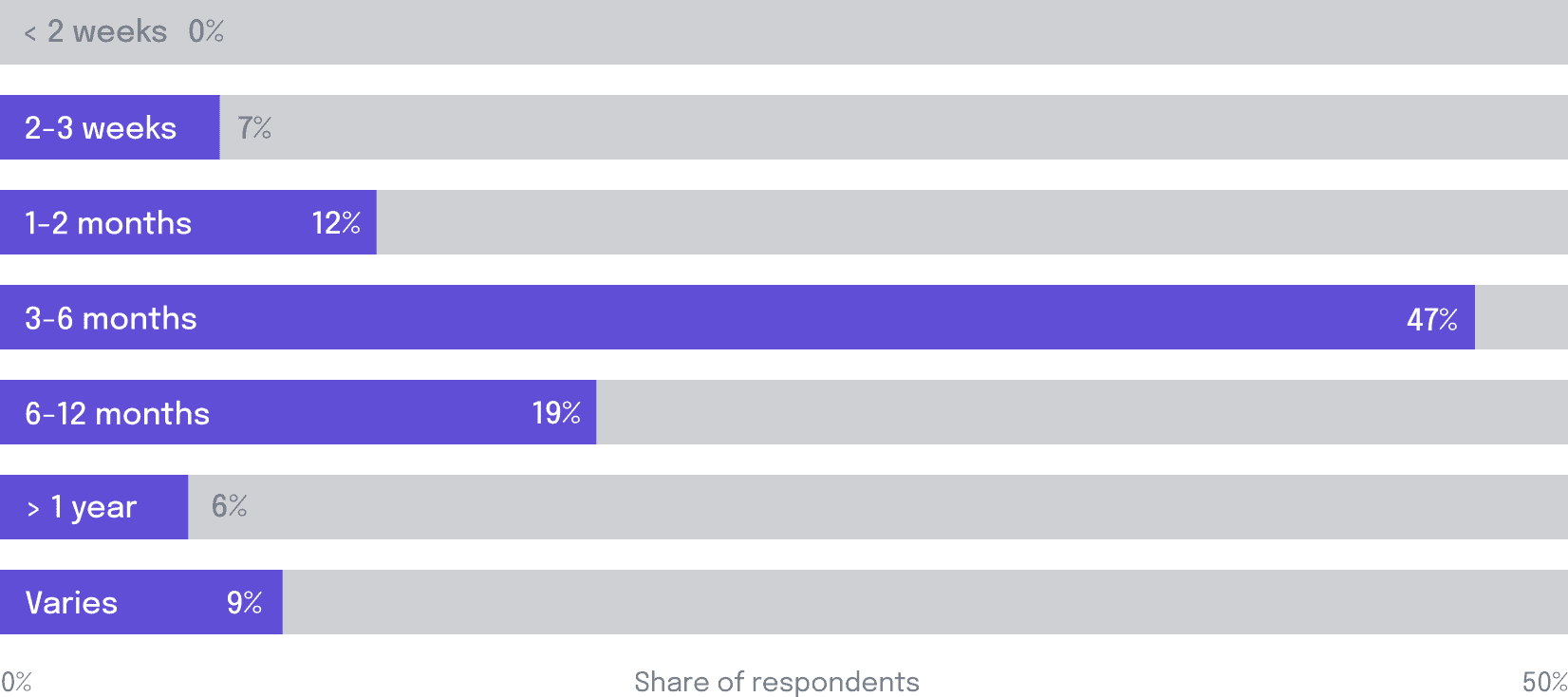
It’s worth a glimpse into the world planning leaders live in. Nearly half of projects (47%) take 3-6 months to complete. About one in five (19%) take six months to a year.
Typical project duration
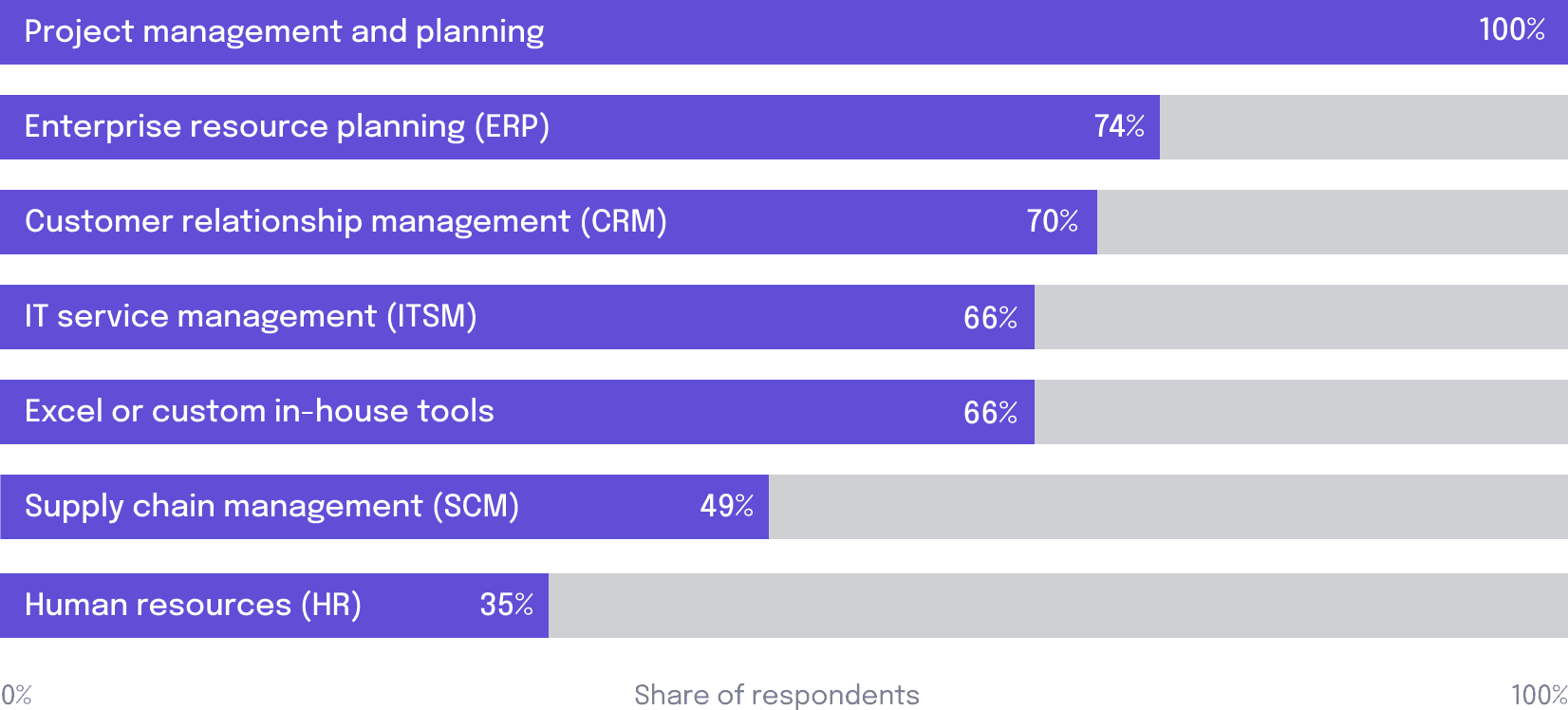
Three quarters (74%) of PMO leaders use enterprise resource planning (ERP) and two in three (66%) use IT service management (ITSM) platforms.
Platforms used by planning leaders
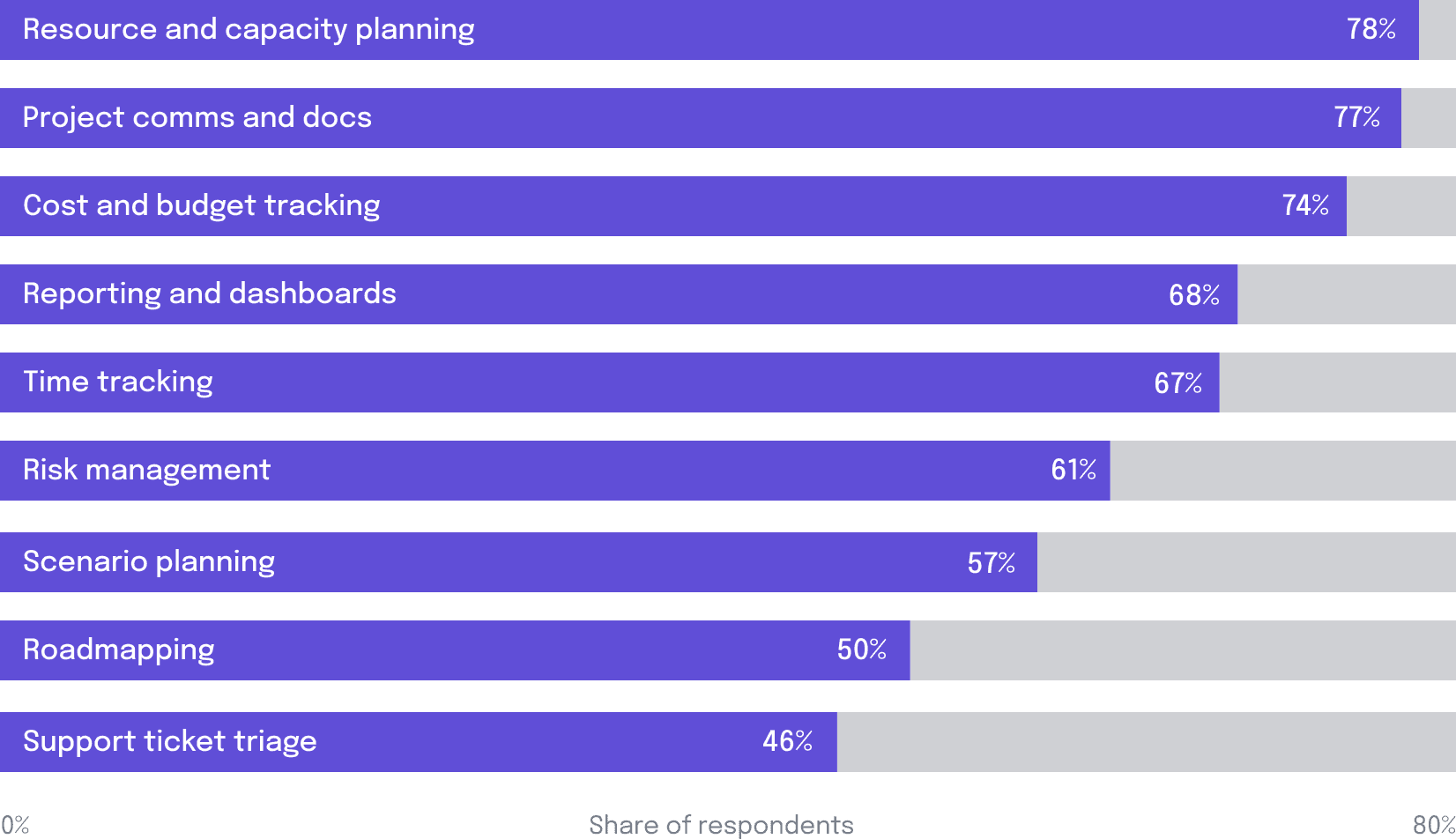
Nearly 4 in 5 (78%) respondents use project or work management software for resource and capacity planning – the top capability.
What planning software helps teams do
Chapter two: What AI-powered portfolio management looks like

A quick glance at the survey data makes it seem like simply using AI is a home run. However, a closer look tells a different story.
While nearly half of respondents (47%) are actively using AI tools, a much smaller cohort (33%) is actually delegating real delivery work to AI agents.
This is a crucial finding. Planning leaders who say their teams are “using AI” don’t have any advantages over their peers who are just piloting or haven’t rolled it out yet. In fact, the “using AI” group underperforms the baseline on some measures.
Delegating real delivery work to AI agents
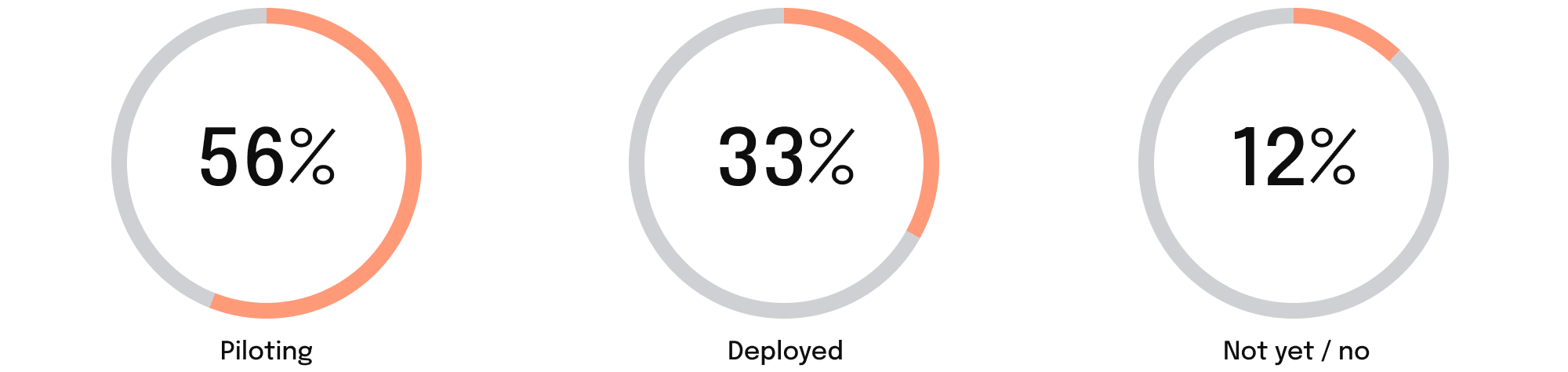
Does your organization delegate work to AI agents or AI tools as part of how projects get delivered/executed – meaning the AI does some of the work itself (writing code, QA, documentation, etc), not just a productivity aid?
Benefits only emerge when companies hand real delivery work to AI agents. More than a simple productivity booster, these teams have their AI shipping code, providing documentation, and performing QA.
Share of delivery work that currently runs on AI
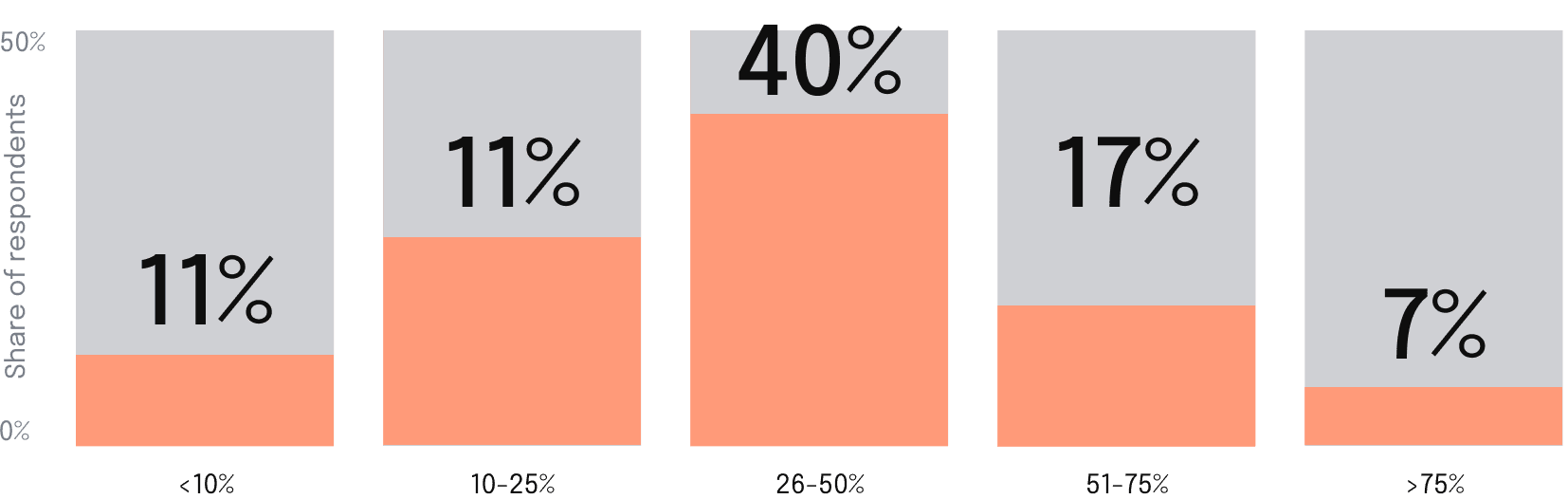
Approximately what share of your organization’s project management and delivery/execution work currently involves AI in some form?”
"Getting value from AI is rarely about technology or adoption. Almost everyone we talk to is ‘using AI,’ but very few are handing it real work and seeing it genuinely improve how things get done.
We don’t start with the model or agent; we start with the work: How it flows, where the friction is, how it connects to purpose, and where AI can unlock value."
Dean Shaffer, Principle Technical Consultant at Adaptavist
Our data shows that even the most AI-forward teams have limited capabilities.
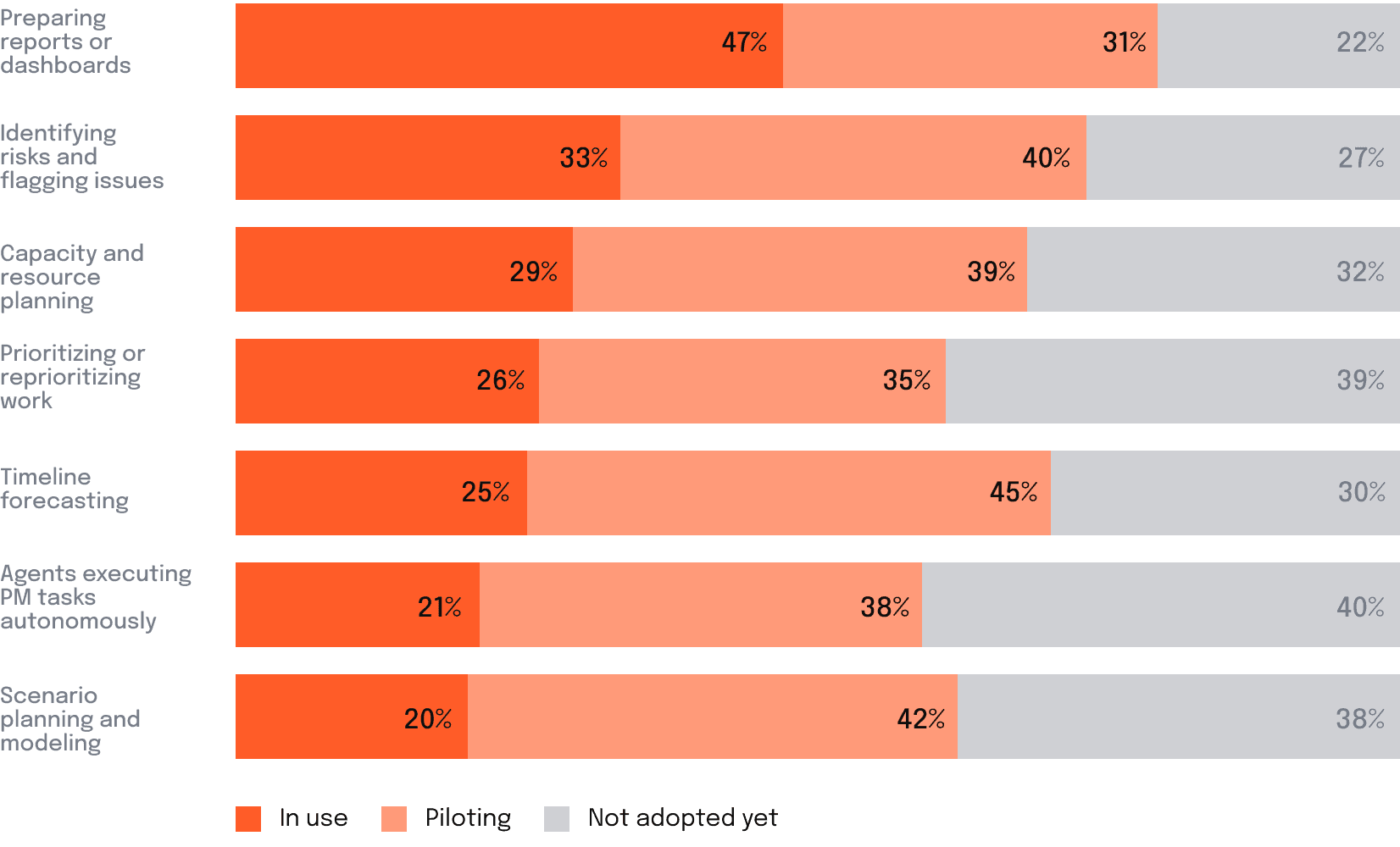
For example, only a quarter (26%) are actively using AI to prioritize or reprioritize work. One in three (33%) are actively using AI to identify risks and flag issues. We’ll return to these seven capabilities throughout the report, labeled in charts as “3+ AI capabilities live.”
Which AI capabilities are in use?
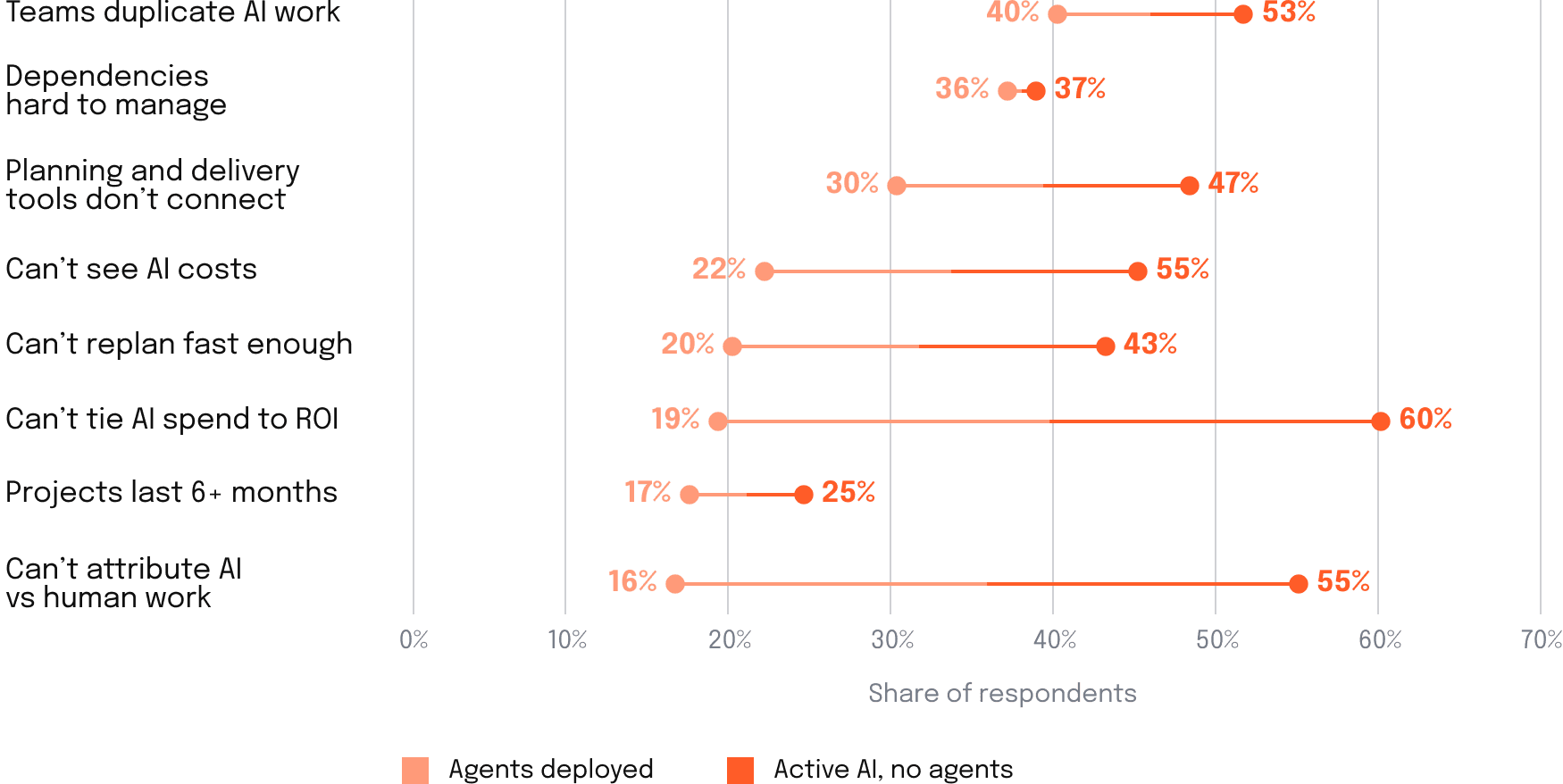
22% of teams with agents in production can’t see what AI costs them, against 55% of teams that use AI but haven’t deployed it into real work.
"One or two AI capabilities barely move the needle for enterprise clients. Based on years of migration and modernization projects, the difference is obvious once all the capabilities are live together. Clients who get there stop firefighting and start planning and building again."
Lia Wood Director of Enterprise Solutions at Isos
With that rollout has come friction. Teams struggle to tie AI spend to ROI (42%); nearly 4 in 10 (39%) can’t see AI costs, and 46% of teams are duplicating work with AI.
Types of AI friction leaders report
Among teams actively using AI: Agents deployed vs. no agents deployed. The distance between the dots is the deployment effect.
For teams that have deployed AI agents into production, those pain points start to fade. The next chart shows the same friction measures falling once agents reach production.
More than half (55%) of teams that are actively using AI struggle to attribute AI vs human work; that number drops to 16% of the teams that have deployed agents to production.
Difficulty eases with deployment to production
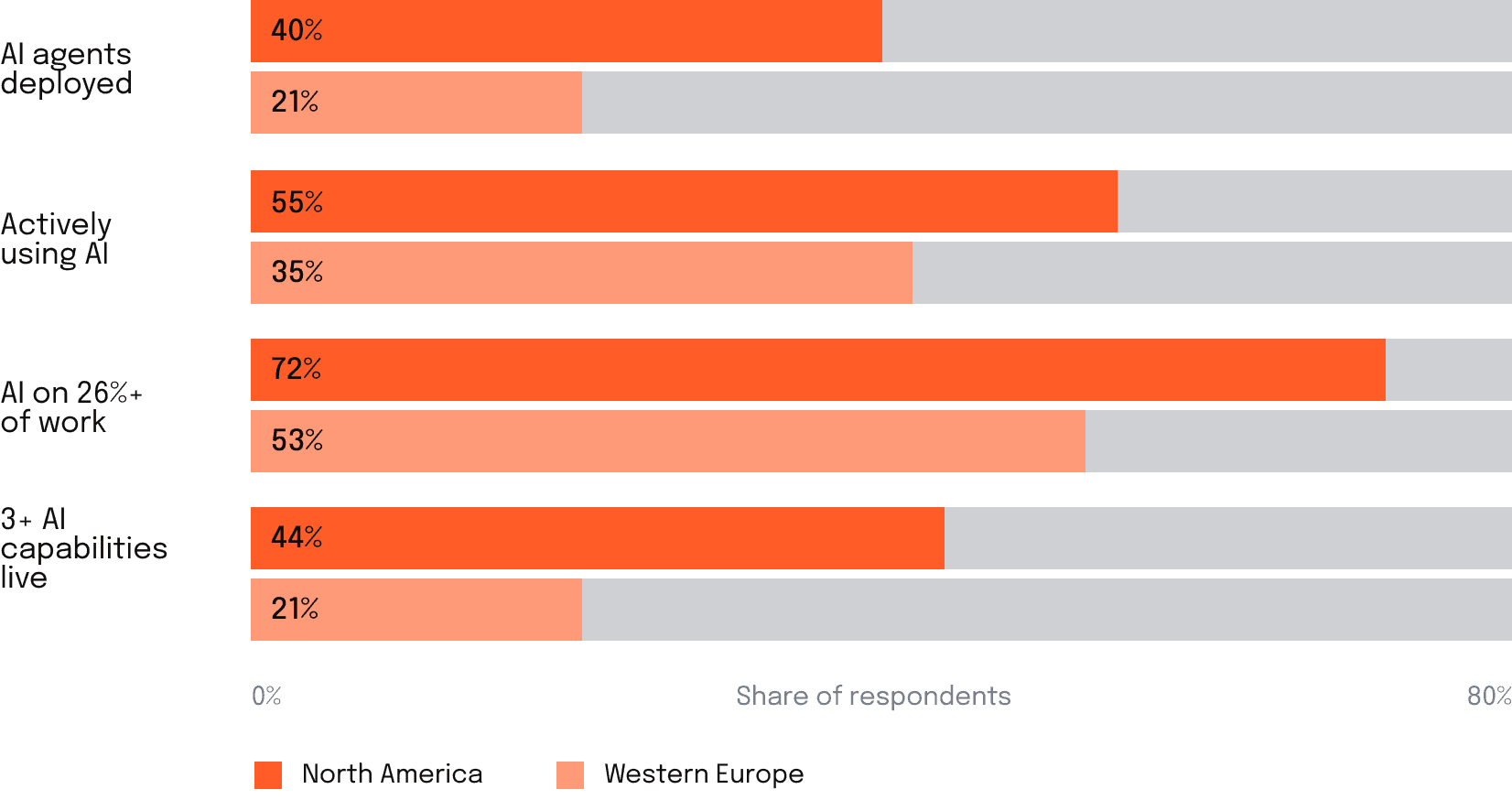
AI deployment varies by region. North American firms are more than twice as likely to have AI agents deployed to production (40%) than their European counterparts (21%).
AI maturity: North America vs Western Europe
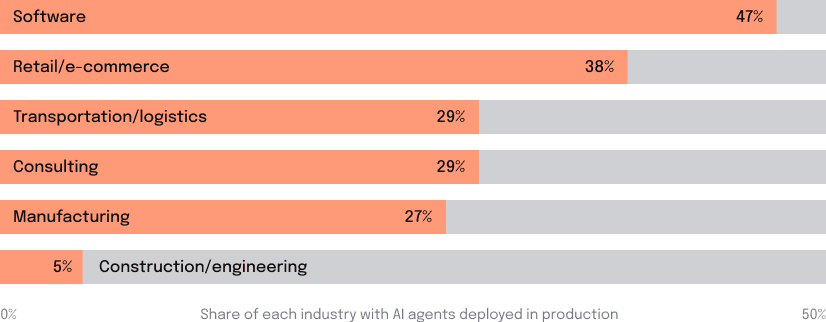
Software companies are much more likely to have deployed AI agents to production at 47%. By stark contrast, just 5% of construction or engineering companies have done the same
AI agents deployed in production, by industry
Chapter three: How teams deliver more projects faster

This report zeroes in on large, complex organizations. Most of them run between 11 and 25 concurrent projects.
We isolated the teams that run many projects with lots of dependencies and still deliver them quickly – then we figured out what they have in common.
How many projects organizations run at once
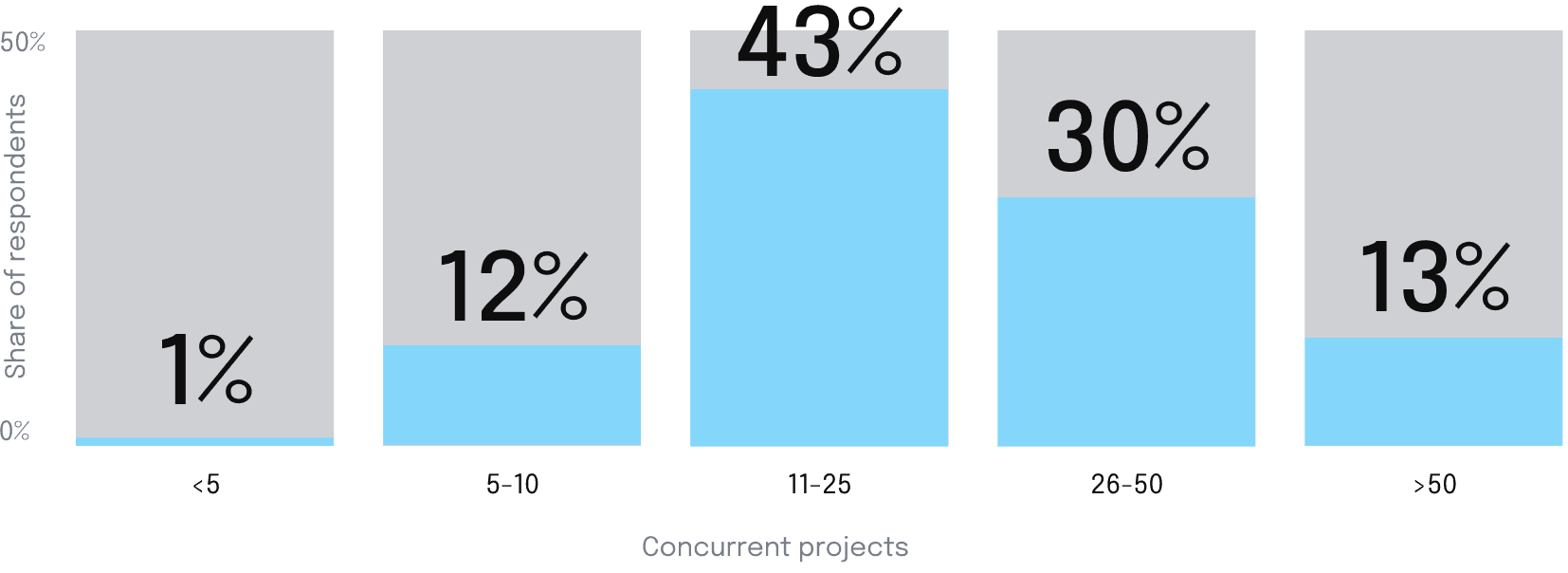
Two things predict fast delivery for these high-volume teams. Those that deploy AI agents into production finish more of their projects in under six months, a nine-point advantage. Teams also have an advantage if they run at least three of the seven AI capabilities outlined in chapter two.
The effect holds regardless of company size, revenue, tooling, or project complexity.
What actually lifts high volume, fast delivery
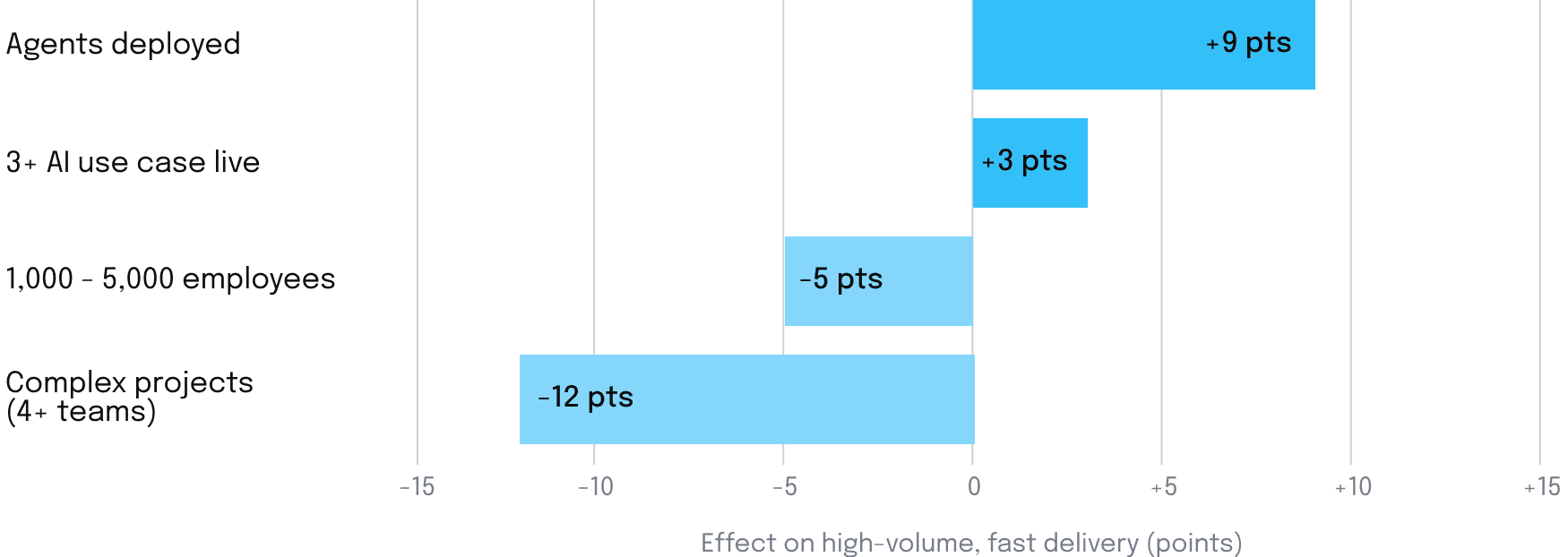
Percentage-point shift in the share of teams hitting high volume and sub-six-month delivery, with each factor present vs. absent.
"Attribution has to be solved before cost. It’s critical to measure agent output and capacity as deliberately as human output and capacity from the start. Treating that as infrastructure is the groundwork for defending where AI investment is going."
Nicole Bruno Head of Client Strategy and Solutions at e-Core
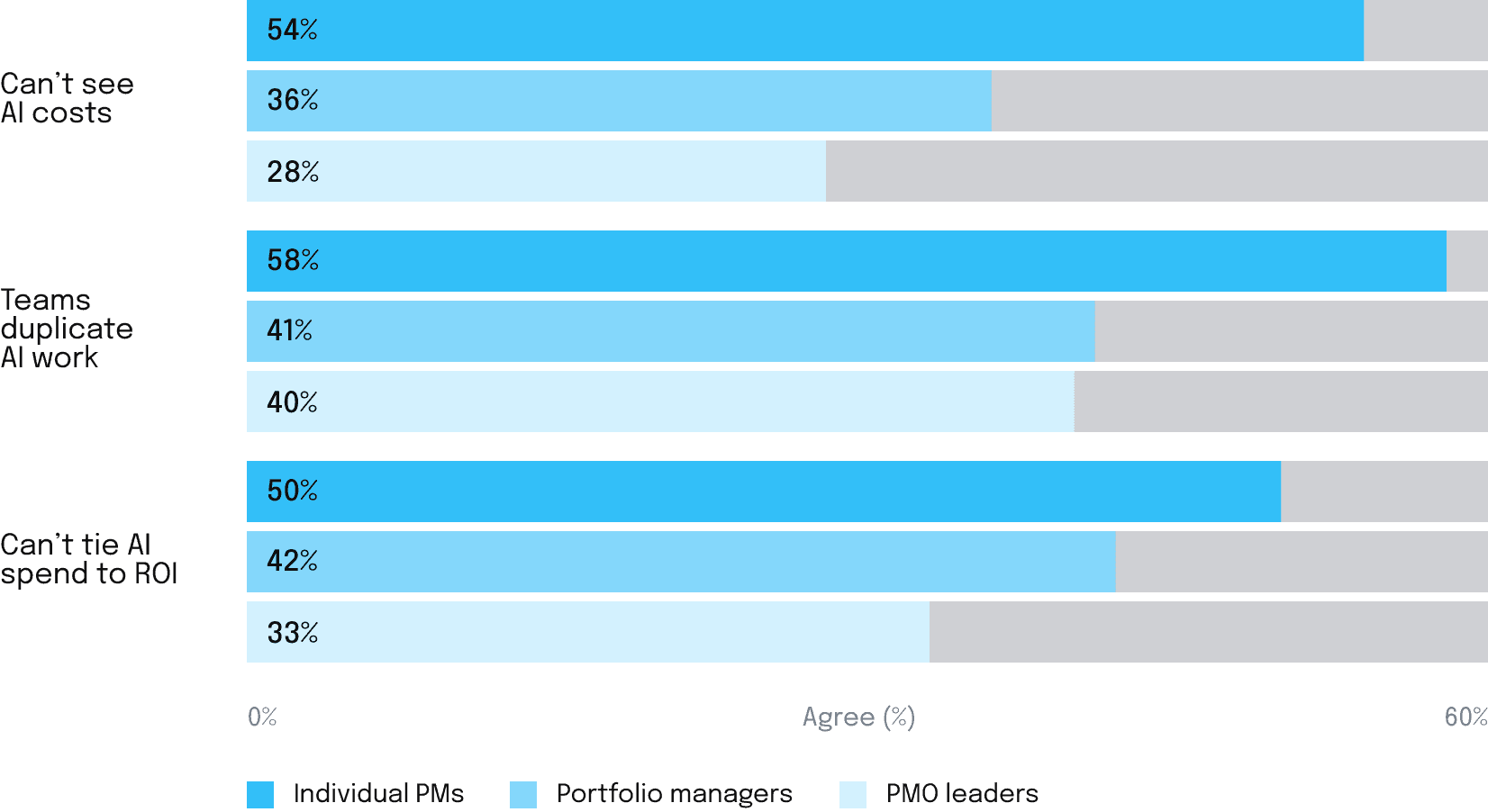
Those who are closest to the work experience AI deployment friction differently from PMO and portfolio leaders. Individual project managers report not being able to see AI costs (54%), against 36% for portfolio managers and 28% for PMO leaders
Project managers vs PMO leaders
While AI tools provide a clear advantage in managing projects, they haven’t yet solved dependencies between teams driving complex portfolios.
Chapter four: Portfolio management remains a challenge

We asked how many teams are involved in a typical project, and how difficult or easy it is to coordinate them.
Nearly half (48%) of respondents say the typical project involves 4-6 different teams.
How many teams a typical project has to coordinate
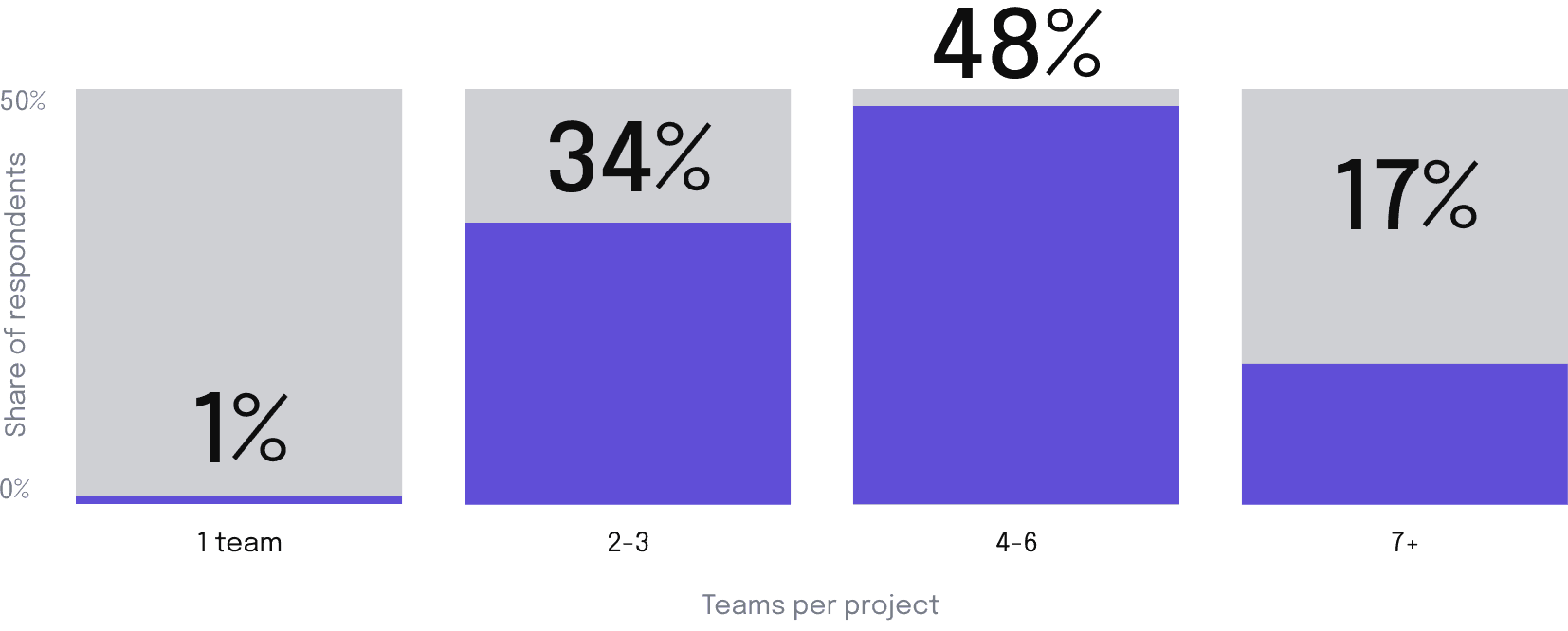
As the previous chart shows, 99% of respondents have to coordinate 2+ teams, and managing dependencies among them is no easy thing.
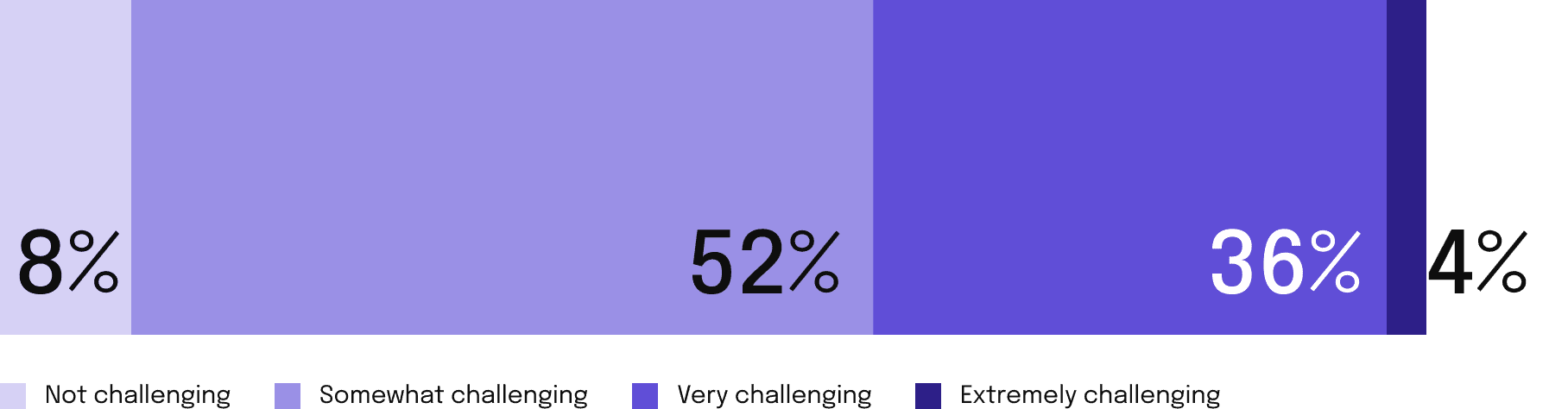
Four in ten (40%) say dependencies are very or extremely challenging to manage, with another 52% describing them as “somewhat challenging.”
Difficulty coordinating dependencies across projects, teams, and resources
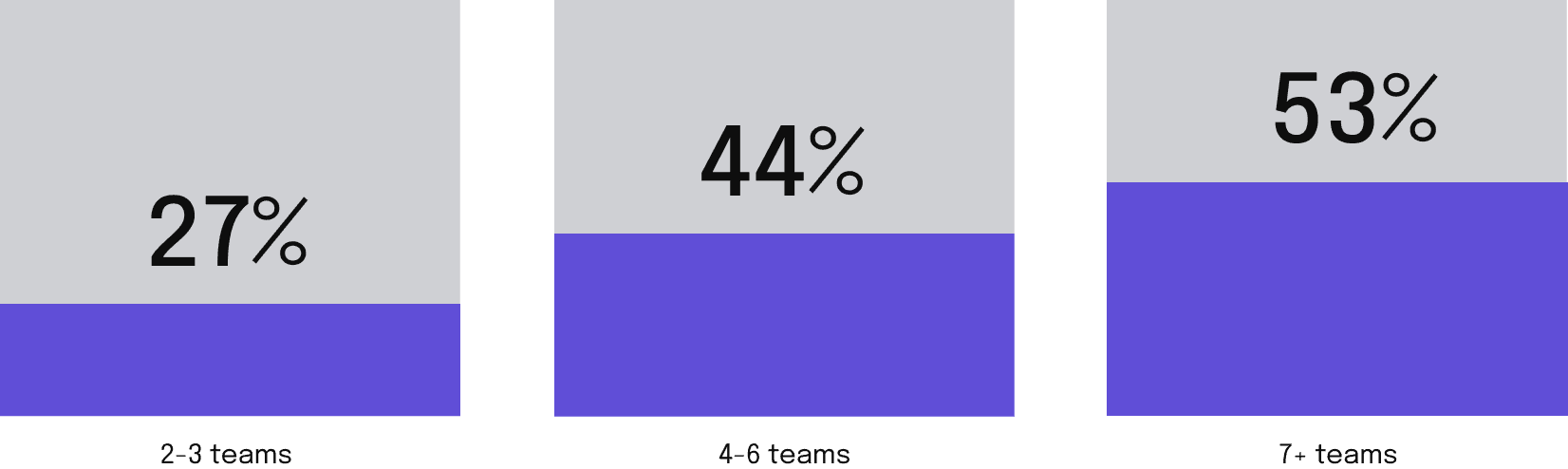
Even controlling for company size, project volume, and AI maturity, more teams means more difficulty managing dependencies. Similar to the other findings in this study, simply using AI has no effect on this.
Dependency difficulty climbs with every team added
While AI tools haven’t solved portfolio management problems yet, some teams are several steps ahead of the rest.
Chapter five: What’s the key to better portfolio management?

Cross-team coordination makes it harder to manage dependencies, but one group of respondents breaks that rule.
The teams that run four or more teams per project and still find dependencies easy to manage break the rule. In short, this is the cohort that does portfolio management well.
What attributes do they share? They’re more likely to have deployed agents to production and are running agents on more than 25% of their work.
What sets the best portfolio managers apart
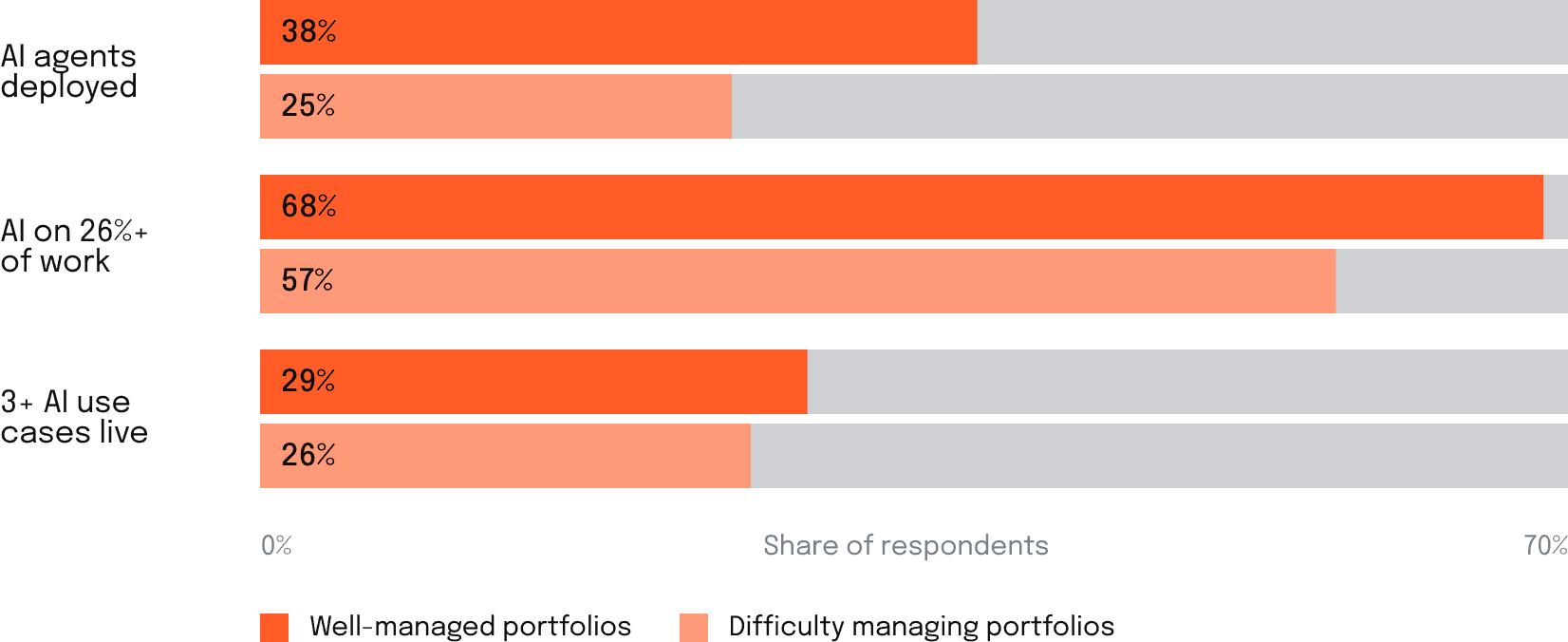
Having established the traits that mark the best portfolio managers in the sample, let’s dig into whether those attributes bring real benefits. It turns out that the capabilities these teams have at their disposal make an enormous difference.
The real challenge isn’t experimenting with AI, it’s turning ad-hoc pilots into measurable enterprise impact. Teams compress delivery cycles most successfully when they rebuild their delivery pipeline around human-AI collaboration: Humans driving strategy and complex tradeoffs, while trusted agents surface cross-team dependencies, handle routine refactoring, and keep documentation in sync."
Jess Fraser-Darling Director of Atlassian Solutions at Eficode
Chapter six: Full AI tooling sets the cohort apart

In chapter 1, we outlined seven key AI capabilities:
Scenario planning and modeling
Capacity and resource planning
Timeline forecasting
Reports and dashboards
Risk and issue flagging
Prioritizing or reprioritizing work
Autonomous PM agents
Just 18 out of 300 respondents have all seven operational – and have deployed agents into production. These organizations are living in a different world. We asked about the pain points they feel, and the responses are astonishing.
AI friction: Advanced tooling vs baseline
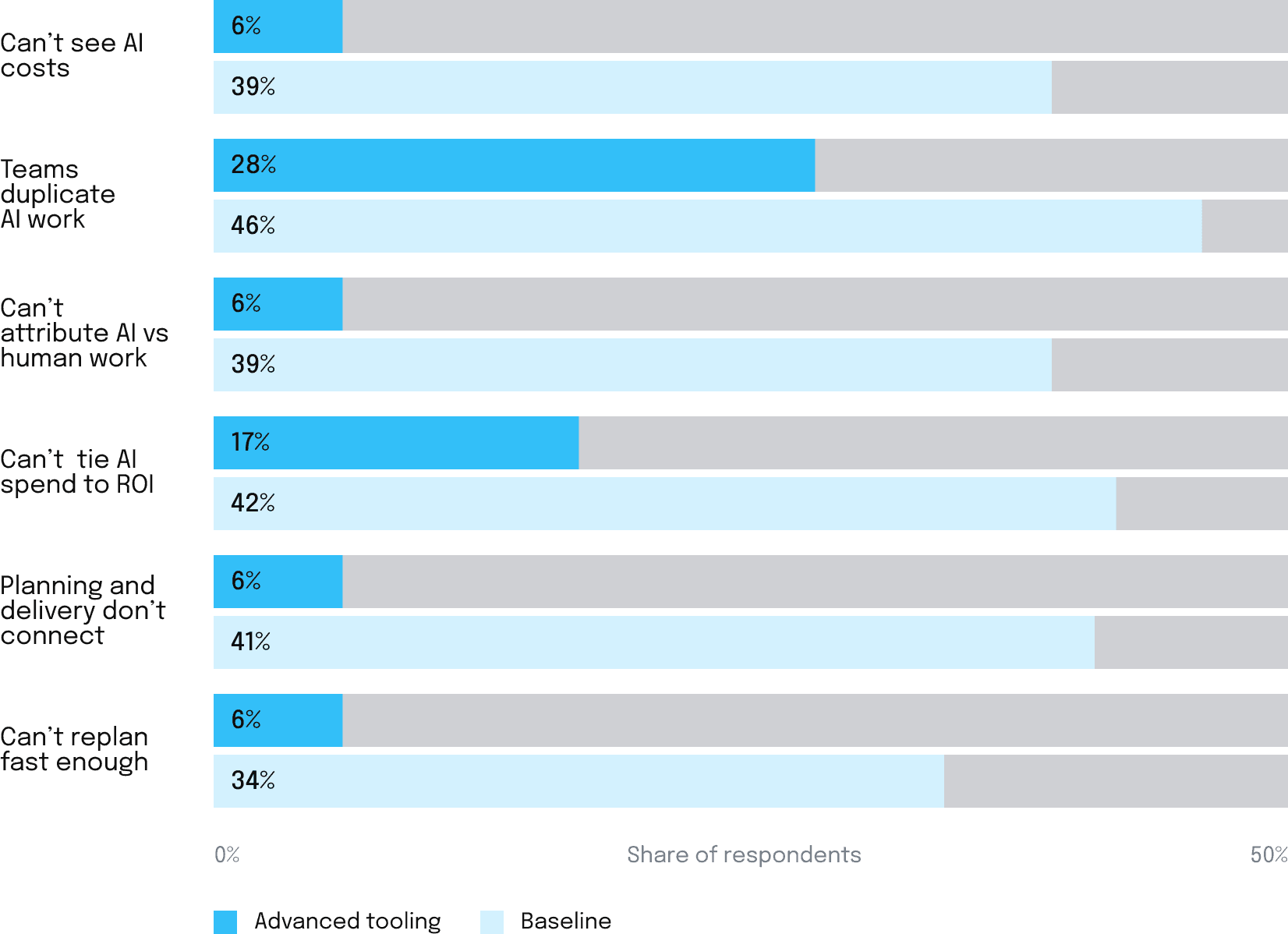
Let’s call this cohort the AI-enabled planning leaders. For them, the operational frictions that define everyone else’s day have nearly disappeared:
6%
Just 6% of this group can’t attribute AI vs human work, against 37% of those who are just using AI.
17%
On tying AI spend to ROI, just 17% of this cohort (versus 39%) can’t make the connection.
46%
Where 46% overall struggle with AI duplicating work, just 28% of this AI-enabled group say the same.
"Every PMO we work with wants prescriptive guidance, not another red flag on a dashboard. They’re trying to do more than catch strategic drift – they need a tool that helps a portfolio leader course-correct in real-time."
Parth Patel Senior Director AI Transformation and Enterprise Solutions at Cprime
It’s clear that the “AI-enabled planning leaders” group doesn’t feel pain points the way the rest of the respondents do.
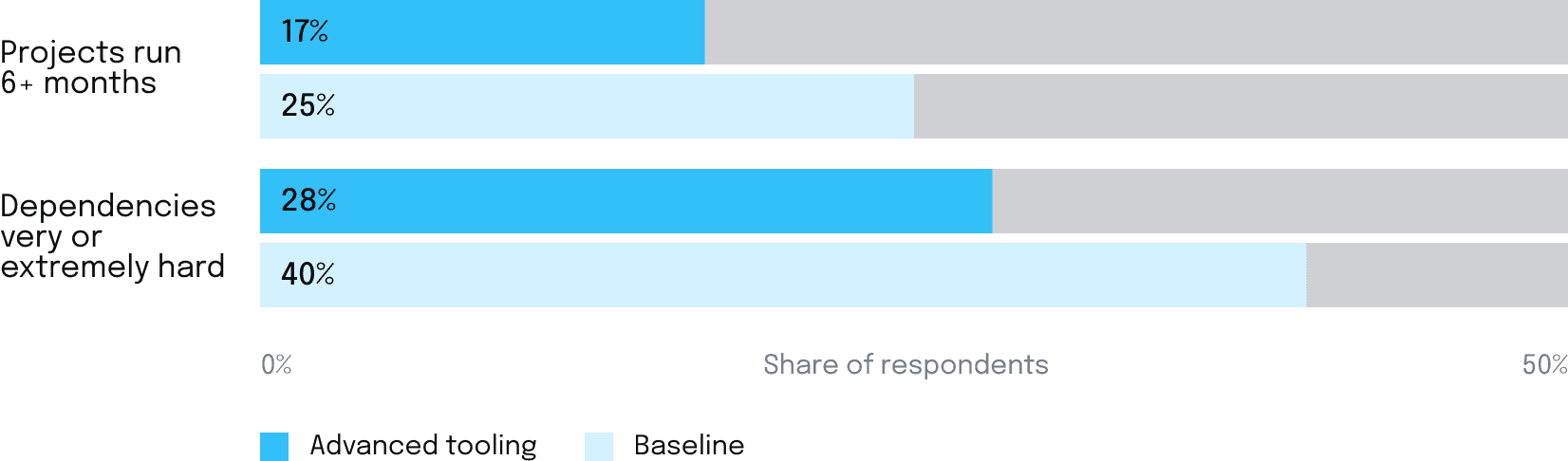
But how does that impact project duration and dependency management? They have a 7-percentage-point advantage in projects that run over six months, and are much less likely to struggle with cross-project dependencies.
Delivery outcomes and dependency management
These AI capabilities are valuable, and it turns out they are elusive as well.
Chapter seven: Valuable capabilities are elusive

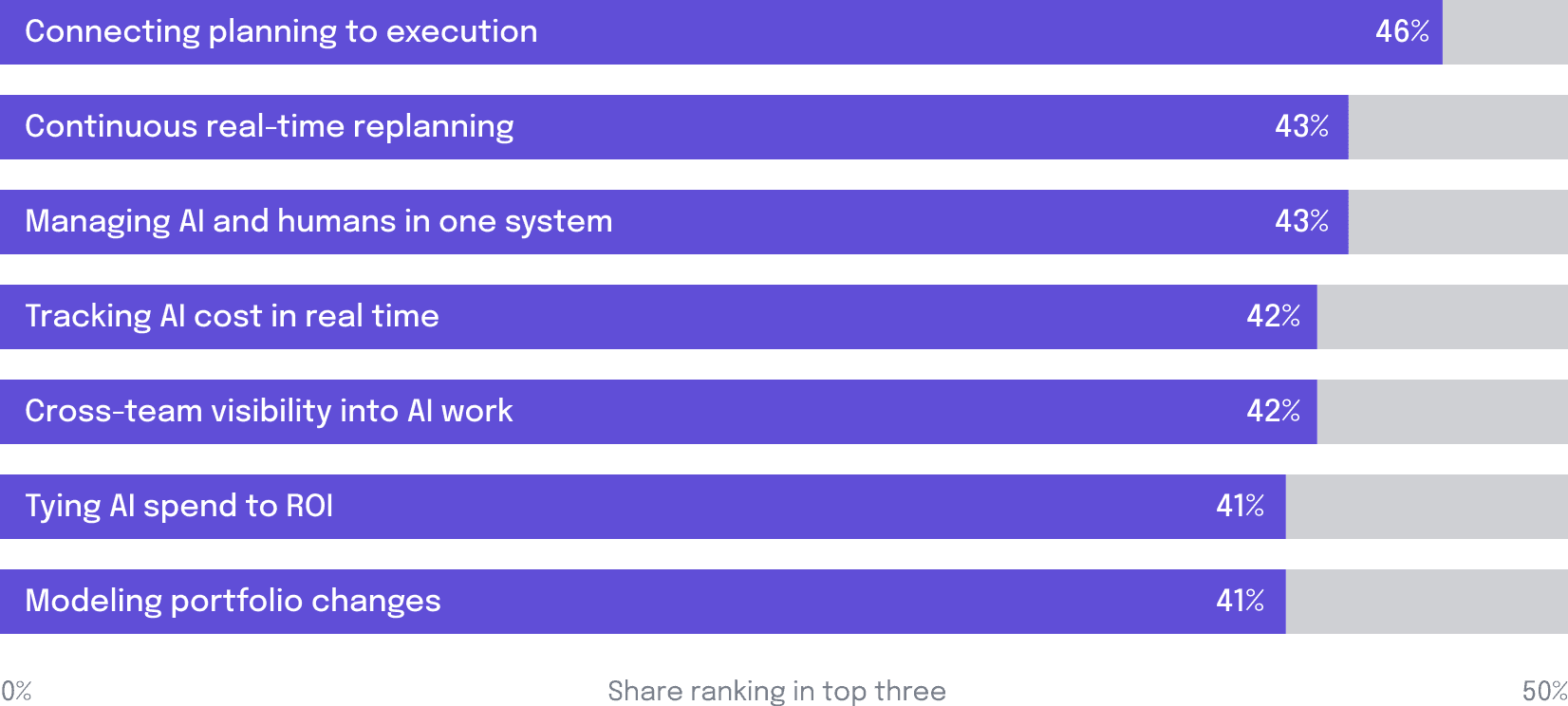
Across all respondents, it’s clear that planning leaders are looking for capabilities they don’t have yet.
Capabilities leaders value most, by share ranking each in their top three
Who already has a tool that already does each capability well
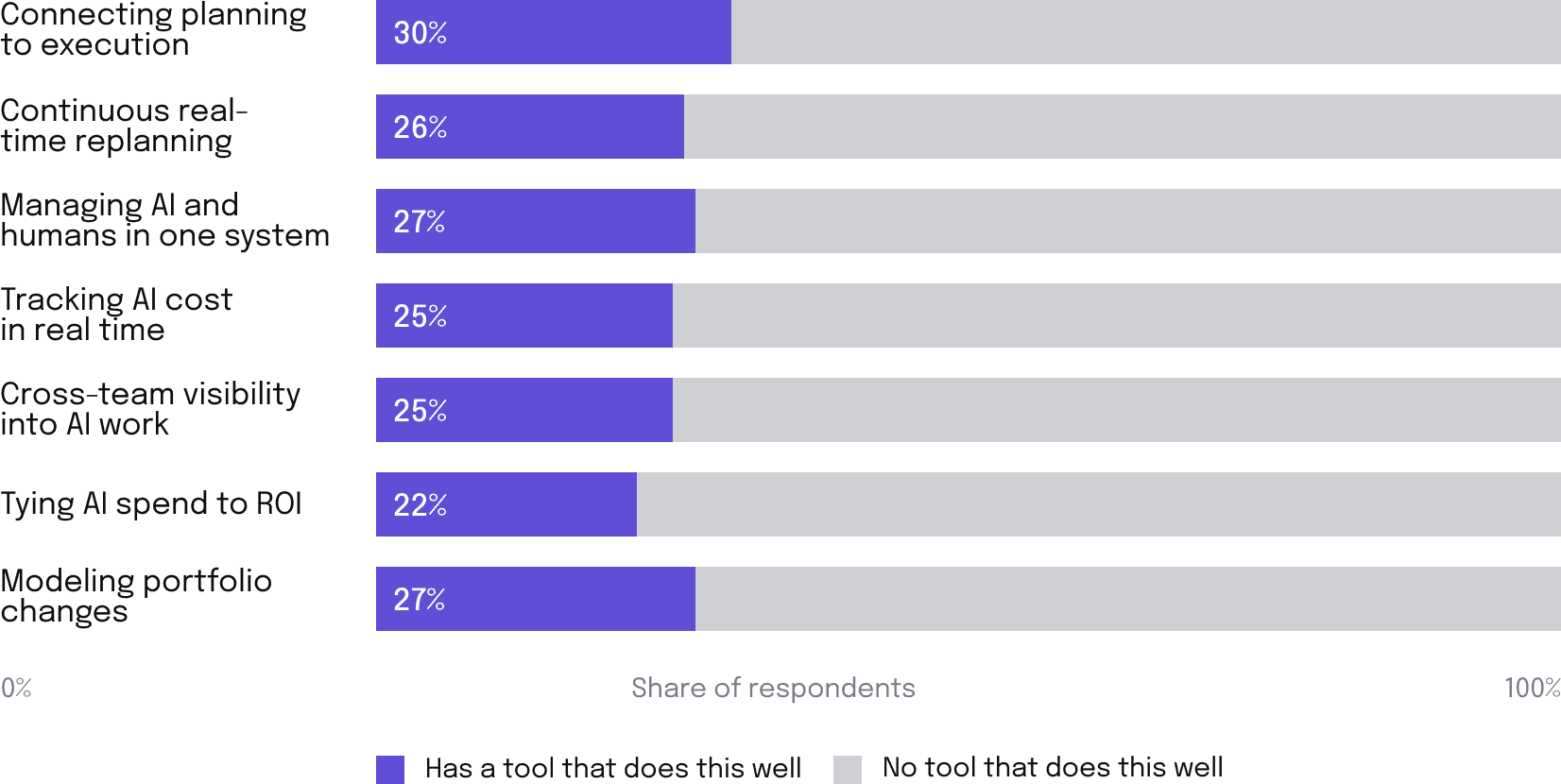
30% of leaders have a tool that connects strategic planning to work execution – the capability they rank most valuable. Seven in ten have no tool that does this.
Chapter eight: What leaders expect: Intelligent Portfolio Orchestration

One finding from this survey is that 100% of respondents use strategic planning and project management tools – yet they are not getting what they need.
Planning and portfolio leaders expect a new range of features that legacy Strategic Portfolio Management tools are simply not offering.
Outcomes leaders expect from an AI-ready platform
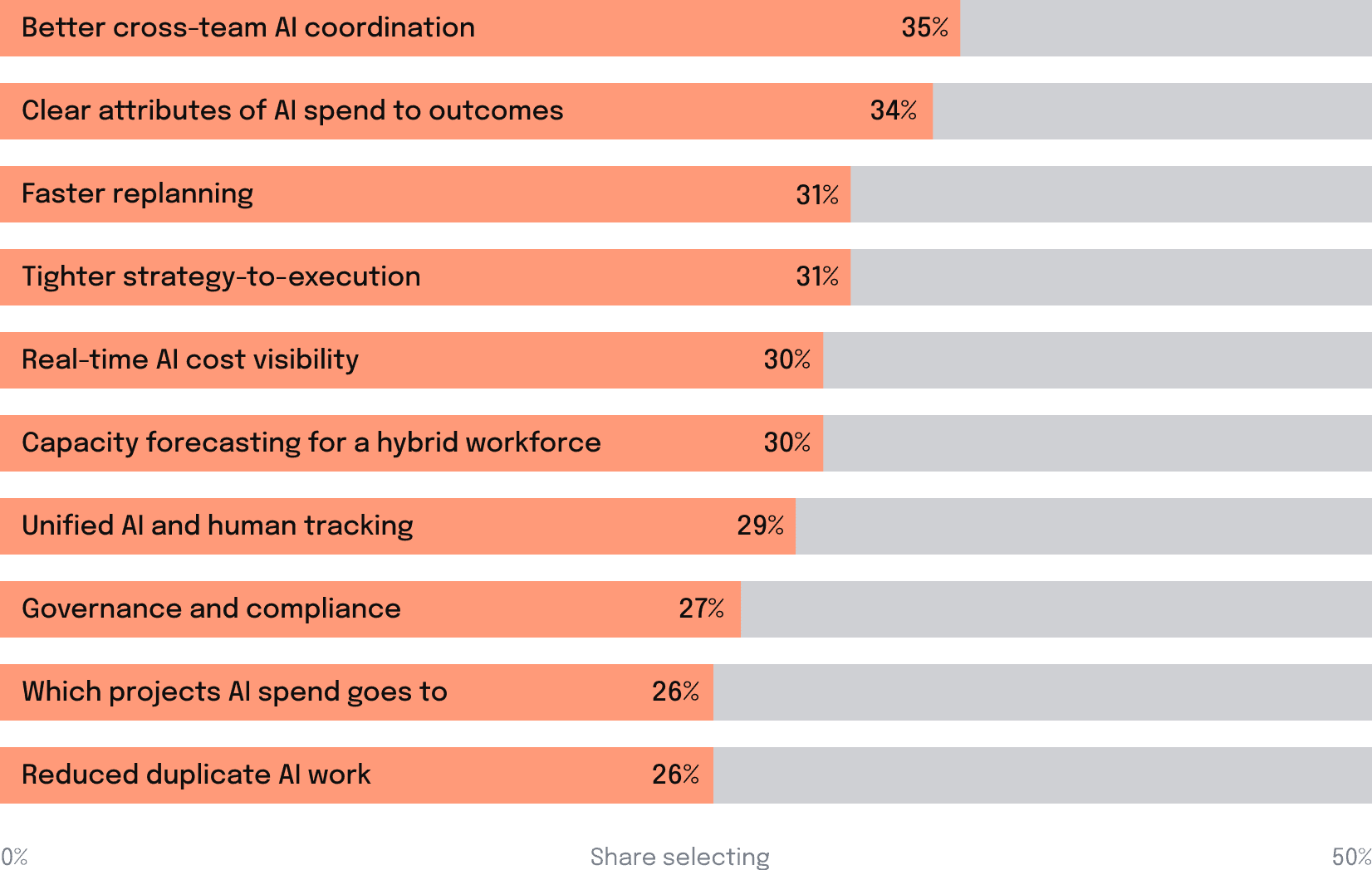
Less than one in three respondents have a tool that can manage humanAI teams (27%), continuously course-correct (26%), provide early warnings on drift (25%), or connect planning to execution (30%).
What leaders expect vs what they already have
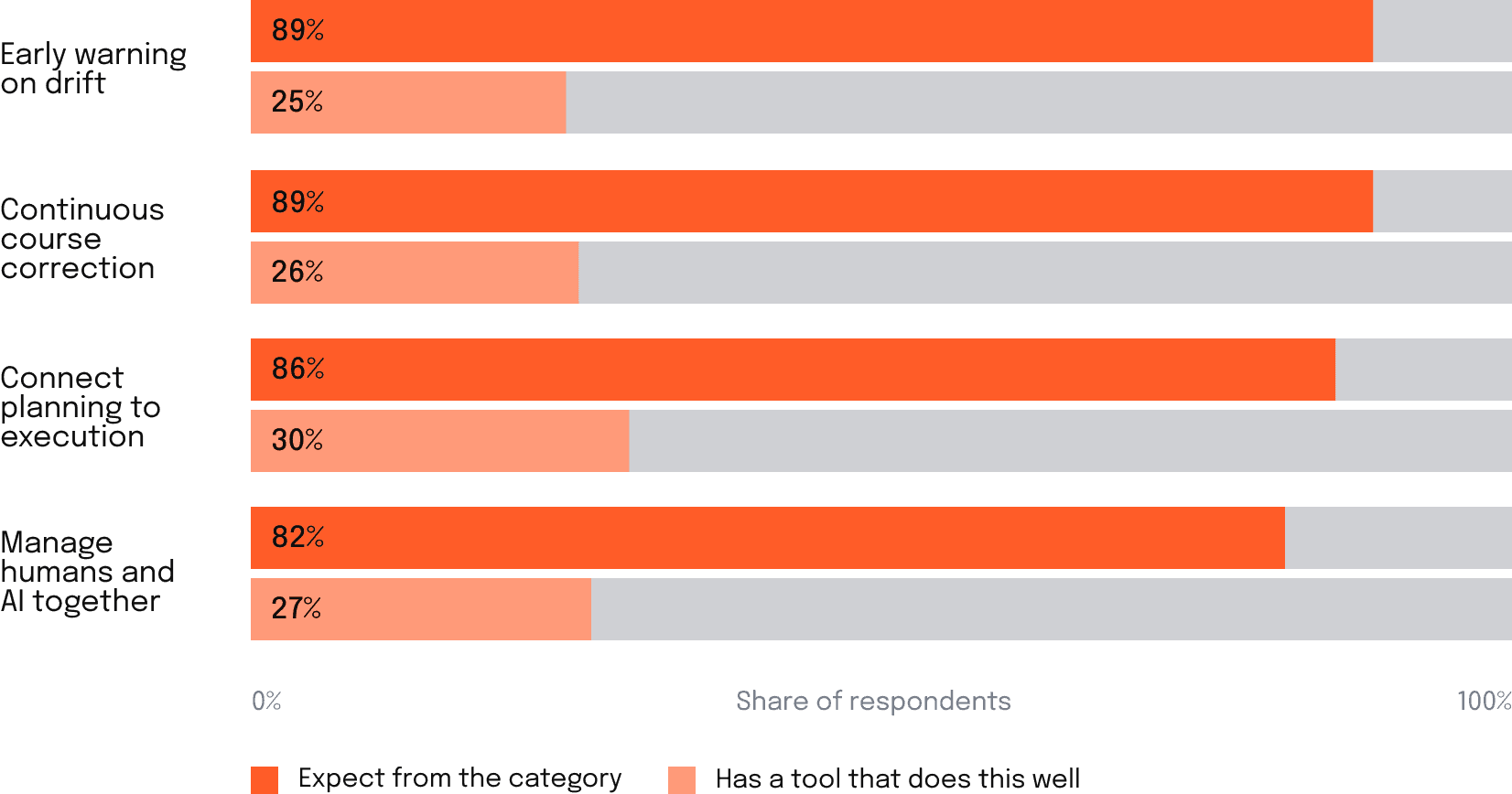
89% expect a platform in this category to tell them how to fix strategic drift, not just show a red dashboard – prescriptive guidance that today’s tools don’t offer.
Intelligent Portfolio Orchestration
Intelligent Portfolio Orchestration is the discipline that aligns strategy, investment, and execution in real time, catching strategic drift before it compounds. It keeps people and agents moving as one system with continuous alignment, recommended fixes, and human-in-the-loop governance.
Project and portfolio management tooling will never be the same
We set out to survey planning leaders who are rolling out AI across their delivery and strategy work.
We found that simply using AI isn’t enough. Some teams deliver more projects, faster. Others manage complex portfolios more effectively
The teams that have rolled out all seven AI capabilities sit far ahead of the rest. In 2026, Tempo is bringing a platform to market built around those seven capabilities.
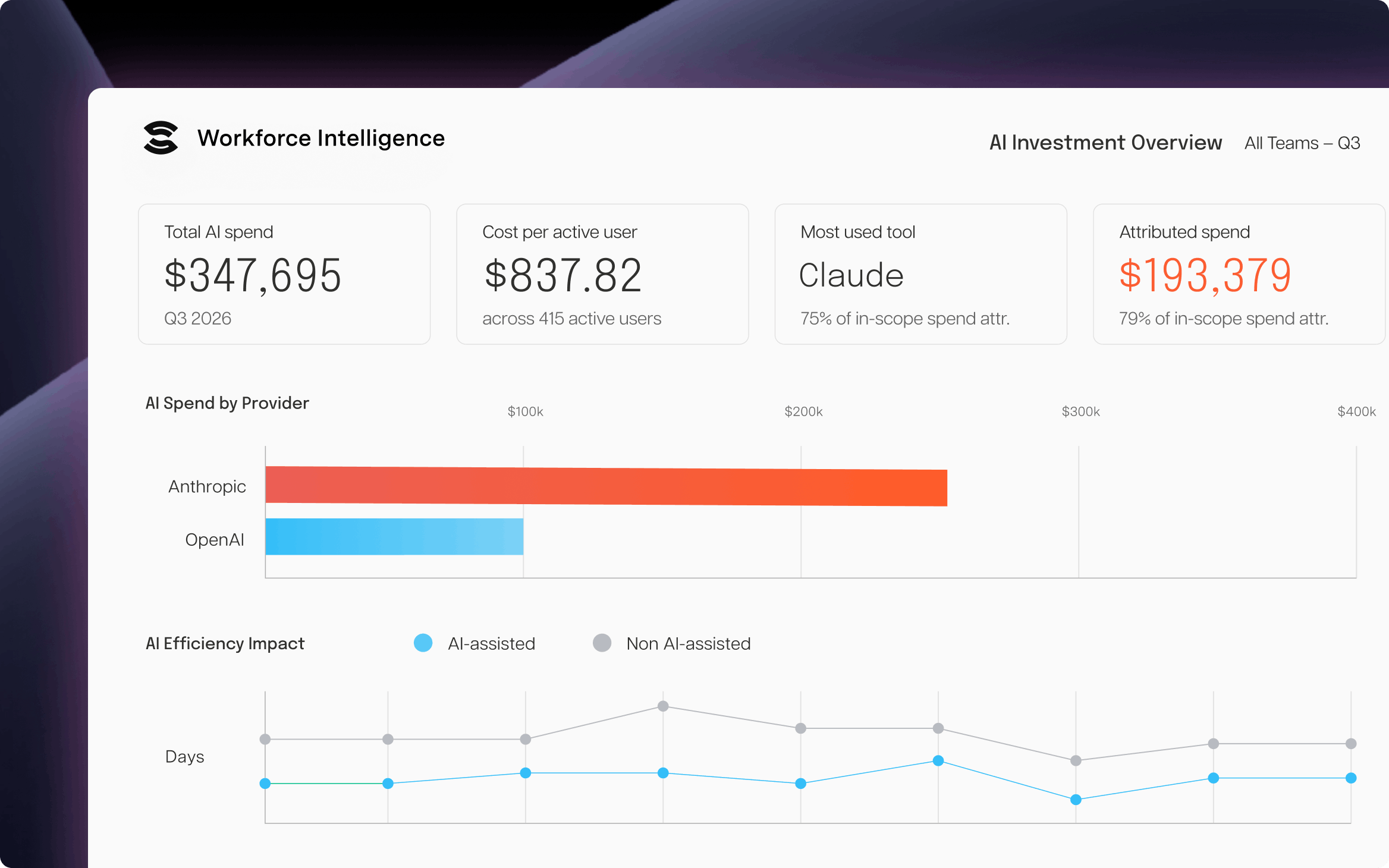
Just 18 of the 300 teams we surveyed have all of them live, and they outperform peers who were themselves selected as the best of the best. Before that platform goes live, Tempo is offering a new tool to attribute human spend against AI spend in Jira.
"Legacy SPM tools weren’t built for continuous, agentic throughput in modern delivery. We’re closing the decision intelligence loop with an AI-native platform that connects strategy to real-time execution – so planning leaders can catch drift early, orchestrate proactive fixes, and ensure funded initiatives actually deliver."
Kevin Nanney Chief Product Officer at Tempo Software
Sample composition
Workforce Intelligence
See the true value and costs of your AI tools
The only solution that ties AI vendor spend to the teams, epics, and Jira issues it supported.
Start a Free Trial