Guide your development team to success using agile sprint goals. Establish goal-setting strategies to increase team productivity and improve outcomes.
Optimize agile workflows with Structure’s sprint planner. Boost team alignment, productivity, and Jira task management for seamless sprint success.

Sprint planning is the meeting where a Scrum team decides which backlog items to complete in the next sprint and how they'll do it. Done well, it keeps stakeholders aligned, sharpens deliverables, and protects the team from overcommitting. Skip it, and misalignment and wasted output follow.
An agile Scrum framework can lift team productivity by more than 200%, and much of that gain traces back to disciplined sprint planning. The right process — and the right tooling — turns planning from a status meeting into the moment the sprint gets set up to succeed.
Sprint planning is the working session at the start of each sprint where the Scrum team selects backlog items, breaks them into tasks, and commits to a sprint goal. A product backlog usually holds months of work — far more than developers can finish in one sprint — so the team narrows the scope to what they can realistically deliver.
A sprint is a one- to four-week period during which the development team pursues a narrow set of short-term goals. Sprints demand careful planning to stay efficient and hit their targets.
Key participants:
Product owner
Scrum Master
Developers
Before the meeting, the product owner refines backlog items into user stories with clear acceptance criteria. In the meeting, they present each story to the developers. Once the team understands a story, they discuss implementation, assign story points, and add it to the sprint backlog. The loop repeats until developers commit to a realistic number of stories.
The Scrum framework has five events: sprint planning, the sprint, daily Scrum, sprint review, and sprint retrospective. Sprint planning is covered in depth below; the others give it context.
Each day of the sprint, the development team holds a timeboxed meeting of 15 minutes or less. Developers discuss progress toward the sprint goal, surface blockers, and plan the next 24 hours.
At the end of the sprint, the Scrum team runs a collaborative feedback session called a sprint review. It typically takes four hours, scaling with sprint length. The team inspects the working product increment and adapts the backlog to keep the product aligned with evolving needs.
Immediately after the sprint review, the team holds the sprint retrospective. It's timeboxed — up to three hours for a one-month sprint. The team inspects its own process and commits to improvements for the next cycle.
Sprint planning builds shared understanding, sharpens deliverables, and creates a feedback loop for continuous learning.
Enhances shared understanding: Stakeholders voice needs and concerns in the meeting. Developers get clarity on priorities; product owners gain insight into technical constraints and feasibility.
Improves deliverables: Breaking user stories into tasks with clear acceptance criteria cuts ambiguity. Teams focus on high-value features, scope creep drops, cycles accelerate, and outcomes become more reliable and customer-centric.
Facilitates retrospective learning: Lessons from prior sprints feed directly into the next plan, refining estimates and adapting the process over time.
Effective sprint planning depends on three ingredients — the goal, the participants, and the plan. Miss one and clarity, alignment, and delivery all suffer.
What: The product owner presents the sprint's primary goal and identifies the backlog items that support it.
Who: Both the product owner and developers must attend. The product owner clarifies business value; the team evaluates technical feasibility. Either party's absence causes misalignment.
How: Developers collaborate to outline the tasks needed to hit the goal. The plan emerges from a conversation that balances value against effort.
Scrum teams should leave with a defined sprint goal and a validated action plan — clear tasks, clear responsibilities, clear acceptance criteria.
Prioritize these steps before the meeting:
Confirm stakeholder attendance: Make sure every participant knows the time, location, and purpose of the meeting.
Align with the product roadmap: Review the roadmap to confirm the sprint supports broader strategic goals.
Prioritize the product backlog: Groom user stories so they're clear, well estimated, and properly ordered.
Analyze past sprint data: Look at average velocity, sprint completion rates, and defect resolution trends.
Assess team capacity: Document individual availability and adjust commitments to avoid overloading anyone.
Once these are done, prepare and distribute an agenda: objectives, time allocation, discussion topics, expected outcomes, and prep requirements.
These practices separate sprint planning that works from planning that drifts.
Backlog grooming — or refinement — organizes the backlog and preps it for planning. A healthy backlog is DEEP: detailed appropriately, estimated, emergent, and prioritized. Product owners should refine the backlog a few days before the planning meeting.
Remove outdated items: Regularly cut stories that no longer apply.
Detail top priorities: Define requirements clearly for high-priority items; leave lower-priority items lighter until they're up next.
Update estimates: Adjust estimates as new information emerges.
Break down large stories: Split oversized stories into smaller, actionable tasks.
Set a recurring meeting time in advance to avoid delays. Use the same day and time each sprint, confirmed with the team.
The sprint's length sets the meeting's length. The upper bound is eight hours for a one-month sprint; two-week sprints usually run two to four hours. Experienced teams often trim that further.
Developers frequently overcommit during sprint planning, which produces missed deadlines and compromised quality. These guidelines keep commitments honest:
Review past sprint performance: Analyze velocity and capacity from recent sprints.
Account for nondevelopment tasks: Include time for meetings, testing, bug fixes, and other non-build work.
Break work into smaller increments: Keep tasks small enough to finish inside the sprint without overextending.
Incorporate buffer time: Reserve roughly 15–20% of sprint capacity for unforeseen work.
Use relative estimation techniques: Story points estimate effort by complexity, effort, and risk. T-shirt sizing groups tasks by size (XS, S, M, L, XL).
Tempo's Structure PPM is an adaptable project and portfolio management solution built into Jira. It streamlines high-level workflows, improves collaboration, and aligns teams around strategic goals.
With Structure, project managers can:
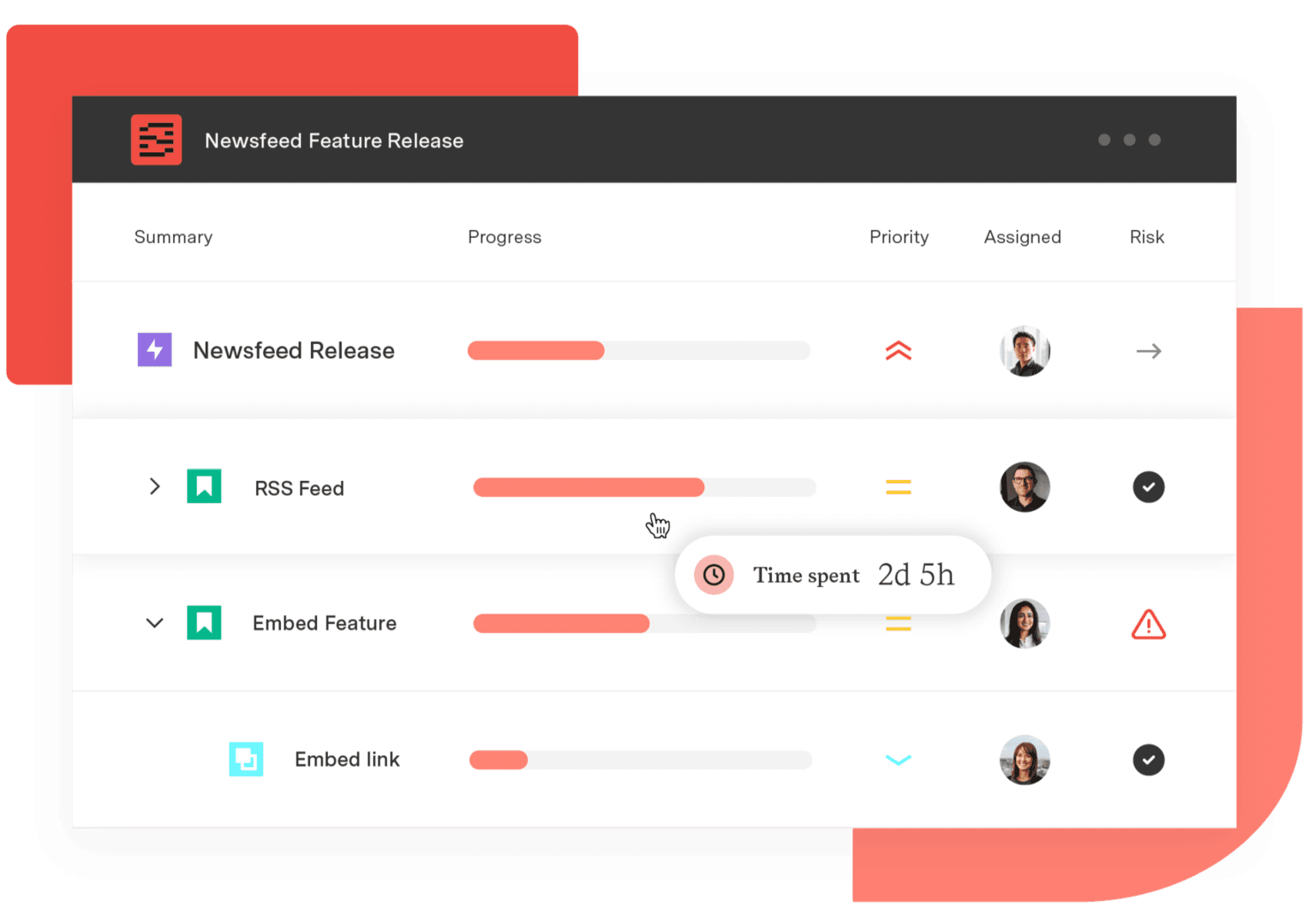
Establish a clear framework: Build a structure to organize and visualize sprints and tasks in one unified view.
Incorporate data: Enrich the sprint planning structure with task status, assignees, priorities, and other critical fields.
Assign tasks: Use drag-and-drop to allocate work to sprints and balance the load across the team.
Structure PPM keeps Scrum teams aligned. As the number one project portfolio management software for Jira, it connects work across projects, teams, and methods into a single view — the foundation for smarter sprint planning.
Ready to upgrade your project management and get more out of agile? Visit our website to learn more and start your free trial today.
Structure PPM
Manage products, projects, and programs in a single spreadsheet-like view. By providing a clear, real-time view of project progress and resource allocation, Structure helps teams meet deadlines and adapt swiftly to changing priorities.
Start a Free TrialCouldn't find what you need?Go to our documentation
The Scrum Master’s primary responsibility in sprint planning is to facilitate the event. This means helping the team collaborate effectively while ensuring they stay within the timebox, among other meeting-specific responsibilities.
Outside the sprint planning meeting, Scrum Masters work closely with stakeholders in multiple capacities: facilitating backlog refinement sessions, resolving dependencies or impediments, and more.
Sprint planning facilitates shared understanding among key teams. It achieves this by aligning the Scrum team on the sprint goal, clarifying scope through collaborative discussion of user stories, and breaking down tasks to ensure everyone agrees on deliverables, priorities, and dependencies.
The sprint backlog consists of product backlog items that the Scrum team selects during sprint planning. Developers break these items into actionable tasks and formulate a plan to deliver the increment and meet the sprint goal.
More generally, the sprint backlog prevents scope creep by clearly defining the agreed-upon work for the sprint and limiting the introduction of new tasks or changes. Additional work must be formally reviewed and accepted by the team.
Guide your development team to success using agile sprint goals. Establish goal-setting strategies to increase team productivity and improve outcomes.

Boost your Agile team’s accuracy with Planning Poker. Discover how this gamified estimation technique can improve forecasting and sprint planning.

Learn how to run the five core agile ceremonies and see how PMO leaders connect them to SAFe and a hybrid portfolio view

Agile frameworks streamline project development without sacrificing quality. Discover why agile workflows are so popular and how to start using them.

Learn how to use velocity charts in Jira to track progress, improve sprint planning & make data-driven decisions for better agile project management.
The Jira Sprint Report supports and facilitates the micro-planning that should be happening in your daily stand-ups, enabling you to stay on track.

Agile in a textbook and in implementation are not the same. It takes putting agile theory into practice and optimizing processes within the team.

Business teams going agile will need to ascribe to one of the agile methodologies. Here we look at the two most common: Scrum and Kanban.

Using Tempo Planner to streamline the management of teams and resources to find available team members and maximize your resource utilization.