Adaptive project management is how fast you re-plan when reality moves, not which method your teams run. A portfolio guide for PMOs
How to run waterfall milestones and agile sprints in one governed portfolio

Key Takeaways
Hybrid project management pairs waterfall's fixed plan with agile's iterative delivery: Plan the predictable parts, embrace sprints for the uncertain ones
Choose the delivery method by workstream. Fixed or regulated work can stay predictive, while evolving customer-facing work can use agile delivery
The hard part is governing several methods at once, so hybrid works only when sprints and milestones share one grid
Hybrid project management combines predictive and adaptive delivery within the same initiative or portfolio.
The predictive part fixes scope, milestones, and approvals upfront. The adaptive part delivers in shorter cycles, so teams can adjust as requirements change.
This matters when one program contains different types of work. A product launch may need waterfall for hardware certification and agile for customer-facing features that change with feedback. Engineering may run sprints, while compliance follows fixed reviews and approval dates.
For the PMO, the challenge is not choosing one method for every team. The real challenge is governing those methods together, so milestones, sprint progress, dependencies, and risks roll up into one portfolio view.
This guide explains the most common hybrid models and how to govern agile and waterfall in one portfolio.
Hybrid project management can take several forms. The first three models deliberately combine practices. The fourth shows what happens when teams combine them without changing how the work is governed.
Teams may retain planning sessions and reviews, but they use work-in-progress limits to control how much work enters the system. Instead of filling a fixed sprint backlog, the team starts another item when capacity becomes available. This is a good model for teams that need regular planning but also receive work that cannot wait for the next sprint.
Here, the organization sets the plan and budget up front, the delivery team works through Scrum sprints, and the project reverts to a fixed process for approval and release. The PMO therefore governs sprint activity inside a program that remains accountable to agreed dates and budgets.
Gartner coined the model bimodal roadmap and uses Mode 1 for predictable work that follows an established approach. Mode 2 handles exploratory work where teams test ideas and adapt as they learn.
Unlike Water-Scrum-Fall, the two modes usually remain separate across teams or workstreams rather than being combined into one delivery sequence. The PMO still has to govern both within the same portfolio, even though they follow different plans and reporting cadences.
Teams run standups and sprints, but fixed scope, sequential handoffs, and approval stages still control delivery. As we explain in our guide to agile practices, ceremonies alone don’t make a process adaptive when teams have no room to replan. Agilefall is therefore an accidental hybrid rather than a model to follow.
The important distinction is where predictive control ends and adaptive delivery begins. An intentional hybrid defines that boundary for each workstream. An accidental hybrid leaves teams following one method while leadership governs them through another.
The models also differ in how they treat planning, scope, and delivery. The comparison below shows where waterfall, agile, and hybrid place those controls.
The table below compares how waterfall, agile, and hybrid handle planning, scope, and delivery.
| Waterfall (predictive) | Agile (adaptive) | Hybrid |
Planning | Full plan set upfront | Planned one iteration at a time | Fixed at the phase level and flexible within selected workstreams |
Scope | Defined upfront and changed through formal requests | Expected to evolve | Fixed where required and adaptable elsewhere |
Delivery cadence | One sequence of phases | Short, repeating iterations | Milestones and sprints within the same initiative |
Documentation | Detailed and tied to approvals | Limited to what supports delivery | Detailed where governance requires it and lighter elsewhere |
Best-fit work | Fixed, regulated, and well understood | Uncertain and likely to change | Initiatives that contain both types of work |
Main risk | A late change can disrupt the full plan | The long-term timeline can become unclear | Different planning and reporting cadences can fall out of sync |
For a fuller comparison, see our guides to waterfall vs agile and traditional project management.
Use hybrid when one initiative contains fixed work and work that must adapt during delivery. A regulatory approval may need a predictive plan, while a customer-facing feature may change as teams collect feedback.
Hybrid is most useful when:
Some requirements and deadlines cannot move
Other parts of the work need regular testing and adjustment
Several teams use different delivery methods within the same program
Skip hybrid when one method already fits the entire project. A small product team may work more effectively in pure agile. A compliance migration with a fixed scope and regulatory deadline may be better suited to waterfall.
The point is to deliberately choose the method for each workstream. Adding both methods where one would work creates more planning and reporting without improving delivery.
Agile and waterfall teams measure progress differently. A Scrum team may report velocity, while a waterfall workstream reports progress against milestones. A PMO needs both to roll up through one portfolio structure.
That shared view matters. Tempo’s 2026 SPM report found that 82% of organizations with fully integrated processes had good or complete project visibility, compared with 37% overall. Those organizations also reported a 14-percentage-point higher rate of projects delivering measurable ROI or strategic value.
Teams can keep the methodology that fits their work. The PMO still needs one way to organize and report progress above the team level.
In practice, that starts with a hierarchy that can hold sprint work, fixed milestones, and dependencies in the same view.
Methodology-agnostic PPM software allows agile and waterfall teams to retain their delivery processes while the PMO applies one portfolio structure above them.
You can start with Tempo Structure PPM, a project and portfolio management app for organizing work across Jira projects. It helps you create adaptable, user-defined hierarchies from Jira issues, presented in a spreadsheet-like grid.
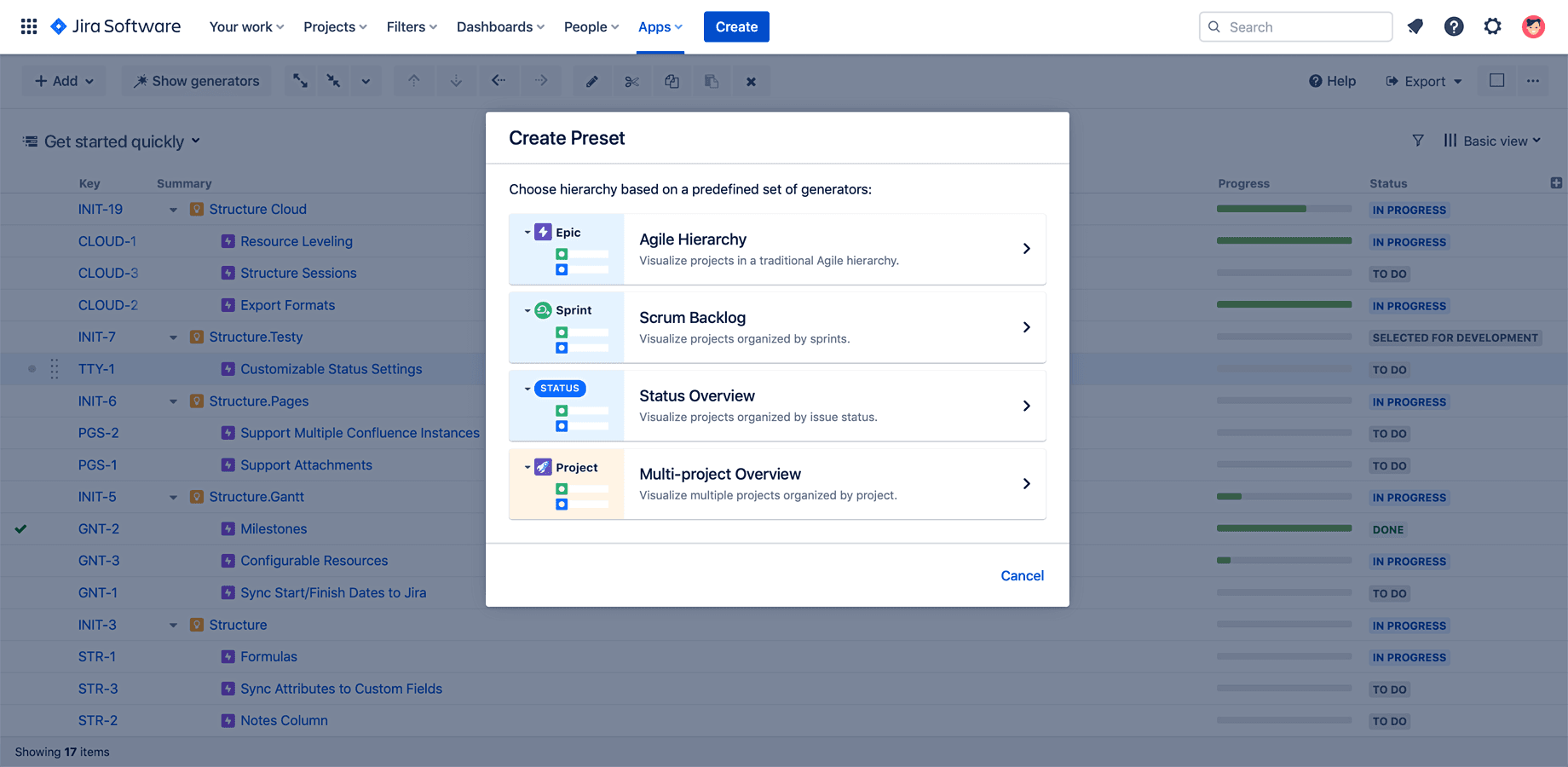
You can organize individual tasks and epics under projects, programs, and portfolio priorities without asking teams to change how they manage delivery. A Scrum team’s sprint can sit beside a waterfall workstream’s milestones in the same hierarchy.
You can also use custom formulas and rollups to calculate progress from the Jira records beneath each initiative. When an executive questions a portfolio figure, you can trace it back to the underlying milestone, sprint, or Jira issue.
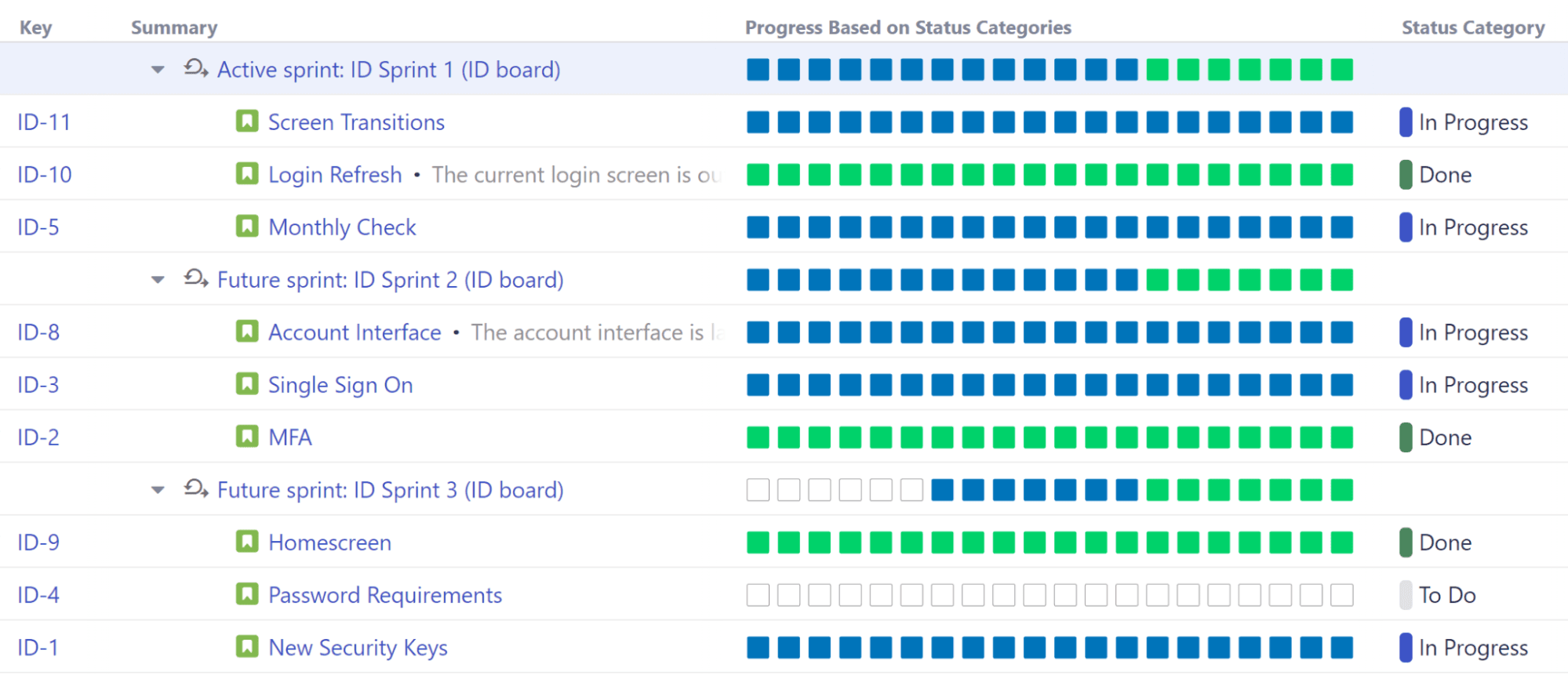
Tempo’s Gantt Charts for Structure PPM is also a timeline and dependency-planning extension for Structure PPM. It uses the work already organized in a Structure hierarchy to create a Gantt chart from live Jira data.
You can place iterative sprint work alongside fixed milestones and sequential phases within the same project timeline. This makes it easier to see whether a delayed sprint or approval affects a dependent workstream or delivery date.
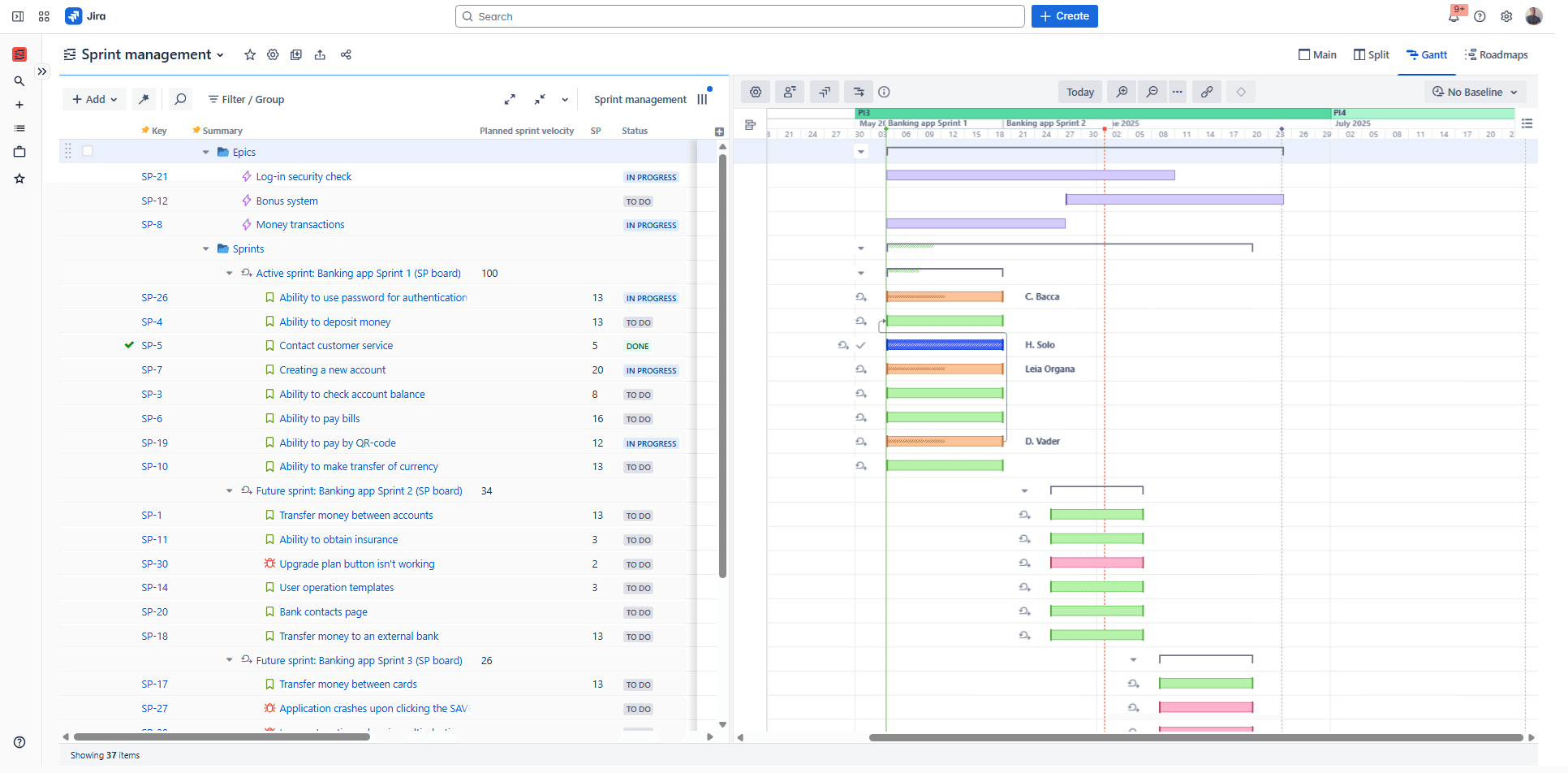
With these, you can then use separate project configurations for waterfall and hybrid projects while retaining cross-project visibility.
A phase gate is a formal review that determines whether a project can move into its next phase. In a hybrid project, agile delivery may take place between two of these gates.
For example, a security review may approve the project before development begins. The engineering team then completes the build through sprints before the work returns to a fixed release and approval process.
Coordination problems often appear during these transitions. A team may finish its sprint while the approval required for the next phase remains outstanding. A delay in one workstream can then affect a milestone owned by another team.
Structure PPM can place gate status, sprint progress, and dependencies within the same hierarchy. You can see how a delayed approval affects the wider plan without reconciling separate team reports.
A shared status structure also allows teams to report through the same portfolio terms, even when their delivery methods differ.
Agile and waterfall teams may estimate work differently. One team may use story points, while another plans fixed task durations. The PMO still needs to determine whether the available people can support both plans.
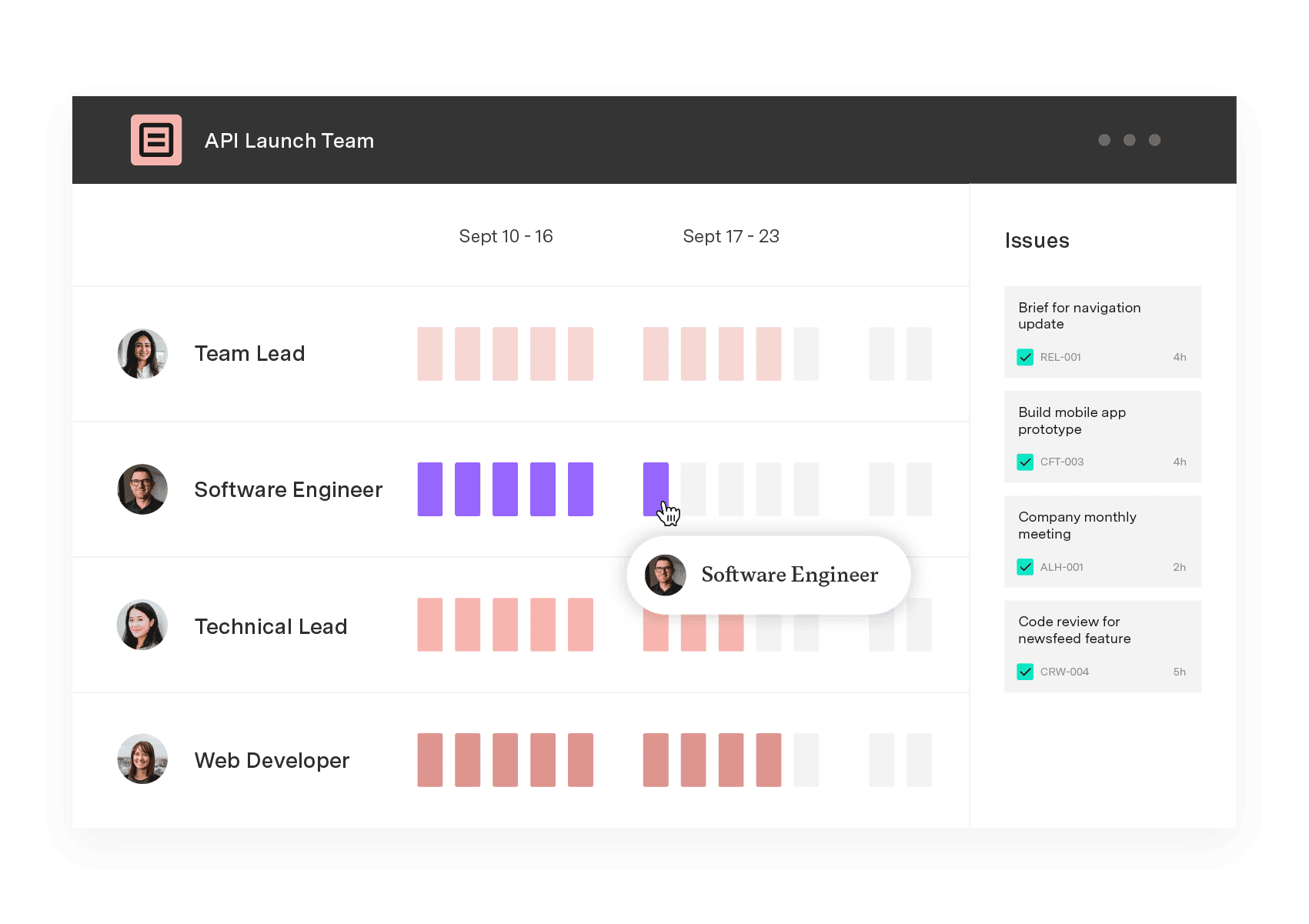
Tempo Capacity Planner is a Jira resource and capacity planning app by Tempo that connects planned work with information about team availability, roles, and skills.
You can review the demand created by sprints and fixed project phases before committing to their delivery dates. When priorities or timelines change, Capacity Planner shows how the revised plan affects team allocation.
This helps you identify overallocated teams during planning rather than after a sprint or milestone has already fallen behind.
Agile and waterfall teams also report progress differently. One may use velocity or throughput, while the other reports progress against milestones. Neither measure shows finance how much labor the work consumed.
Tempo Timesheets is a Jira time-tracking and reporting app that helps record time against the Jira issue where the work takes place, creating a consistent record of actual effort across both delivery methods.
You can compare logged effort with the work organized in Structure PPM. This shows how much time teams spent on a project, regardless of whether they completed the work through sprints or predictive phases.
Finance can also trace labor costs back to the tasks and deliverables that consumed them. That evidence supports budgeting, forecasting, and capitalization reviews without requiring the PMO to reconstruct actual effort in a separate spreadsheet.
Structure PPM remains the central portfolio view. Capacity Planner adds planned resource demand, while Timesheets adds actual effort from the Jira work beneath the plan. A PMO can adopt either product when it needs more capacity or cost context without replacing the portfolio structure teams already use.
Hybrid gives a PMO more flexibility than using one methodology across the entire portfolio. However, that flexibility creates additional governance work.
Benefits
The right method can support each workstream: Fixed commitments can follow a predictive plan, while uncertain work can adapt during delivery
Teams can retain established delivery practices: The PMO doesn’t have to move every team to agile or waterfall
Portfolio plans can include both delivery styles: Fixed milestones and iterative work can contribute to the same program objectives
Trade-offs
Reporting cadences may differ: Sprint reviews, approval dates, and portfolio updates don’t automatically align
Documentation can increase: Teams may maintain agile delivery records alongside evidence required for audits or formal approvals
Governance responsibilities must be explicit: The PMO must define which method governs each workstream and how progress rolls up to the portfolio
Without those decisions, hybrid project management can turn into Agilefall. Teams may perform agile ceremonies while fixed scope and waterfall approvals continue to control delivery.
Hybrid project management allows each workstream to use the delivery method that fits its requirements. The PMO must then apply consistent governance across those methods.
That means keeping sprint progress, fixed milestones, dependencies, and risks visible within the same portfolio structure. Teams can continue working through the processes that suit them, while portfolio leaders review progress in a single view.
Explore Structure PPM to see how a methodology-agnostic Jira hierarchy can bring waterfall milestones and agile sprints into one governed portfolio view.
Capacity Planner
Capacity Planner is the only tool in the Atlassian Marketplace that allows planning for multiple resources on one issue. Users can customize the UI to include their existing Jira issues and projects.
Start a Free TrialCouldn't find what you need?Go to our documentation
No. Hybrid project management is a deliberate combination of predictive and adaptive practices rather than one prescribed framework. The combination can vary by phase or workstream. A PMO must define where fixed controls apply, where teams can adapt, and how both types of work report progress.
No. Hybrid project management describes the methods used to deliver the work. Adaptive project management describes how frequently plans change as teams receive new information. A project can therefore be both hybrid and adaptive. It may combine waterfall and agile practices while revising its wider plan at regular intervals.
Disciplined Agile is a process-decision toolkit that helps teams choose practices based on their circumstances. Hybrid project management is one possible result of that decision. A team may use Disciplined Agile to select a combination of predictive, agile, and lean practices, but they aren’t synonymous.
Measure each workstream using metrics suited to its delivery method. Predictive work may use milestone, schedule, and budget variance, while adaptive work may use throughput or sprint progress. The PMO can then roll those measures into a shared portfolio status covering progress, dependencies, and risk. This preserves the context behind each workstream instead of forcing every team to report through one delivery metric.
Yes. Agile teams can manage iterative work through Scrum or Kanban boards, while predictive workstreams use sequential workflows, versions, dates, and dependencies. The same Jira issues can then contribute to cross-project reporting. Structure PPM organizes both types of work within one portfolio hierarchy, while Gantt Charts for Structure PPM place sprints, phases, and milestones on the same timeline.
Adaptive project management is how fast you re-plan when reality moves, not which method your teams run. A portfolio guide for PMOs

Learn how to run the five core agile ceremonies and see how PMO leaders connect them to SAFe and a hybrid portfolio view

Discover different types of project management methodologies and learn how to choose the best one for your project.

Yes, Jira works for waterfall. Learn how to configure native workflows, Advanced Roadmaps, and Gantt Charts to run sequential or hybrid projects.

There are pros and cons on both sides of the waterfall versus agile divide. Here’s how to choose the right methodology for your project.

What is traditional project management? Discover the tools of the project management trade and whether they have a place in your current practice.
Explore top tools and strategies to master website project management. Track progress, boost team collaboration and deliver high-quality sites on time

When you can't see your portfolio clearly, the consequences ripple through every level of the organization.

There are clear advantages to program management: Visibility, dependency control, resource alignment. So how do you implement these capabilities?