Kanban, Scrum, Scrumban – the differences, challenges and solutions
Kanban, scrum, and scrumban each come with real trade-offs. Here’s how to pick the right method and avoid the most common implementation failures.


Key Takeaways
Kanban suits steady flow work, scrum suits product teams with short feedback cycles and shifting requirements, and scrumban bridges the two when sprint commitments keep slipping.
No framework repairs broken culture. Cross-functional trust, honest retros, ceremonies, and metrics do the work that drives improvement.
Scrum is a sprint-based agile framework, kanban is a continuous-flow workflow management method, and scrumban is a hybrid of both. Which you choose depends on how predictable your team's incoming work is and how often that changes.
Every engineering manager inherits the kanban vs. scrum vs. scrumban debate and nobody really resolves it cleanly. Each framework has its strengths: Kanban is a flow-based method that visualizes work and caps WIP without prescribing roles or iterations.
Scrum is a cadence-based framework built around fixed sprints with defined roles and ritualized ceremonies.
Scrumban sits between them, keeping scrum's planning discipline while loosening sprint commitments so flow can take over when requirements get messy.
Choosing a method comes down to culture. Scrum can be a struggle for teams that can't tell leadership when an estimate is wrong – because sprint planning depends on honest capacity data. Kanban can be a challenge for teams that can't sustain WIP limits under pressure from a demanding PM because the whole system relies on that constraint.
A framework that works for one squad can be a disaster for another, and often it's hard to tell before the rollout. We'll dig into each framework and how to roll them out successfully.
What makes kanban work (or not)
Kanban is a flow-based framework built on three principles: Visualize the work, limit work in progress, and improve the flow continuously. It doesn't prescribe roles or fixed iteration lengths. No scrum master. No sprint ceremony. No required daily standup.
That flexibility is kanban's biggest strength. It's also its biggest liability.
When kanban is implemented well, the kanban board becomes a shared view of exactly where work stands and where it's stalled. Teams can see the bottlenecks. WIP limits force real conversations about priorities. Cycle times shrink because the team stops starting and starts finishing.
Organizations that get kanban right report shorter time to market, reduced development cost, and higher customer satisfaction. But those outcomes don't happen automatically. They happen when someone owns the implementation and measures it.
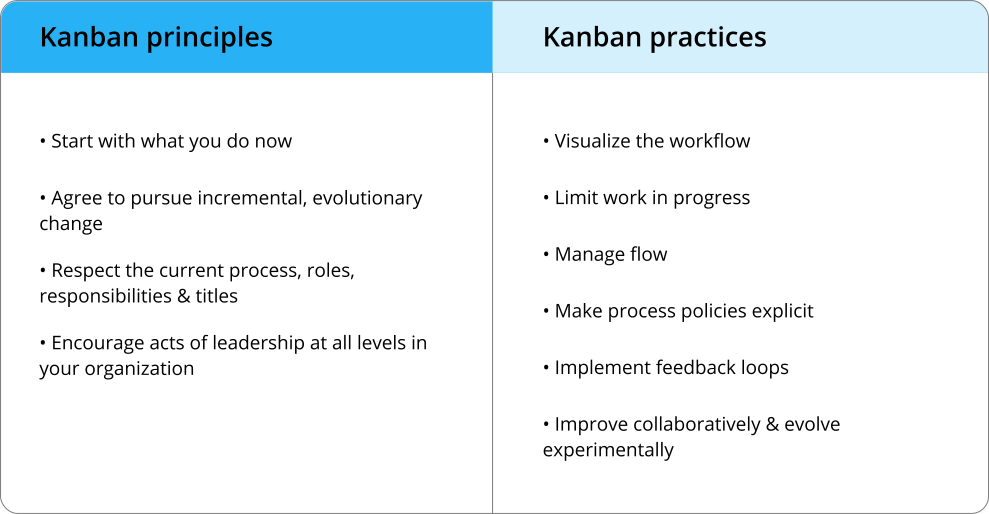
Kanban challenge 1: No built-in change management
Kanban isn't a change management framework. It tells you what to visualize and limit, but it doesn't tell you how to bring a skeptical organization along.
What works: Assign a kanban champion – someone, ideally a product manager, who tracks the metrics and looks for ways to improve the process. Then build an implementation strategy with specific success metrics before you move a single card.
Kanban metrics every product team should track
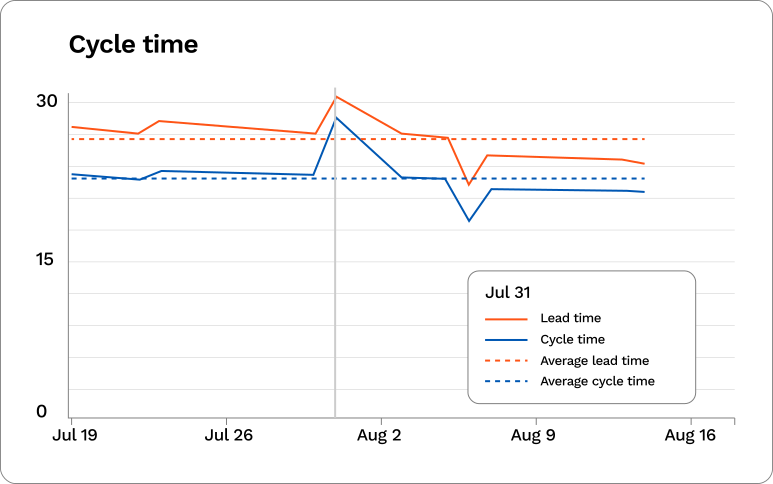
Two delivery time metrics matter most. Lead time is the full span from when a task enters your workflow to when it exits – idea to finished feature. This is what the customer experiences. Cycle time is the time a task spends in active work, from "in progress" to "done." Long cycle times point to unclear requirements or too much context switching.
Use a lead time and cycle time chart to see where work slows down across your entire workflow. The distinction matters: A long lead time with a short cycle time usually means the bottleneck is in queuing and handoffs, not execution.
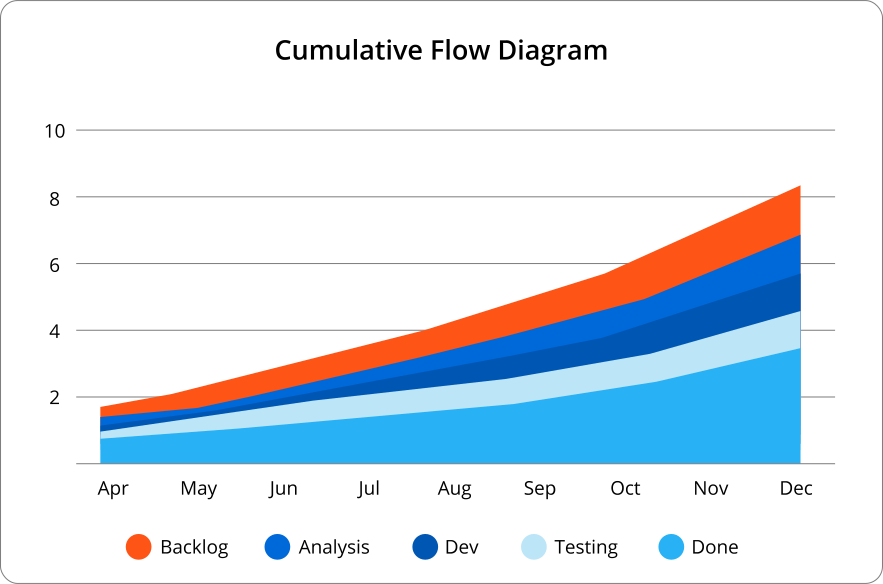
On the performance side, track throughput (the number of tasks completed in a given period – your team's actual output rate, not an estimate) and work in progress (WIP) – any work that's been started but hasn't yet delivered value. Tracking WIP against your limits shows whether your team is overloaded.
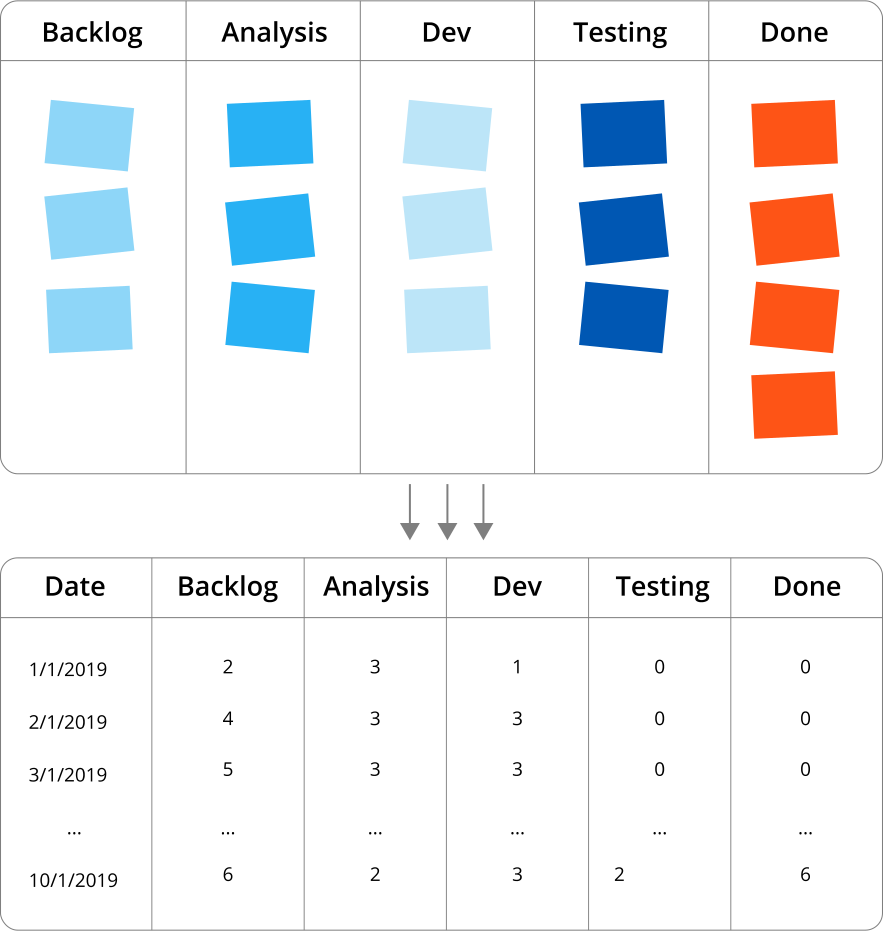
A cumulative flow diagram (CFD) visualizes all of these at once. Plot the number of tasks in each workflow stage over time. Healthy CFDs show bands of consistent width moving left to right. Widening bands signal a growing bottleneck.
Kanban challenge 2: Monotony kills motivation
Kanban doesn't prescribe ceremonies, and teams often interpret that as "no ceremonies." The result: teams go through the motions of moving cards, feel no ownership over the process, and disengage.
Add ceremonies when they're needed, not on a fixed cadence. Retrospectives, demos, and flow reviews don't need to be tied to sprint dates – they need to happen often enough to generate learning. Give teams room to identify what's not working and generate their own solutions. That ownership is what makes kanban stick long-term.
What makes scrum work (or not)
Scrum is a structured framework built around short delivery cycles called agile sprints, typically one to four weeks. It defines specific roles (product owner, development team, scrum master), specific artifacts (product backlog, sprint backlog, increment), and specific ceremonies (sprint planning, daily standup, sprint review, sprint retrospective).
That structure is scrum's advantage. Regular feedback loops, forced prioritization, visible delivery commitments. For product teams building software with evolving requirements and close user relationships, scrum is often the right fit.
It works best with smaller cross-functional teams, frequent access to stakeholders, requirements that change often, and a willingness to invest in training.
Scrum challenge: Resistance to change
Resistance is the most predictable obstacle in any scrum rollout. It comes from two places: people who don't understand the methodology, and people who understand it fine but don't want to give up how they've worked for years.
Here's what works:
Connect the change to outcomes. If the goal is faster delivery, show concretely how scrum's short cycles create earlier feedback. If the goal is better user satisfaction, show how sprint reviews bring user input into each cycle. Generic arguments for "agility" won't move anyone.
Define everything upfront. Ambiguity about roles, artifact ownership, and ceremony purpose is where most scrum adoptions fall apart. Make sure everyone agrees on what "done" means before the first sprint starts.
Set a scrum vision with OKRs. Describe the target state in measurable terms. Share it through multiple channels – not just the kickoff meeting.
Make people feel heard. Incorporate team feedback into how the process is shaped. When team members see their input reflected in the way ceremonies are run, they're more likely to invest in the outcome.
Document and celebrate what works. Scrum generates a lot of data. Use it. When velocity improves or a sprint review surfaces a real user insight, make that visible across the team.
This approach also addresses adjacent pitfalls: Lack of clarity on the methodology, loss of autonomy, misalignment on goals, and absence of short-term wins.
What scrum can achieve when done right
Teams that execute scrum well consistently report faster delivery cadence through regular small releases rather than large, high-risk launches. Risk drops because "fail early" iteration surfaces problems before shipping. Cross-team communication improves through shared sprint goals and daily standups. And user satisfaction goes up when users are involved early and often in the testing phase.
See also: Parabol's analysis of 300+ agile statistics.
Scrum vs. kanban: The real differences
Both frameworks are adaptable, use visualization to improve transparency, and encourage teams to own their process. The similarities end there.
Scrum is an end-to-end product development model. It redefines how teams are structured, how work is planned, and how results are reviewed. Kanban doesn't ask for any of that. It asks teams to map their existing workflow, limit what's in progress at any stage, and improve from there.
In Jira, this often surfaces as the question of a scrum board vs. a kanban board – which reflects the underlying difference in how each framework thinks about time and commitment. Scrum commits to a fixed scope for a sprint. Kanban maintains a continuous flow with no sprint boundary. This is also what teams are asking when they look up scrum vs. kanban for non-software teams.
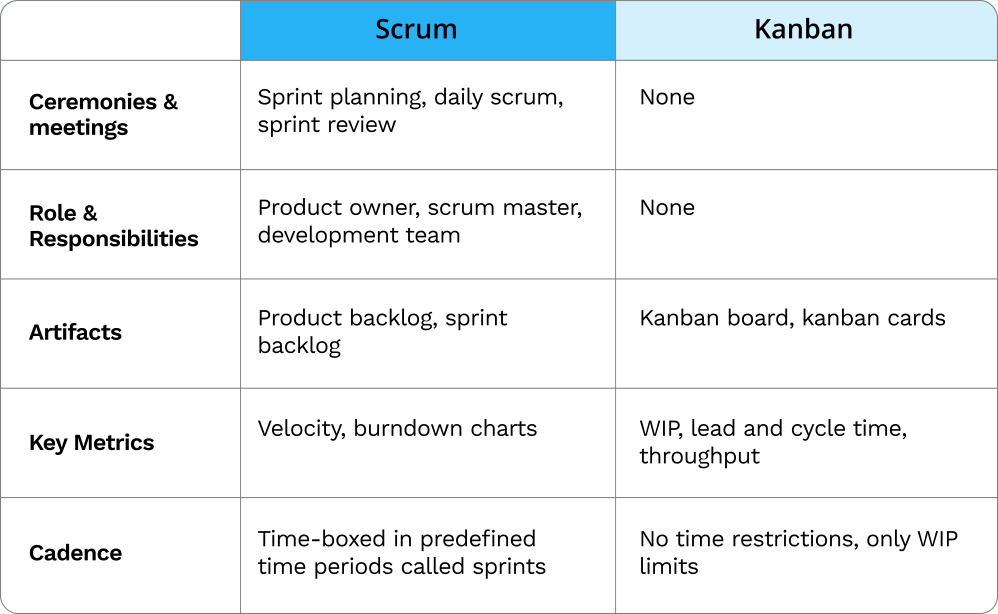
The key practical differences:
Teams that look at the two lists often notice something: Scrum and kanban are complementary. Where scrum is silent – like on how to visualize the sprint board – kanban offers tools. Where kanban is loose – like on planning cadence – scrum provides structure.
Dimension | Scrum | Kanban | Scrumban |
|---|---|---|---|
Planning cadence | Per sprint | Continuous, pull-based | On-demand, triggered by flow |
Time boundaries | Fixed sprint length (1–4 weeks) | None | None; uses WIP limits instead |
Roles | Product owner, scrum master, dev team | No prescribed roles | Optional; usually keeps product owner |
WIP control | Via sprint capacity and velocity | Via explicit WIP limits | Via explicit WIP limits |
Primary metrics | Velocity, sprint completion | Lead time, cycle time, throughput | Lead time, cycle time, throughput |
Change tolerance | Limited during a sprint | Any time | Any time |
Scrumban: When neither framework fully fits
Scrumban combines scrum's planning discipline with kanban's continuous-flow approach. It started as a transitional methodology for teams moving away from scrum, but it's become a legitimate framework in its own right – especially for teams managing a mix of project-based and operational work.
Who should use scrumban
Scrumban makes sense for a few types of teams:
Scrum teams with persistent sprint overload. If your team regularly can't complete the work committed to in sprint planning, that's a signal – either the sprint scope is wrong or work arriving mid-sprint is disrupting it. Scrumban's WIP limits and pull-based planning address both.
Teams with high-volatility backlogs. When user stories and priorities shift so frequently that sprint commitments feel arbitrary, rigid sprint planning creates overhead without value. Scrumban lets teams plan on demand rather than on a fixed cadence.
Teams transitioning from scrum to kanban. Scrumban is the classic bridge methodology here – it preserves enough of the scrum structure to keep the team oriented while introducing kanban's flow-based principles.
What a scrumban practice looks like
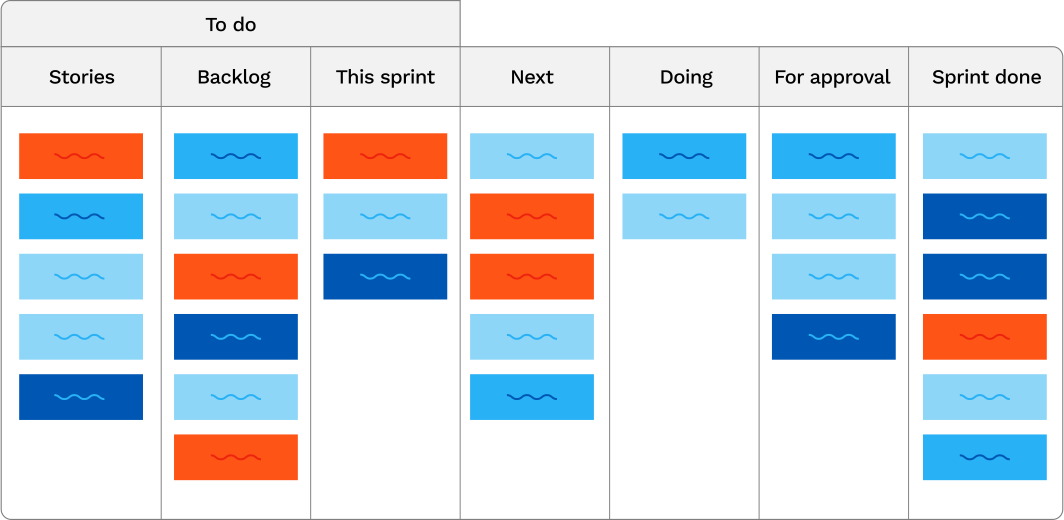
The scrumban board expands on a standard kanban board by adding columns that represent specific phases in the development process – particularly around the "to do" stage, where user stories and backlog items need more visibility before entering active work.
From kanban, it keeps continuous workflow, WIP limits, lead time and cycle time as primary metrics, and pull-based task selection. From scrum, it keeps self-organizing teams, a backlog, on-demand planning sessions, and retrospectives as needed. What it drops: fixed sprint commitments, velocity as a primary metric, and mandatory sprint ceremonies on a fixed cadence.
Teams using scrumban often find that retrospectives become more frequent and more tactical – triggered by flow data rather than calendar dates. Continuous improvement happens because the data demands it, not because a ceremony was scheduled.
How to choose between kanban, scrum, and scrumban
The decision comes down to four questions.
How stable are your requirements? If they change constantly, scrum's sprint structure creates friction. Kanban or scrumban handles volatility better.
How much organizational change can you absorb? Scrum requires restructuring around defined roles and ceremonies. Kanban doesn't. If your org isn't ready for structural change, start with kanban.
What's your team size? Scrum is built for small, cross-functional teams. Larger teams need additional frameworks (SAFe, LeSS) to coordinate across pods.
Do you have the measurement infrastructure? Kanban lives or dies by metrics. If you can't track cycle time and throughput, you can't improve. Make sure you have the tooling and the discipline to measure before you commit.
No methodology works without leadership buy-in, clear metrics, and a champion who keeps the process honest. Pick the framework that fits your current reality. Not the one that sounds best in a presentation.
Sign up for a demo
Request Demo
Strategic Roadmaps
Strategic roadmapping
Build your portfolio vision with Strategic Roadmaps. With powerful visualization capabilities, you can communicate strategy to the entire organization and gain alignment around strategic objectives, product goals, and milestones.
Start a Free TrialFrequently Asked Questions
Couldn't find what you need?Go to our documentation
Yes, and many organizations do. Scrum typically works well for product development teams with defined sprints and release cycles, while kanban suits support, operations, or maintenance teams handling continuous inbound work. The key is keeping each team’s workflow visible and making sure cross-team dependencies are tracked at the portfolio level – otherwise the two systems create coordination gaps that no board can surface.
The most frequent failure point isn’t process – it’s commitment. Scrum requires all three roles (product owner, development team, scrum master) to be fully engaged and clearly defined. When the product owner is unavailable during sprint review or the scrum master is also carrying a full developer load, ceremonies lose their purpose and the framework degrades quickly. The mechanics of scrum are straightforward; the discipline is harder.
Give it at least three to four months before drawing conclusions. Cycle time data from the first month reflects historical behavior, not the new system. By month three, you’ll have enough flow data to see whether WIP limits are improving throughput or just creating a different kind of bottleneck. Make sure you’re measuring lead time and cycle time from day one so you have a baseline to compare against.
Yes. Marketing, IT operations, design, and HR teams have adopted scrumban precisely because they manage a mix of project-based and ongoing work that doesn’t fit neatly into either pure scrum or pure kanban. The pull-based task selection and WIP limits work for any team where work arrives continuously and priorities shift frequently. The key adjustment is mapping scrumban’s board columns to whatever workflow stages actually reflect how the team works – not copying a software development template.