AI spend management software controls buying and meters usage. See the leading tools and how finance attributes AI cost to the work it produced.
How to balance AI delivery velocity with cost control.

Key Takeaways
How to get answers to these key questions the board is going to be asking:
Are our AI investments delivering?
Are we investing in the right places?
Can we act confidently on that data?
CEOs face competing demands: Ramp up productivity, adopt more AI tools like your rivals have, and lead a cutting-edge company. At the same time, there's a new and rapidly growing line in the budget that needs justifying. Are those AI tools delivering what the board was promised they'd deliver?
Adam Mosseri, who runs Instagram, framed where the broader market is heading: "…the cost of using AI tools may soon reach a level comparable to the cost of hiring the engineer themselves."
Some teams are already beyond that threshold. Bryan Catanzaro, who runs applied deep learning at Nvidia, put the scale of the problem in plain terms: "…For my team, the cost of compute is far beyond the costs of the employees."
Despite the rising costs, only 7% of tech leaders have established ROI reporting on their AI investments according KPMG’s Q2 2026 Global AI Pulse Survey.
Finance teams get the bill and have no credible way to connect it to the initiatives it supported. Engineering teams have no hard data to show which projects and results came from specific AI investments.
Here at Tempo – we’ve been developing the answer: Workforce Intelligence.
After Uber famously burned through its annual AI budget in four months, COO Andrew Macdonald noted that AI productivity statistics don't show results: "That link is not there yet… It's very hard to draw a line between one of those stats and, 'Okay, now we're actually producing 25 percent more useful consumer features.'"
With compute costs approaching headcount economics, it deserves headcount-grade accounting. You know precisely what each engineer costs and which team they serve. AI arrived with none of that discipline attached to it. In fact, 47% of large organizations lack full visibility into which AI tools their employees are even using, according to Protiviti's 2026 AI Pulse Survey.
For leaders who can't attribute AI spend to work delivered, the only instruments available are caps: Token allowances, frozen budgets, or licenses pulled back.
Activity is easy to track. Executives need something much more granular to effectively report on the value of AI tools: Every token mapped to the piece of work it helped produce. That allows attribution to be rolled up through epics, initiatives, OKRS, and strategic objectives.
Workforce Intelligence gives that picture inside Jira, where the work already lives, without asking anyone to change how they work.
Tempo Workforce Intelligence optimizes AI productivity across your workforce by giving you traceable ROI tied to work delivered.
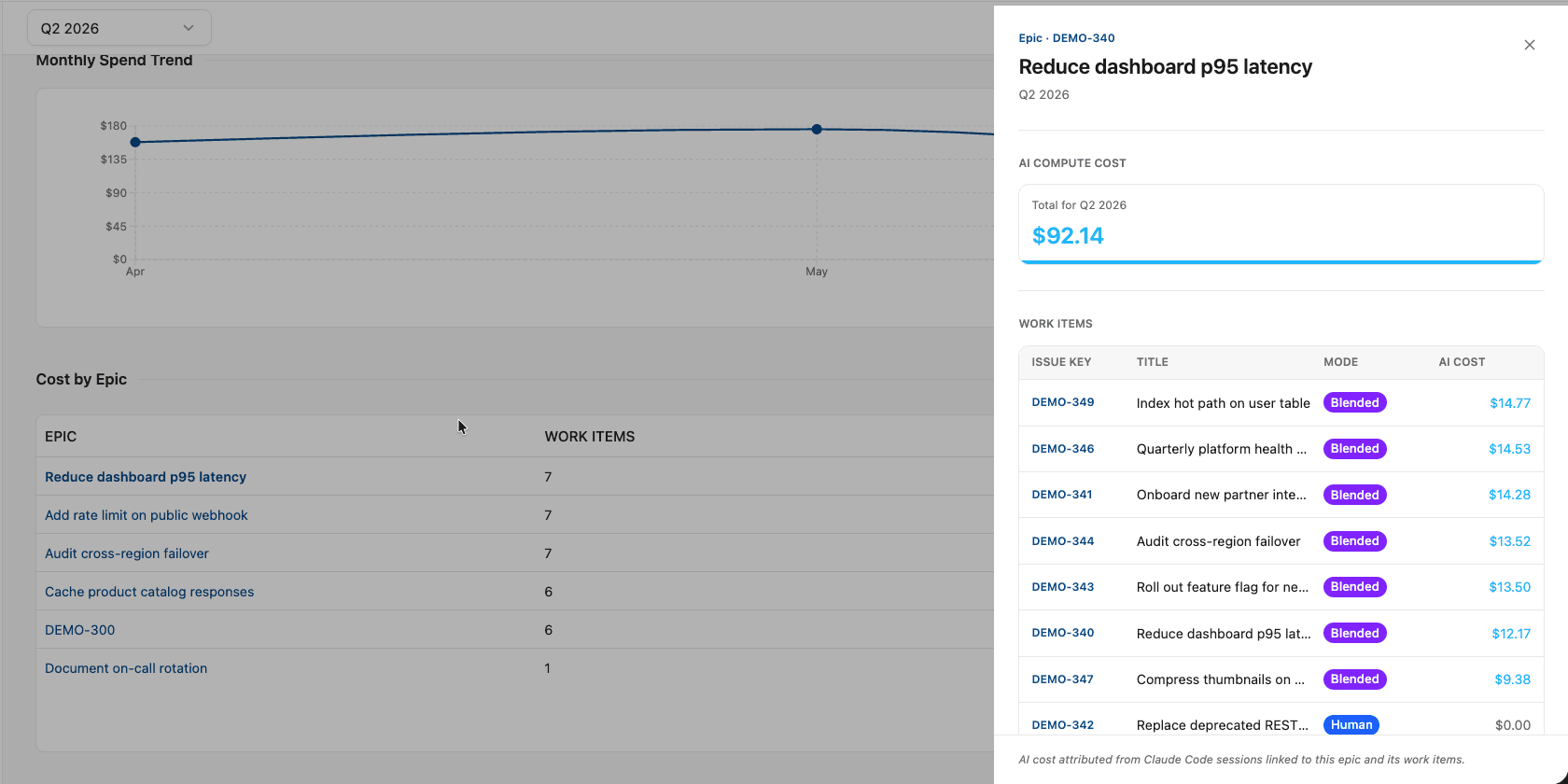
The design idea behind it is straightforward: Workforce Intelligence records AI cost against the same Jira work item that already carries human effort. CTOs get to see which AI tools contribute most meaningfully to work delivered, and CFOs see a blended view of the human hours and AI spend that went toward each specific work item.
The product organizes around three moves.
Native connectors reach your AI tools, Git, and Jira, with token and compute cost pulled straight from provider APIs. Claude Code, GitHub Copilot, and Codex go on one side; every dollar comes out traced to a ticket, an epic, and an initiative. A verified receipt, with a line item for unattributed spend – the parts of the AI bill that isn't tied to any project.
Human time and AI activity land in one work record, which lets you deploy people and agents deliberately rather than by default. What did this kind of work cost with a person, and what did it cost with an agent? Which objectives are getting genuine AI lift, and which are being funded on the assumption that they are?
Your product organization sees its own roadmap. Your engineering organization sees its own throughput. The view of which strategic bets receive AI investment spans both, and it determines where you reallocate next quarter.
Verified cost rolls up from work item to portfolio, and comparison becomes defensible across five axes: Team against team, quarter against quarter, tool against tool, model against model, and AI-assisted work against everything else. Each comparison runs on the delivery data your organization already trusts rather than a vendor's proprietary score.
The practical consequence is that a lagging team gets diagnosed rather than dismissed. When Team A outperforms Team B, attribution tells you whether AI adoption explains the difference or whether something else does.
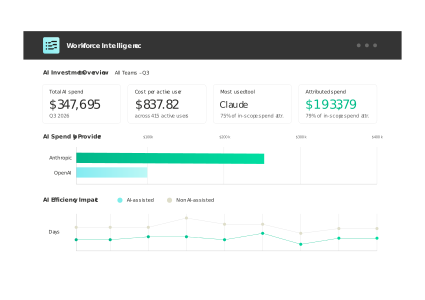
Your CTO gets an architecture built for a permanent multi-tool reality. Session cost from Anthropic and OpenAI at the source. GitHub Copilot and other AI tools detected from commit metadata. Developer machines untouched. Attribution built into the Jira issue itself.
Your CFO gets attribution that holds up under audit. Per-ticket traceability, exports at the work item, story, epic, initiative, and OKR level, and a mechanism for moving the capitalizable share of AI spend from an estimate on the P&L to a traced number on the balance sheet.
Both sides read the same record. When your CTO argues for a new AI tool, your CFO can answer with cost per outcome. When your CFO asks whether AI is producing what it costs, your CTO can point to the initiatives it moved and the ones that stayed flat. The conversation stops being a negotiation.
Whether you're the one presenting to the board, the one signing off on the invoice, or the one accountable for what the whole organization delivered, the underlying need is the same: Numbers that agree with each other, and a leader who can trust what's underneath them.
Workforce Intelligence is available today with a free 30-day trial against your own Jira and AI tools.
Workforce Intelligence
The only solution that ties AI vendor spend to the teams, epics, and Jira issues it supported.
Start a Free TrialAI spend management software controls buying and meters usage. See the leading tools and how finance attributes AI cost to the work it produced.

Tempo Workforce Intelligence connects AI tool usage to Jira work items so leaders can see what their AI investment is really delivering.

AI attribution should pair human effort and AI spend on the same Jira work item, tracing every dollar to the work it delivered. Learn how we built it.

Agentic AI governance means securing your agents and proving their ROI. Get the framework CIOs use to govern the AI-agent workforce end to end.

What is strategic drift, and why is a theory from 1988 suddenly urgent again? AI adoption is universal, but why doesn't it show an advantage yet?
Workforce intelligence captures human effort and AI activity per Jira ticket, so finance can classify AI costs and prove ROI to the board.

Strategic workforce planning still runs on headcount. For CIOs planning human and AI-agent teams, here's how to understand real capacity and cost.

Four trends from Tempo's leadership on what 2026 has in store for the workplace, as well as where we we’ll be in 12 months.

Project retrospectives fuel team growth and development. Learn how to conduct effective postmortems that improve collaboration and productivity.