Streamline your business’s software deployment with these IT release management tips. Discover best practices and customizable software solutions.
DevOps requires robust version control as supplied by Jira release management. Discover essential workflows, best practices, and more.

Jira release management is how software teams plan, track, and ship versioned updates inside Atlassian Jira, using releases (also called versions), workflows, and reporting to move work from development through staging to production. Done well, it gives product managers control over what customers get, when, and with what level of quality.
Here's how to manage releases in Jira, the KPIs that matter, and the common failure modes to watch for.
A software release and a version are the same thing: A collection of changes — bug fixes, new features, and enhancements — that a development team rolls out to customers in a single update.
Most teams categorize releases into:
Major releases, which deliver significant updates to functionality.
Minor releases, which add smaller features or enhancements.
Maintenance releases, which primarily fix bugs and update infrastructure.
Deployment is the pivotal stage of the release lifecycle for teams using iterative delivery. Releases go to one of two environments:
Staging/Testing environment: A non-public server mimicking real-world conditions, where developers test updates.
Production environment: A publicly accessible server where customers can download or log into the latest version.
Versioned releases and release management tooling give product managers four concrete advantages.
Versioned releases require a system to track changes and updates. An organized team and workflow provide visibility into maintenance efforts, supporting long-term product stability and reliability.
Shipping updates as releases clarifies delivery milestones and creates a transparent, incremental cadence that product managers can communicate to stakeholders.
Staggered releases give the development team time to gather customer feedback, identify improvements, and test hypotheses before shipping. Each version lands with a stronger user experience.
An uninterrupted deployment pipeline lets the team keep refining, improving, and evolving the product.
Jira's release workflow covers planning, tracking, and deployment.
Before shipping a new version, product managers plan the release in Jira by creating a Release in the project and defining epics, stories, bugs, and other updates. They then set milestones and timelines using Jira's scheduling tools.
Jira Data Center and Jira Cloud Premium include the Jira Plans functionality for cross-project roadmaps.
Atlassian's tracking tools let leaders monitor development activity inside Jira:
Release burndown charts show team progress against a release's planned work.
Kanban board releases visualize workflow and bottlenecks on Jira's Kanban boards.
Release reports surface insights into the release process so product managers can make informed calls.
Jira integrates continuous integration/continuous deployment (CI/CD) tooling into the platform, providing real-time deployment status across environments and tracking where specific issues ship.
Product managers use key performance indicators (KPIs) to judge release workflow effectiveness and spot improvement opportunities. Four KPIs form the baseline; teams add more as needed.
Frequency: How often new releases go live. Some teams ship monthly, others quarterly. Consider the release type — a high frequency of patch releases can signal quality problems upstream.
Cycle time: The period from the start of development to production deployment. A long cycle time can point to broken release management processes.
Success rate: A go-to quality KPI. It measures the share of defect-free deployments, so the team must define "done" first.
Rollback rate: The number of times the team reverted a release due to quality, security, or infrastructure issues. A high rollback rate flags process problems.
Tracking updates across environments is central to release management. Developers control deployment, so they need to tell the team and stakeholders what is going to customers and when. Automating the process cuts human error. Here's how to automate version tracking in Jira.
Developers usually manage changes with feature branches, merging to master through a Pull Request. Bugs or minor updates often surface after that first merge, forcing multiple Pull Requests for the same change — hard to manage.
Grouping Pull Requests into a single unit of change — tracked by a Jira issue — makes them easier to follow and keeps stakeholders informed. Status changes show up on the dashboard.
Jira workflows default to three statuses: To Do, In Progress, and Done. Add three more to support release management and track which issues belong to a specific update:
Awaiting release: Development is complete and the update is ready to ship.
Released to staging: The update moved to the staging environment for testing.
Released to production: The update is publicly available.
To add transitions and statuses to the basic Jira workflow:
1. Click "⛭" > "Projects," then select your project. 1. From the Administration page, select "Workflows." 1. Click the "Edit" icon at the top right of the box to create a draft and scheme of the new workflow and associate issues within the project with it. 1. Click on a status or transition to open the editing options panel and make changes. 1. Select "Publish Draft" to save. Jira lets you keep the original workflow as a backup.
Next, activate the new workflow in each project's configuration. Kanban teams also need the new statuses on their boards:
1. Open the project board's configuration screen. 1. Click "Columns." 1. Drag the new statuses into the Done column.
When developers move issues from "In Progress" to "Done," Jira prompts them to pick the correct release status.
If the team builds releases from a git repository, the commit history can identify which changes belong to a release. Prefix commit messages with an issue key:
$ git commit -am 'PROJ-1: change publish button color to red'
Prefixes give changes context and make them easier to trace. Naming the branch with the same key makes merge commits easier to identify later.
Use a git command to tag the commit with a version number so you can track changes to a specific release:
$ git tag -s -a 6.0.0-OD-2016.12.1-1106 && git push $remote 6.0.0-OD-2016.12.1-1106
Git retrieves every commit logged since the previous release tag, so you can identify keys and build issue history.
Pull issue keys with a JQL query like:
issue in ('CONF-41003', 'CONF-40973', 'CONF-38645', 'CONF-40446', 'CONF-41014', 'CONF-41035') and status = 'AWAITING RELEASE'
Once you have the list, use Jira's Bulk Update feature to update every issue in the current release.
The release is ready to deploy. After it ships, move every related issue to the correct release status. A JQL search identifies the issues in a release:
fixVersion = "6.0.0-OD-2016.12.1-1106"
Use Bulk Update or the REST API to transition them.
Notify stakeholders once the release lands in staging or production.
Even with strong practices, things go wrong. A few recurring challenges and how to handle them.
Adopt a standardized version naming convention to avoid confusion.
Track version progress and status across projects using Jira's Release Hub.
Use Jira Plans or Jira Align for complex cross-project releases.
Link issues and dependencies through Jira's roadmap feature to spot bottlenecks.
Address task or issue dependencies early in the release cycle to clear roadblocks.
Build change management protocols in Jira for last-minute scope changes.
Include impact assessment, approval workflows, and communication plans to protect the release schedule.
Tempo's solutions extend Jira's native release management. Custom Charts for Jira surfaces key release metrics with real-time tracking and visualization. Structure PPM organizes release tasks and issues and helps teams monitor project progress. Strategic Roadmaps maps the development process in an intuitive format that highlights dependencies and roadblocks.
Tempo streamlines your workflows so you can focus on what matters: Delivering quality updates to your customers.
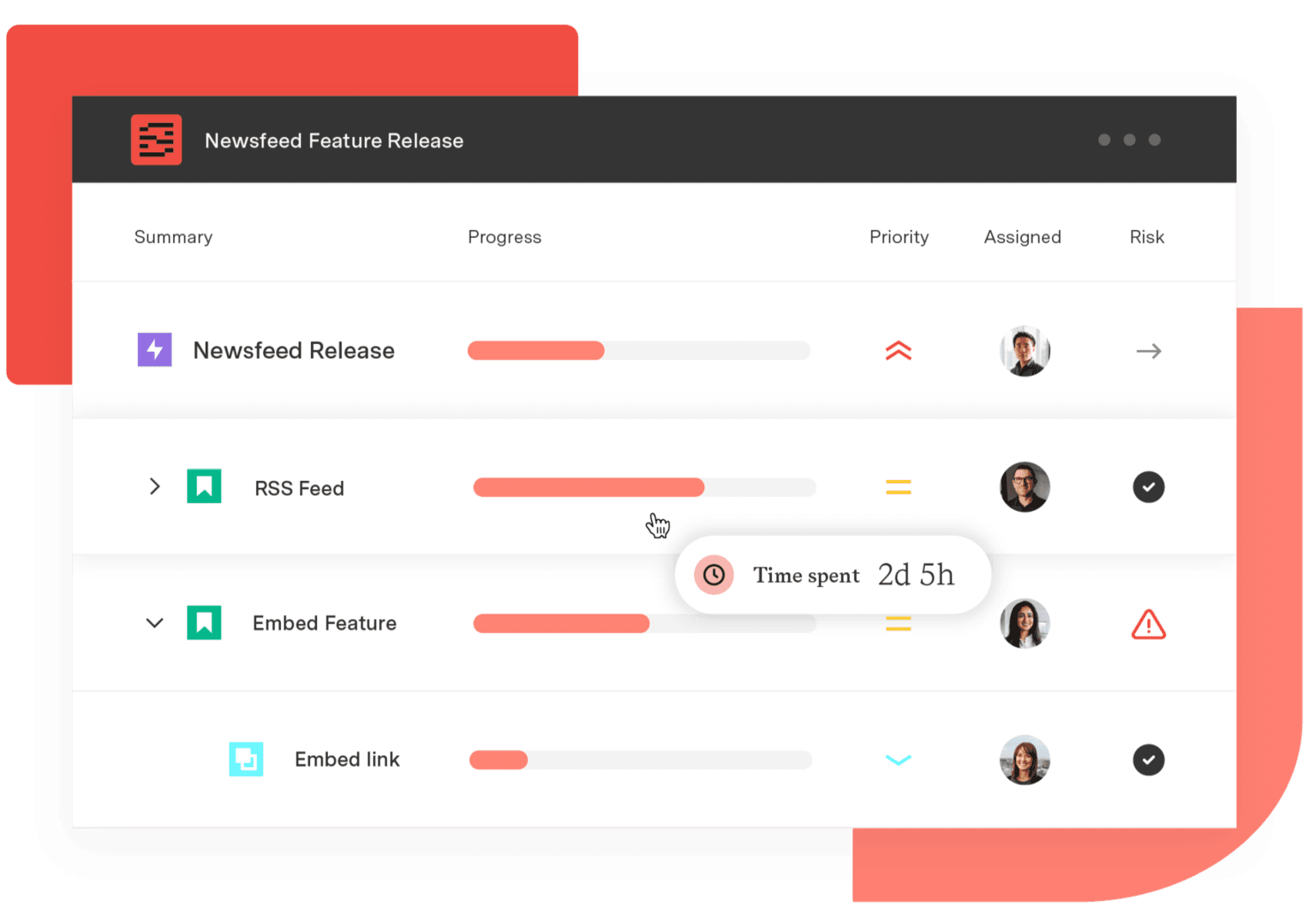
Structure PPM
Manage products, projects, and programs in a single spreadsheet-like view. By providing a clear, real-time view of project progress and resource allocation, Structure helps teams meet deadlines and adapt swiftly to changing priorities.
Start a Free TrialCouldn't find what you need?Go to our documentation
A service release focuses on fixing bugs, stabilizing infrastructure, or installing security patches. A feature release adds new functionality or significant product updates.
Track versions in Jira using the Releases feature to monitor progress. You can leverage built-in reports and custom fields that measure metrics like cycle time, release success rate, and change failure rate.
Numerous third-party release management tools are available in the Atlassian Marketplace. Tempo’s suite of Jira-ready tools provides unparalleled clarity and control over every release.
Streamline your business’s software deployment with these IT release management tips. Discover best practices and customizable software solutions.

Learn the fundamentals and the importance of continuous integration and delivery (CI/CD), a mainstay of the DevOps development pipeline.

DORA metrics help DevOps teams measure speed and quality and achieve consistent results. Learn how to gauge these KPIs and boost performance.

Learn about DevOps project management and how this agile framework improves from team performance to product quality and customer satisfaction.

Learn the best practices for professional services project management to optimize workflows and build a more successful business.

Discover secrets behind effective task management and workflows by learning Jira best practices to incorporate into your project management practice.

Create meaningful issue displays, speed up workflows, and increase efficiency by learning the best practices for Jira screens.

Group issues by version fields (including custom fields) and keep items with the same version name together, even across different projects.

A folio can be created for many more initiatives and track financials in Jira other than specific projects