Take control of your schedule with time management AI. Use smart tools to schedule meetings, set deadline alerts, and establish time blocks for work.
A digital billable hours tracker, such as Tempo’s Financial Manager, ensures you maintain accurate records of your team’s hard work.

Time is a precious commodity, no matter your position within an organization. Some days, work flows unimpeded and you head home feeling accomplished. On others, interruptions and unexpected obstacles keep you from completing even basic tasks.
A work log fixes that. It tracks time spent on daily activities and shows you exactly how the day gets spent — the factors driving productivity and the roadblocks holding you back.
If you're new to time tracking, here's what you need to establish a daily log-keeping practice for yourself and your team.
A work log (or activity log) helps employees track their daily tasks and the time each one takes. Daily work gets arranged chronologically into time blocks and classified by task type, due date, priority, or other categories.
A work log template is a preformatted document tailored to a project team with custom tags or fields. Implementing one gives your team consistent time tracking, so every team member's daily report uses the same metrics.
Templates are reproducible. Once formatted, leadership can reuse a template across projects instead of building a new one each time.
Tracking how much time you spend on individual tasks supports the following:
1. Evaluating progress: Time tracking helps project managers assess work in progress (WIP) and confirm tasks are on track for milestones and deadlines. It also motivates the team to keep momentum. 1. Time management: Regular work log monitoring uncovers patterns that hurt individual or team productivity. Once identified, better time management solutions become easier to put in place. 1. Increasing visibility: An accurate work log gives leadership an overview of project progress, deadline risk, and potential bottlenecks. If delay looms, the project manager can take proactive measures to get back on track. 1. Prioritization: A work log helps team members organize their day, prioritizing tasks by value, strategic alignment, deadlines, or other factors. 1. Decision-making: Using timesheet data to track task duration improves schedule accuracy and confirms the team has capacity to deliver on time. 1. Accurate bookkeeping: Factual invoicing requires accurate attribution of billable hours to clients. 1. Accountability: Work logs keep team members honest about their daily activities. If time drains into break rooms or pointless meetings, a daily record surfaces the issue and lets you address it.
There are many ways to build a daily activity report, and some work better than others. You could go old-school with pen and paper or a printable log built in MS Word. You could download a free daily log to Google Sheets or Excel from WPS Templates.
Traditional methods can work, but they don't integrate with project management software, which makes analysis hard and errors likely. A digital work log is the better solution for accurately tracking daily activities.
A digital work log offers several benefits:
1. Convenience: Most digital work logs are accessible from workstations, tablets, or smartphones, which simplifies on-the-go tracking. 1. Efficiency: A digital activity log offers time-saving features that streamline daily reports, including task categories and search. 1. Insight: Many digital work logs include built-in analytics to evaluate team efficiency and productivity. 1. Visibility: Most time-tracking software integrates with project management platforms, which simplifies logging and connects time spent to progress made. 1. Customizations: Activity report templates are typically customizable, letting users modify categories and menus for their workflows and team needs. 1. Transparency: Digital time tracking promotes openness and collaboration through information sharing and communication. 1. Security: Users can protect data by storing daily work logs with the tool's secure backup feature.
The process for creating a work log template is the same whether you use MS Word, Excel, or a digital activity log.
1. List daily work tasks
Create a task list of everything you plan to accomplish throughout the day. Include meetings, simple tasks, and significant to-do items. Prioritize your work using tags like
Due dates
Billing types
Status
Effort
Next, format an area of your timesheet into half-hour or one-hour time blocks. Use these slots to track completed tasks.
Whenever you complete a daily activity, the small hit of gratification from logging it into the corresponding time slot can keep you going.
As you log completed activities and tasks, include time spent. That data will help plan future project work. The hours don't have to match the blocks perfectly — adjust each slot to reflect the actual duration.
To keep your logs accurate, include activities outside your daily tasks: working lunches, coffee breaks, personal appointments. Capture everything to see the distractions affecting productivity.
Review your task list at the end of the day to evaluate completed and outstanding work. Record why a task remains incomplete. Did other work take longer than expected? Was there an emergency meeting? Those reasons offer insight into your time management and where to improve.
Hold weekly or monthly work log reviews with management and direct reports to analyze performance. Use the daily report feature to find patterns of behavior or repeating scenarios that impede progress, then brainstorm solutions, such as:
Delegating routine tasks to subordinates
Automating repetitive work
Using time management and prioritization techniques to improve focus and effectiveness
Recording daily activities with a time-tracking work log helps you see where you're losing time and find ways to manage work better. An effective work log template includes:
A daily task list
Time blocks
Billing type per task
Priority
Task duration
If you're using a digital work log, it will also offer integrated features to make tracking and analysis easier, such as:
Workload: A workload feature visualizes team capacity across multiple projects. It streamlines deployment by surfacing capacity risks and conflicts so staff isn't overworked.
Dashboards: Dashboard-level reporting tools (graphs and visualizations) track project progress. A customized dashboard gives immediate insight into team productivity, helping you prioritize tasks, spot roadblocks, and find underutilized resources.
Custom fields: Customized fields track relevant data such as status, assignees, due date, and time. Digital work logs let you share custom fields across projects and tasks for consistent task reporting.
List view: Review your task list in a spreadsheet-style format to improve readability. A list template lets you scan all outstanding tasks, due dates, and other fields in a single glance.
Keep these factors in mind when creating a work log template:
1. Simplicity: Don't overcomplicate your work log. Keep the format simple to streamline the recording process. 1. Focus: Prioritize essential task information such as descriptions, time spent, and challenges. Include details relevant to your goals, productivity, and improvements. 1. Consistency: Incorporate daily work logging into your routine. Making a habit of time tracking produces accurate and timely records. 1. Flexibility: Adjust your activity log to reflect changes in your work routine, position, and career goals. 1. Reflection: Take time to evaluate your daily reports. Identify what works and what doesn't, and adjust your workflows.
Tracking daily activities is about more than better time management. When you understand how a team spends its working hours, you gain insights that help prioritize tasks, set realistic project schedules, and see when team members need help. A time-tracking system supports high-quality deliverables while reducing stress and overwork.
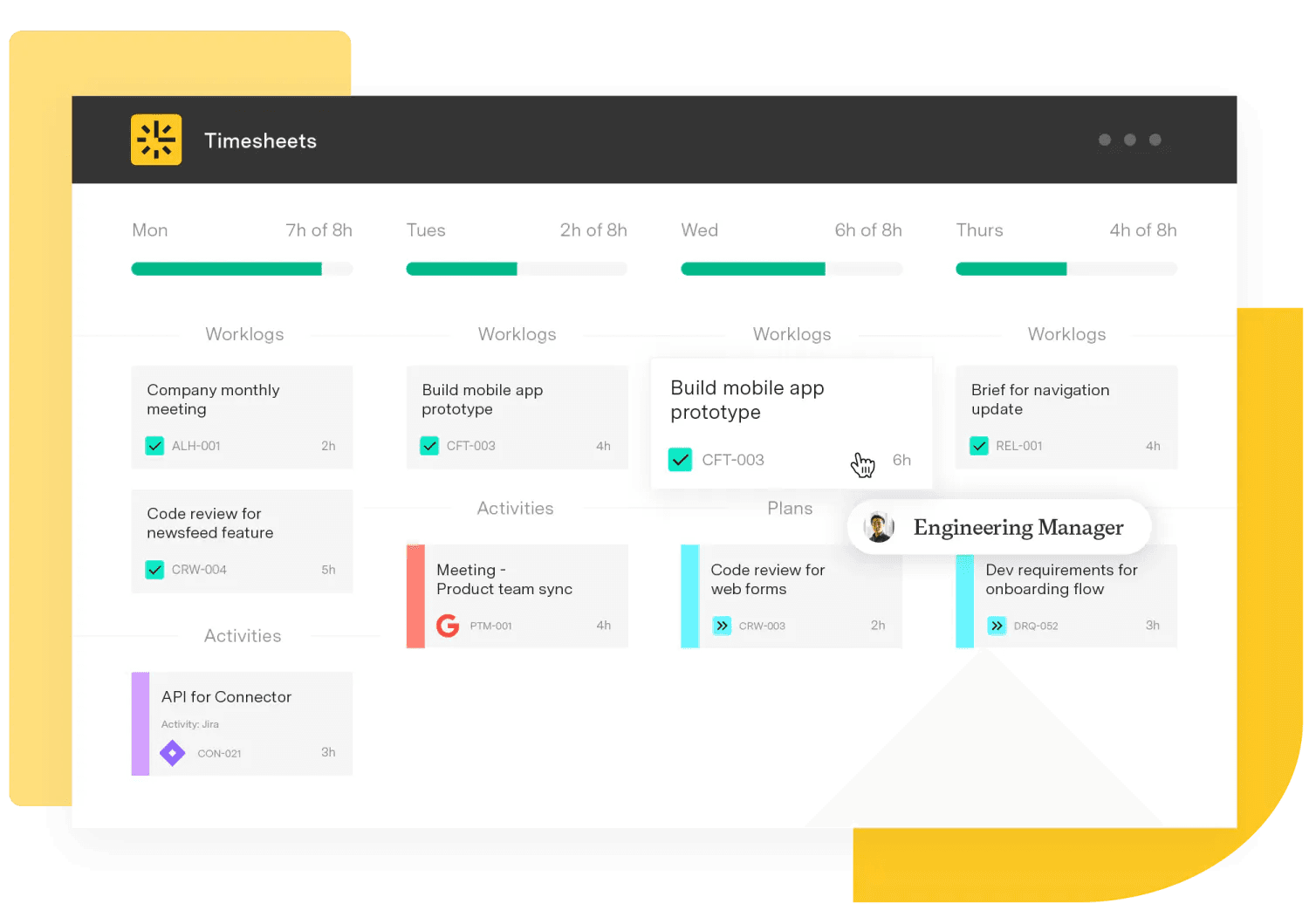
Tempo understands the importance of work logs. Timesheets integrates with Jira to pull project management data and give you an accurate overview of team progress. With AI functionality and automation, you can log, collect, and create a daily report in a few clicks.
With Tempo Timesheets, better productivity and efficiency are within reach.
Timesheets
The #1 time-tracking app for Jira. Timesheets seamlessly integrates with Jira and your existing workflows to help you track time for accounting, CapEx tracking, client billing, compliance, and more.
Start a Free TrialCouldn't find what you need?Go to our documentation
Ideally, employees should update their work log whenever they complete a task. However, this may not be possible in a time crunch. In that case, updating the timesheet whenever team members take a break is acceptable.
The most common way to share daily or weekly activity reports is via a PDF doc attached to an email.
Essential work log fields include
-Date and time of each entry
-Task title
-Description
-Duration
-Affiliated project or category
-Billable or non-billable hours
-Additional notes
Increase tracking relevancy by customizing your work log template with additional tags and fields.
Take control of your schedule with time management AI. Use smart tools to schedule meetings, set deadline alerts, and establish time blocks for work.

Leverage a billable hours calculator to build client trust, improve bookkeeping accuracy, maximize profitability, and save time.

Take control of your day with these essential time management strategies. Discover tips, techniques, and tools to help you work smarter, not harder.

A digital billable hours tracker helps ensure you maintain accurate records of your team’s hard work.

Learn how timesheet reports enhance productivity and resource management. Discover valuable tools that automate the reporting process.

Should project managers use a work plan, action log, or both? Learn how to choose the right PM tool for the job in this post.

Feeling overwhelmed? Need more hours in the day? Time blocking can lead to fewer distractions and better time management.

Take control of the unexpected in project management by creating an issue log to address and monitor problems before they impact your work.

With a deep understanding of your team’s activity, you’ll be better equipped to make the decisions that matter.