If you’re looking to optimize employee productivity, look no further than Tempo’s guide to measuring and improving employee productivity reports.
Learn how timesheet reports enhance productivity and resource management. Discover valuable tools that automate the reporting process.

Time is a resource. Leaders who want organizational success have to track, budget, and allocate it as carefully as any other asset.
A timesheet report gives you a snapshot of where that time goes. It informs payroll and billing, sharpens project management, and shapes resource planning. Here's how these reports work and how to build one that earns its place in your workflow.
A timesheet report is a structured summary of recorded work hours used to track employee productivity and project progress. It shows logged time entries with the tasks worked on and time spent, so project managers can analyze work patterns or bill clients who pay hourly. You can generate one in a spreadsheet or through timesheet reporting software.
Timesheet reports give managers a view of workload distribution and project progress, flagging tasks that are off track and areas that need more support. For employees, they act as a work record that captures effort accurately. The goal in both cases is clarity and efficiency in time allocation.
Timesheet reports also help with employee growth. Managers who track time allocation can identify strengths and development areas faster, which feeds better coaching, sharper performance reviews, and feedback grounded in real work patterns.
Beyond raw hours, timesheet reports show how responsibilities spread across a team. That visibility surfaces when someone is overextended, so leaders can rebalance assignments, offer support early, and keep collaboration steady.
At the organizational level, timesheet reports become a foundation for operational improvement. Businesses can review where time piles up, pinpoint inefficiencies, and adjust workflows to match.
Timesheets do more than record the past — they help predict future needs. Historical data lets project managers make informed calls on staffing, budgets, and deadlines. Timesheets can help you forecast:
Hiring demands: Teams that log consistent overtime may need additional hires or contractors to expand capacity.
Project estimates: Comparing actual hours on past projects to your initial estimates sharpens bidding and scheduling.
Seasonal trends: Industries with fluctuating workloads like retail or consulting can spot peak demand periods and prepare.
Use cases vary by industry. Creative agencies use timesheets to adapt to shifting client demands. Manufacturing relies on precise hour tracking to optimize shift rotations and cut downtime. In legal practices, timesheets justify billable hours and keep clients in the loop.
For service-based industries, accurate timesheet reports are how you maintain client trust. Detailed logs validate invoiced hours and reveal work that happens off-screen. That transparency streamlines dispute resolution and shows clients that every billed minute is backed by data.
Your ideal timesheet format depends on the rhythm of your workplace. Reporting frequency is the first thing to settle:
Daily logs suit services billed by the hour, like on-site construction or fast-paced customer service.
Weekly summaries give enough detail for short-term reviews without overwhelming managers.
Biweekly timesheets align with common payroll cycles, giving room to catch discrepancies and manage overtime. They're popular in manufacturing and retail.
Monthly summaries offer a broader view that works for strategic planning or long-term project oversight, and they fit professional services or creative agencies well.
There are several ways to create and maintain timesheets, and the right approach depends on how your organization runs.
Typically involve paper forms or spreadsheets that employees fill out by hand
Often used in smaller organizations or in regions with limited digital infrastructure
Can be customized to specific needs
Require more administrative effort to compile
Use integrated systems with biometric scanners or card swipes to log work hours
Are ideal for larger organizations that want to minimize human error and streamline payroll
Catch discrepancies early by flagging irregularities, which makes them popular in hospitality or retail
Use specialized software with real-time tracking, mobile access, and integration with project management systems
Work well in remote or hybrid environments where teams need a live view of project progress
Provide robust reporting and analytics, supporting tech and creative services where detailed data drives decisions
Building a project timesheet report doesn't have to be complicated. These steps will get you tracking your team's work:
Before analyzing data, define the report's purpose: Tracking resource allocation, measuring productivity, spotting bottlenecks, or keeping projects on budget. A clear goal tells you which data points matter.
If you're focused on resource allocation, look at how hours are distributed across tasks and whether team members are overburdened. If productivity is the focus, metrics like task completion rates and the ratio of core to non-core work are most useful.
Patterns in these areas help you adjust timelines and keep the team pointed at what matters most.
Manual entry in Excel depends on people logging hours correctly, which invites mistakes and outdated data. A dedicated time-tracking tool syncs with your project management software to gather data, reduce errors, and surface insight into productivity and task progress.
Focus on actionable insight rather than tracking time for its own sake. Without a clear intention, you risk misreading the data and creating an atmosphere of over-monitoring.
With tools like Tempo Reports, you can automate data collection and reporting and turn raw data into decisions. The software updates each field for you, freeing time to analyze insight and act on it. Tempo also arranges figures into tables or pivot charts to highlight trends and KPIs at a glance.
AI-powered tools like Tempo's Timesheets improve efficiency, reduce friction, and simplify time tracking. Timesheets pulls the data it needs and offers templates that shorten report generation during payroll runs or project reviews.
Tempo's AI upgrades time tracking from record-keeping into a smart tool that analyzes work patterns. It processes logged data to find recurring patterns and suggest more efficient scheduling. Over time, the system improves accuracy and cuts down on manual corrections.
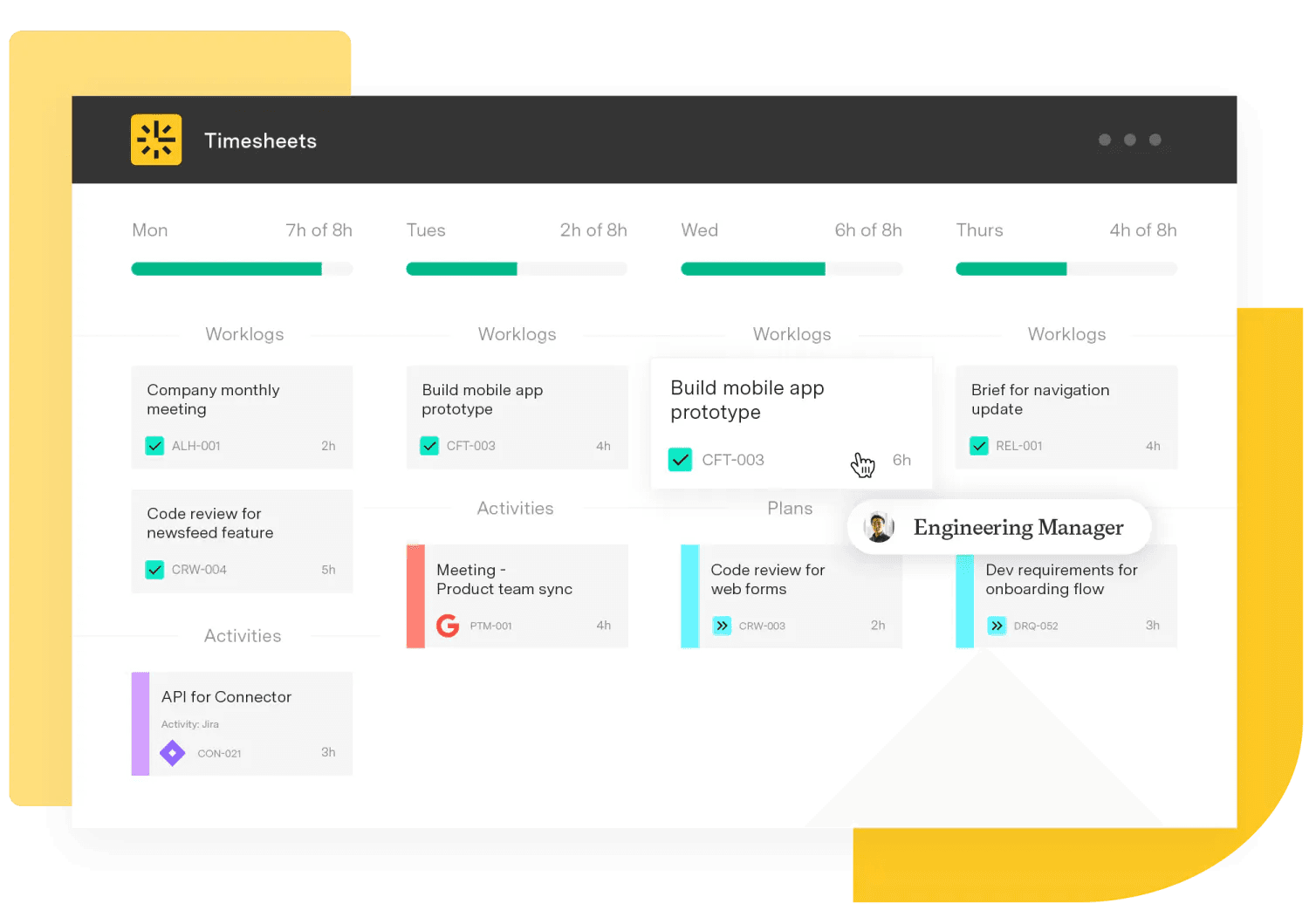
Tempo's time-tracking software integrates with Jira, automating work logs and real-time analytics. Its AI-powered system minimizes manual entry by pulling data from calendars and other sources to capture every billable hour. With Timesheets, you can track project progress and see team performance through dashboards and burn-up reports.
The platform offers customizable reports that let you filter, sort, and analyze data at a glance, and it consolidates individual entries into team timesheets. These reporting and forecasting tools make resource management far less painful.
Ready to boost productivity and improve project profitability? Start your free trial of Tempo's Timesheets today and see the difference for yourself.
Timesheets
The #1 time-tracking app for Jira. Timesheets seamlessly integrates with Jira and your existing workflows to help you track time for accounting, CapEx tracking, client billing, compliance, and more.
Start a Free TrialCouldn't find what you need?Go to our documentation
A timesheet report should detail each employee’s hours worked, specifying the tasks or projects they worked on and the dates of these activities.
Organizations can optimize resource allocation and enhance project planning by analyzing timesheet information.
Timesheets improve resource management by providing records of how employees allocate their time to various tasks. This data allows managers to assess productivity, identify areas where resources may be overextended or underutilized, and make informed decisions regarding task assignments and workload distribution.
Tempo’s Timesheets integrates with Jira to automate time tracking. It gathers data from connected apps and external calendars and creates activity suggestions that can be logged with a single click.
If you’re looking to optimize employee productivity, look no further than Tempo’s guide to measuring and improving employee productivity reports.

Work management systems streamline processes, boost productivity, and improve your bottom line. Learn how to leverage these valuable tools.
A digital billable hours tracker helps ensure you maintain accurate records of your team’s hard work.

Learn what Parkinson’s Law is, see real examples, and discover time management tips and tools to overcome it and boost productivity at work.

Learn how to use a production schedule to monitor the production process, provide accurate completion predictions for products, and set shipment dates

Leverage a billable hours calculator to build client trust, improve bookkeeping accuracy, maximize profitability, and save time.

Want to save money while maintaining productivity? Discover proven cost reduction strategies to limit business expenses without disrupting operations.

Learn the secrets of drafting a compelling executive report that gives the C-suite valuable data and insights to support informed decisions.

Jira started purely as an issue tracking software targeting software developers, and quickly evolved into one of today’s biggest productivity tools.