Tempo Timesheets features custom price tables where you can set different hourly price rates for team roles.
Loop connects strategy and execution across a workforce that now includes AI agents, so drift shows up while it's still cheap to fix.

Key Takeaways
Loop is a new product launch from Tempo – a continuous decision intelligence layer for the AI-enabled enterprise
It reads live signals across your enterprise, surfaces problems, and writes the approved correction back to your source systems
Loop replaces the quarterly guess with a live view of the gap between what leadership decided and what's actually happening
Loop is built for continuous course correction across people and AI agents alike, and integrates with the tools your team are already using
Loop is an AI-native Intelligent Portfolio Orchestration platform built for the AI-empowered enterprise. It's Tempo's first ecosystem-independent platform, launching with Jira and Azure DevOps connected from day one, with support for additional work-management systems following in the coming months.
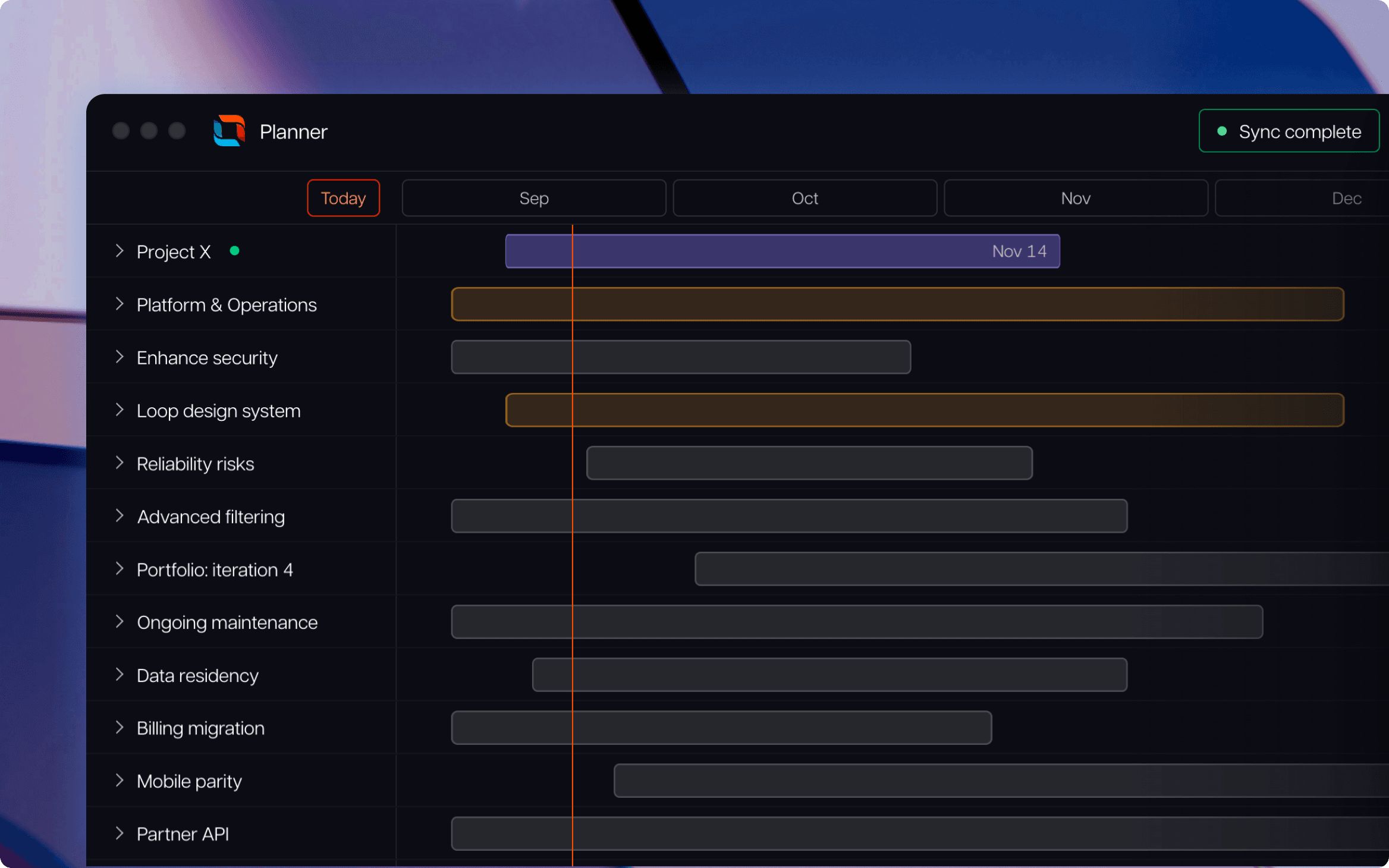
Loop runs as one continuous cycle across your portfolio: Loop continuously looks at the signals from the places where your team is working. It checks when that work is meant to be done, the hours spent on that work, the budget for the plan, and how much AI tools are working on that issue. When something starts to drift away from the plan – Loop highlights it, gives you a data-backed recommendation on what you can do to fix it, then dynamically updates your systems to reflect the change you’ve just approved.
Then, Loop learns what helped that project and your portfolio and how it functioned in reality – and gives you and your team better recommendations for next time. We call that Intelligent Portfolio Orchestration.
Tempo's 2026 State of SPM report found that organizations that review and reforecast their portfolios most frequently also cancel more projects – and still deliver more ROI doing it.
Frequent reviewers see 74% of their projects deliver measurable ROI, compared with 66.2% for infrequent reviewers.
That gap has a lot to do with tooling. Tempo's 2026 State of AI report found fewer than one in three organizations have a tool that can manage human and AI effort together, continuously course-correct, or give an early warning on drift – which is exactly the gap between knowing something's wrong and doing something about it.
The lesson isn't that cancellation itself creates value. It's that seeing a problem early and acting on it, including killing something that isn't working, consistently beats sticking to the original plan out of momentum. Most organizations don't get that chance until a quarterly review, by which point the cost of changing course has already gone up.
Drift starts the day after kickoff. Loop catches it the same day – flagging work drifting from the plan while there's still a cheap option available, instead of waiting for the next scheduled checkpoint.
Legacy strategic portfolio management tools lock organizations into one system, disconnected from Jira, Azure DevOps, or wherever teams actually work, and force a migration before anyone sees a shred of value.
Some claim to be neutral but were never built to connect to the tools a company actually runs. Most bolt AI onto the same broken foundation rather than building with it from the ground up.
Loop is different on three fronts:
Reads every system, not just one: Loop treats every connected system as an equal signal source rather than requiring one platform to serve as the source of truth.
Tracks AI agents alongside people: Most legacy planning tools predate agents doing real work. Loop attributes work and spend at the individual level across both human contributors and AI agents.
Recommends a fix, not just a flag: A dashboard that shows a project is behind isn't the same as a system that shows what it would take to fix it. Loop gives you a recommendation – and adapts to your portfolio to make better suggestions.
The decision stays with the customer's team. Organizations set their own governance over how far Loop is allowed to act, from recommend-only up to greater autonomy over time. At general availability, the decision and the action stay with the people accountable for them.
For PMO and strategy leaders, Loop means a live view of execution mapped to strategic priorities – instead of a status picture rebuilt by hand every cycle.
For technology leaders, it means one place to track and govern human and AI work together, so sprint execution finally connects to strategic priority instead of running as a second, invisible roadmap.
For product leaders, it means attribution of AI and human investment at the individual level. The AI spend line stops being a guess and starts being an answer you can bring to the board.
For practitioners, it means less time on manual status updates, and a clearer line from the work in front of you up to the strategy funding it.
Tempo runs on the same foundation as 30,000 customers, including 53% of the Fortune 100, with more than 350 channel partners such as Accenture and PwC.
Early Loop customers report an 85% improvement in keeping strategy and execution connected, 38% faster project delivery, and 82% more effective replanning when priorities shift.
Start by pulling your last quarterly portfolio review next to what actually shipped in that window. If the two don't line up cleanly, that's drift, and by Tempo's own research, you're far from alone.
Loop gives you a live version of that comparison instead of a quarterly reconstruction, across a workforce that now includes AI agents alongside people.
[Explore Loop →]
Tempo Loop
Direct every human, every agent, and every dollar to the work that matters most.
Book a demoTempo Timesheets features custom price tables where you can set different hourly price rates for team roles.

I have taken on an in-flight project. We need more time, and I don’t think the client will take the news well. How can I break it to them?

Projectrak Jira Project Tracking stores crucial data, which presented visually allows better insights for the whole team.

Learn the best ways to adopt the agile leadership model at the organizational level and how it improves communication, collaboration, and productivity

Transform your operations management for the better with this guide to aggregate planning. Learn how it can help your organization thrive.

Leverage critical path project management to keep your team on schedule. With CPM, you’ll effectively schedule crucial tasks for successful delivery.

Discover how operational data, such as sales transactions and system logs, empowers businesses to boost efficiency and effectively manage risk.

Introducing Strategic Roadmaps (formerly Roadmunk), an award-winning strategic roadmapping platform that lets users build, strategize, and connect.

Cross-Jira reporting improves your execution for multiple projects by helping you monitor resources and identify dependencies to optimize execution.