Forecast project costs in Jira with Tempo Financial Manager. Combine actual and planned data to prevent overruns and improve budgeting.
This post was created by Mashhood Ahmed, in partnership with Tempo Loop

Mashhood Ahmed · Gen AI strategy and adoption consultant

In May 2018, Google showcased Duplex, an AI assistant calling a hair salon and a restaurant, negotiating date and time availability with a real person on the other end. It didn't sound like a scripted voice or a bot. It sounded like a natural, human negotiation, and that's what caught my attention.
Project managers negotiate with stakeholders constantly, whether it's freeing up a shared resource or defending a timeline to a sponsor. So, I started researching what this kind of capability meant for us in the future. My research was selected for the PMI New Zealand Conference later that year, then PMI Singapore, the PMI PMO Symposium in Denver, and other PMI chapters in the following years.
I opened these sessions by playing that Duplex video. I told the room that AI can help us negotiate with our stakeholders not eventually, but “within the working careers”. AI tools wouldn't just summarize what already happened, which is now available in meeting minutes/transcripts, status reports or Jira updates. They'd act inside our systems, doing real work, on real projects.
I pointed to a disparity that kept showing up on projects: The gap between the hours a project actually needed and the hours it had been resourced for.
I argued AI tools would eventually catch that gap before it became a crisis, by pulling from a project's history to flag when a team needed reinforcement, or when someone should be pulled off.
I made the same argument about scope: That AI would validate what was actually in scope against the approved baseline, predict missed deadlines before they hit, revise the baseline against real data instead of a plan-built months earlier.
That's the blind spot I highlighted in 2018-19 without fully naming it: work and decisions happening inside disconnected systems, with the people accountable for outcomes finding out last.
Recently, I sat in on a live product demo of Tempo Loop, what it does today and where it's headed for 2027 and beyond.
Tempo calls Loop an Intelligent Portfolio Orchestration platform.
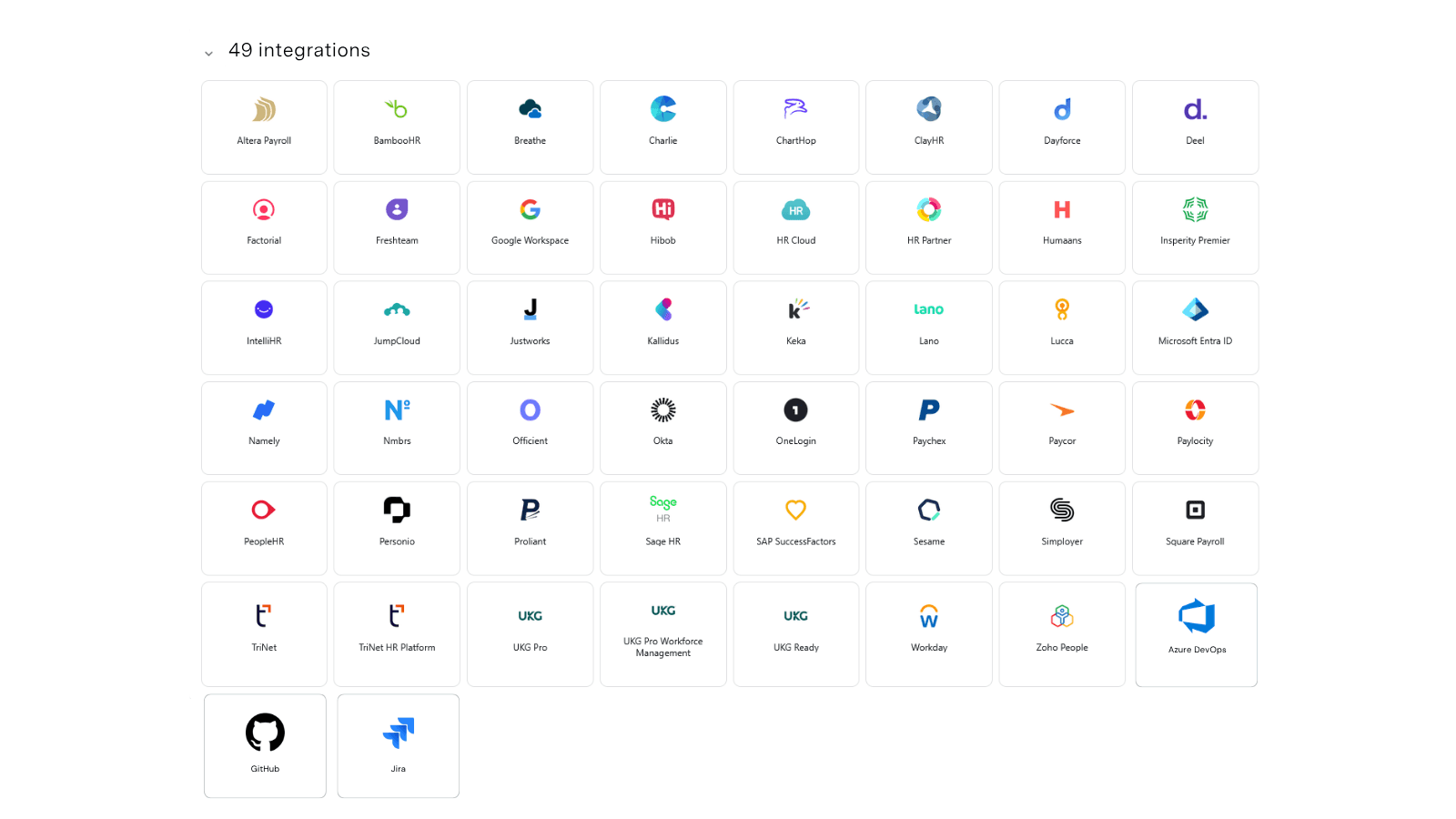
Today it connects to and pulls data from Jira, Azure DevOps, and HR systems, with a broader set of connected systems on the roadmap. Loop is also adding basic financial capabilities directly in-product – starting with a live view of actual vs. budget across the portfolio – so leaders can see the finance picture alongside the work picture without another integration.
What it builds from that data is a single, continuously updated view of whether the work happening across the portfolio still lines up with the strategy that funded it.
The moment something starts going off track, Loop calls it out and recommends a fix:
· Observe: Review the recommendation and act on it yourself
· Assist: Review and approve before anything happens
· Delegate: Let Loop execute autonomously within boundaries you've set
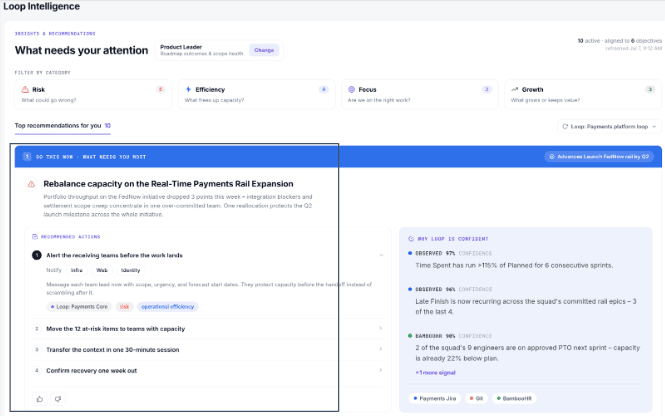
This is the part that answers my own 2018 argument directly: Loop doesn't govern human work in one place, and AI work somewhere else. It's built to govern both inside the same system, no separate layer bolted on for whichever kind of worker happens to be doing the task.
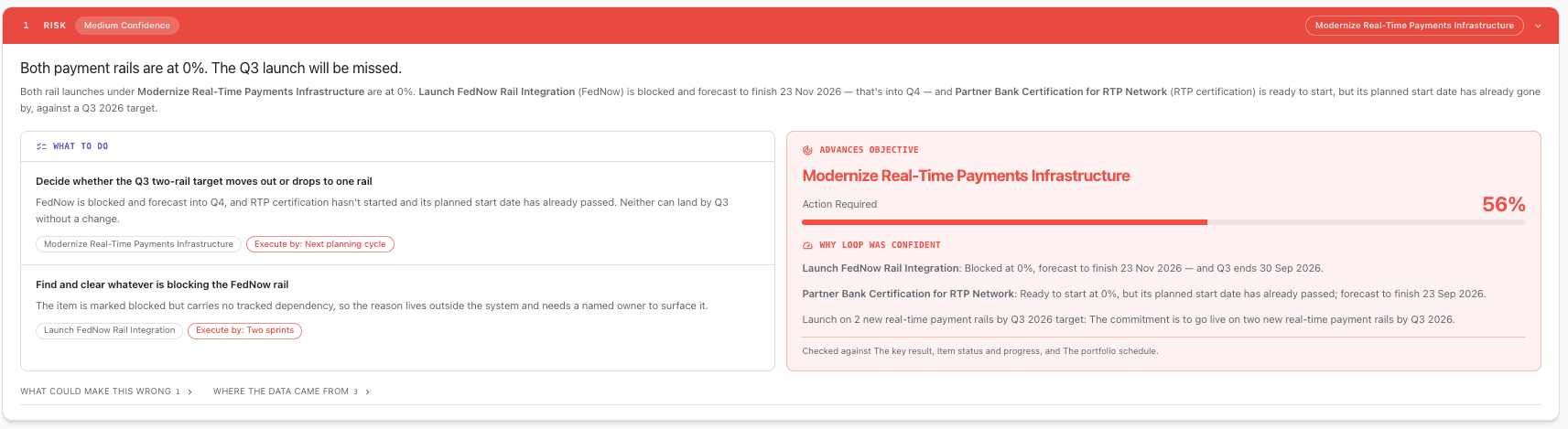
What makes Loop different from typical portfolio software isn't just that it flags problems; it's that the Loop closes it.
In the demo, this became concrete: When a recommendation gets approved, Loop writes the change straight back to the source system. Reassign a team, and Jira updates to reflect it. Adjust a timeline, and the relevant dates update too.
Then Loop watches for confirmation that the change actually produced the intended result, and feeds that outcome back into the system as new reality.
That's the cycle, five steps, repeating continuously:
1. Work becomes visible through verified data, not estimates.
2. Every person and every AI agent's activity maps to the strategy it's supposed to serve.
3. Loop watches for drift and, when it appears, recommends a fix.
4. What was decided, and why, gets remembered.
5. Each cycle, the recommendations get sharper, because Loop has now seen what happened the last time.
That last point is the one worth sitting with. This isn't a system trained once on a generic dataset and shipped everywhere the same way. It's trained on what happens inside your organization specifically, what you acted on, what worked, what didn't.
Any tool can ingest your OKRs. Fewer can tell you, based on your own history, what to actually do next. Here are two scenarios for drift monitoring.
When a reduction in force removes resource capacity, sometimes that surfaces in bits and pieces, a slipped sprint, a missed date, until it shows up as a surprise impact on more than one initiative.
Loop reads live capacity signals continuously instead of on a review cycle. The moment a headcount change is reflected in connected systems, Loop maps the new capacity picture against every funded initiative and flags which ones are now at risk, then recommends a reallocation that protects the highest-priority work, with the trade-offs.
Worth being precise here: Even at full autonomy, Loop isn't deciding the RIF or the reallocation on its own. That stays a human call. Delegate means Loop executes the approved, bounded action once someone makes it, not that it owns the decision.
This is another drift scenario, the live gap between what was planned vs actual is widening, and nobody notices until the team is already behind. As new work gets folded in without going through change control, that scope change never makes it into a status report.
Loop watches that trend continuously and recommends a fix, not after a sprint or a quarter has already been lost. This could mean adding capacity, extending the timeline and accepting the impact on dependent initiatives, or cutting scope back to the original commitment, so the portfolio leader walks into the QBR with a defensible next move, not just a status update.
Tempo describes this as replacing the old plan-publish-hope cycle with a system that keeps strategic PMO investments aligned to your goals continuously, not quarterly or monthly, but all the time.
Typically, AI tools have a habit of always having an opinion, always agreeable, even when there's nothing worth saying. Ask an AI for your top risks, and it'll hand you ten, whether or not seven of them actually matter.
That's not intelligence, it's noise, and enough of it trains people to stop reading recommendations altogether. This kind of AI noise is what causes human cognitive fatigue.
Loop manages noise with the confidence scoring: Every insight and recommendation Loop surfaces carries a score reflecting how certain it actually is, based on the quality of the underlying data. If your source data is stale or incomplete, the confidence score drops accordingly, instead of Loop pretending certainty it doesn't have.
Full traceability is part of the same design, you can trace any recommendation back through the specific signals that produced it, so it never functions as a black box.
There's also a feedback loop planned for the roadmap: Tell Loop via an AI agent, "Ask Loop," that a recommendation wasn't useful and why, and that gets folded back into how future recommendations get made. That's the difference between a tool that talks constantly and one that's actually worth listening to.
Back in 2018-2019, I was describing the future I couldn't fully picture yet, watching Loop's demo this past August was the first time I've seen a product actually built to close that specific gap, not as an add-on feature, but as the core design.
Loop is still early. Some of what I've described here is live today, some is on the roadmap for 2027 and beyond, and I'll be watching closely as it moves from demo to daily use. But the direction is the one I argued for in 2018: strategy and execution, human and AI work, aligned continuously instead of reconciled after the fact.
Tempo's own line for this sums it up better than I can: Aligning strategy and work at the speed of AI. Eight years after I first made that case on stage, I'm glad to see Tempo is building it.
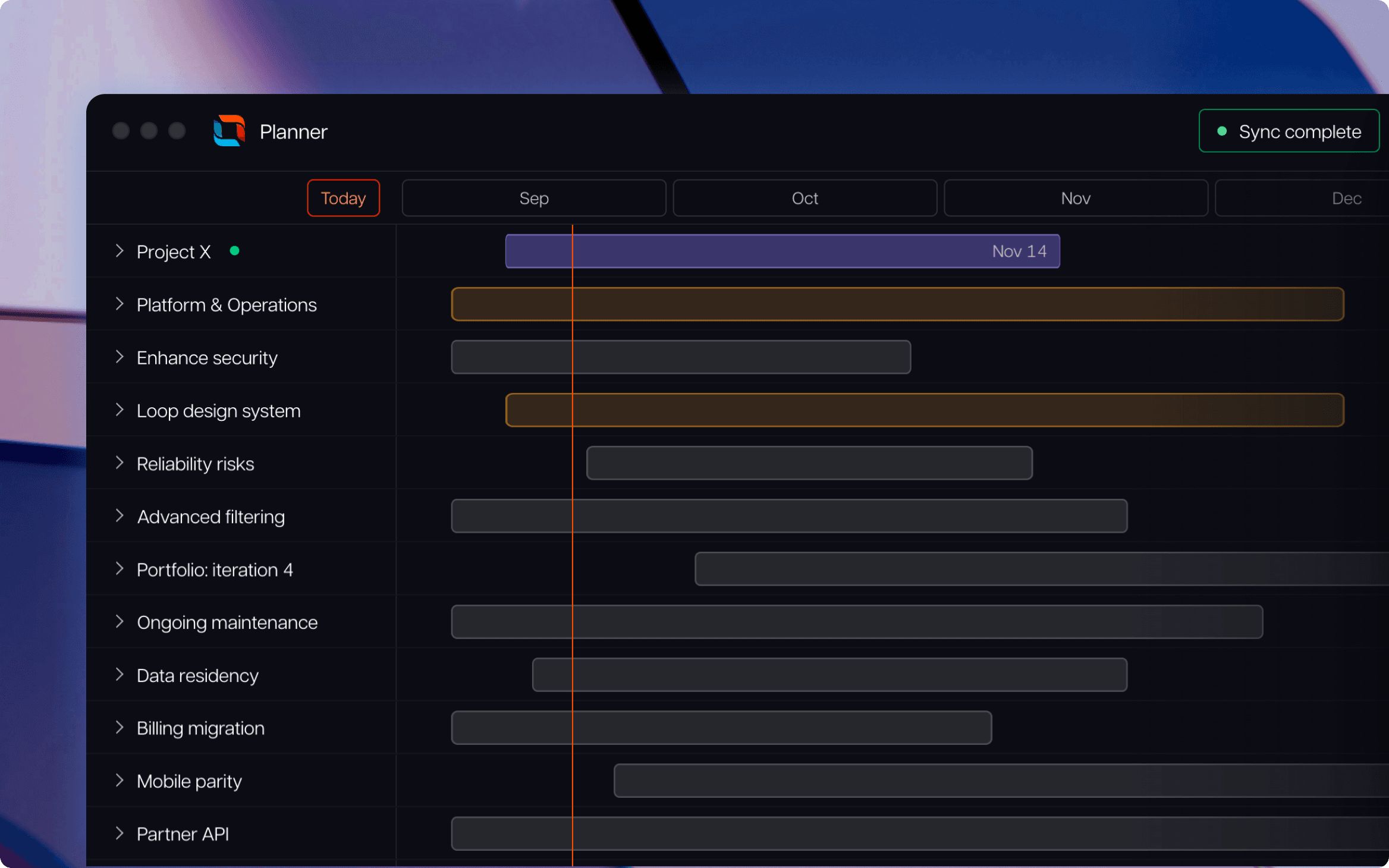
Tempo Loop
Direct every human, every agent, and every dollar to the work that matters most.
Book a demoForecast project costs in Jira with Tempo Financial Manager. Combine actual and planned data to prevent overruns and improve budgeting.

A well-designed RFQ template streamlines procurement and helps you secure the best prices. Learn how to create an RFQ form for your business needs.

Understand Scrum master responsibilities, who can become a Scrum master, and how to train for the role. Find out how Scrum masters benefit teams.

Knowing how to engage stakeholders is crucial to successful project execution. Learn the different stakeholders and strategies to keep them engaged.

Corrective action plans resolve issues and prevent recurrence. Learn how CAPs improve accountability, compliance, and long-term success.

Capture worklogs as work happens. Automated time tracking in Jira gives finance and managers data they can trust without nagging the team.

Learn how process mapping can improve efficiency across your business, from projects to cross-functional operations.

Why Intelligent Portfolio Orchestration (IPO) has become a category, why traditional SPM isn’t the answer, and why you should care.

Improve task prioritization by learning how to conduct the Pareto analysis and use the 80/20 rule to deliver outcomes with the greatest impact.