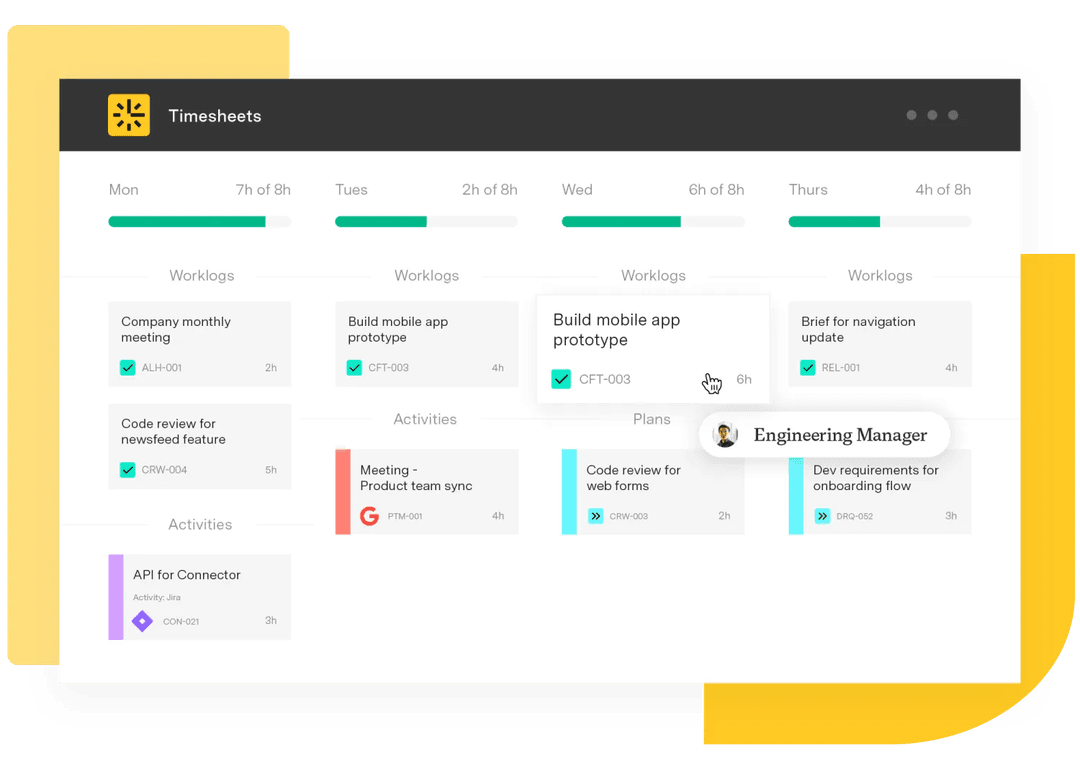

Broadcom Clarity vs. Tempo: Comparing enterprise SPM solutions

Key Takeaways
Broadcom Clarity is a standalone, finance-first PPM platform built for top-down governance in regulated industries. Tempo offers a modular SPM platform that runs natively inside Jira and connects strategy to what your teams actually deliver.
According to some reviewers, enterprise Clarity deployments take 9–12 months. Tempo's modular setup means most organizations start seeing value in weeks.
Clarity carries heavyweight enterprise licensing, implementation, and consulting costs; Tempo's modular, Jira-native model keeps total cost far lower.
Broadcom Clarity and Tempo are built around different assumptions about how portfolio management works. Clarity treats the portfolio as a separate governance structure that sits above the work – one that leadership controls and delivery teams report into. Tempo treats the portfolio as the work itself – visibility built up from execution data already flowing through Jira.
That difference shapes how long each takes to deploy, what kind of data leadership trusts, and whether the people doing the work ever log in.
What is Broadcom Clarity?
Broadcom Clarity is a traditional, finance-led project and portfolio management (PPM) platform. It built its enterprise reputation on strict budget oversight and detailed audit trails.
The organizations that get the most out of it tend to look similar: Large, heavily regulated, with PMOs that track complex investments across multiple currencies and produce detailed audit evidence on demand. Financial services firms, telecom providers, and government agencies have been its core customer base – places where a missed compliance requirement has real consequences.
It sits above day-to-day execution. Executives set funding priorities and track programs at the governance level. The teams doing the actual work typically operate in separate tools.
What is Tempo SPM?
Tempo Strategic Portfolio Management (SPM) provides a modular solution built natively for Atlassian and Jira environments.
Many enterprise teams already run delivery in Jira. Tempo connects to that work directly – pulling time logged, resource usage, and issue progress into portfolio views – so leadership sees what's happening as it happens.
Tempo builds portfolio visibility from the bottom up, using execution data your teams are already generating. No separate system, no manual handoff between plans and actuals.
According to Gartner research, only 15% of organizations are effective at resource and capacity planning. For most PMOs, that gap is a data problem – and it gets worse when execution data lives in Jira but portfolio reporting lives somewhere else.
Pros and cons of Broadcom Clarity
Pros
Granular financial controls, including detailed invoicing, chargebacks, and multi-currency tracking
Enterprise scorecards for large, complex investment programs
End-to-end project oversight that supports regulatory compliance, from funding approval through maintenance
Proven in regulated industries where audit trail depth is non-negotiable
Clarity Vaia, Broadcom's built-in AI assistant, generates summaries, charts, and resource recommendations from Clarity's portfolio and financial data through natural-language prompts
Cons
Moving between modules for routine tasks can feel slow
Keeping the platform configured typically requires outside consultants
According to some reviewers, implementation timelines of 9–12 months delay the point where teams start seeing value
Pros and cons of Tempo SPM
Pros
Jira-native integration keeps portfolio plans tied to real execution data
Modular setup lets organizations start with one product – like Timesheets or Capacity Planner – and expand over time
Forecasts delivery timelines based on team capacity and actual constraints, not estimates
Modern interface that drives adoption beyond the PMO, including engineering leads, product managers, and scrum masters
Cons
Portfolio visibility often depends on teams keeping Jira issues and time logs consistently up to date
If your teams aren't already in Jira, there'll be an adjustment period before integrated workflows take hold
Feature-by-feature comparison
The real differences between Clarity and Tempo show up in daily PMO work – especially around financial governance, resource planning, and how long it takes to get running.
1. Resource allocation and capacity planning
Without reliable capacity data, your roadmap is guesswork.
Clarity's resource forecasting tools are detailed, but the data they rely on needs constant tending. Resource managers update availability by hand. When Clarity isn't connected to where work runs, the numbers drift – and by the time a capacity report reaches leadership, it may be weeks out of date.
Tempo Capacity Planner reads current assignments and upcoming work directly from Jira. Managers can spot overloads before they become delivery problems. Plans stay current instead of expiring between review cycles. Capacity Planner also compares planned time against actuals logged in Timesheets, so utilization and team capacity reports reflect what teams are doing.
2. Budgeting and financial control
Financial governance is often the primary reason PMOs evaluate SPM tools. Both platforms handle budgeting, but they take different paths.
Clarity's financial controls are deep. Phase-gate funding models, multi-currency tracking, granular invoicing – Clarity was purpose-built for PMOs that need strict, auditable financial oversight. It's the stronger choice when a budget reconciliation error carries regulatory consequences, not only operational ones.
Tempo Financial Manager works differently. Time gets logged against Jira issues, and those hours roll up automatically into the portfolio budget, categorized as they're entered. Leadership can check spend at any point in the month without waiting for a month-end reconciliation run. Beyond live spend, Financial Manager tracks budget versus actuals, forecasts revenue and cost using planned time from Capacity Planner, and reports profitability at the project and portfolio level.
3. CapEx and OpEx categorization
It's easy to underestimate the difference between CapEx and OpEx categorization until you're the one cleaning up a misclassification before an audit.
Clarity supports CapEx/OpEx categorization, but the setup requires IT involvement and ongoing maintenance whenever project structures change. In a stable environment, that's manageable. When delivery teams are constantly reorganizing in Jira, the categorization rules can lag behind by weeks.
Financial Manager handles this as time is logged. It reads Jira issue types and worklog data and applies the right classification automatically. No batch corrections, and no manual reclassification runs before the quarter closes.
4. User experience and implementation
A tool that takes a year to deploy also takes a year before anyone gets value from it. By the time it launches, the pressure to justify the investment can push organizations to declare success before the system is working.
Clarity deployments are complex by design. The depth of configuration the platform offers is real, but it requires specialized consultants rather than internal teams to get it right. According to some reviewers, full enterprise deployments take 9–12 months, with total cost of ownership accumulating across licensing, implementation, and ongoing consulting.
With Tempo, most organizations pick one module and start there. Timesheets is a common entry point – get accurate time data flowing first, then build on it.
Because it lives inside Jira, teams aren't learning new software. They're logging time and tracking issues the same way they do now, and the portfolio picture appears for leadership as a byproduct. Since they can log time directly in the system of work, teams tend to see more consistent, accurate time data compared to those that have to switch between systems to log hours. The 9–12 month implementation timeline largely doesn't apply, because you're not replacing how teams work.
High-level comparison: Tempo vs. Broadcom Clarity
Feature | Tempo SPM | Broadcom Clarity |
|---|---|---|
Native Jira integration | Yes | Limited |
Automated CapEx/OpEx categorization | Yes | Limited |
Real-time cost tracking from worklogs | Yes | No |
Implementation time | Weeks | 9–12 months |
Modular "start small, scale up" | Yes | No |
Modern UX / high adoption | Yes | Recent Modern UX release; adoption still typically PMO-centric |
No-code configuration | Yes | No |
Predictive capacity planning | Yes | No |
Financial governance and audit trails | Yes | Yes |
Strategic roadmapping | Yes | Yes |
Resource capacity planning | Yes | Yes |
Gantt charts | Yes | Yes |
Timesheets and time tracking | Yes | Yes |
Scenario modeling | Yes | Yes |
Both platforms cover the core enterprise checklist – roadmaps, financial tracking, capacity planning, and scenario modeling. The gap shows up above that line: How tightly each tool connects to Jira, how quickly it deploys, and how much configuration overhead it carries day to day.
If your PMO primarily serves compliance and financial reporting in a regulated industry, Clarity's depth in those areas is real. If your delivery team lives in Jira and your biggest problem is that leadership can't see what those teams are doing, Tempo has a different answer.
Data reconciliation
When execution data lives in Jira and financial governance lives in Clarity, reconciliation is a recurring tax on someone's time. The platform is configured correctly – the data is technically in there. But because entering financials in Clarity is a separate task from doing the actual work in Jira, the numbers fall behind and stay behind.
Someone updates Clarity when they get around to it. The gap between what happened and what's recorded widens every week.
TransUnion's Clarity time-tracking costs had risen to around $1 million annually. That price increase didn't come with the level of product innovation TransUnion was looking for. That led them to replace Clarity's time tracking with Tempo Timesheets.
The result: Time tracking costs reduced by 94%, $750K in annual savings, and approval workflows cut from 17 steps to 4. In their words:
"We have a much more robust dataset where I can pull what we call developer productivity metrics, capacity charts. We're just at the beginning stages of this, trying to tap into the value of the data that's out there."
When time logs in Jira feed directly into the portfolio budget, that reconciliation overhead shrinks – sometimes to almost nothing. The controls and audit trails stay intact.
How Tempo's modular adoption works in practice
Most organizations start with Timesheets. Other modules build on accurate time data – get that right first, and cost, capacity, and portfolio reporting all become easier downstream.
Get time data flowing – capture labor costs from Jira worklogs with Timesheets.
Add capacity visibility – use Capacity Planner to see who's available, who's overloaded, and where upcoming work is going to land.
Connect cost to work – layer in Financial Manager to tie time data to budgets. CapEx/OpEx categorization happens automatically as hours are logged.
Build the portfolio view – add Structure PPM for cross-team hierarchy and roll-up reporting – scaling to 30,000 issues per structure on Cloud and 100,000 on Data Center, across unlimited structures.
None of these steps requires deploying the others first. You can run Timesheets alone for six months and get real value from it. Most organizations find the pressure to expand comes from the data itself – once leadership can see accurate time and cost, they start asking questions that need Capacity Planner to answer.
Final verdict: Tempo is the better fit for most Jira-centric organizations
Broadcom Clarity has a specific job and does it well. If your PMO serves a heavily regulated industry, needs multi-currency audit trails, and has the IT capacity and budget for a 9–12 month rollout, Clarity's financial governance depth is hard to match. That description fits a real set of organizations – government agencies, large financial institutions, global telecoms where compliance risk shapes every decision.
Outside that profile, the math changes quickly. A six- to seven-figure annual commitment, a year before delivery teams see value, and an interface that keeps adoption inside the PMO – those costs add up. And they compound: Every month the portfolio data lives in a separate system from where teams work, someone is reconciling it manually.
Tempo's argument is direct. If Jira is where your engineers, product managers, and project leads already work, portfolio reporting should live there too – because it means the numbers leadership reads on Monday reflect what happened last week.
For most Jira shops – whether that's a 500-person company or a 10,000-person enterprise – that's the stronger case.
See how Tempo's Strategic Portfolio Management solution fits your Jira environment – start with one module and build from there.
Sign up for a demo
Request Demo