Explore the best KPI software for tracking performance and aligning goals. Compare top tools & see how Tempo surfaces real-time KPIs directly in Jira.
Explore the best OKR software for goal alignment and progress tracking. Compare top tools and learn how Tempo enhances OKR visibility in Jira.

Setting bold goals is critical for success, but being able to track and execute them properly is what turns dreams into reality. That’s where objective and key result (OKR) software comes in. It’s designed to help organizations set, align, and measure goals across departments, from the first brainstorming session to the final product.
In this guide, we’ll define what OKR software does, highlight 15 of the best OKR software tools on the market, and show how Tempo’s helps teams align daily activity with high-level strategy using built-in product management tools.
OKR software are digital platforms that help organizations manage their goals. They facilitate teams in defining objectives (what they want to achieve) and results (how they'll measure success), and they simplify progress tracking. Plus, integration with task and time-tracking methods and precise software requirements tools helps keep OKRs rooted in achievable, measurable outcomes.
The right OKR platform enables transparency, connects individual contributions to organizational goals, and creates team alignment. OKR tracking software typically includes features like:
Goal-setting templates
Progress dashboards
OKR alignment maps
Notifications and check-ins
Integration with other workspace platforms
Some tools are standalone platforms, while others are built into project planning and management systems. Either way, OKR platforms support a repeatable trajectory of goal setting, tracking, and reflecting, which is the foundation of any outcome-focused project.
Here’s a comparison of 15 leading OKR platform options that support goal alignment, progress tracking, and cross-functional strategy execution:
Jira Align is an enterprise agile planning platform that connects strategy to work execution. It helps organizations align their portfolios, programs, and teams toward a shared strategic vision. Jira Align is ideal for large enterprises practicing scaled agile frameworks because it integrates deeply with other Atlassian products.
WorkBoard is a comprehensive OKRplatform for strategic planning and execution. It offers features for objective setting, key result tracking, and automated progress updates. WorkBoard is well-suited for mid-sized to large enterprises looking for robust OKR functionalities and integration with built-in coaching and support.
Quantive is an OKR and strategy execution platform that offers extensive dashboards, AI and cross-software integrations, and financial insights to drive business performance. It’s a good fit for organizations that need powerful analytics and reporting capabilities for their OKR tracking software.
Weekdone focuses on weekly planning and OKR tracking, making it suitable for teams that prefer a shorter iteration cycle for goal setting. It provides a simple interface for setting objectives, tracking progress, and assisting team communication. Weekdone integrates with tools like Jira, Asana, and Slack, and is suitable for startups or small businesses adopting OKRs for the first time.
Perdoo is OKR software that emphasizes simplicity and clarity in goal setting with an easy-to-use UX and customizable engagement metrics. It also helps companies define objectives, track key results, and increase alignment across the organization with its strategic mapping tool. Perdoo is ideal for small to mid-sized businesses looking for a straightforward OKR solution, who also value integrations with Slack, Google Sheets, and Salesforce.
While known for its performance management features, 15Five also includes OKR functionalities to connect employee growth with company objectives. It combines OKRs with continuous employee performance feedback and engagement tools, making it suitable for companies prioritizing team development alongside goal achievement.
Ally.io, now part of Microsoft Viva Goals, is OKR tracking software that helps organizations accelerate performance and foster a culture of transparency. Users can define, share and then track their priorities online at any time on web and mobile devices. Due to its deep integration with Microsoft 365, Ally.io is a strong choice for Microsoft-centric organizations.
Profit.co is a comprehensive OKR software solution that offers a suite of features for OKR planning, execution, and review. It provides modules for performance and employee engagement, making it well-suited for businesses seeking a central platform for their OKR needs.
Betterworks is an enterprise-grade performance management platform with OKR capabilities, including roadmapping and targeted demographic tracking. It’s an ideal choice for large enterprises that require employee performance management and OKR functionalities due to its built-in team feedback structure.
Asana Goals is a feature within the Asana project management platform that allows teams to set and track their objectives. It’s a great option for teams already using Asana for project management who want to integrate OKR tracking within their existing workflow.
Similarly to Asana Goals, ClickUp Goals is an optional feature within an existing framework that enables users to set, track, and manage their goals and objectives. It offers flexibility in defining targets and monitoring progress, letting users customize almost every variable. ClickUp Goals is suitable for teams using ClickUp for comprehensive work management and who need integrated goal setting.
Lattice is a people management platform that includes OKRs as part of its broader suite of engagement and growth tools. It’s a good fit for companies looking for a unified HR and performance management platform with OKR capabilities.
Koan is OKR software designed for simplicity and ease of use. It focuses on regular updates and reflections and encourages transparent communication and progress sharing. Koan is suitable for teams and organizations prioritizing a lightweight and collaborative approach to OKR management.
Mooncamp offers a flexible and customizable platform for OKR management, enabling organizations to adapt the framework to their specific needs. It provides features for goal alignment, progress tracking, and reporting. Mooncamp is a good choice for companies that need a highly adaptable OKR solution.
Tability is a minimalist OKR tracking tool that focuses on quick setup and clear communication of goals and progress. It's designed to make OKR updates easy and transparent. Tability is ideal for small teams or startups looking for a simple and effective way to track their OKRs without unnecessary complexity.
While dedicated OKR software helps define and track objectives, understanding how your team's daily activities contribute to those objectives is crucial for success. Tempo’s Jira-native tools bridge this gap by providing insights that help leaders reallocate resources, strengthen focus, and maintain high levels of employee engagement as goals evolve.
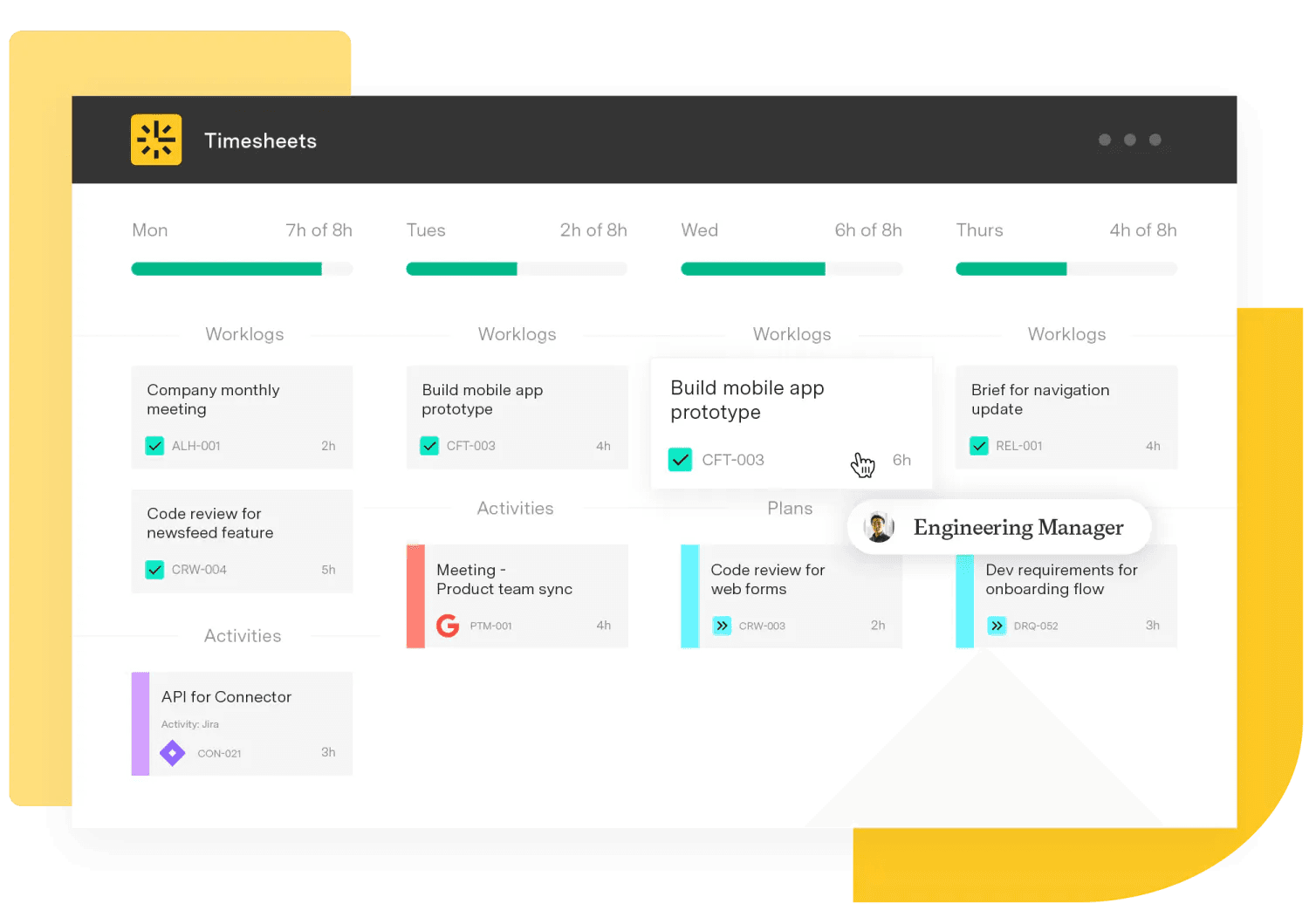
Tempo Timesheets helps organizations understand how their teams spend their time and matches daily activities with strategic goals. This allows businesses to see if their time investment aligns with their OKRs, ensuring that resources are allocated to the most impactful work.
Tempo Structure PPM provides a clear overview of project progress and resource allocation across your entire portfolio. This tool allows you to track the hours spent on each task, giving you insight into any blockers.
Tempo's capacity planning tools make it easier to optimize resource allocation in support of those goals. By visualizing the time and effort invested in projects directly linked to your OKRs, you gain visibility into how well your teams drive results.
Timesheets
The #1 time-tracking app for Jira. Timesheets seamlessly integrates with Jira and your existing workflows to help you track time for accounting, CapEx tracking, client billing, compliance, and more.
Start a Free TrialCouldn't find what you need?Go to our documentation
Tracking Objectives and Key Results effectively is crucial for aligning teams, maintaining focus, and driving measurable progress toward strategic goals.
Best practices for tracking OKRs
Establish a regular review cadence through weekly or bi-weekly check-ins. Assess progress, address challenges, and adjust strategies as needed.
These sessions foster accountability and keep teams aligned with organizational objectives.
Use clear scoring systems by adopting a scale from 0.0 to 1.0 to quantify progress. A score of 0.0 to 0.3 needs significant improvement. A score of 0.4 to 0.6 shows moderate progress. A score of 0.7 to 1.0 means you're on track or exceeded expectations.
This transparency helps identify areas requiring attention.
Visualize progress with dashboards that display real-time data. Highlight achievements and areas needing improvement.
Tools like Weekdone and Tability offer intuitive dashboards that simplify tracking and reporting.
Align OKRs across all levels by ensuring that individual, team, and departmental OKRs connect with the organization's overarching goals. This alignment promotes coherence and collective focus toward shared objectives.
Automate tracking to reduce manual effort using OKR software that automates data collection and progress updates. This minimizes manual input and potential errors.
Platforms like Profit.co and Tability provide features that streamline the tracking process.
Recommended OKR tracking tools
Weekdone provides weekly OKR tracking with a simple interface, team alignment features, and feedback loops.
Tability offers lightweight OKR management with real-time updates and a user-friendly design.
Profit.co delivers a comprehensive OKR platform with goal setting and performance management capabilities.
SugarOKR serves startups and growing teams with an easy-to-use interface that focuses on alignment.
Additional tips for OKR success
Set ambitious yet achievable targets that challenge the team but remain attainable. Stretch goals should motivate rather than discourage.
Foster a culture of transparency by encouraging open discussions about progress and obstacles. This promotes collective problem-solving.
Celebrate milestones by acknowledging achievements to maintain motivation and reinforce desired behaviors.
By implementing these practices and utilizing the right tools, you can effectively track and achieve your OKRs, driving your organization toward its strategic goals.
When evaluating OKR software, consider how each platform aligns with your organization's size, goals, and existing workflows.
Leading OKR tools comparison
- Quantive suits enterprise-level strategy execution with AI-driven insights, cascading goals, and performance forecasting. It works best for teams with 50-plus members.
- Tability serves startups and small teams with a modern interface, real-time updates, intuitive design, and flexible integrations. It fits teams of 5 to 50 members.
- Weekdone works for small teams and startups with weekly OKR tracking, KPI dashboards, and TV mode for meetings. Team sizes of 5 to 50 members benefit most.
- Profit.co targets mid to large organizations with OKR and performance management integration, task tracking, and mobile access. Organizations with 50-plus members use it effectively.
- Perdoo handles strategy and performance alignment through OKRs, KPIs, performance reviews, one-on-ones, and check-ins. It scales for teams of 20 to 200 members.
- WorkBoard focuses on large enterprises with OKR execution, analytics, coaching, and outcome mindset methodology. Organizations with 100-plus members get the most value.
- Fitbots provides OKR software with coaching and certification to build an outcome-focused culture. Companies with 50-plus members benefit from the coaching approach.
- Lattice specializes in people and performance management, integrating OKRs with 360-degree feedback, engagement surveys, and performance reviews. It serves organizations with 50-plus members.
Key differentiators
- Quantive offers AI-driven insights and cascading goals, making it suitable for large enterprises requiring sophisticated analysis.
- Tability features a modern interface with real-time updates and flexible integrations, ideal for startups and small teams wanting agility.
- Weekdone provides weekly OKR tracking and KPI dashboards with a TV mode for meetings, catering to small teams preferring visual displays.
- Profit.co integrates OKR and performance management with task tracking and mobile access, suitable for mid to large organizations needing comprehensive features.
- Perdoo combines OKRs, KPIs, and performance reviews, offering a comprehensive strategy and performance alignment tool for growing companies.
- WorkBoard focuses on OKR execution with analytics and coaching, tailored for large enterprises requiring structured implementation support.
- Fitbots provides OKR software with coaching and certification, promoting an outcome-focused culture through guided implementation.
- Lattice specializes in people and performance management, integrating OKRs with comprehensive performance review systems.
Choosing the right OKR tool
For startups and small teams, consider Tability or Weekdone for their user-friendly interfaces and scalability.
For mid to large organizations, Profit.co or Perdoo offer comprehensive features suitable for larger teams with complex needs.
For enterprises, Quantive or WorkBoard provide advanced analytics and enterprise-level support for sophisticated implementations.
For people-centric organizations, Lattice integrates OKRs with performance management tools to support comprehensive employee development.
Several free OKR software options help align and track your team's goals, from startups to small teams.
Top free OKR tools
SugarOKR provides a user-friendly interface designed for simplicity. It helps teams stay focused and aligned on their goals through intuitive design.
OKR by BOJA offers a free plan with no user limits. This makes it suitable for both individuals and teams aiming to align and track their objectives.
Weekdone works for teams looking to implement weekly OKR tracking. The free plan supports up to 3 users and features weekly check-ins with progress tracking.
Perdoo's free plan supports up to 10 users and provides a comprehensive OKR framework. It includes goal setting and tracking tools for growing teams.
Burning OKR offers an open-source solution for those comfortable with self-hosting. It can be customized to fit specific organizational needs.
Notion provides customizable OKR templates that can be tailored to your team's workflow. It offers a flexible and visual approach to goal setting.
Comparison of free OKR tools
SugarOKR provides full access with no user limits, making it best for teams seeking simplicity and straightforward implementation.
OKR by BOJA is free forever with no user limits, ideal for individuals and small teams starting their OKR journey.
Weekdone offers free access for up to 3 users, perfect for teams wanting weekly OKR tracking and regular check-ins.
Perdoo provides free access for up to 10 users, suitable for teams wanting structured OKR frameworks with comprehensive tracking.
Burning OKR is open source and self-hosted, best for tech-savvy teams comfortable managing their own infrastructure.
Notion Templates are free with a Notion account, ideal for teams wanting customizable OKR setups within a flexible workspace.
Choosing the right free OKR tool
Each tool offers unique features tailored to different team sizes and needs. Consider your team's requirements and technical capabilities when choosing the right OKR software.
For teams prioritizing simplicity and ease of use, SugarOKR or OKR by BOJA provide accessible starting points.
For teams wanting regular check-ins and visual tracking, Weekdone delivers weekly OKR management.
For structured frameworks with comprehensive features, Perdoo offers robust tools within its free tier.
For technical teams wanting full control and customization, Burning OKR provides open-source flexibility.
For teams already using Notion, the built-in OKR templates integrate seamlessly with existing workflows.
OKR software is a type of goal-setting software that helps organizations define and measure outcomes across all levels of the business.
The best OKR tracking software depends on your team’s size, structure, and needs. Jira Align works well for large agile teams, while tools like Perdoo or Weekdone are great for smaller groups.
Many platforms connect OKRs to individual performance. This is especially true for employee goal-setting software like 15Five or Lattice, which integrate OKRs with one-on-ones and feedback cycles.
An OKR software comparison between competing platforms should analyze their features, scalability, and cost. Look for tools that offer alignment tracking, goal transparency, easy-to-use dashboards, and integrations with your existing systems, but that also stay within your budget.
Yes. Tempo’s tools, including Timesheets, Structure PPM, and Portfolio Manager, support OKR tracking by connecting team activity, time data, and progress reporting within Jira.
Explore the best KPI software for tracking performance and aligning goals. Compare top tools & see how Tempo surfaces real-time KPIs directly in Jira.

Discover how goal-setting software promotes clarity, accountability, and alignment from strategy to execution, helping teams deliver results.

Discover eight OKR templates to set and track team goals, including Excel, Google Sheets, & other planning formats that support alignment & execution.

B2B CRM software streamlines sales, enhances collaboration, and improves forecasting. Explore top options, and find the right one for your business.

Learn how to use an initiative tracker to monitor your progress and goals. Discover software solutions to optimize your workflow.

Track key metrics in real time with a KPI dashboard. Learn how to build one, explore examples, and improve visibility using Tempo’s Jira-native tools.

Learn how to turn annual goals into 90-day targets with structured quarterly planning that supports alignment, adaptability, and measurable progress.

Learn how to write an effective project progress report with our step-by-step guide and actionable best practices.
Stretch goals are just outside your reach, but that doesn’t mean they’re unachievable. These are ambitious goals that push you and your team further.