Discover the importance of productivity tools and how they can help your team work smarter, collaborate better, and achieve goals more efficiently.
Discover product management tools to enhance your launches. Tools offer heatmaps, immersive user research, roadmapping, product analytics, and more.

As technology rapidly evolves, so does the field of product management. Product managers must stay updated on new tools and resources that can facilitate efficient project management; software drives successful product launches.
Numerous product management tools exist to streamline your workflow and elevate your overall performance as a product manager. Each is tailored to specific needs so you can find the right tool for your unique approach.
Product management tools are the backbone of project planning and execution. They help teams coordinate their efforts, streamline workflows, and adhere to deadlines.
However, choosing the best software for your company can be tricky. Each option has unique features, making the selection process overwhelming. You must identify and prioritize the features your team needs the most. Whether it’s detailed reporting tools or advanced collaboration features, knowing what your team requires will help you choose software that best suits your business goals.
Sign up for a demo
Request demoIn no particular order, here are 10 product management tools your team should consider based on specific use cases:
Where are customers clicking on your website or digital product? How far are they scrolling down the page? Where are they hovering?
Heatmaps show you what parts of the experience draw the most attention and which facets are underperforming. They show how web and mobile visitors behave when interacting with your website. You’ll learn whether your calls to action work and discover what user interface elements might be frustrating or confusing. With this information, you can adjust accordingly.
Our favorite: FullStory helps companies monitor the digital experience of their products, services, and websites – especially where customers need help understanding or using a specific feature. It also provides custom reporting with valuable insights into the root causes of these problems.
User research or user experience testing software provides a cheaper, quicker alternative to focus groups. Deliver your product to end-users so they can try it out. Then, gather their feedback (typically via surveys or interviews) and adjust products as necessary.
Our favorite: Maze helps you validate new product ideas, feature updates, and roadmap decisions with usability testing and feedback options sent directly to end users. PMs can capture early-stage feedback on new products or create testable wireframes to get input before using prototyping tools.
If you don’t have a user base to sample, you can use the Maze Panel, a group of Maze-approved testers.
Product management roadmapping software visually represents your strategy, communicating the how and why behind feature releases. Roadmapping lets teams base their plans on honest customer feedback and set the right priorities. It reduces repeat questions and creates clarity and confidence for internal and external stakeholders.
Our favorite: Strategic Roadmaps of course! It’s geared toward user-friendliness and high visual appeal, keeping everyone aligned on managing product strategy. Varied roadmap templates help users start quickly, and integrations with Jira, Azure DevOps, Asana, Trello, GitHub, GitLab, and Shortcut eliminate duplicate data entry and keep everyone updated. You can also use the master portfolio view to roll up all your organization’s roadmaps for a bird’s-eye view of every project.
Product analytics tools help you gather and analyze various data points about how people find and explore your product, which types of customers are the most valuable for your company (e.g., subscription-based versus one-off purchasers), what might make customers leave, and more. Your team can better track, visualize, and understand engagement and behavior data to enhance existing products and develop new ones that tap into unmet customer needs.
Our favorite: Amplitude is a digital analytics platform that helps PMs discover the specific features and customer actions that generate loyal, high-value customers. It analyzes data you’re already collecting across your company to give real-time insights into customer acquisition, activation, engagement, and retention.
Product onboarding software guides users through your product so they understand what it does and how to get the most out of it. Feature tours highlight new or essential aspects of the product experience. Ideally, the software feels like a seamless, on-brand part of the app, but you don’t have to task your developers with creating it.
Our favorite: Appcues helps PMs design, create, test, and publish onboarding experiences. It includes tooltips, short videos, and in-app surveys and lets you build targeted experiences for different types of users.
Instead of laboriously building a deck from scratch, presentation software provides templates and visual tools to quickly create high-quality presentations so PMs can express their product visions creatively and effectively.
Our favorite: Beautiful.ai has attractive, intuitive templates for individual slides and complete presentations. Smart templates follow design best practices, and you can easily incorporate your branding.
Beautiful.ai also has an impressive slate of integrations. For example, you can get Slack notifications about new comments on the deck, pull media from Dropbox, or quickly dress up PowerPoint presentations.
Finding a calendar opening where the whole team can get together is tough, but a lengthy message on Slack or another text-based collaboration tool doesn’t always cut it. That’s where recording and sharing short videos comes in handy.
It’s often more accessible and impactful to talk through something (rather than type it). A straightforward video tool helps you asynchronously record and share information and conversations, which is a lifesaver for remote teams.
Our favorite: Loom has valuable features for collaboration. Viewers can add comments and reactions to videos. Users can enhance their presentations by drawing on the screen as they record. Presenters can also add calls to action to point their audience toward the next step in the collaborative process.
A virtual whiteboard provides a visual space to mull over ideas together, especially during brainstorming around specific questions or goals. With a shared mind-mapping tool, your remote team can better plan projects and hold free-flowing discussions.
Our favorite: Miro lets you put your heads together and visualize ideas however you like – in hierarchies, flow charts, random sticky notes, or whatever suits the topic. PMs can use it to build wireframes and user flows, automatically import customer feedback from other tools, or help guide team conversations in a productive, strategic direction.
Companies store customer data across various locations, slowing down PMs who need it to make informed decisions. Data management tools help you find and organize data from multiple sources for more efficient use.
Our favorite: Segment helps companies integrate the data they collect and store in their tech stack. PMs can collect real-time user experience data from web and mobile apps to develop a comprehensive view of their users.
Product teams, marketing, and company leadership require a shared understanding of who their customers are and what they need. Product managers can develop this understanding with tools that articulate user experience workflows and uncover the product features they value most. You need time to build and update personas and the customer journey; these tools make that work easier and faster.
Our favorite: TheyDo creates a big-picture view of all customer journeys. Unify all customer journeys in the application, increasing their visibility with filters. It has journey templates to standardize their look and feel, plus an automatic prioritization feature to improve your customer experience decisions.
Product and project management tools aren’t just helpful; they’re must-haves. They make a team more efficient, effective, and organized. With centralized collaboration, everyone understands their roles and responsibilities.
Moreover, these tools let you optimize resources and the product development process. Companies with a centralized platform can allocate resources and manage tasks to maximize their assets and abilities.
These tools ensure high productivity and effectiveness by illustrating resource availability, efficiently assigning tasks, and monitoring real-time progress. For example, Kanban boards use cards to visualize work items at various stages.
Additionally, product management tools offer flexibility. They adapt as a business grows and changes, providing value during each product lifecycle stage. They track valuable data, facilitate communication, and ensure every process aligns with the overall strategy.
When selecting the ideal product management tool for your business, consider these factors:
User-friendliness: The tool should be easy to implement. Does it offer user-friendly interfaces, onboarding workflows, and ready-to-use templates?
Features: The tool must meet your specific needs. Look for comprehensive task management capabilities and specialized features that satisfy your business requirements.
Integration: You need seamless integration with the software your company already uses. This ensures a smooth transition and operation for your entire team.
Customization and flexibility: The best product management tools enable customization and adaptability. Does the tool enable you to tailor workflows, features, or processes?
Collaboration capabilities: Look for a tool that fosters efficient collaboration among team members via shared task lists, streamlined communication channels, or accessible project updates.
The best product management tool is the one that works for your specific use case and organizational requirements. Most software tools offer free trials and demos. The time you spend researching and onboarding a new solution will pay off in the long run, ensuring fewer headaches, better insights, and closer team collaboration.
Need help aligning your company’s strategic vision? Check out Strategic Roadmaps’ roadmap templates page to facilitate quick progress toward your big-picture goals.
Strategic Roadmaps
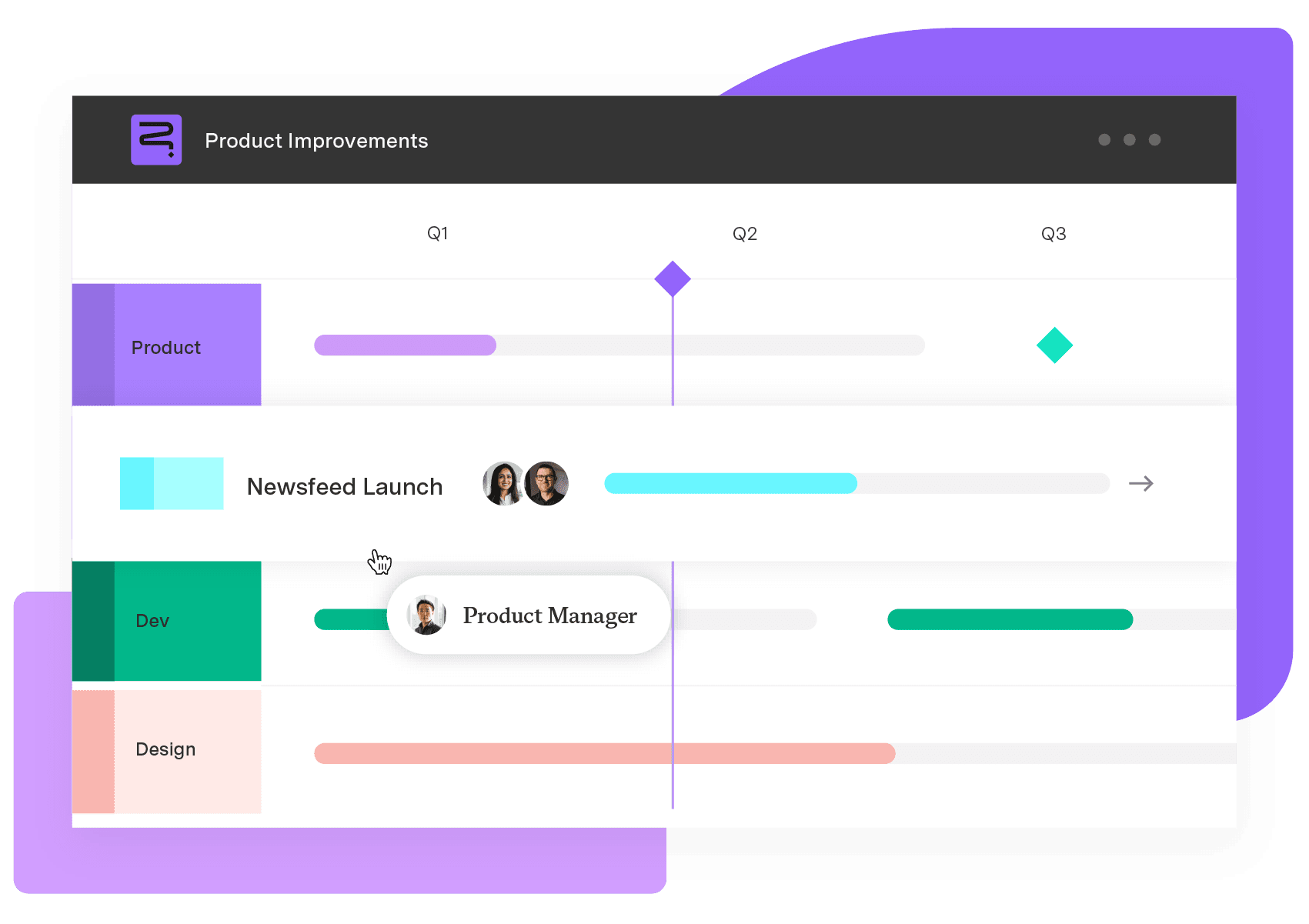
Build your portfolio vision with Strategic Roadmaps. With powerful visualization capabilities, you can communicate strategy to the entire organization and gain alignment around strategic objectives, product goals, and milestones.
Start a Free TrialCouldn't find what you need?Go to our documentation
Product management systems are digital tools used by product teams to oversee every phase of the product lifecycle. They cover idea generation, customer feedback, sprint execution, releases, and post-launch analytics.
The systems help align strategy, execution, and stakeholder communication into a cohesive, manageable workflow.
Core functions
Idea and backlog management captures, prioritizes, and organizes feature ideas, requests, and roadmap items in a central repository.
Product roadmapping builds and shares high-level visual roadmaps that align product strategy across teams.
Task and sprint tracking creates prioritized backlogs, manages user stories, and tracks progress using Scrum or Kanban boards.
Automations reduce friction and manual workload by automating routine tasks or transitions.
Collaboration and documentation hosts your product requirement documents, briefs, meeting notes, and feedback loops in integrated or partnered doc tools like Jira with Confluence, ClickUp docs, or Notion.
Integrations connect to analytics tools, design apps like Figma, Slack or Teams, code repositories, and feedback platforms.
Benefits for product teams
Product management systems streamline workflows and increase efficiency by eliminating scattered tools in favor of centralized planning, execution, and reporting.
One source of truth consolidates roadmap, backlog, feedback, and status reporting into a unified platform. This improves visibility for all stakeholders.
Better alignment and transparency happen through roadmaps and dashboards that help align engineering, design, marketing, and leadership teams on objectives and timelines.
Efficient sprint execution comes from agile tools that make backlog grooming, sprint planning, and progress tracking cleaner and more structured.
Feedback prioritization and decision support happen through systems that enable prioritizing features with built-in feedback loops or AI-driven scoring.
Automated reporting and analytics through custom dashboards track key metrics across teams and sprints, assisting in data-informed decision-making.
Popular tools and use cases
Jira works for agile software development teams with backlog, issue tracking, customizable workflows, and automation.
Asana suits cross-functional product teams with multi-view project tracking, timelines, automation, and collaborative access.
ClickUp provides an all-in-one workspace for documentation, roadmap, and execution. It's highly customizable with built-in docs and AI-supported workflows.
ProductPlan focuses on visual roadmap building and strategic planning with drag-and-drop roadmaps and collaborative feedback tools.
Monday.com handles workflow alignment across product and operations with visual workflows, automations, and cross-team dashboards.
Airfocus, Productboard, and Craft.io support feedback-driven prioritization and product strategy with AI-assisted planning and built-in customer feedback integration.
How product management systems help
The systems accelerate ideation to decision-making with idea capture, prioritization, and alignment using fewer meetings and email threads.
Improved team coordination means everyone knows what's being built, when, and why. Developers, product leads, and stakeholders stay aligned.
Support for agile delivery comes from tools that enable fast sprint cycles and adaptive responses to change.
Track feedback and measure impact through AI-enhanced or feedback-integrated tools that help prioritize based on business value and user needs.
Simplified stakeholder communication happens through visual roadmaps and shared dashboards that keep executives and cross-functional teams in sync.
Choosing the right system
Consider the size and maturity of your team. Jira and ProductPlan suit engineering-heavy teams, while Asana or Monday work well for mixed or non-technical teams.
Look at tools already in use. If your organization uses Confluence or GitHub, Jira integrates seamlessly. ClickUp may align better if docs and tasks need centralization.
Evaluate your need for feedback prioritization. Platforms like Productboard, Airfocus, or Craft.io offer deeper prioritization workflows.
Determine your level of customization needs. ClickUp and Monday allow tailored workflows, while simpler tools may work well for smaller product teams.
Essential tools for product development support every stage from ideation to launch, testing, and feedback.
Ideation and collaboration
Miro provides a real-time visual canvas for brainstorming, user journeys, roadmapping, and mind-mapping. It excels at aligning cross-functional teams around concepts and strategy.
Notion offers an all-in-one workspace combining ideation, documentation, task-tracking, and knowledge sharing. Teams often use it as an internal wiki or research repository.
Design, wireframing, and prototyping
Figma is a cloud-based UI/UX design platform supporting wireframes, prototypes, shared components, and real-time collaboration. It even bridges handoff to engineering.
Balsamiq provides low-fidelity wireframing focused on concept structure and flow. It's quick, intuitive, and ideal for early-stage sketches.
Project and agile task management
Jira is a robust tool tailored to Agile development. It enables backlog management, sprint planning, issue tracking, reporting, and workflow automation – and is especially powerful with built-in Tempo apps like Timesheets, Capacity Planner, and Financial Manager.
Trello offers a lightweight Kanban-style board tool for smaller teams or simpler workflows, with visual task tracking, automation called Butler, and integrations.
Asana provides flexible project management with timeline views, custom fields, task dependencies, and reporting. It works well for cross-functional coordination.
ClickUp delivers a full-featured productivity workspace combining docs, Kanban boards, Gantt charts, whiteboards, and integrations. It's ideal for centralized planning.
Feedback, analytics, and decision-making
Productboard enables centralization of customer feedback, prioritization of feature ideas, and alignment of roadmaps with user insights.
Amplitude (or Mixpanel) provides quantitative analytics for tracking user behavior, retention, conversion, and engagement to inform product decisions.
Workflow automation and integration
Zapier connects and automates repetitive tasks across tools. For example, it syncs feedback into your roadmap or auto-creates tasks from form entries. This saves time and keeps data in sync.
Communication and cross-team coordination
Slack provides real-time messaging organized by topic or team channels, integrating with project tools. It keeps product discussions fluid.
Zoom (or equivalent) offers video conferencing and screen-sharing for design reviews, usability feedback sessions, and cross-team alignment meetings.
Emerging tools and specialized use cases
Requstory provides an AI-powered workspace to streamline writing user stories and process maps, helping early-stage teams.
Blitzllama offers in-app feedback and surveys for gathering user insights directly from customers in real time.
Tool mapping by product stage
For ideation and brainstorming, use Miro, Notion, or Requstory to capture ideas and align vision.
For wireframing and prototyping, Figma and Balsamiq enable rapid mockups and user validation.
For agile planning and tracking, Jira, Trello, Asana, and ClickUp handle sprint planning, tasks, and collaboration.
For feedback and prioritization, Productboard, Blitzllama, and Google Sheets help score features and process insights.
For user behavior analytics, Amplitude and Mixpanel measure engagement and usage patterns.
For automation and integrations, Zapier keeps tools in sync and automates workflows.
For communication and alignment, Slack and Zoom support discussions, presentations, and decision-making.
Why these tools matter
This stack offers product teams faster alignment through Miro and Notion that help surface consensus early.
Reduced waste comes from Figma and Balsamiq enabling rapid iteration before development.
- Clear execution happens through Jira or Asana streamlining workflows and sprint cycles.
- User-focused priority results from Productboard or Blitzllama guiding decisions using real feedback.
- Insight-driven evolution comes from analytics tools surfacing what works post-launch.
- Operational efficiency happens through Zapier automating routine coordination across systems.
- Seamless collaboration comes from Slack and Zoom keeping teams connected across geographies.
Production managers rely on powerful tools to plan, schedule, monitor, and optimize manufacturing operations from shop floor execution to enterprise-level resource planning.
Manufacturing and production scheduling tools
Odoo Manufacturing provides an integrated ERP with modules for production scheduling, inventory tracking, quality control, and work order management. Its modular architecture and real-time data make it a versatile platform for scalable production control.
Katana MRP is designed for small to midsize manufacturers. It offers visual drag-and-drop scheduling, real-time shop-floor tracking, material requirement planning, and integration with e-commerce and accounting tools.
SAP S/4HANA Manufacturing delivers an enterprise-grade solution with AI-driven forecasting, production costing, and tight integration across procurement, inventory, and execution systems. It's ideal for large-scale and complex manufacturing environments.
Oracle Production Scheduling and NetSuite combine scheduling capabilities with ERP and real-time dashboards. They support efficient resource allocation and multi-site production oversight.
Manufacturing execution systems
MES platforms like DELMIA, Siemens Opcenter, and DELMIA Apriso help production managers monitor real-time operations including work-in-progress, quality control, and downtime. These integrate deeply with ERP systems and support traceability and compliance tracking.
Advanced production simulation and optimization
Siemens Tecnomatix Plant Simulation provides discrete-event simulation software used to model manufacturing flows, material usage, throughput, and production layouts. It's useful for planning expansions or redesigning processes with visual analytics.
FlexSim offers another top-tier simulation platform for logistics, robotic cells, conveyor systems, warehousing, and process optimization. It's ideal for evaluating layout changes or automation investments.
Quality, OEE, and process monitoring
Statistical Process Control tools detect variation within manufacturing processes to control quality and reduce scrap.
Overall Equipment Effectiveness tools offer real-time metrics on equipment efficiency, performance, and quality to inform maintenance or process decisions.
Combined with Industrial IoT platforms, these tools support predictive maintenance, resource utilization tracking, and live process dashboards. They provide insights from shop floor to strategy.
Additional tools for broader production management
Adobe Workfront provides a robust enterprise-level work management tool with capacity and resource planning, workload balancing, portfolio scheduling, automated workflows, and approval processes. It suits creative, IT, or operations production teams that span departments.
Camunda and Signavio serve as process and BPM platforms. They're useful in production management for designing, automating, and optimizing workflow and process logic. Camunda is open-source and configurable, while Signavio offers strong modeling and collaboration features.
Recommendations for production managers
Start by identifying immediate needs like scheduling, inventory, real-time tracking, quality control, or process flow optimization.
Smaller teams may benefit from Katana or Odoo. Larger operations often lean toward SAP S/4HANA, Oracle NetSuite, or MES platforms.
For actionable insights, mesh MES with ERP systems and incorporate OEE or SPC tools.
Use Plant Simulation or FlexSim to evaluate process changes, equipment layouts, or scaling decisions with minimal operational risk.
Consider SOP standardization through Camunda or Signavio for firms focused on continuous improvement, compliance, or cross-functional traceability.
Discover the importance of productivity tools and how they can help your team work smarter, collaborate better, and achieve goals more efficiently.

Explore the best OKR software for goal alignment and progress tracking. Compare top tools and learn how Tempo enhances OKR visibility in Jira.

Learn about common product management challenges and how to prepare for them. Find out how using the right tools helps you do better work.

Take control of your schedule with time management AI. Use smart tools to schedule meetings, set deadline alerts, and establish time blocks for work.

Take control of your project management tasks by implementing project planning tools to foster collaboration and increase team productivity.

Discover how goal-setting software promotes clarity, accountability, and alignment from strategy to execution, helping teams deliver results.
Discover how to conduct a product audit and how it improves manufacturing productivity, quality assurance effectiveness, and customer satisfaction.

Develop your product sense with five simple tips and guidance from top product managers. Use these insights to drive innovation of your own.

Learn how timesheet reports enhance productivity and resource management. Discover valuable tools that automate the reporting process.