Learn how user story mapping helps agile teams break down work, align goals, and build better products with real user value.
Epics and stories are part of your working hierarchy. Learn how they help you and your teams break work into manageable chunks.

An epic is a large chunk of work that gets broken down into smaller tasks — usually called issues or stories in Jira or a similar tool. Epics and stories form the working hierarchy that lets teams split big goals into manageable pieces.
Why the dramatic name? Some early agile thinker with a soft spot for ancient Greece noticed that "epic" (ἔπος/epos) meant a long story, and the label stuck. Epics are the big narratives that contain the smaller stories about your work.
An epic could be a product launch, a major campaign, or any sizeable business goal. Group epics that share a purpose and you have an initiative. Group initiatives that ladder up to long-term company objectives and you have a theme.
The point of the whole structure is to make work legible both top-down and bottom-up. Every small issue traces up to a larger project. Every project traces up to a company goal. Boardroom ambitions get a path to real, shippable work.
Breaks a team's work into pieces small enough to plan and finish
Keeps day-to-day tasks tied to bigger goals so priorities stay visible
Well-supported by agile tools, so setup and tracking are largely built in
There is no one-size-fits-all shape for an epic, but most run for several weeks or months, carry their own success metrics, contain smaller issues and subtasks, and link up to a broader theme.
Here is a quick example.
Your team builds a tool that helps people work in Jira. For the next major release, customer feedback keeps flagging the UX as clunky, so the team commits to a UX overhaul.
Create an epic called "UX improvements" inside the initiative for release 5.1.2.
Break it into stories: New font system, visual redesign of common fields, stability fixes, and new panels.
Assign each story a timeframe, a description, and (ideally) an owner.
Story size is up to you. Some stories span weeks; others take an hour. What matters is that every issue rolls up to an epic. Finishing the stories completes the narrative arc of the epic itself.
Homer would be confused about how we got from Achilles to agile software, but the shape of the story is the same.
Managing epics and stories well is what keeps projects aligned to strategic goals, especially at large organizations. Structure gives you a clean way to organize issues in an advanced agile hierarchy — from the largest epic down to the smallest sub-task, all connected, all native to Jira.
With Structure, epics and stories live in a single source of truth. Visibility improves, alignment tightens, and project execution gets less friction between the plan and the work.
For a step-by-step walkthrough, see the guide on managing epics and stories with Structure.
Learn more about Structure and try it for yourself.
For more direct tips on running epics and stories inside Structure, take a look at the guide.
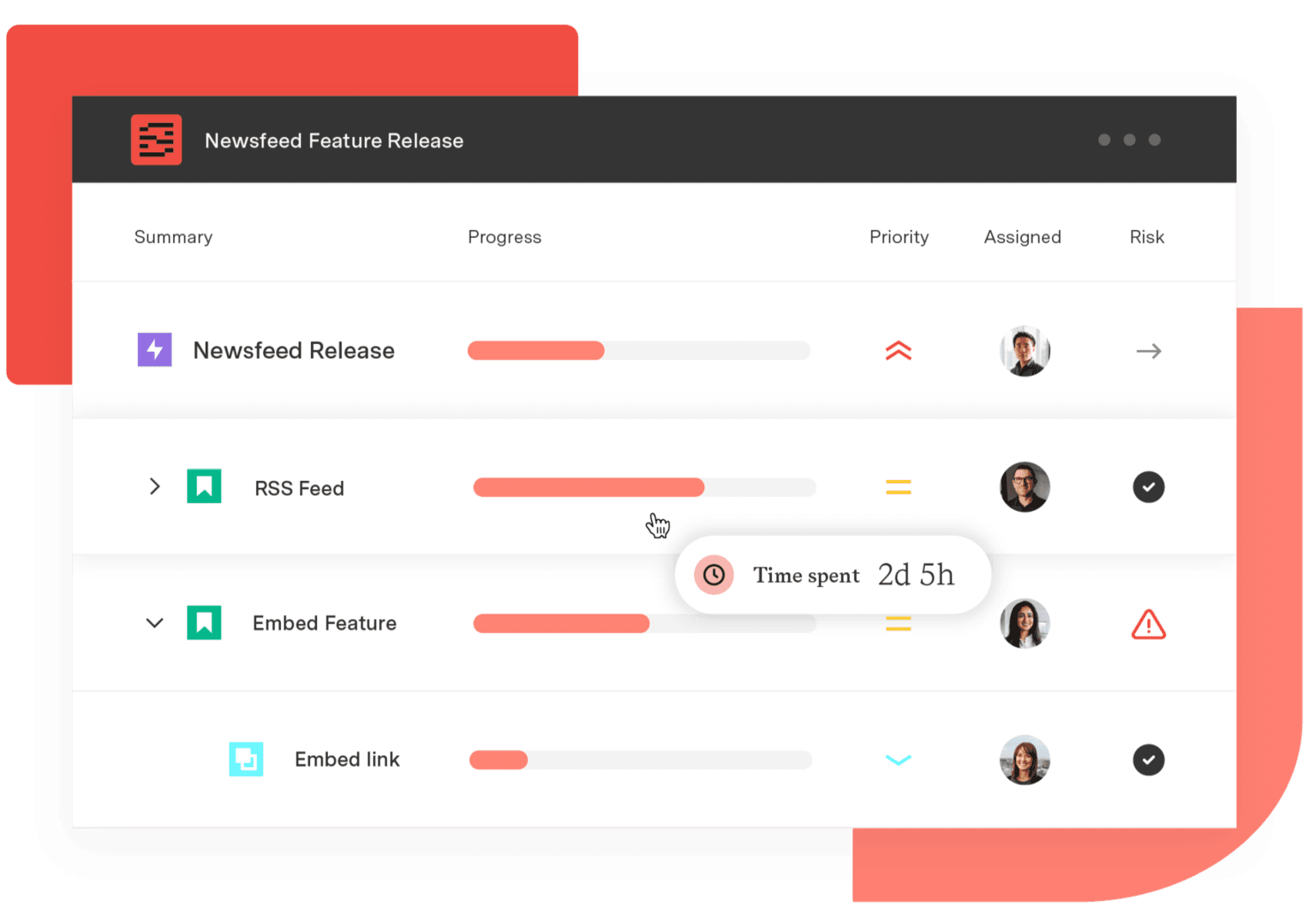
Structure PPM
Manage products, projects, and programs in a single spreadsheet-like view. By providing a clear, real-time view of project progress and resource allocation, Structure helps teams meet deadlines and adapt swiftly to changing priorities.
Start a Free TrialCouldn't find what you need?Go to our documentation
Measuring epics involves tracking the progress of various user stories and tasks that fall under them. This can be done using key performance indicators (KPIs) such as:
Story points: Assigning points to each user story to estimate the effort required.
Completion percentage: Measuring the ratio of completed tasks to the total number of tasks.
Time spent: Tracking the actual time spent on tasks in comparison to the estimated time.
Burndown charts: Visual representations that show the remaining work versus the time available to complete it.
A burndown chart is a graphical tool used track the amount of work remaining in a project or sprint. It plots time on the x-axis and work remaining (in story points or hours) on the y-axis. As tasks are completed, the line on the chart "burns down" to zero, ideally reaching zero by the end of the sprint. This helps teams visualize their progress and identify any potential bottlenecks.
Epics are best used when you have large, complex features or initiatives that need to be broken down into smaller, more manageable tasks. They are particularly useful when:
- Planning long-term projects
- Aligning teams as epics can display a common objective for teams to work towards
- Managing dependencies between various tasks and user stories
- Tracking progress for larger bodies of work
Learn how user story mapping helps agile teams break down work, align goals, and build better products with real user value.

When you report on epics in Jira, you get a big-picture view of the work being done. Find out how to visualize your epics on Jira dashboards.

Perfect the art of agile story mapping to develop products and features that delight consumers while meeting their needs and maximizing value.

Learn how agile project management helps teams stay flexible, work smarter, and deliver results faster. Explore key principles, methods, and benefits.

While the distinction may seem trivial, there are far-reaching implications to choosing which option is right for your organization.

Learn about different levels within the Jira hierarchy and how to leverage them to prioritize tasks, improve productivity, and monitor progress.

How to use Structure's progress aggregation for tracking progress in Jira agile projects from different angles and at different levels.

Why can it feel like such a headache to get everyone, from leadership to long-established teams, on the same page and working with agile?

Structure's portfolio-management capabilities by help you create data-informed timelines, adapt to the unexpected, and deliver results more reliably.