How to use Structure's progress aggregation for tracking progress in Jira agile projects from different angles and at different levels.
Learn about different levels within the Jira hierarchy and how to leverage them to prioritize tasks, improve productivity, and monitor progress.

Structure is how project teams turn chaos into shipped work. Atlassian's Jira Cloud captures that structure by breaking projects into units called issues, then arranging those issues into a ranked framework that tracks every action item from intake to delivery.
That framework — Jira's issue hierarchy — is what lets teams prioritize, monitor progress, and keep stakeholders aligned on scope, schedule, and budget. Here's how it works, where it falls short, and how to extend it.
Every to-do item in Jira — fixing a broken link, drafting wireframes, signing a contract — is an issue. To make issues trackable, Jira sorts them into four default categories:
1. User story: Used in agile sprints, stories describe work from the user's point of view. Some teams break stories down further into tasks. 1. Bug: A defect the team must resolve before shipping. 1. Task: A catch-all unit of work owned by a single team member or group. Sometimes called a parent task. 1. Sub-task: A child of a bigger issue, used to split complex work into smaller, manageable pieces.
With the right permissions, admins can also create custom issue types for niche use cases. Distinct issue types give teams cleaner data, tighter dashboards, and workflows tuned to each kind of work.
Jira's hierarchy defines how issue types relate to one another.
Above the standard issues sits the epic. An epic represents a project or larger initiative that contains default issues plus parent and child tasks. It closes once every child issue underneath it is done.
Features bridge epics and user stories. This level groups stories into a single body of work that produces a function, component, or technical specification.
Jira models dependencies with a parent/child relationship, which streamlines tracking of individual components. The hierarchy covers epics, features, stories, and their dependent tasks: Epics sit at the top of the parental structure, followed by features, then bug, task, and story issues.
Organizing work into a tree gives project teams clearer visibility across the development lifecycle.
Sub-tasks are children of the default issue types — bugs, tasks, and stories. They add granularity to complex work units and make progress easier to track.
A project team needs a shared vision, but vision alone doesn't ship anything. Teams convert intent into a manageable process by breaking it into components and milestones, then organizing those into logical steps that track progress.
Each level of the hierarchy captures information through templated fields, including:
Title and description: Give assignees the context, requirements, and purpose of the work.
Start and end dates: Set the delivery timeline.
Priority level: Helps teams sequence work to hit critical milestones.
Size, story points, and effort estimates: Quantify scope and complexity to guide resource allocation and accountability.
Here's how each level works in practice.
Epics sit at the top of the project roadmap. They deliver big-picture outcomes tied to the project vision and typically span multiple releases.
Example: Stakeholders ask a mobile app team to "enhance the user experience." That goal becomes the epic.
Features outline the steps needed to achieve the epic's goals. They're smaller than epics but still meaningful pieces of the vision. Project teams work with stakeholders to identify and rank features.
Example: After user consultations, the team picks in-app messaging and improved search as the two highest-priority features.
Teams break features into stories that capture requirements from the end user's point of view. Each story ships with acceptance criteria and can be built, tested, and released on its own.
Example: For in-app messaging, stories include arrival and read receipts — signaling to a user whether a message was delivered and opened.
Tasks come out of user stories and define the exact work an assignee needs to perform. They can also cover QA testing and analytics.
Project managers often ask for effort estimates before work begins. If a task needs input from more than one person, the PM can split it into sub-tasks, adding another hierarchy level.
Example: The mobile team builds a function that pings the sender when their message hits the recipient's inbox and returns the read time.
Bug tracking is part of QA. The team logs defects that must be fixed before release, and the product owner uses Jira to triage which ones ship in the current sprint.
Example: An in-app message crosses time zones and the read receipt records the recipient's clock instead of converting to the sender's. Dev has to fix it before launch.
Jira's default hierarchy doesn't fit every project or org. Project managers can extend the tree to break high-level specs into more initiative or issue types across multiple epics. Teams can also add levels above stories — rather than subdividing tasks — so those items land inside sprints.
Jira Cloud Premium and Enterprise include built-in customization. The recommended path to add a new level:
1. Go to the bottom of the list of levels and click "+ Create level." This adds a new level at the top of the issue type hierarchy. 1. Name the level and open the dropdown in the "Jira issue types" column to associate it with one or more issues. 1. Click "Save Changes."
Jira Cloud or Data Center users on other tiers can install an app from the Atlassian Marketplace — search "issue hierarchy" and pick the option that fits.
Jira Cloud Premium users have another option: Advanced Roadmaps, which lets you configure issue types above the epic level and push roadmaps upward.
1. Create a "New Issue type" and configure it to sit above epics in the hierarchy. 1. Link "Epics" to the new parent issue using the "Parent link" field. 1. Once linked, child epics appear inside the parent category, similar to child stories nested under epics.
Tempo's tools help teams solve hierarchy problems inside Jira. The modular portfolio management suite is built to scale, giving enterprises a single view of every ongoing and planned initiative so they can coordinate work and resources across teams.
Structure PPM connects work across multiple epics and groups, so project managers can align initiatives with strategic goals and spot bottlenecks in real time.
Tempo Timesheets adds trusted time tracking and capacity management. Integrated with Jira, it shows exactly where time goes across projects, epics, and tasks — surfacing where processes can improve.
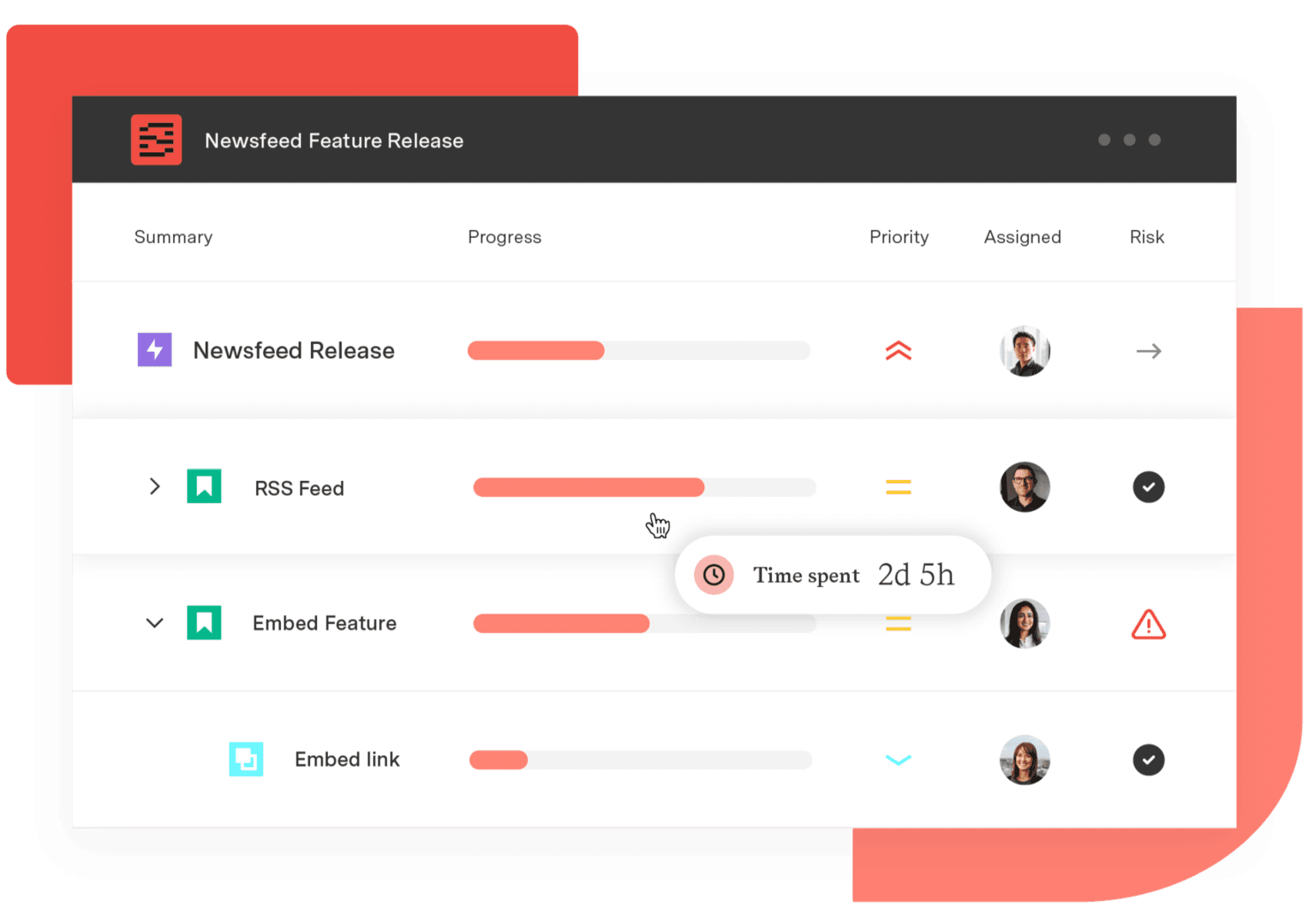
Structure PPM
Manage products, projects, and programs in a single spreadsheet-like view. By providing a clear, real-time view of project progress and resource allocation, Structure helps teams meet deadlines and adapt swiftly to changing priorities.
Start a Free TrialCouldn't find what you need?Go to our documentation
Jira Align is an enterprise-level task management solution. Similar to Jira Cloud, it includes a tree-like hierarchical structure that shows data from the highest organizational level to teams.
In Jira Service Management, service tiers distinguish between mission-critical services and valuable but nonessential services.
Jira users define stages as the sequential workflow required to complete a task.
How to use Structure's progress aggregation for tracking progress in Jira agile projects from different angles and at different levels.

Simplify project work by categorizing and tracking tasks using Jira issue types and hierarchies to uncover trends and prioritize work.

Unlock the power of Jira automation to streamline business processes, manage repetitive manual tasks, and boost productivity, all in a few keystrokes.

With Advanced Roadmaps you can create long-term plans in Jira tying together the work of different teams. But what are the reporting options?

Combined with Tempo’s Strategic Roadmaps, Jira is a powerful way to visually represent and communicate strategic, product, and project plans.

Did you know you can use Timesheets data to track project progress by billable hours and more – all within the Structure interface?

Yes, Jira works for waterfall. Learn how to configure native workflows, Advanced Roadmaps, and Gantt Charts to run sequential or hybrid projects.
Epics and stories are part of your working hierarchy. Learn how they help you and your teams break work into manageable chunks.

Structure's portfolio-management capabilities by help you create data-informed timelines, adapt to the unexpected, and deliver results more reliably.