Learn how to use an initiative tracker to monitor your progress and goals. Discover software solutions to optimize your workflow.
Learn how to use a project tracker to assess progress, identify risks, and manage resources, taming the chaos and setting your team up for success.

A project tracker is software that records task status, timelines, budgets, and resources in one place so the team and stakeholders can see where the work stands. Without one, project managers rely on scattered updates, stale spreadsheets, and hallway conversations to answer questions leadership expects on demand.
With an online project tracking tool, leaders monitor task progress, assess timelines, and check resource reliability while keeping stakeholders informed of the team's activities. This guide walks through what tracking is, why it matters, and how to set up a tracker that actually gets used.
Project tracking is the practice of monitoring and recording a project's progress throughout its lifecycle. It tells the team whether work is on pace toward the goal and gives stakeholders visibility into tasks, timelines, and budgets.
Tracking also lets team leaders:
Review the project schedule, milestones, and due dates to identify and address bottlenecks before they cause delays
Monitor expenditures and resource levels to stay within budget and avoid overloading the team
Compare actual progress against the plan to see how close the team is to its objectives
Confirm the team has access to the staff and material resources it needs
Reduce risk by spotting threats to delivery in time to mitigate them
Let stakeholders measure variance and track milestones as part of an earned value analysis
Project managers don't rely on a single tool. Common methods include Gantt charts to prioritize tasks, KPIs to measure progress, and stand-ups to update the team on deliverables, risks, and performance. The approach depends on project complexity and management style.
A project tracker is project management software that consolidates the data leaders need to monitor five things:
Task progress
Outstanding work
Resources
Budget
Schedules
When the team updates its work inside a tracker and shares the information with leadership, the tool becomes the single source of truth in real time. A centralized record lets project managers decide based on evidence rather than conjecture.
Trackers can be as simple as a whiteboard or Excel spreadsheet, but a digital app is usually the better call. Tracking software integrates data with visual dashboards, communication channels, and collaborative tools, and it automates a lot of the manual work. That makes the process less labor-intensive for the project manager and more accessible for the team.
Project tracking is what makes on-time, on-budget delivery repeatable. It provides visibility into priorities so the team works on vital tasks first and keeps operating expenses inside financial constraints.
By tracking progress, teams manage workloads to meet deadlines, see resource availability, and monitor task duration. When work drifts off course, the project manager can see what happened and pull it back on plan, saving the organization time, money, and resources.
Tracking also builds alignment. Team members can address dependencies before they turn into blockers, and everyone hits their milestones instead of finger-pointing after the fact.
A tracker doubles as a communication tool that builds transparency and accountability. When people log work through the software's time-tracking features, team members see each other's progress and stay on task. The manager reviews the same data to determine where the work stands and draft a status report for stakeholders using current numbers.
Some tracking software also supports sprint planning and Kanban boards for teams running an agile framework.
A systematic approach to tracking sets the team up for a successful project. Here are the steps to start:
A team's ability to deliver good outcomes hinges on a clear understanding of the objectives and requirements. Use the SMART framework to define specific, measurable, achievable, relevant, and time-bound goals. From there, the project schedule, milestones, and deadlines fall into place.
Draft the project plan next. Outline scope and deliverables, then break each outcome into a task list. Assign every task to a team member to establish accountability before kick-off.
Once the plan is in place, define baselines. Project managers oversee three interrelated factors: Time, cost, and scope. The key to managing all three is estimation and control.
Estimate costs to define the budget. Review each task's expected duration to build timelines. Then refer to the scope from the planning phase to set the schedule.
Once the team understands these details, set up the tracker to monitor work. By actively tracking these three factors, project managers spot blockers and necessary changes early.
Save time by using a project tracking template instead of building one from scratch. The best templates cover everything management needs to monitor progress:
Project scheduling
Timelines and milestones
Task management
Integrations
Automations
The manager fills in the blanks, and the tool is ready to use.
Train the team to update task status inside the software. The process is straightforward: As people complete tasks, they update the status, and integrations push the information through the rest of the system. Some platforms even broadcast updates to the team's Slack channel.
Schedule regular review meetings to discuss progress and keep stakeholders informed. Team members use these gatherings to solve issues they're hitting before those issues turn into delays.
These meetings keep the team moving and help project managers identify process improvements for the next round of work.
When you use comprehensive project management software, tracking gets much easier. Tempo offers options and integrations to fit different organizational needs.
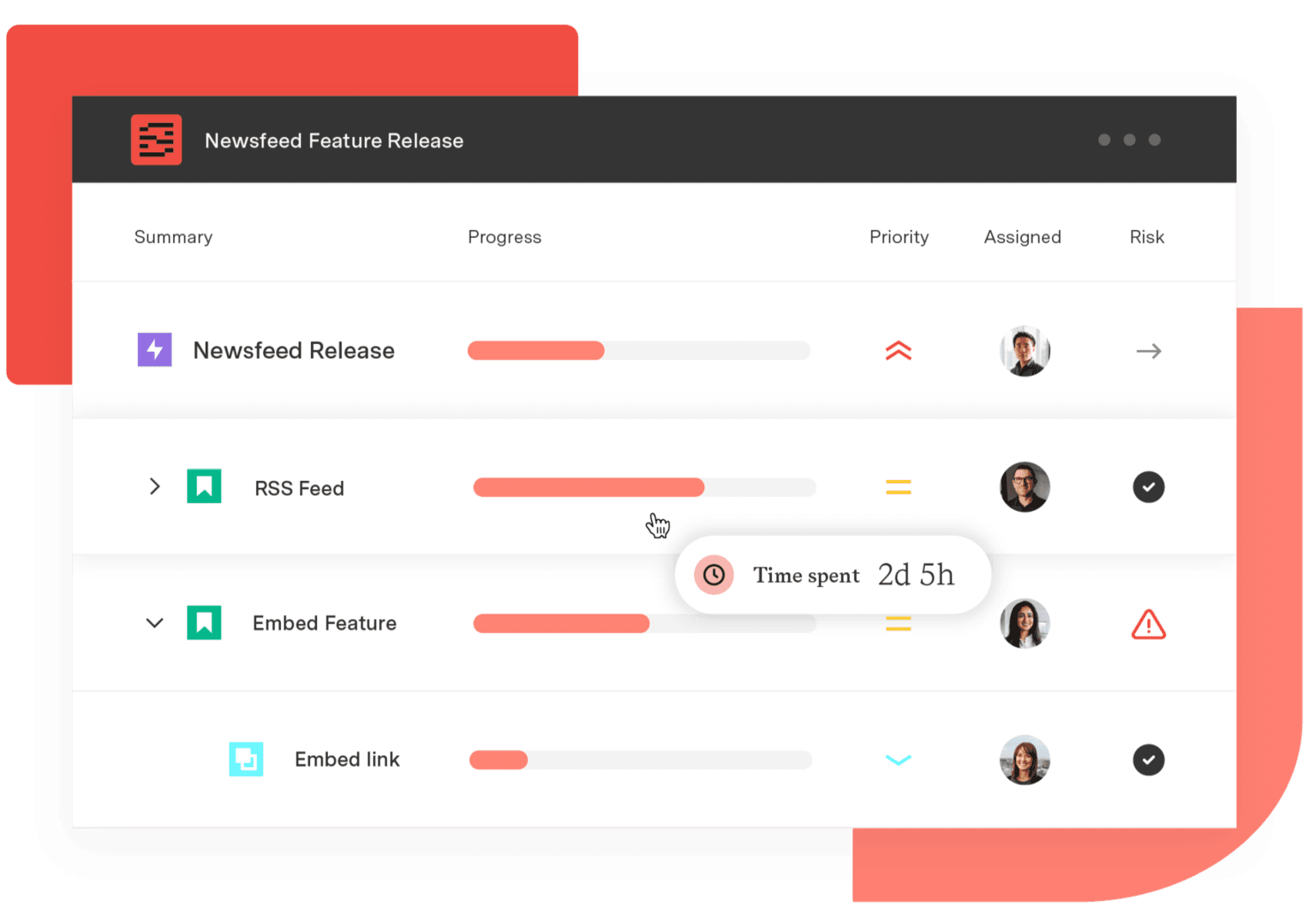
Structure PPM is a Jira-enabled portfolio and project management tool that tracks and communicates real-time progress across multiple initiatives through visual dashboards and reporting. With a holistic view, project managers monitor progress and resource usage inside their team while coordinating with colleagues, so everyone has the assets they need.
Structure integrates with other project management apps, including Gantt Charts for Structure PPM, which helps teams visualize plans and priorities, and Time Tracker, which delivers insights into employee efficiency and productivity.
For complex projects, Portfolio Manager is an all-in-one option that uses predictive scheduling to help teams adapt to change and manage uncertainty. With workload predictions, dynamic visualizations, and automatic resource leveling and prioritization, leaders keep their teams on the right track.
Structure PPM
Manage products, projects, and programs in a single spreadsheet-like view. By providing a clear, real-time view of project progress and resource allocation, Structure helps teams meet deadlines and adapt swiftly to changing priorities.
Start a Free TrialCouldn't find what you need?Go to our documentation
If you prefer using a spreadsheet to track projects, Microsoft Excel is a viable option.
Start by labeling the spreadsheet with the project’s name and manager. Then, label column headers as follows:
* Tasks (in order of completion)
* Task assignees
* Duration
* Progress
* Budget vs. actual
* Other factors
Finally, fill in the relevant data. Remember to update information regularly . Create formulas that will automatically revise cells to accurately reflect progress. Use the data to create charts and illustrate project status for reporting purposes.
Excel has a basic project plan template that does the following:
* Lists project tasks
* Allocates staff and resources to each task
* Defines start and end times for each task
* Calculates task duration
Learn how to use an initiative tracker to monitor your progress and goals. Discover software solutions to optimize your workflow.
A good risk management strategy is critical to your success. Learn how to identify, assess, and manage risk in your project portfolio.

Learn everything you need to know about project planning: how it’s done, its purpose, and its role in securing your team’s success.

Learn the basics of project scheduling and help your team manage time, establish priorities, and visualize workflows without becoming overwhelmed.

Project metrics provide invaluable insights into progress. Learn how these benchmarks help your team achieve timely, high-quality deliverables.
Learn how to use the top-down and bottom-up project management approaches when it comes to estimating project times, resources and more.

Maximize efficiency with six innovative project timeline templates. Learn how to improve team productivity while saving time and resources.

Take control of your project management tasks by implementing project planning tools to foster collaboration and increase team productivity.

Program management is more than scaling up your project management practices. You'll need new capabilities to create order from program chaos.