Improve your team’s productivity and work-life balance by learning to balance workloads with the help of Tempo.
Learn how predictive scheduling can boost your project team’s operational efficiency, and help members achieve better work-life balance.

Predictive scheduling uses historical data and ongoing trends to forecast staffing needs, then builds a project schedule that adapts as conditions change. For distributed teams working across time zones and shifting availability, it replaces static Gantt-chart guesswork with a schedule that recalibrates when resources, dependencies, or priorities move.
The approach originated in retail, hospitality, and food service, where fair workweek laws forced employers to publish reliable shift schedules in advance. Project managers now apply the same logic to Agile at Scale portfolios: predict the schedule from data, then adjust milestones as work progresses.
Predictive scheduling applies algorithms to historical project data and current trends to forecast staffing needs for a given period or initiative. Managers use those forecasts to size teams to expected demand, improving utilization and cutting the cost of over- or under-staffing.
Compliance with fair workweek ordinances is one reason to adopt it. The larger reason is scheduling accuracy: predictive models let project managers build dynamic timelines with flexible start and delivery dates, then adjust deadlines against actual progress and resource availability.
The method fits Agile at Scale teams best, because those teams already expect timelines to shift with resource constraints, dependencies, and changing priorities.
Predictive scheduling derives start and end dates from data and trend analysis. That flexibility lets the project manager build in time buffers to absorb schedule changes and dependent task delays without slipping the final delivery date.
Pick-a-date (or fixed-date) scheduling sets firm deadlines from rough duration estimates, usually without reviewing historical project data. Without a dependency map, there's no way to model how a delay in one task ripples into every downstream milestone.
Pick-a-date scheduling belongs to projects with hard external deadlines: A client contract, a regulatory date, a product launch. The project manager works backward from that fixed date.
Predictive scheduling belongs to portfolio planning. Early estimates land in three- to six-month increments. As detail arrives, the schedule tightens into firmer timelines and more realistic deadlines.
A flexible, data-driven schedule benefits the organization in three ways.
Predictive scheduling surfaces workloads before they spike. Project managers see heavy weeks coming and can redistribute or defer work instead of dropping overtime on the team.
Long-range visibility into milestones and deadlines lets team members plan their own workloads and time off around the calendar's pressure points, rather than colliding with them at the last minute.
Trend analysis shows managers when and where support is needed. That precision lets them avoid over- and under-staffing, streamline operations, and control cost.
A predictive scheduling system needs three things to work:
The forecast is only as good as the data that trained it. Managers need a clean record of past projects, employee availability, and resource allocation patterns.
A robust forecasting model finds the trends and correlations inside historical data. That analysis is what lets the system predict resource demand with enough confidence to schedule against it.
Agile at Scale and Kanban both assume the plan will change. A predictive scheduling tool has to recalibrate in real time as work moves, so productivity holds even when the inputs shift.
Every rollout runs into the same three problems. Each has a fix.
The challenge: Bad data on resource demand, availability, and scheduling patterns produces unrealistic forecasts.
The solution: Build a rigorous data collection process. Use tools that feed historical information into the scheduling system automatically, and store it in a structured, accessible location.
The challenge: Contractors, in-office employees, and remote workers all have different constraints. Building one schedule around all of them gets complicated fast.
The solution: Pick a scheduling tool that models different working scenarios. Let team members enter preferred hours and time-off requests so the algorithm can balance individual constraints against operational needs.
The challenge: No schedule predicts illness, family emergencies, or one-off crises. Left unaddressed, they cascade into missed deadlines.
The solution: Bake contingency into the plan. Cross-train team members so someone can step in when a colleague can't.
Involvement: Consult stakeholders and team members while designing the scheduling process, not after.
Communication: Explain the change to the team and the reasons behind it. Make each person's role in the new process explicit.
Training: Train project managers, team members, and stakeholders on the tool. Answer questions in real time.
Feedback: Open a channel for team members to flag scheduling problems and suggest improvements.
Adjust: Review the model on a cadence. Account for new hires and changes in how the business operates.
Stay flexible: The whole point is flexibility. Accommodate the unexpected, and codify how the team handles unplanned absences.
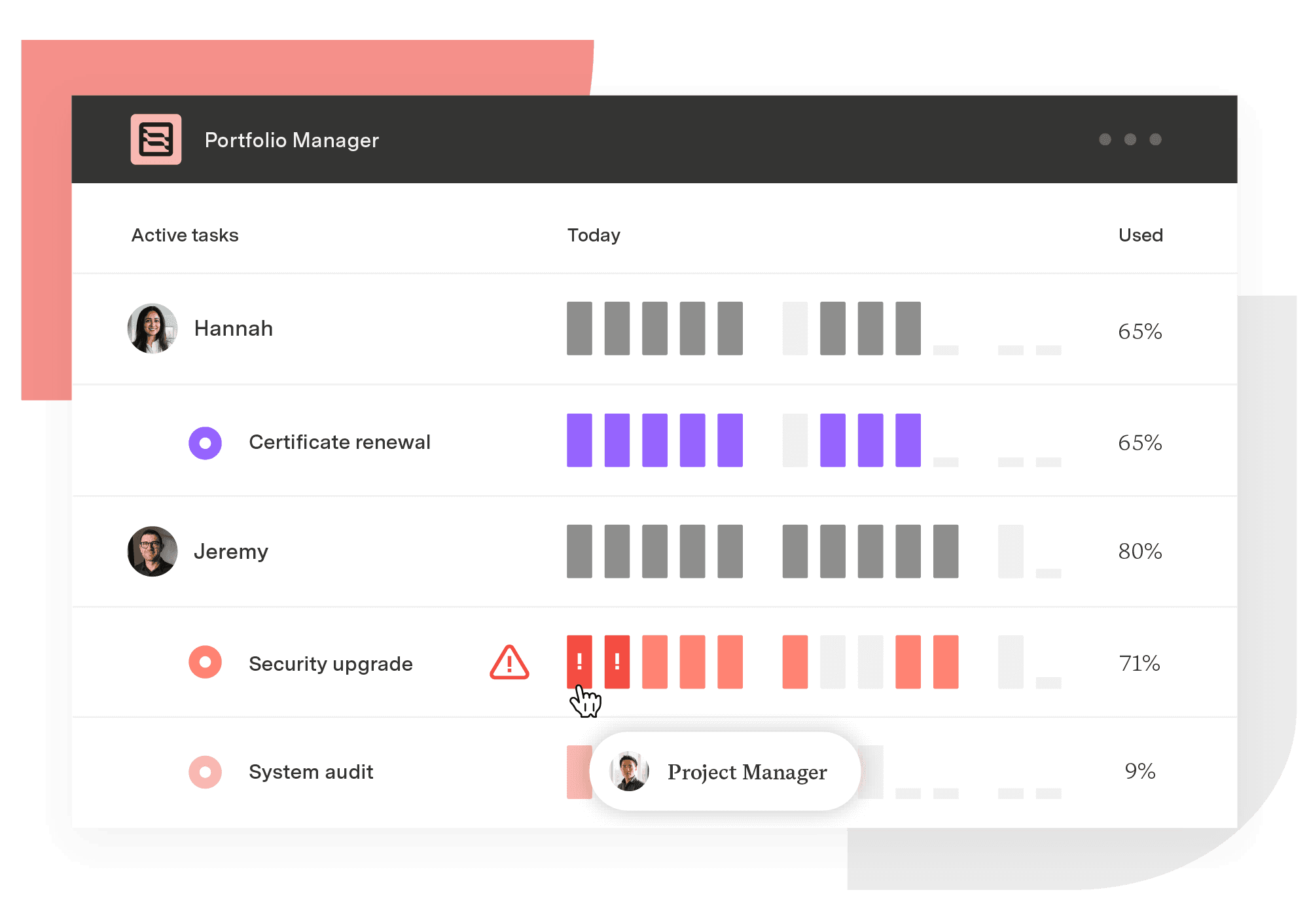
Tempo brings portfolio management and predictive scheduling into a single application. The platform uses an algorithm that balances workloads across even the most tangled project structures, and it handles automatic resource leveling, task prioritization, and dynamic dashboards so no one has to guess when work is due.
Scheduling chaos stops being the default.
Note: Retail chains and fast food franchises use predictive scheduling to manage shifts, on-call rotations, and last-minute changes. The same techniques apply to any industry with flexible work schedules, and they help employers stay compliant with laws covering good faith work estimates, predictability pay, and rest periods for minimum wage workers.
Portfolio Manager
The only project management solution that adapts to change and manages uncertainty to help teams plan, predict, and perform.
Start a Free TrialImprove your team’s productivity and work-life balance by learning to balance workloads with the help of Tempo.

Learn the basics of project scheduling and help your team manage time, establish priorities, and visualize workflows without becoming overwhelmed.

Discover seven essential tips for achieving a better work-life balance as a project manager. Enhance your productivity and well-being today!

Discover how operational data, such as sales transactions and system logs, empowers businesses to boost efficiency and effectively manage risk.

Transform your operations management for the better with this guide to aggregate planning. Learn how it can help your organization thrive.

Learning about business forecasting can help you prioritize projects to better align your team with company strategies and leverage changing markets.

Boost efficiency with project portfolio optimization. Align resources, focus on high-value projects, and make smart decisions for long-term success.

Learn to allocate resources, balance workloads, and prevent burnout. Practical strategies and real examples for project managers and team leads.

Tempo helps manufacturing teams prioritize tasks, predict results, and perform with confidence using the power of planning intelligence.