Learn about Jira Software Cloud’s integration with Google Calendar to streamline your time management efforts and stay on top of your to-do list.
Take control of your workday. Learn how to integrate the Jira Calendar with Google to maintain focus on high-priority tasks and improve productivity.

Jira Calendar is a native project view that plots issues on a calendar by start and due date, and it becomes far more useful once you sync it with Google Calendar. That pairing puts your work schedule and your meeting schedule in the same field of view, so you stop toggling tabs to see whether Tuesday afternoon is buildable time or a wall of calls.
Here is how the integration works, what it gets you, and how to set it up.
Project execution takes a mix of strategy and creativity. Teams need the quantitative side of the work — goals, deadlines, scope — and the qualitative guidance that shapes what a deliverable should look like.
Linking Confluence and Jira Work Management with Google Calendar gives leaders one schedule that carries both: the analytical layer (due dates, distribution channels, allocated time) and the creative layer (whether the piece is a blog post, a long-form article, or something else).
Opening the Jira Calendar view in Jira Cloud or Data Center takes one click. From the project dashboard, select the Calendar tab on the horizontal navigation bar. A new browser window opens with project issues organized by start and due dates. From there, you can filter by:
Projects
Tasks and subtasks
Resolution status
Assignees
Deadlines
A Jira team calendar helps users schedule daily or weekly tasks and organize their time. They can block off hours to work without interruption, and the same view tells the group when they are available for discussions.
Time blocking on top of that view delivers:
More time in the day for productive work
Focus on high-priority tasks
Fewer distractions and less context-switching
Fewer back-to-back meetings
Visibility into activities and workflows
A record of time spent on project tasks and subtasks
Sprint goals grounded in actual availability
Syncing Jira directly to Google Calendar is straightforward. Here is the sequence:
1. Launch Activity Timeline 1. Navigate to "My Account" 1. Click "Calendar Integration" 1. Select "Renew Calendar Link" to produce a unique identity assurance level (IAL) URL 1. Copy the URL 1. Open Google Calendar 1. Click the "+" next to "Other calendars" 1. Select "From URL" on the dropdown menu 1. Paste the URL into the "URL of calendar" field 1. Tick "Make the calendar publicly accessible" to permit team members to view your schedule 1. Click "Add calendar"
A Jira calendar plugin from the Atlassian Marketplace can also manage the integration for you.
Confluence, Jira, and Google Calendar can work together to run content production. To build an editorial calendar inside Google, you populate the analytical work in Jira and handle the creative work in Confluence.
Inside Jira, production leadership can:
Schedule content publication
Track time spent on creation
Assign content to team members
Report on topic frequency and distribution
Monitor progress and confirm next steps
On the creative side, Confluence lets the team:
Draft content
Proof
Update
Collaborate
Discuss and problem-solve
Confluence doubles as a single source of truth, holding content, how-tos, brand guidelines, and instructions in one place.
Some projects need heavier scheduling and planning than an editorial calendar can carry, even with Jira and Google combined. Tempo Timesheets adds that layer as a Jira-native time-tracking and capacity tool.
Timesheets produces detailed reports on time spent per project and task, so teams can see where efficiency is leaking. Accurate monitoring keeps resources optimized. Work logs get created as a byproduct of tracked activity, which encourages consistent use.
Timesheets also reports on individual productivity, surfacing strong areas and growth opportunities so managers can make informed decisions. Automation extends that reporting across Jira programs, projects, and portfolios, keeping stakeholders informed and team members on track.
Timesheets pairs with Tempo's other Jira-integrated tools — Capacity Planner and Strategic Roadmaps — to build a stack that fits how your team plans and delivers.
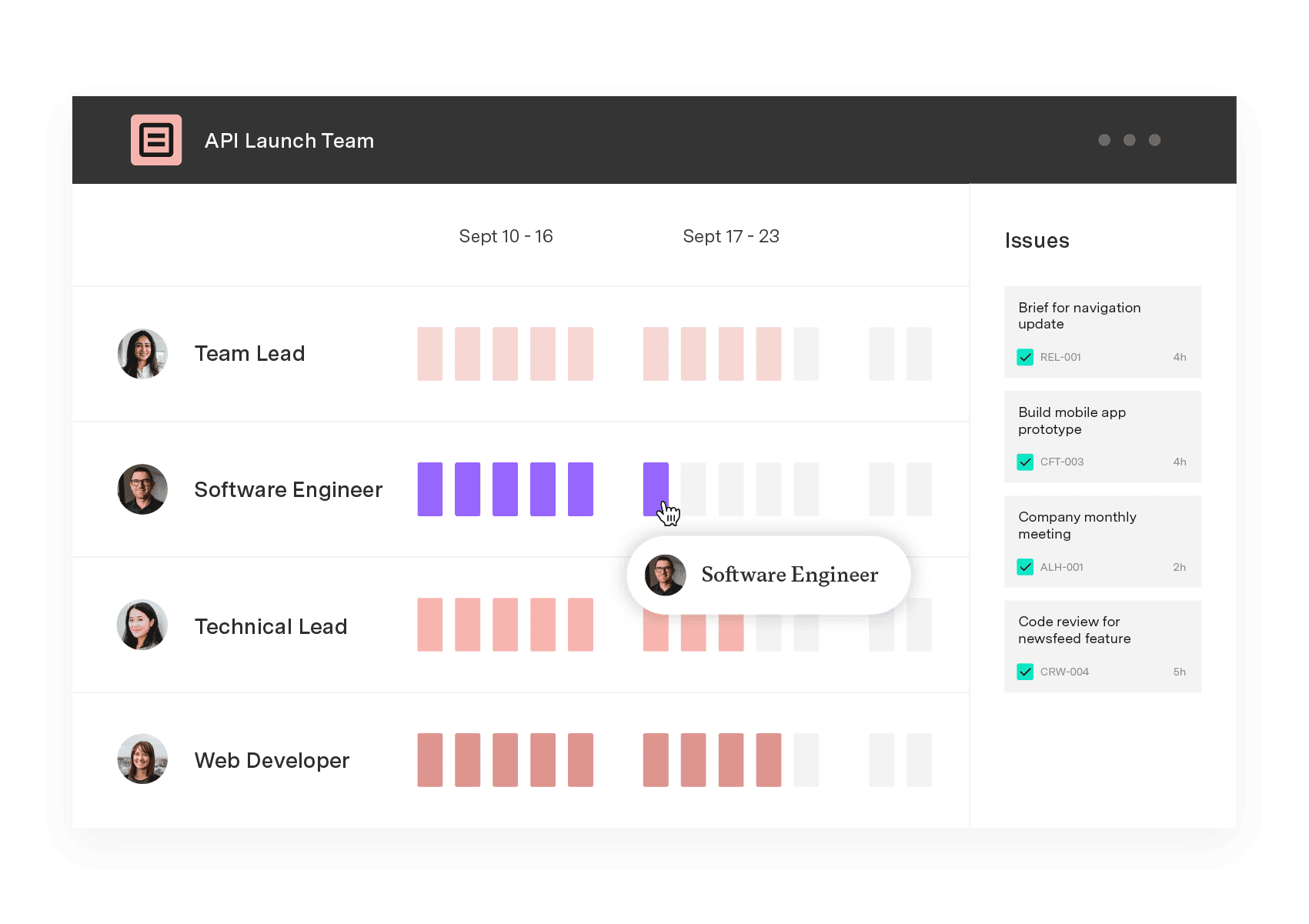
Capacity Planner
Capacity Planner is the only tool in the Atlassian Marketplace that allows planning for multiple resources on one issue. Users can customize the UI to include their existing Jira issues and projects.
Start a Free TrialCouldn't find what you need?Go to our documentation
To activate the native Jira Calendar plugin,
1. From the Jira Administration page, click “Add-ons” > “Find new add-ons”
2. Search for “calendar”
3. Install “Jira Calendar Plugin”
4. Return to the dashboard and click “Add Gadget”
5. Enter “calendar” in the search bar
6. If you don’t see “Jira Issue Calendar,” click “Load all gadgets” on the right side of the browser window
7. Click “Add gadget” next to “Jira Issue Calendar” to add it to the dashboard
Choose any project at the “Project” or “Saved Filter” level and click “Save.”
Jira software lets you view upcoming releases and your team’s progress toward meeting those goals within the Calendar view.
To show release dates:
1. Click “View settings” from the top right of the calendar view
2. Under the “Show calendar items” heading, switch the “Releases” toggle to “On”
Once releases are visible in the calendar, you can view
• Status: Denoted by a blue dot if the release is not shipped, a green check if it’s shipped, and a red warning icon if it’s behind schedule
• Progress
• Important dates: The day work starts and the release date
• Project source
Learn about Jira Software Cloud’s integration with Google Calendar to streamline your time management efforts and stay on top of your to-do list.

Learn how to use different types of marketing calendar templates to streamline your workflows. Find free template resources to get you started.

Take the hassle out of your time management by integrating Google Calendar and O365 Calendar into Timesheets.

Tired of repetitive tasks? Time batching boosts productivity and reduces burnout. Learn what batching is and improve your workflows.
Learn about the Ivy Lee method, a proven productivity technique that helps you prioritize tasks, sharpen your focus, and accomplish more each day.

Limit access to sensitive tasks and information within your project management tool using Jira permission schemes at the global and project levels.

The benefits of exercise include boosted productivity, enhanced creativity & improved mental health. Learn how this can impact your professional life.

Explore how Jira plugins for Outlook enhance project management by automating task creation from emails and simplifying file attachments.

Timesheets by Tempo's integration with Jira Align, product leaders can effortlessly assess development investments