Is AI the future? Discover the benefits of AI, plus its disadvantages, impacts, and implications for the future of the project management profession.
The AI revolution is here. Learn about AI in project management and how machine learning and predictive analytics will shape the industry’s future.

Artificial intelligence is an engaging water cooler topic in offices everywhere, with implications for news, art, and everyday life. AI technology is poised to affect every facet of existence, professional and personal.
Within the project management industry, AI is already demonstrating an impact. Some experts believe the sector is on the verge of an artificial intelligence revolution, with AI handling 80% of project management work by 2030.
It’s a startling statistic, but project managers don’t need to fear for their jobs. AI project management will never replace human expertise, creativity, or problem-solving abilities. What AI project management tools will do, however, is increase speed, accuracy, and productivity, ensuring project success. Here’s how.
In recent years, project management has evolved beyond shepherding an initiative over the finish line. It’s now about steering an organization toward a future rooted in strategic excellence and intelligent technology.
This new focus is transforming the practice and its tools. For the longest time, project managers and team members depended on static implements (e.g., slides, spreadsheets, and documents) that required hours of labor to update and communicate. Artificial intelligence for project managers is primed to take over repetitive, labor-intensive tasks, freeing leaders to do what they do best: strategic thinking, prioritization, and complex problem-solving.
AI tools using machine learning algorithms, natural language processors, and predictive analytics will take over the tedious aspects of project management, such as:
Automating routine tasks and workflows
Delivering insights to back data-driven decision-making
Conducting project risk assessment and monitoring
Forecasting roadblocks, dependencies, and outcomes
Optimizing project planning, scheduling, and resourcing
Streamlining employee retraining and upskilling
With AI taking on the lion’s share of administrative duties, project managers can focus their energy on tasks that require a human touch, such as stakeholder engagement, negotiation, and brainstorming.
There are many examples of AI in project management, demonstrating support for the full range of lifecycle activities, including:
Integrating an artificial intelligence application into the project management process removes guesswork from planning and scheduling, reducing stress and improving efficiency.
AI machine learning algorithms can analyze historical project data to identify patterns and trends. Based on this information, the AI software generates accurate task duration and dependency forecasts, further optimizing the schedule as it learns.
Artificial intelligence enables efficient resource management by leveraging machine learning to match project team members’ skills with specific tasks. Project managers who use AI to analyze performance can always find the right person for the job.
The system also uses predictive analytics to forecast resource requirements and availability, so project management is never caught short.
AI systems proactively minimize risk by leveraging natural language processing to scan documents and communications to uncover potential challenges. Once identified, machine learning takes over, assessing risk probabilities and impacts and alerting the project manager to take action.
Many AI-powered project management platforms include dashboards that output real-time status updates, informing the team of progress and potential roadblocks.
Data and evidence enable successful project management decisions; without this information, choices are nothing more than guesswork. AI can source valuable data and analyze multiple scenarios to optimize action plans and prioritization.
Instead of leafing through pages of documentation, team members can use chatbots and virtual assistants to streamline research for project-related questions.
Process automation via AI software takes on many of project management’s more onerous tasks, such as repetitive administrative work, documentation updates, task dependencies, and status reports.
AI-powered machine learning performs large-scale predictive analysis, minimizing risk, saving time, and reducing effort. The system analyzes past project data to model outcomes, uncover delays, and identify bottlenecks so project management can take steps to mitigate their impact.
AI tools can quickly get the team up to speed on new project management tools, processes, and techniques by streamlining and gamifying training efforts. An AI chatbot can quickly answer standard questions about new products and solutions.
Project managers can use AI guidance to optimize resource planning based on accurate estimates of employee availability, project prioritization, and budget restrictions. These insights can significantly reduce costs and promote project success.
Project managers who use AI enjoy significant boosts in speed, productivity, and effectiveness. Specifically, artificial intelligence provides the following benefits:
More efficient project plans and schedules
Improved risk assessment and mitigation activities
Optimized resource allocation
Accurate estimates and forecasts
More time thanks to automated repetitive or linked tasks
Data-informed decision-making
Still, AI’s full capacity has yet to be realized. Its abilities will continue to advance in new and unprecedented ways. Early adopters of this technology are positioned to take advantage of its evolution. AI-powered organizations will reap the benefits and secure a competitive advantage as the technology develops instead of racing to play catch-up.
Project managers must find an AI tool that meshes seamlessly with their existing tech stack to take advantage of the artificial intelligence revolution. Fortunately, Tempo offers just that.
Tempo’s modular, AI-powered project management tools integrate harmoniously with Atlassian Jira. We recommend starting with Timesheets, our trusted time-tracking and capacity management software. Timesheets eliminates manual entry by leveraging AI automation to log work hours and produce status reports.
Take resource allocation to the next level with the insights of Tempo’s Capacity Planner. This project management tool uses machine learning to deliver valuable analytics of project trends and patterns so you can make informed decisions. AI optimization makes resource prioritization and deployment easier than ever.
Tempo is constantly seeking new and innovative ways to integrate AI into its products, including introducing Rovo agents for sprint planning and Structure formula writing. The revolution is only beginning.
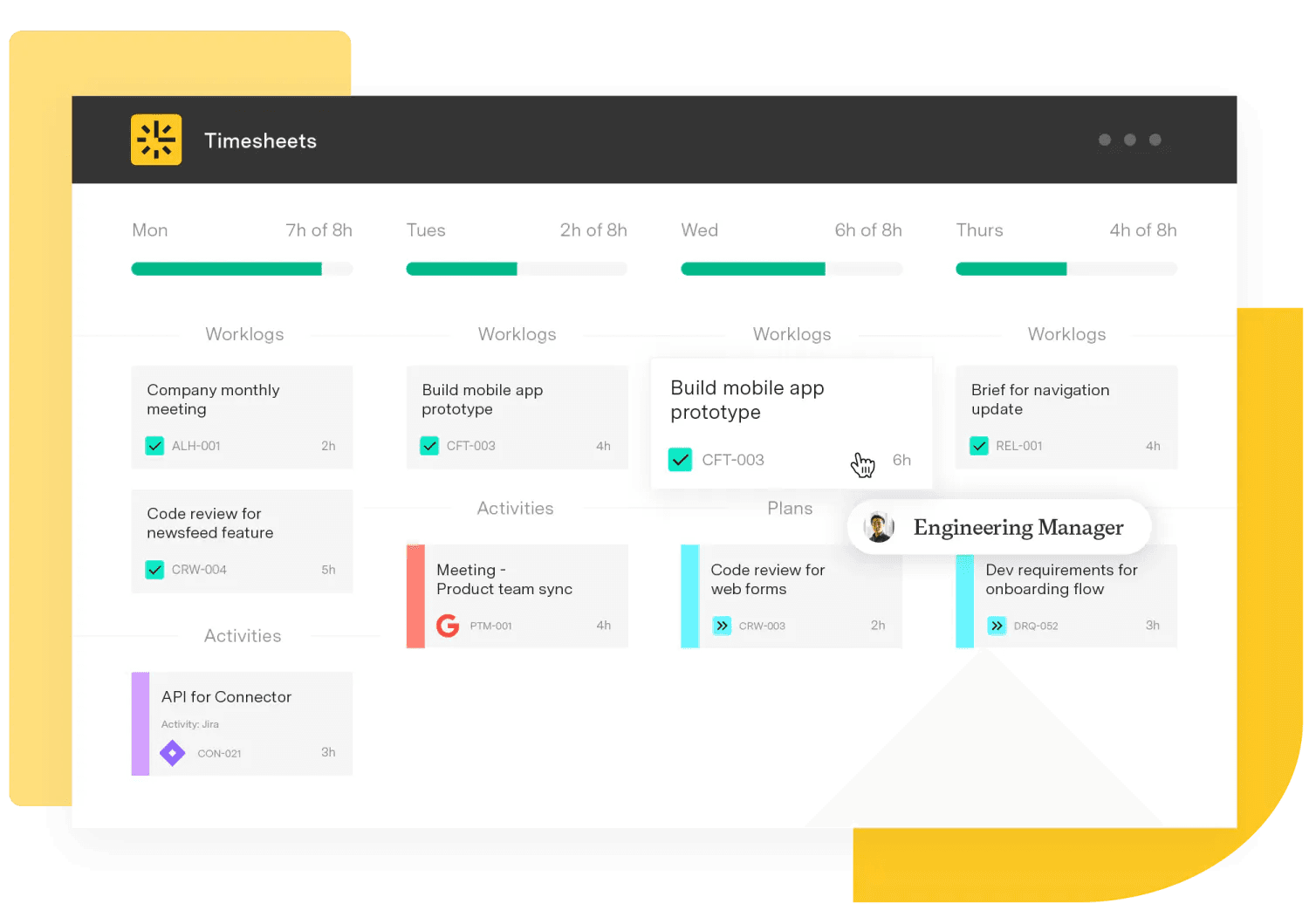
Timesheets
The #1 time-tracking app for Jira. Timesheets seamlessly integrates with Jira and your existing workflows to help you track time for accounting, CapEx tracking, client billing, compliance, and more.
Start a Free TrialCouldn't find what you need?Go to our documentation
Tempo offers several AI project management tools, including Timesheets, Capacity Planner, Sprint Performance Assistant and Structure Formula Assistant. These applications use artificial intelligence to track working hours, balance workloads, and assign project resources.
AI will never fully take over project management. Although artificial intelligence is a powerful tool for automating repetitive or labor-intensive tasks, the industry will always need human skills, such as leadership, intuition, and creative problem-solving, to guarantee project success.
Artificial intelligence can leverage machine learning and data analysis to review objectives, historical data, and current resources to produce a functional project plan.
Is AI the future? Discover the benefits of AI, plus its disadvantages, impacts, and implications for the future of the project management profession.

Understanding disruptive technology helps you identify innovations that serve your interests and reap the benefits of early adoption.

We're taking a look into the trends in project management that will continue to shape the profession moving forward.

AI strategic portfolio management makes portfolio decisions consistent and continuous. See how native data & governance shape the new operating model

Learn how a digital business transformation strategy helps organizations leverage technology, improve processes, and drive growth successfully.

Learn about project demand management and how it balances resources with project requests to maximize value and achieve strategic business goals.

Businesses increasingly use workflow automation to reduce manual tasks, improve accuracy, and streamline processes. Try it yourself in 6 simple steps.

Learn how to improve your technical and project management skills with Tempo’s complete guide to technical project management.

Did you know Tempo offers 7 Rovo Agents? Try them for free today and stay tuned for more announcements soon.