
What is enterprise program and portfolio management?
Enterprise program and portfolio management (EPPM) is the discipline of selecting, funding, sequencing, and governing a portfolio of programs and projects against a finite pool of capacity and capital. It spans intake and prioritization, multi-program coordination, capacity and financial governance, and the executive reporting that closes the loop with the strategy that started it.
In a Jira-native enterprise, EPPM is less about installing a separate planning tool and more about lifting the data already in Jira into a portfolio-grade view. That means hierarchies that span business units and programs, dependencies and milestones managed at scale, capacity modeled across hundreds or thousands of contributors, and financials – budgets, actuals, CapEx, OpEx – tied back to the work that consumed them.
Why enterprise program and portfolio management matters
Most enterprises don't suffer from a lack of PPM tooling. They suffer from a portfolio view that lags reality by weeks because it's stitched together by hand. PMOs export from Jira on Friday, reconcile in spreadsheets, build slides on Monday, present on Tuesday – and by Wednesday the portfolio has moved. Decisions get made on stale information, and confidence in the portfolio function erodes accordingly.
The stakes climb in regulated and capital-intensive industries. Financial services, insurance, healthcare, manufacturing, and telecom run multi-year programs with hard external commitments – regulatory deadlines, product launches, customer go-lives. Missing the warning signs because the data is two weeks old is the difference between a manageable replan and a public miss.
There is a governance dimension too. Boards and audit committees ask harder questions about how investment dollars are converting into delivery. EPPM that connects portfolio decisions to live program data – not narrative – is what holds up under that scrutiny.
Benefits of enterprise program and portfolio management with Tempo
One source of truth, top to bottom. Strategic themes, portfolios, programs, and team-level work live in a single hierarchy fed by live Jira data, not weekly exports.
Capacity governance at enterprise scale. Model capacity across thousands of contributors and hundreds of teams, and stress-test new portfolio commitments before approving them.
Financials tied to delivery. Budgets, actuals, and forecasts run off the same worklog and effort data the teams produce, with CapEx/OpEx classification baked in.
Executive reporting on demand. Portfolio dashboards, milestone status, and risk views built on live Jira queries, refreshed automatically for steering committees and the board.
Modular and Jira-native. Adopt portfolio-level governance without replatforming the work, and expand from program to portfolio as the operating model matures.
How Tempo enables enterprise program and portfolio management
Structure PPM is the foundation. It rolls up Jira issues from every business unit, program, and team into a single hierarchy that mirrors how the enterprise actually invests – strategic themes at the top, portfolios and programs in the middle, epics, features, and stories at the bottom. Generators pull issues in via JQL, so the structure stays current as new programs spin up. Custom columns aggregate progress, story points, target dates, and any custom field across the tree, giving the PMO a portfolio view that matches what the teams are doing.
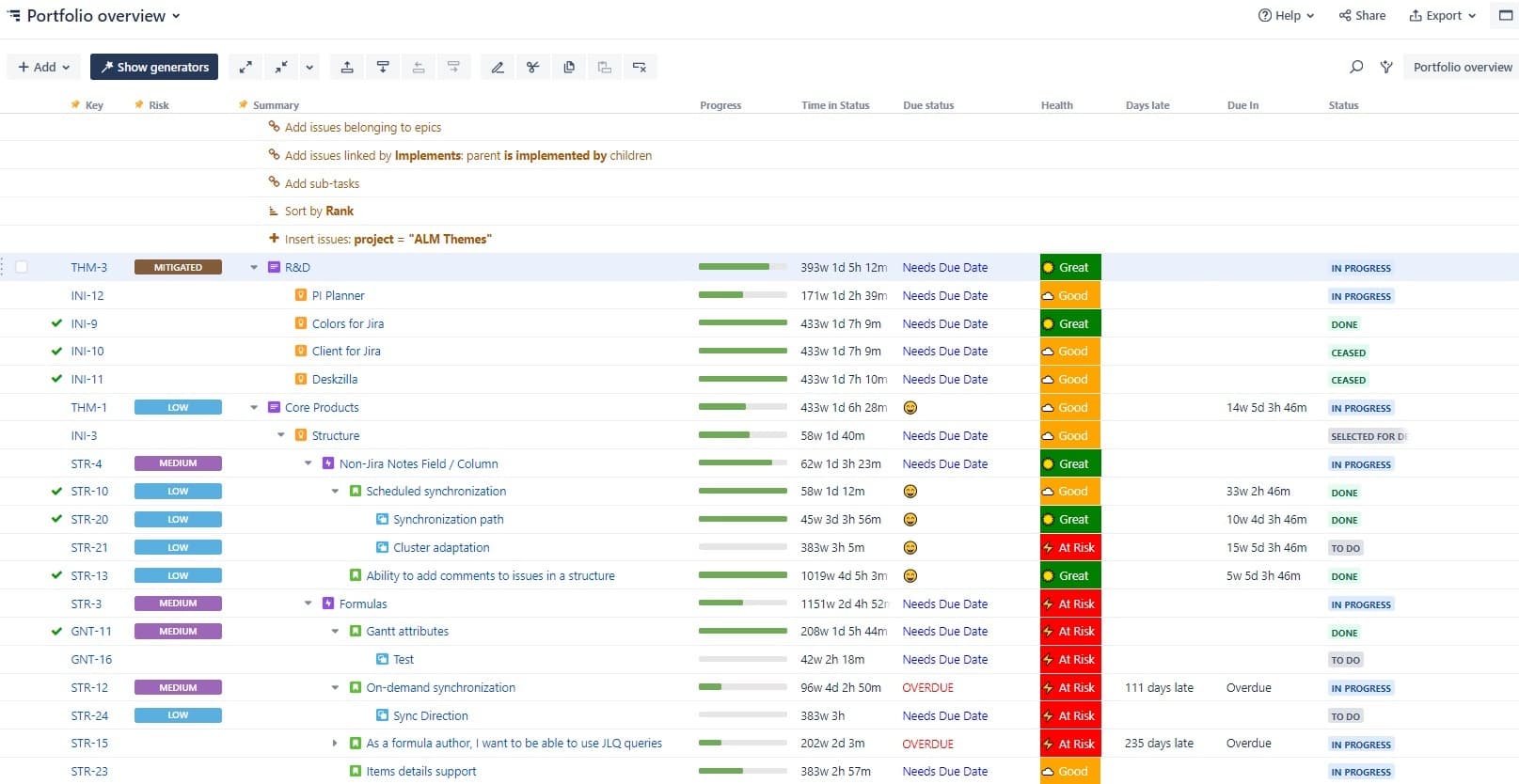
Gantt Charts for Structure PPM adds the timeline. Program managers and portfolio leads see milestones, dependencies, and critical paths across programs on the same data, and replan with the underlying Jira issues moving in lock step. When a date slips at the team level, the downstream impact on program and portfolio milestones is immediately visible.
Capacity Planner brings capacity into the planning conversation. It models commitments, allocations, and availability across the enterprise, supporting what-if scenarios for new portfolio bets before they're approved.
Financial Manager governs the money. Project and program budgets, actuals from logged work, forecasts, and CapEx/OpEx classification all live alongside the delivery data, so finance and the PMO are reading from the same numbers.
Custom Charts for Jira powers reporting. Portfolio dashboards, program status views, and steering committee reports run off live Jira queries, so what executives see is the latest state, not a Tuesday-morning snapshot. BI Connectors (Power BI, Tableau, BigQuery, Looker Studio, SQL) push the same data into the enterprise BI layer for cross-functional analysis with finance, HR, and operations data.
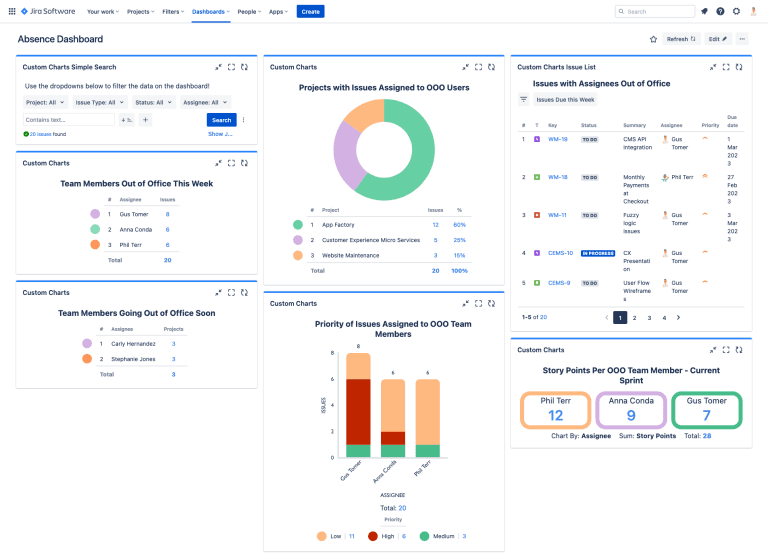
The combination delivers enterprise-grade governance in Jira.
Sign up for a demo
Request Demo


