What's a project roadmap? A primer for beginners
Learn what a project roadmap is, why it matters, and how to create one in six steps – from goals and milestones to stakeholder alignment.


Key Takeaways
A project roadmap condenses the plan to the few fields an executive can absorb without a walkthrough: what ships, when, and what it hinges on.
Roadmaps and project plans differ by zoom level; the plan owns execution detail, the roadmap owns the communication layer above it.
The format choice (timeline or swimlane) follows the audience question: "when will this ship" points toward a timeline, "where does this stand" points toward a swimlane.
A project roadmap is a visual summary of a project – the view an executive sponsor needs when they don't have time to read the full project plan.
With a roadmap, you can compress weeks of delivery detail into something a stakeholder can scan quickly and walk away with a grasp of status and risk.
Compression is the hard part. Teams try to cram Gantt-level detail into a one-pager, or they strip so much context that leadership has to ask a bunch of follow-up questions. We'll get into how Strategic Roadmaps resolves that problem.
What is a project roadmap?
A project roadmap is a high-level visual summary of a project's goals, milestones, key deliverables, and overall timeline. It gives a project manager and the relevant stakeholders a bird's-eye view of the major components.
This type of roadmap works across all departments – sales, marketing, HR, engineering, or otherwise. A complete roadmap usually includes:
Project goals
Milestones
Primary deliverables
High-level timeline
Task dependencies
Resource needs
Notable risks
How is a project roadmap different from a project plan?
The key difference is zoom level. A roadmap is the high-level view. A project plan gets into the details.
An effective project plan answers granular questions:
What is the value proposition?
How is the project scope being managed?
How much budget is allocated?
What are the biggest risks? What contingency plans are in place?
The project plan holds all the key factors and behind-the-scenes context that prove every aspect of the work has been thought through.
The roadmap takes all that detail and surfaces what matters most. In simple terms: If your roadmap is a photograph, your project plan is the same photograph under a microscope – every pixel visible.
Attribute | Roadmap | Project plan |
|---|---|---|
Purpose | Communicate direction and highlights to stakeholders | Document every detail the team needs to execute |
Detail level | High-level – goals, milestones, timeline | Granular – scope, budget, risks, contingencies, tasks |
Audience | Executives, cross-functional stakeholders, sponsors | Project team members and anyone executing the work |
Update cadence | Updated when priorities shift or milestones move | Updated continuously as tasks, scope, and details evolve |
Level of commitment | Directional – the photograph | Detailed – the photograph under a microscope |
Why do you need a project roadmap?
Not every project member wants to wade through pages of documentation. Your CEO doesn't need every technical and non-technical requirement – they want to know when to expect deliverables.
PMI's 2025 Pulse of the Profession found that only 23% of projects are aligned to strategic goals. That means most teams are executing work that's disconnected from what leadership actually cares about. A roadmap is the simplest fix for that gap. Atlassian's guide to agile roadmaps covers the fundamentals if you want a second perspective.
Stakeholders need the highlights. A well-built roadmap delivers them:
Keeps everyone aligned on timelines and high-level goals
Supports smarter planning and prioritization
Makes it clear who's responsible for what
Gives a common reference point for status conversations
Surfaces risks and dependencies early
Stays flexible when priorities shift
A roadmap is what you present in recurring project syncs to get everyone aligned without getting pulled into the weeds. Team members who need more detail can reference the project plan. And for project managers juggling multiple workstreams, a set of roadmaps – one per project – is the fastest way to spot conflicts before they become crises.
How to create a project roadmap
Whether you're creating your first roadmap or rebuilding one that stopped being useful, these six steps walk through the process from blank page to a roadmap your stakeholders can act on.
1. Define the project's goals and scope
Start with the question every roadmap exists to answer: What does done look like? Write down the project's primary objectives, the boundaries of what's included, and – just as importantly – what's out of scope. Skip this and the roadmap drifts into a wish list.
Anchor each goal to a measurable outcome. "Improve onboarding" is a direction; "reduce time-to-first-value from 14 days to 7" is something a team can build toward. A clear scope statement keeps the roadmap honest. And it gives you a reference point when someone asks to add "just one more thing."
2. Identify key milestones and deliverables
Break the project into its major milestones – the checkpoints that prove progress. Each milestone should have at least one deliverable attached. For a product launch, that might be "beta release ready" or "marketing assets approved." For a consulting engagement, it could be "discovery complete" or "final report delivered."
List these in rough order; you'll refine the sequence in the next step. If your milestones feel vague, they probably are. A useful test: Could a stakeholder look at a milestone and know whether it's been hit? If not, sharpen it.
3. Set a high-level timeline
Your roadmap is a communication tool, not a motivational poster. Plot milestones along project timelines that reflect realistic estimates – use quarters, months, or sprints depending on project length.
Leave buffer for the work that always takes longer than expected – testing, reviews, approvals. A common mistake is scheduling milestones back-to-back with zero slack. One delay cascades into every milestone after it. This is the step where the roadmap starts to look like a roadmap and not a list.
4. Map dependencies and risks
Few milestones exist in isolation. Identify which deliverables block others and where external factors – vendor timelines, regulatory approvals, resource planning constraints – could slow things down. A dependency that's obvious to you may be invisible to a stakeholder two levels up.
Call out the top three to five risks alongside your dependencies. You don't need a full risk register on the roadmap, but stakeholders should see the pressure points at a glance. When a risk materializes later, you want the conversation to start with "we flagged this" rather than "why didn't we know?"
5. Choose a format
Deadline-driven project where the question is "when will this be done?" Use a timeline layout.
Question is "where does this stand right now?" Swimlane.
Either way, grab a project roadmap template instead of starting from scratch – it enforces structure and saves the hour you'd spend fiddling with columns.
6. Share with stakeholders and iterate
Walk stakeholders through the first version, flag open questions, and set a cadence for updates – every sprint, every two weeks, or whatever matches your project rhythm.
Keep the review lightweight: five minutes at the start of a project sync is enough. When priorities shift – and they will – update the roadmap first, then cascade changes into the project plan. Expect the first review to change things. That's the point.
Project roadmap examples: What Tempo Strategic Roadmaps offers
Strategic Roadmaps offers two roadmap views that work for any type of project.
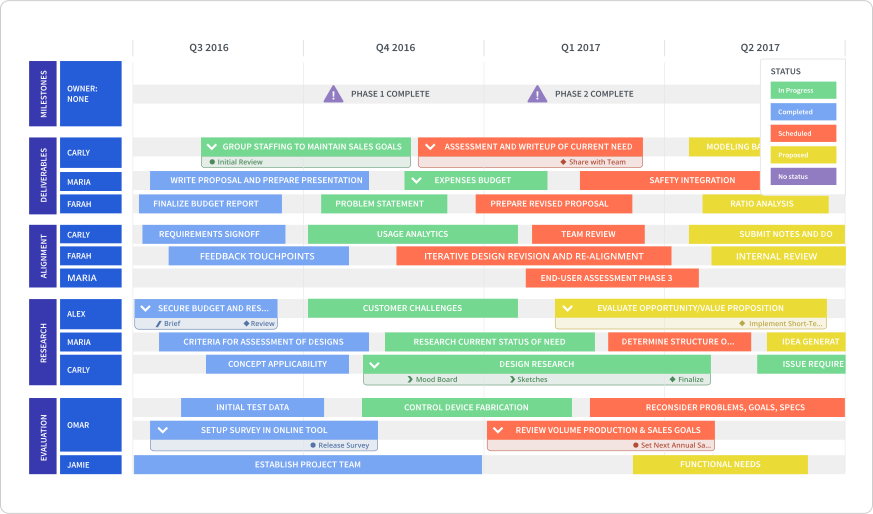
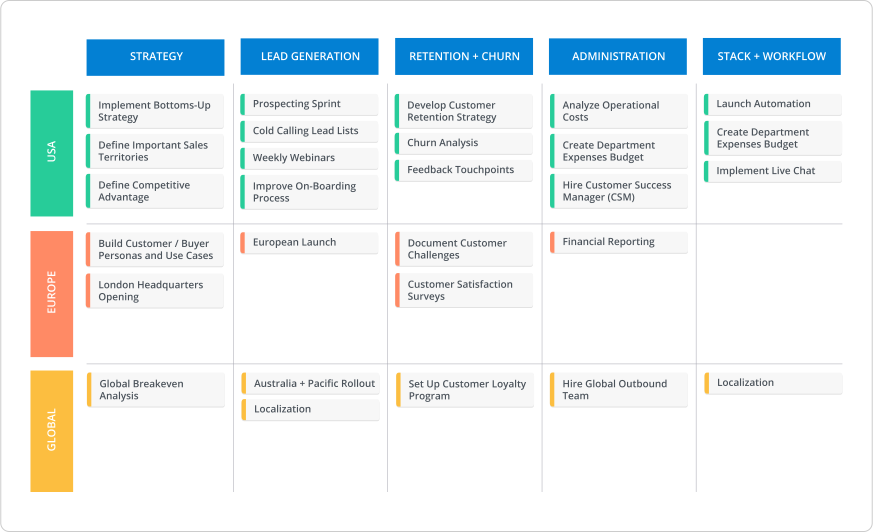
Roadmap views at a glance
View | Best for | Key capability | Example use case |
|---|---|---|---|
Timeline view | Deadline-driven teams | Shows task duration, resourcing, and milestones – with the ability to pivot and filter by theme, status, or owner | Mapping a product launch where specific dates matter and multiple teams need to see how their work overlaps |
Swimlane view | Teams focused on task status over deadlines | Groups work by status (complete, in progress, waiting) and lets you pivot by theme or owner | Running agile status syncs or longer projects where dates shift and stakeholders need a quick view of where things stand |
The Swimlane template is available to use and customize at tempo.io/templates.
A project roadmap is the big picture, not a detailed breakdown
The main thing to remember: Your roadmap is the big picture. It doesn't replace the project plan – it works alongside it. Use it when you need to quickly present and align everyone on the critical project details.
Anyone who has tried to get a team member to find one answer in a 40-page project plan understands why the roadmap exists. By putting the important components of the plan into a visual format, a roadmap helps you push your team and project closer to the finish line. And following the six steps above – goals, milestones, timeline, dependencies, format, iteration – gets you a roadmap that actually gets used instead of gathering dust in a shared drive.
Ready to put this into practice? Start a free trial of Strategic Roadmaps and build your first roadmap today. For a head start, grab a project roadmap template and customize it for your team.
Sign up for a demo
Request Demo
2026 State of SPM report
This is the data you've been looking for
This original research from almost 700 PMO leaders shows you what is working, what is wobbling, and what it all means for SPM in 2026.
Download the 2026 State of SPM reportFrequently Asked Questions
Couldn't find what you need?Go to our documentation
A project roadmap should include the project’s goals, major milestones, primary deliverables, high-level timeline, key dependencies, resource needs, and notable risks. It should be visual, concise, and pitched at the level of detail your stakeholders need – not the granular task list that belongs in the project plan.
Update your project roadmap whenever something significant changes: a timeline shifts, a dependency surfaces, a deliverable is dropped, or priorities change. For active projects, a quick review at the start of each sprint or every two weeks keeps the roadmap accurate and stakeholders aligned.
A Gantt chart is a task-level tool that shows each activity, its duration, and its dependencies in a timeline format. A project roadmap operates at a higher level, showing goals, milestones, and deliverables without drilling into every individual task. Tempo Strategic Roadmaps’ Timeline view combines the best of both: the strategic clarity of a roadmap with the ability to pivot by field, owner, or theme.
Yes. Project roadmaps are as useful for marketing campaigns, HR initiatives, or sales planning as they are for software development. Any project that involves milestones, timelines, stakeholders, and dependencies benefits from a visual, high-level summary. The format stays the same; the content reflects your project type.