9 product prioritization frameworks for product managers
Nine proven prioritization frameworks – from RICE to Cost of Delay – that help product managers make defensible roadmap decisions.


Key Takeaways
RICE and Value vs. Effort are the fastest frameworks for quantitative ranking with minimal setup, which is why most teams start with one before layering anything specialized.
Kano Model, product tree, Buy a Feature, and opportunity scoring are the frameworks to reach for when prioritization hinges on direct customer input instead of internal scoring.
Frameworks do not produce defensible answers on their own – their job is making tradeoffs visible so the team can debate them on shared terms.
Trying to build everything at once is a great way to make sure nothing gets shipped.
So how do you decide what to build first? You need product prioritization frameworks. They're shared scoring methods that force tradeoffs into the open. A prioritization framework helps the team justify the order of work – especially when a loud stakeholder shows up asking why a feature slipped to the next sprint. Anyone can inspect the inputs used to make that call.
Most product orgs pick a framework that flatters the data they already have. A team with rich customer research defaults to Kano or Buy a Feature. A team drowning in engineering requests reaches for RICE.
The scoring method inherits whatever bias the team brought in, which is why switching frameworks mid-cycle or running two against the same backlog often reveals more than any single score does.
Prioritization frameworks at a glance
Framework | Best for | Inputs required | Time to run | Main limitation |
|---|---|---|---|---|
RICE | Quantitative ranking tied to a specific goal | Reach, impact, confidence, effort estimates | Medium | Does not account for dependencies |
Value vs. Effort | Fast initial triage across a feature list | Value and effort scores per feature | Short | Estimation is subjective; consistency breaks at scale |
Kano model | Separating must-haves from delighters | Customer questionnaire responses | Long | Requires statistically meaningful survey sample |
Story mapping | Identifying MVP and release slices | User stories, journey stages | Medium | Ignores business value and technical complexity |
MoSCoW | Release scoping with non-technical stakeholders | Feature list and shared priority criteria | Short | Teams overinflate Must-Haves; weak for intra-release ranking |
Opportunity scoring | Finding underserved customer outcomes | Customer ratings of importance and satisfaction | Medium | Survey bias can skew the graph |
Product tree | Collaborative customer workshop on direction | Whiteboard, sticky notes, customer participants | Medium | No quantitative ranking output |
Cost of delay | Putting a dollar figure on backlog decisions | Weekly value estimate and build time per feature | Medium | Monetary estimates are partly gut-feel |
Buy a Feature | Direct customer input without a dry survey | Priced feature list, group of customers | Short | Only evaluates features already on the roadmap |
1. RICE
RICE started as Intercom's internal scoring system for prioritizing ideas. It helps product teams zero in on the initiatives most likely to move a specific goal forward.
Each idea gets scored on four factors: Reach, impact, confidence, and effort. Here's what they mean and how to quantify them:
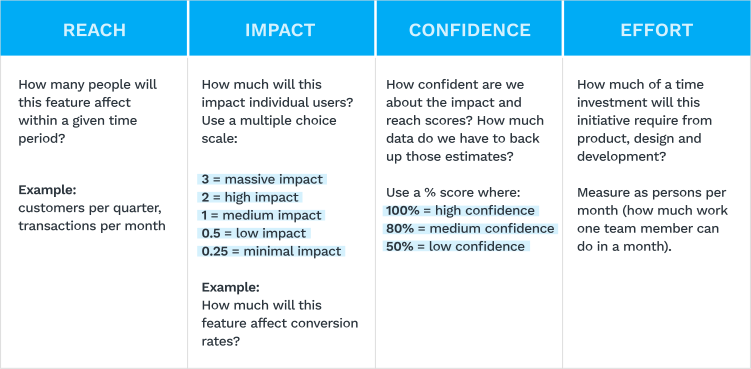
Those numbers feed into one formula. The result is a standardized score you can apply across any initiative on the roadmap:

After running each feature through this calculation, you get a final RICE score you can use to rank order. Here's an example:
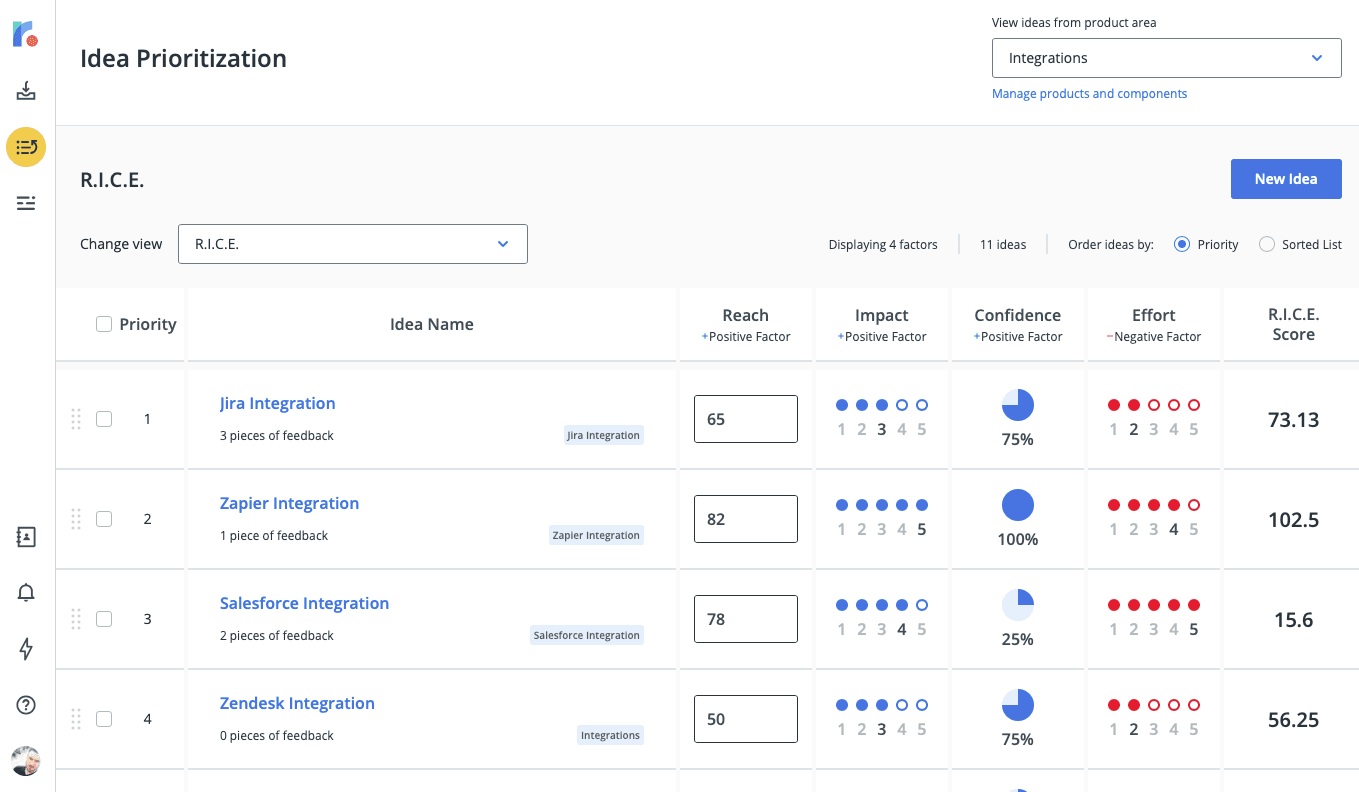
Pros of the RICE method
It forces teams to make their product metrics SMART – specific, measurable, attainable, relevant, and time-based – before they score anything. That alone is worth the exercise.
It reduces the pull of inherent biases by adding a confidence dimension. The conversation shifts from "how much is this feature worth" to "how confident are we in each of these estimates?" Much more productive.
Cons of the RICE method
RICE scores don't account for dependencies. A feature with a high score sometimes needs to wait for something else – so treat the score as an input, not a final verdict.
Estimations won't ever be fully accurate. RICE is structured estimation, not prediction.
2. Value vs. Effort
Take your list of features. Assign two scores to each: value and effort. That's it. The goal is a quick, visual way to see which ideas are worth pursuing now and which aren't.
The scores are estimates – a lot of judgment goes into answering two questions: Will this push our goals forward if we build it? Can we actually build it with what we have?
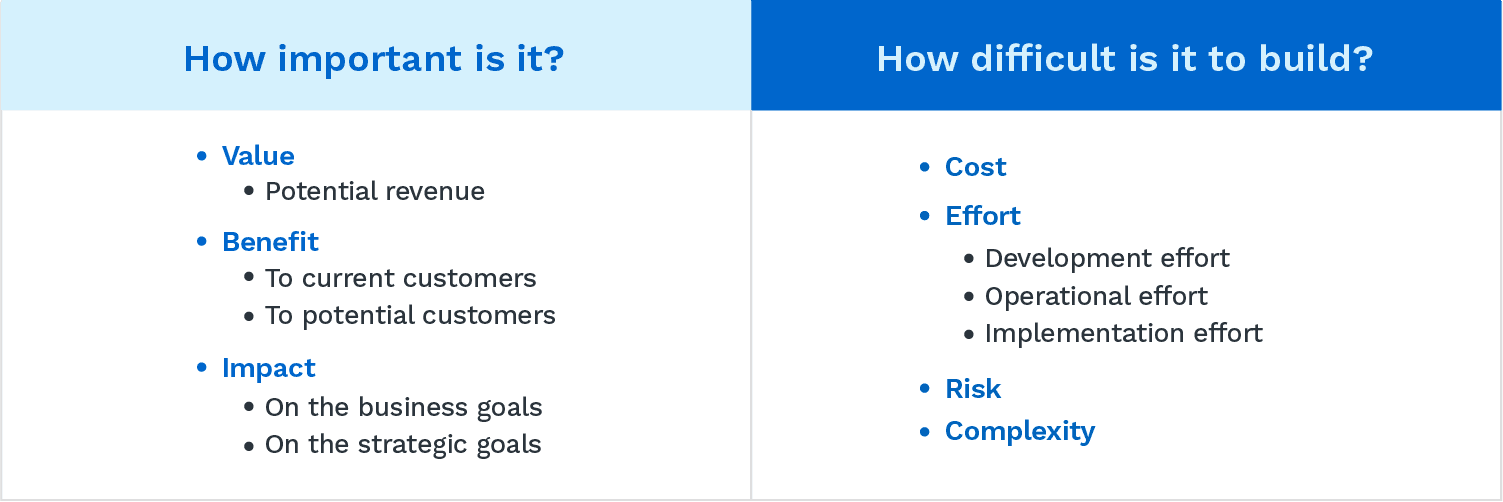
Value vs. Effort also creates space for the disagreements that should happen. When stakeholders argue over how to score a feature, they're actually working through the strategic alignment gaps that need resolving anyway. Here's what a scorecard looks like in Strategic Roadmaps:
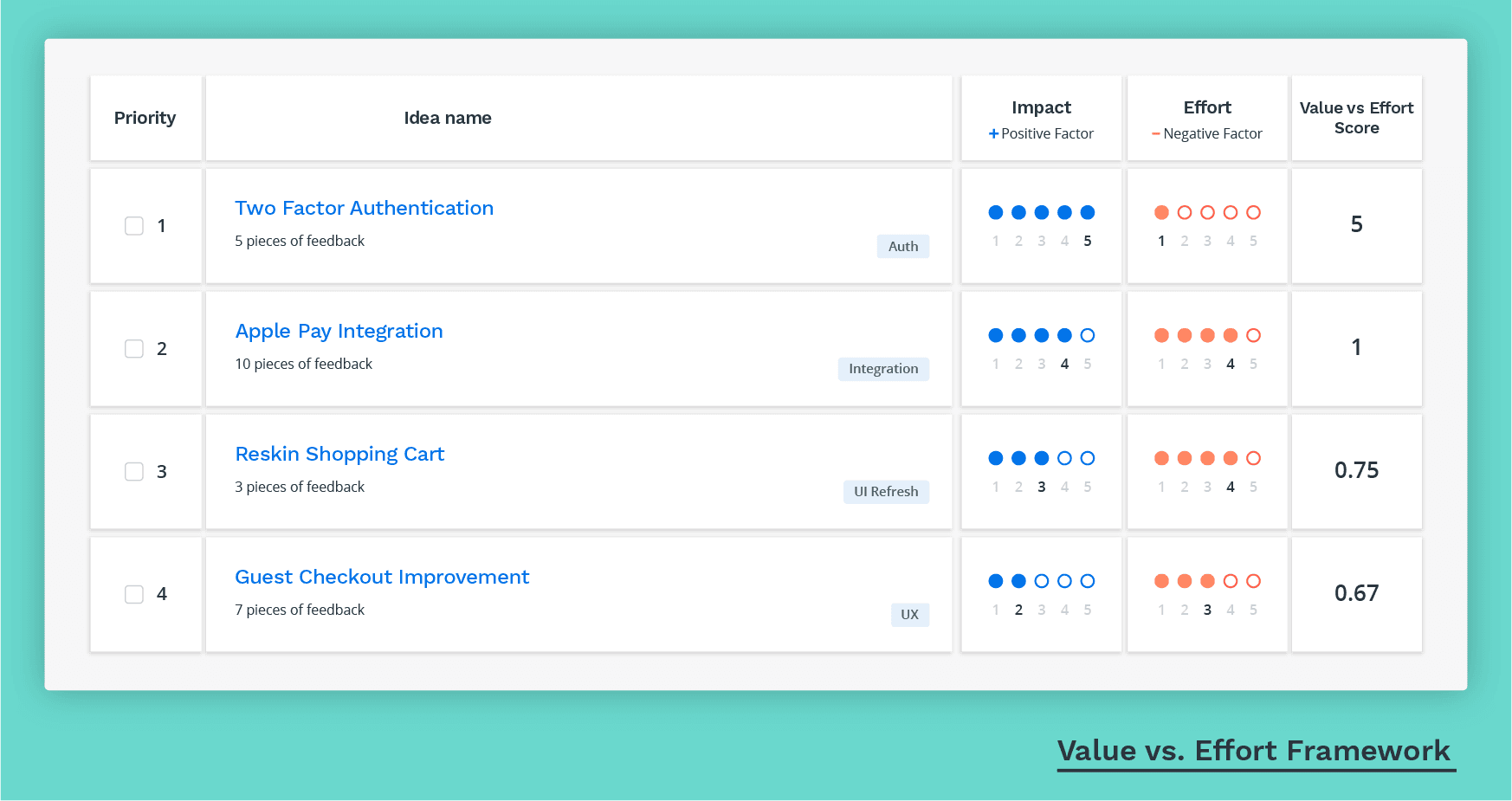
Value vs. Effort is a built-in prioritization template available in Strategic Roadmaps. You can also create custom prioritization criteria using any factors relevant to your organization.
Pros of Value vs. Effort
What counts as "value" or "effort" is flexible. For some teams, effort means development time; for others, it's total implementation cost. That flexibility makes it usable across industries and product types.
Forcing teams to put numbers on features surfaces assumptions and gets people on the same page about what actually matters.
In resource-constrained environments, it focuses attention on the highest-impact work without complex models. And it's easy to run – no formulas, no special software, just an agreed-upon scoring scale and a shared document.
Cons of Value vs. Effort
It's largely an estimation exercise, which leaves room for cognitive bias. Final scores can be inflated or underweighted depending on who's in the room. Getting product and dev teams to agree on scores can take time, particularly when there are strong opinions in both directions. And it gets harder to use as team size grows – with multiple product lines and product teams, scoring consistency breaks down fast.
3. Kano model
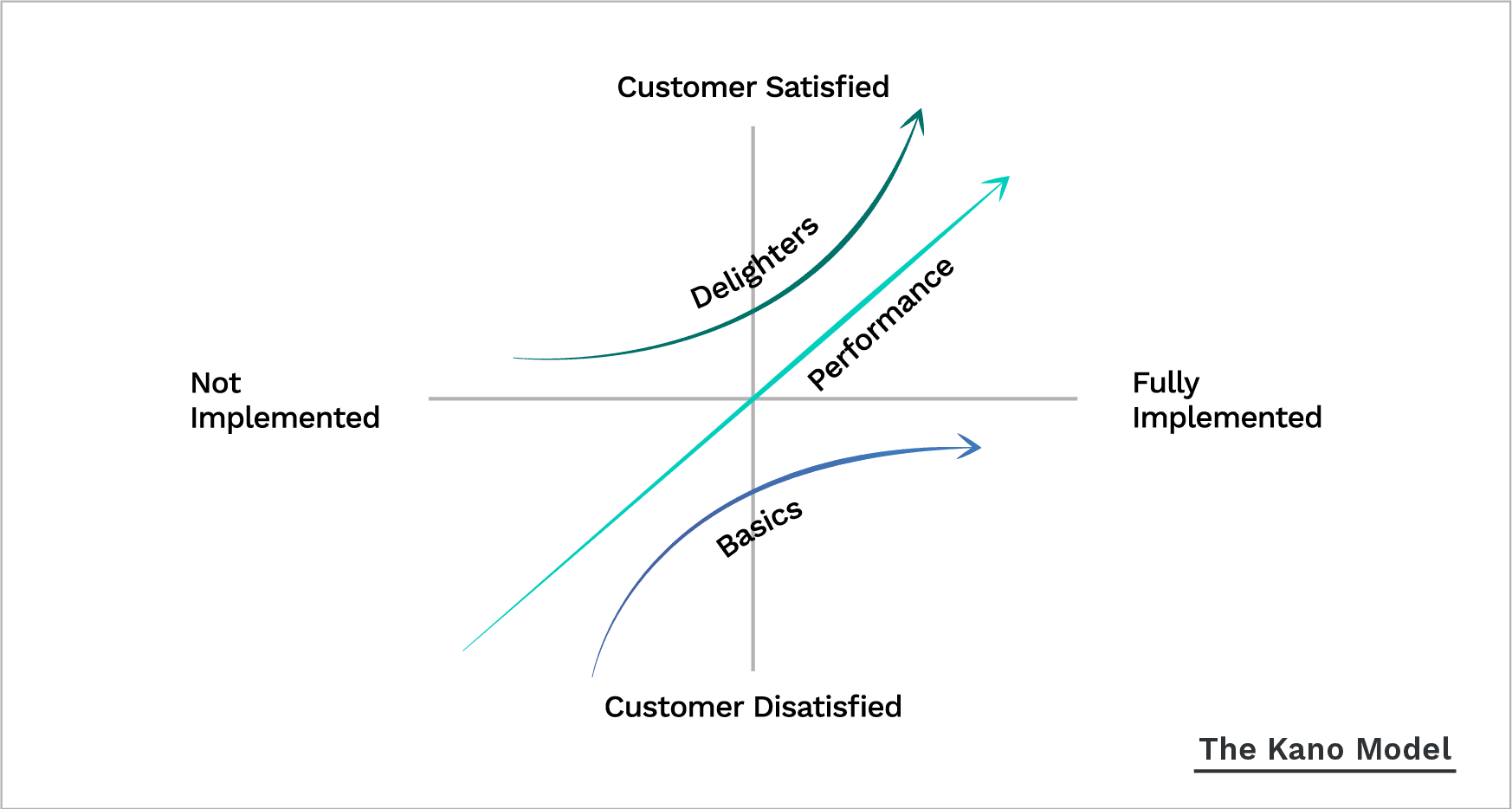
The Kano model plots two dimensions against each other: how fully a customer need is met (implementation) and how satisfied customers are as a result. Features fall into three buckets.
Must-haves are what customers expect as a baseline. Without them, the product isn't viable. Performance features scale with investment – the more you put in, the higher satisfaction climbs. And then there are delighters: Surprises customers didn't ask for but respond to with genuine enthusiasm when you deliver them.
You gather this data through a Kano questionnaire, asking customers how they'd feel both with and without each feature. The core idea: investing in any bucket makes customers happier – but the Kano model shows you which bucket to invest in first. That's the part most teams get wrong.
Pros of the Kano model
The questionnaire prevents teams from over-investing in excitement features while neglecting the must-haves that keep customers from churning. It also produces better market predictions for which features will land, and with whom.
Cons of the Kano model
Running a statistically meaningful Kano survey takes time – you need enough responses to be representative of your full customer base. And customers may not understand the features you're asking them to evaluate, which skews the results.
4. Story mapping
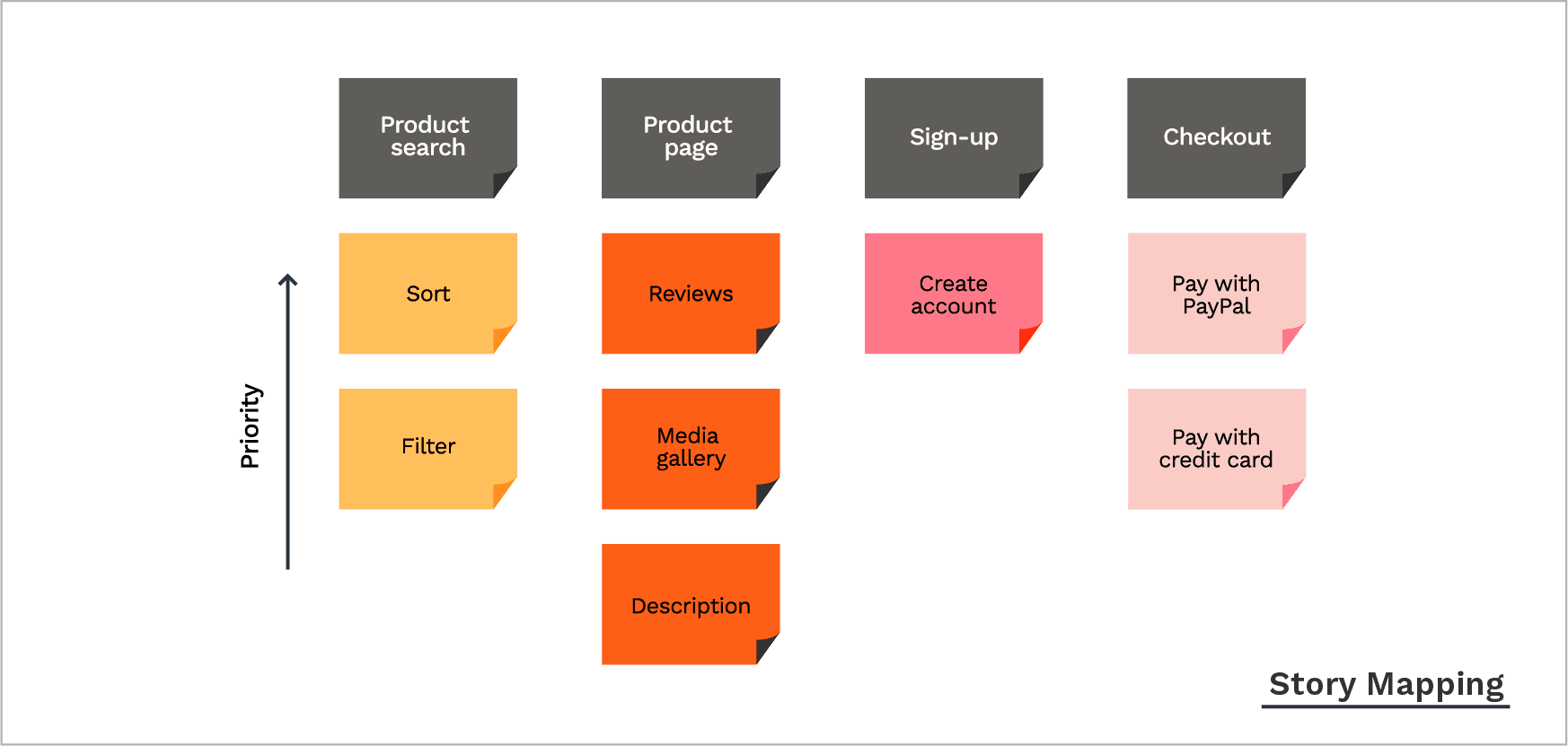
Story mapping lays out each step of the user journey on a two-dimensional map. It's a visual technique that helps teams identify the must-have tasks for every release – and it keeps the focus on the user's actual experience rather than internal opinions.
Here's how it works. Along the horizontal axis, create sequential buckets for each stage of the user journey – signing up, setting up a profile, using specific features. Along the vertical axis, rank tasks by importance, top to bottom. Work at the bottom gets labeled "backlog." A horizontal line across the map divides stories into releases and sprints.
Pros of story mapping
It's one of the fastest ways to identify your MVP. You're writing user stories, not internal requirements – so user experience stays front and center. And it's collaborative by design: story mapping works as a group activity across functions.
Cons of story mapping
It doesn't account for external prioritization factors like business value or technical complexity. That's a real gap if your roadmap has to balance user needs against engineering constraints.
5. The MoSCoW method
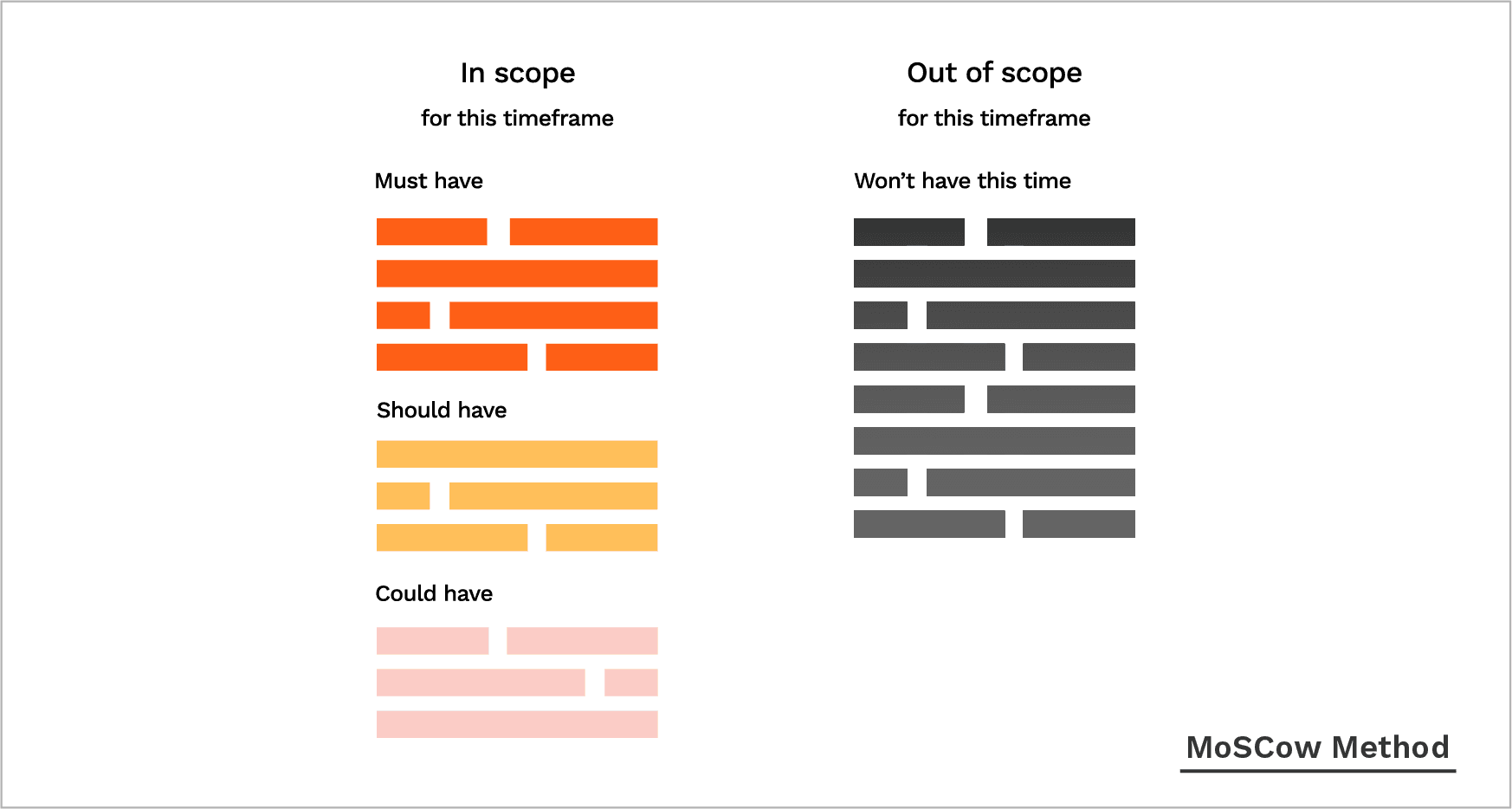
The MoSCoW method sorts features into four priority buckets, giving teams and stakeholders a shared vocabulary for what matters most right now. (The Os are added to make the acronym memorable – it's not a reference to the city.) It stands for Must-Have, Should-Have, Could-Have, and Won't-Have.
Must-Have items are non-negotiable. If any are missing at launch, the product can't ship. Example: "Users MUST log in to access their account." Should-Have items are important but not time-sensitive – they belong in the next release, not necessarily this one. Example: "Users SHOULD have an option to reset their password."
Could-Have items are bonuses. They'd improve satisfaction but won't break anything if they're absent. Example: "Users COULD save their work directly to the cloud from our app." Won't-Have items are the lowest priority and first to go under resource constraints – candidates for future releases.
The model is dynamic. A Won't-Have today can become a Must-Have once the product matures or the market shifts.
Pros of the MoSCoW method
It works well with non-technical stakeholders who need to participate in prioritization without drowning in scoring models. It's fast to run and easy to explain. And it naturally prompts teams to think about resource allocation when categorizing features.
Cons of the MoSCoW method
Teams consistently overestimate the number of Must-Haves. If everything is critical, nothing is. It's also better at defining release criteria than ranking features within a release – which is why most teams pair it with something else.
6. Opportunity scoring
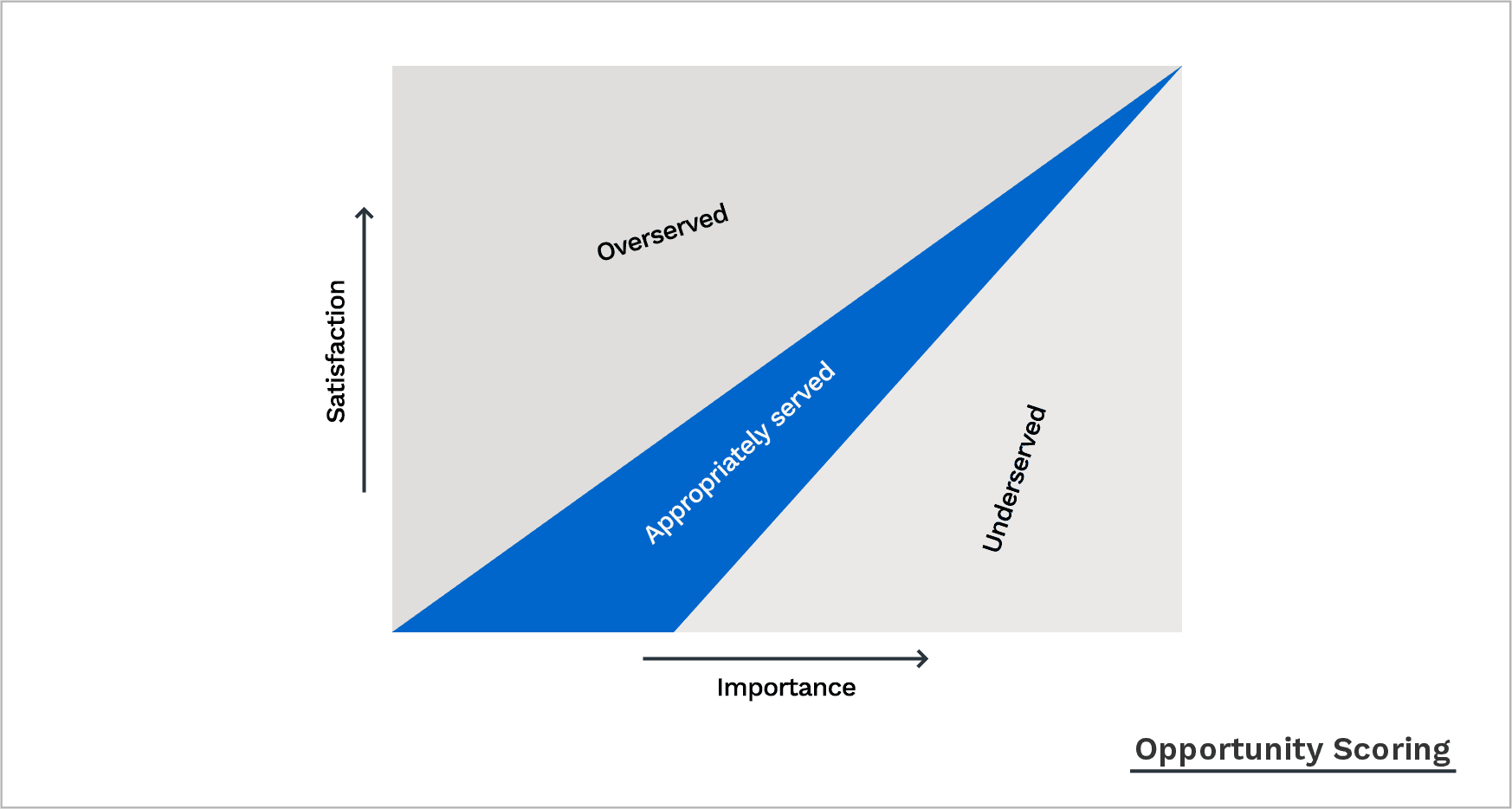
Opportunity scoring ranks features by comparing how important each outcome is to customers against how satisfied they are with existing solutions. The method comes from Anthony Ulwick's Outcome-Driven Innovation framework. Ulwick's argument: customers buy products to get certain jobs done – and while they struggle to generate solutions, their feedback on desired outcomes is genuinely useful.
The process is straightforward. Develop a list of ideal outcomes, then survey customers on two questions:
How important is this outcome or feature?
How satisfied are you with current solutions?
Plot the responses on a satisfaction-vs-importance graph. The features customers care about most but are poorly served by today? Those are your next priorities.
Pros of opportunity scoring
Fast identification of the gaps where innovation will actually land. Easy to visualize and act on – which matters when you're presenting to stakeholders who don't want to sit through a methodology lecture.
Cons of opportunity scoring
Survey respondents tend to over- or understate feature importance, which can skew the graph. You're only as good as your sample.
7. The Product Tree
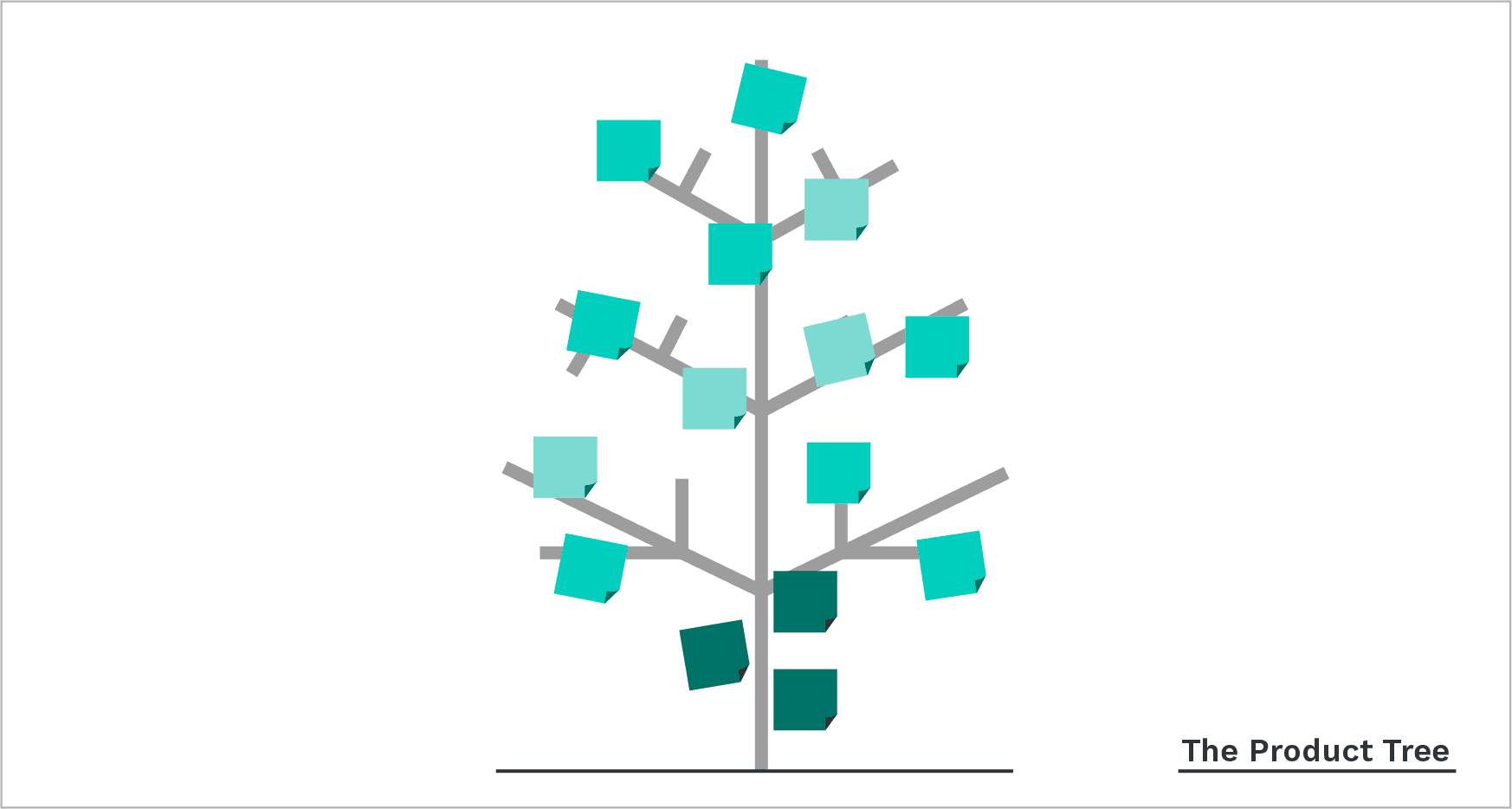
Developed by Bruce Hollman, the Product Tree – sometimes called "pruning the product tree" – is a collaborative workshop game. The goal: shape the product around the customer outcomes that generate the most value, and keep good product backlog items from getting buried.
Here's how it works:
Draw a large tree with several branches on a whiteboard or paper. The trunk represents features already in the product, the outermost branches represent features planned for the next release, and inner branches represent features not yet on the roadmap.
Ask participants – ideally customers – to write potential features on sticky notes (the leaves).
Ask them to place their leaves on the branch where they think the feature belongs.
Clusters tell you where customers want investment. Sparse branches signal lower-priority areas.
Pros of the Product Tree framework
It gives a visual read on how balanced your feature set is across product areas. And it pulls insight directly from customers without the rigidity of a formal survey.
Cons of the Product Tree framework
It produces no quantitative ranking – just a visual guide. Product managers have to translate the output into actual priorities. And without clear groupings, the exercise can run long. Really long.
8. Cost of Delay
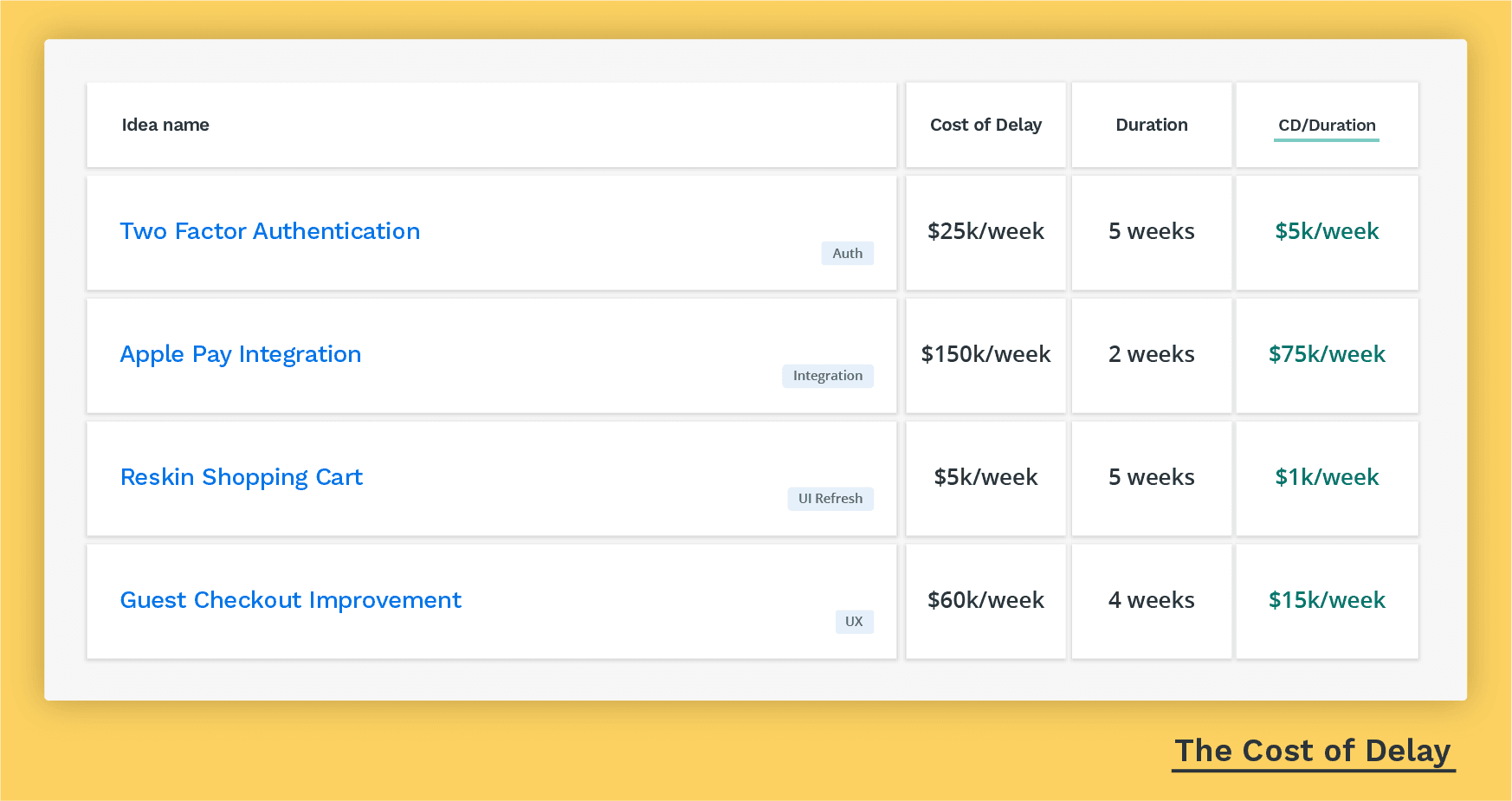
Joshua Arnold defined Cost of Delay as "a way to communicate the impact of time on the outcomes [the company wishes] to achieve." The method asks three questions about every feature: What would this be worth if we had it right now? How much more would it be worth if we delivered it earlier? How much does it cost us for every week we wait?
You assign a monetary value by calculating the time and team effort required to build each feature, and the incremental value it creates once live.
Here's a simple example. Feature A costs $30,000 per week delayed and takes three months to build. Feature B costs $10,000 per week delayed and takes the same time. Feature A goes first. No debate needed.
Pros of the Cost of Delay method
It puts a dollar figure on backlog decisions, making the stakes concrete. And it shifts the team's mindset from "what does this cost to build" to "what does it cost us not to ship this sooner." Better decisions get made when value and speed both factor in.
Cons of the Cost of Delay method
Assigning monetary value to a feature is partly gut-feel, which creates room for internal disagreement on the numbers. The debates can be healthy – but they can also stall the process if nobody's set ground rules for estimation.
9. Buy a feature
Buy a Feature is an innovation game that can involve customers, internal stakeholders, or both. With customers, it gives you a quantifiable read on how much any given feature is worth to the people who'll actually use it. And it's more fun than a survey.
The game works like this:
Choose a list of features, ideas, or updates and assign a monetary value to each – based on how much time, money, and effort each feature will cost the team.
Gather a group of up to eight customers (or internal team members) and give each person a set amount of money to "spend."
Ask participants to buy the features they want. Some will put everything on one feature they care about; others will spread it around. Ask them to explain their choices.
Reorder the feature list by total money spent.
A useful mechanic: price some features high enough that no individual can afford them alone. This forces participants to negotiate and pool their money, which reveals shared priorities.
Pros of the Buy a Feature method
If you want customer input without a dry questionnaire, this is far more engaging. It forces people to rationalize their priorities with real (simulated) tradeoffs and replaces abstract feature rankings with concrete decisions.
Cons of the Buy a Feature method
It only works for features already on your roadmap. It tells you what customers value most, not what they want that you haven't thought of yet. And getting a group of customers in one place at the same time requires more coordination than most teams expect.
Which framework should you use?
None of these frameworks replace judgment. They're tools for getting a room full of people – who all have different opinions – to agree on what matters most right now. The point isn't a perfect ranking. It's making tradeoffs visible so you can have a real conversation about them.
Teams sometimes use other models too, including weighted scoring prioritization and the ICE scoring model. You can also combine frameworks – Value vs. Effort for an initial triage, then RICE on the candidates that survive.
A good framework brings multiple perspectives in: team members, stakeholders, and sometimes customers. It produces results you can act on, not just a vague sense that several things matter. It connects individual features back to the company's real goals. And it removes noise – ideas that don't hold up under scrutiny fall away cleanly.
But prioritization is only one piece. You also need to communicate the "why" behind your decisions across the whole organization. That's the harder part.
Tempo Strategic Roadmaps can help with that. It lets you capture, manage, and analyze customer feedback in one organized place, create a backlog of customer-validated product ideas, surface the best ideas with built-in prioritization templates, and commit to ideas by promoting them to your roadmaps.
References
Sign up for a demo
Request Demo
Structure PPM
Align your entire organization
Manage products, projects, and programs in a single spreadsheet-like view. By providing a clear, real-time view of project progress and resource allocation, Structure helps teams meet deadlines and adapt swiftly to changing priorities.
Start a Free TrialFrequently Asked Questions
Couldn't find what you need?Go to our documentation
RICE adds a "Reach" variable that ICE doesn't have, making it better suited for consumer products where the number of users affected by a feature varies significantly. ICE – which scores ideas on Impact, Confidence, and Ease – is faster to run and works well for early-stage teams that need a lightweight process. For teams already tracking user reach data, RICE produces more precise rankings.
Set a hard cap before the session starts. Many teams limit Must-Haves to no more than 20–30% of the total feature list. Forcing participants to justify each Must-Have against launch criteria – rather than personal preference – also helps. If a feature doesn't block the product from shipping, it's not a Must-Have.
Yes, and it's often useful. A common pattern is using Value vs. Effort for an initial triage, then applying RICE to the high-value candidates that survived that first pass. The risk is over-engineering the process – if scoring takes longer than building, simplify. Pick the one or two frameworks that match your current decision and use the others sparingly.
When internal opinions have stalled the discussion or when you suspect your team's assumptions about customer value are off. The Kano model questionnaire, the Product Tree workshop, and the Buy a Feature game are all designed for direct customer involvement. If you're early in a product lifecycle or entering a new market segment, customer-driven frameworks are worth the extra coordination effort.