Find your product differentiation strategy using an analytical framework
How to use SWOT analysis and a balanced product scorecard to identify where your product can differentiate – and make that differentiation stick.


Key Takeaways
Pick one primary differentiator from the short list product managers actually pick between – design, features, support, brand, or pricing – and commit behind it so marketing and operations reinforce the same claim.
A product differentiation strategy only works when the differentiator maps to a user benefit that a buyer can verify quickly.
SWOT analysis maps external threats against internal strengths, and Roman Pichler's balanced product scorecard tracks KPIs across people-focused, process-focused, product-focused, and financial dimensions.
A product differentiation strategy picks one specific aspect of the product – a feature decision, a pricing model, a support experience, a design choice – and makes it stand out clearly enough that buyers in a crowded market pick you over a near-identical competitor.
"Abstract uniqueness" is not enough to close deals. Your key product differentiator has to map to a measurable user benefit that a customer can verify quickly in actual use.
Picking that one thing is harder than most product teams admit. The pull is always toward broad claims that sound safer in a pitch meeting. The cost of breadth shows up later, when marketing, support, engineering, and sales each optimize for a different angle and the product ends up recognizable for nothing in particular.
A disciplined differentiation strategy commits the whole organization to one primary claim long enough for buyers to associate it with the product.
So, which will you choose?
Design as a differentiator
Your product should have a straightforward experience and look good. So should your competitors'. That's table stakes.
The real question: How are you applying design principles to make your target users' lives easier in a way your competitors aren't? Can you draw a direct line from your design choices to the specific problems your users are solving?
Features as a differentiator
Rather than building every possible feature, you can differentiate by focusing tightly on a specific problem or set of problems.
Does this feature solve a high-priority problem for the target user?
Is it addressing something the competition hasn't solved?
Feature differentiation doesn't require doing everything differently. It requires solving real problems that others are missing.
Customer support as a differentiator
How your company handles support directly shapes how users perceive the product's value. Fast response times, personalized onboarding, helpful communities – whatever you choose, it should be clearly different from what competitors offer.
How to find your product differentiation strategy
Start by mapping three things: What your customers need most, how competitors address those needs, and where your own strengths give you an edge.
You defined your product's value proposition at the start of the product development process. Now you're at a stage in the lifecycle where you want to find better ways to differentiate it. Or maybe you're working on a new product line in a saturated market, with data pointing to an opportunity to stand out.
Either way, step back first. Audit your current strategy and the moving parts that make up your product – internally at the development level, externally at the stakeholder, competitor, and customer level – before choosing one area to differentiate.
For an external view, start with a product feature competitive analysis (covered in our Product Planning guide). Then dig into your users' motivations, problems, and needs using one of these product value proposition models. They help you uncover the relationship between what your product offers and what your specific users and business actually need.
For an internal view – covering design, pricing, features, and customer support – use the tools below. They assess the product from multiple angles and point toward the areas with the most differentiation potential.
SWOT analysis
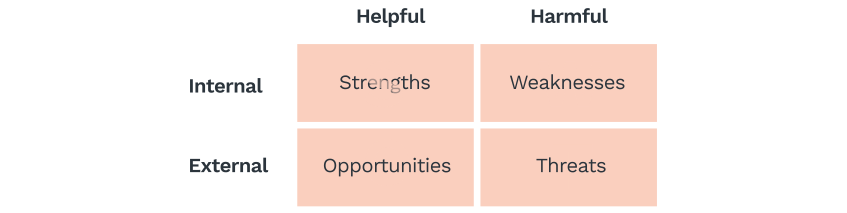
If you're not sure which areas to explore for a differentiation strategy, run a SWOT analysis. SWOT is a strategic analysis and planning tool that examines both external and internal influences on product development. It stands for Strengths, Weaknesses, Opportunities, and Threats.
Strengths are the product aspects that put you ahead of competitors, satisfy your users, and contribute directly to the product vision. Ask: What value props does the product offer? What problems do you solve in a way competitors don't? What internal and external resources can you use to push an aspect of the product forward? What do users say your strengths are?
Weaknesses are the areas competitors could exploit – where the product needs improvement. Ask: What could be better? What's the competition doing that you're not? What are the most common complaints from current and potential users?
Opportunities are external factors – market shifts, consumer trends, new technology – that the product can take advantage of. Ask: Could one of your weaknesses be turned into an opportunity? Can any competitor weakness become your opening? What user complaints point toward a growth opportunity?
Threats are external factors you can't control but must plan around. Ask: How are competitors better equipped – in funding, company size, or resources? What market or industry trends should you be preparing for?
For a deeper look at external factors affecting your differentiation potential, you can also use:
Pestel Analysis (Political, Economic, Social, Technological, Legal, Environmental factors)
Porter's Five Forces Analysis (the five competitive forces that shape product strengths and weaknesses)
Balanced product scorecard
A traditional product scorecard tracks external KPIs like revenue and user satisfaction. Those numbers matter, but they don't tell the full story.
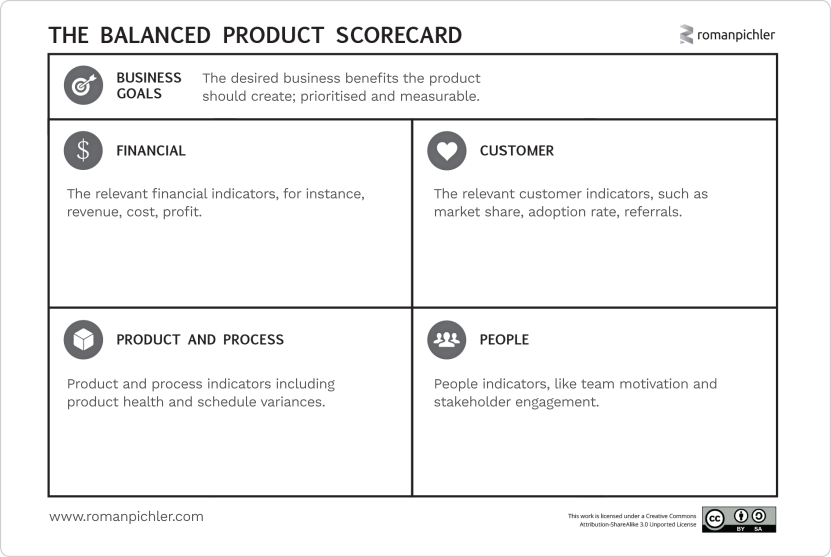
A balanced product scorecard adds people, process, and internal product metrics so you can see performance from every angle. Originally designed by Roman Pichler – inspired by The Balanced Scorecard: Translating Strategy Into Action by Robert Kaplan and David Norton – it pushes product managers to look beyond the usual financial and user KPIs. The BSC also covers people, processes, and product KPIs. All of these can be explored for differentiation possibilities.
A BSC works well as a diagnostic before developing a product strategy. Define the process, people, and product KPIs. Measure them over a quarter or two. Analyze the results. The areas with room for improvement become candidates for a differentiation strategy or an innovation initiative.
Credit: Roman Pichler
The BSC defines business goals as the benefits the product should deliver. Kaplan and Norton's framing: to satisfy shareholders and customers, what business processes must we excel at? This section asks you to examine what the product is actually doing to meet those goals. Is it meeting specific user requirements? How are you measuring that? Can you measure it better?
The financial section covers every aspect that affects financial health – pricing strategy, how current pricing affects existing and potential customers, whether there's a budget for expanding performance or technical goals, and whether stakeholders and users are meeting the goals they hoped the product would satisfy.
For the product and process section, define the operational metrics and KPIs that show how the product is being used and developed. For the customer section, look at conversion rates, customer feedback, and market share. For the people section, look internally at the product team: how engaged are they, and do they feel their work connects to the vision and goals?
The answers to these questions – and the resulting KPIs – point toward the areas where differentiation is both needed and feasible.
The bottom line
Differentiation only holds up when it ties directly to a user problem and a measurable benefit. Abstract uniqueness won't survive contact with the market. Tools like SWOT analysis and a balanced product scorecard help you validate where to invest before committing resources. Pick one clear differentiator, then align design, features, pricing, and support around it.
Sign up for a demo
Request DemoTo answer some questions we often hear from our audience:
How is a product differentiation strategy different from a USP?
A differentiation strategy is the process you follow to decide where and how your product will stand out. A USP (unique selling proposition) is the promise you make to customers once that decision is made. Think of it this way: the strategy is the plan, the USP is the headline.
Example: if your strategy identifies pricing as your edge, the USP might be, "Try it free for 30 days – twice as long as anyone else."
Why build a product differentiation strategy?
Without one, you compete on price by default. That's a race most teams can't win.
A clear differentiation strategy gives buyers a reason to choose you in a crowded market. It builds loyalty by making your value obvious to a defined audience, and it creates competitive advantages across design, support, and features that keep you from competing solely on price.
It can also improve pricing power – Bain & Company's 2025 Commercial Excellence Survey found that companies with a "clear value story aligned with pricing" were more confident in negotiations and better able to pass through cost increases (see Expanding Profit Margin Through Intelligent Pricing).
If you can't explain your differentiator in one sentence, your marketing is probably blending into the background.
How to identify your product differentiation strategy
Write down what customers need most and what they actually value.
Run a competitor review – look at how others differentiate through design, features, pricing, and support.
Audit your strengths and constraints so your strategy stays feasible for the team delivering it.
Choose one focus area and define the specific benefit you'll own.
Test, measure, and refine using user research, internal KPIs, and stakeholder feedback.
What are four common ways to differentiate a product?
Through features – solve a problem your competitors don't, or solve a shared problem in a clearly better way. Through design – make the day-to-day experience smooth enough that the value is obvious from first use. Through pricing – offer flexibility, transparency, or packaging that matches how your buyers actually want to pay. Or through support – build trust through fast onboarding, responsive help, and genuine product expertise.
What does a differentiated marketing strategy look like in practice?
Say you're building a SaaS tool for freelancers. Your go-to-market strategy starts narrow: instead of targeting "all small businesses," you go after designers specifically. You support that with a pricing model built for project-based work, an onboarding flow that starts with their portfolio, and support staff who understand common design workflows. The strategy isn't "be different." It's "be the obvious choice for this specific person."
Sign up for a demo
Request Demo
2026 State of SPM report
This is the data you've been looking for
This original research from almost 700 PMO leaders shows you what is working, what is wobbling, and what it all means for SPM in 2026.
Download the 2026 State of SPM reportFrequently Asked Questions
Couldn't find what you need?Go to our documentation
Use a SWOT analysis when you need to orient quickly – it surfaces both internal strengths and weaknesses and external opportunities and threats in one exercise, which makes it a good starting point when you’re entering a new phase of the product lifecycle or facing a significant competitive shift. Use the balanced product scorecard when you want a more systematic picture of performance over time across financial, customer, process, and people dimensions. The scorecard requires more setup but produces richer data for strategic decisions.
Specific enough that you can measure it. “Better customer support” is not a differentiator. “First response time under two hours, with a dedicated onboarding specialist for the first 90 days” is a differentiator. If you can’t describe the differentiator in terms that a user could verify, it’s still too vague.
Most teams need at least one to two product cycles – typically one to two quarters – to see whether a differentiation investment is landing with users. Pricing changes may show faster signals through conversion data; design changes often take longer because they depend on behavioral shifts. Set a clear measurement plan before you invest so you know what “working” looks like.
Yes, but execution gets harder with each one you add. A product can have a strong design advantage and a pricing advantage – but both require sustained investment to maintain. The risk of trying to differentiate across too many dimensions is that none of them end up being meaningfully better than the competition. Most successful products build a clear primary differentiator and use the others as supporting evidence.