4 product value proposition models for product managers
Four frameworks – from Crossing the Chasm to Lean Canvas – that help product managers define, validate, and share a clear product value proposition.

Key Takeaways
A product value proposition doubles as an internal reference for roadmap decisions – especially if a new request threatens to pull the product away from its core buyer.
Crossing the Chasm works for the internal thesis and Lean Canvas gives executives a one-page view.
Pichler's Vision Board and Osterwalder's Canvas each earn business-lens buy-in through different framings.
Sean Ellis's 40% rule is a crucial validation test: If fewer than 40% of active users would be very disappointed to lose the product, the proposition has not landed.
A product value proposition is a short statement naming who your product is for, and why a buyer should pick you over the obvious alternative.
Question is, are you using it to shape roadmap decisions? A strong product value proposition has to be built with a specific customer job in mind – and validated with real users before the messaging gets locked in.
What is a product value proposition?
A product value proposition – also called a customer value proposition – is a concise statement that communicates two things: The benefits your product delivers to users, and why they should choose you over the alternatives.
In practical terms, it answers: What problem does your product solve, for whom, and what makes your approach better?
Many teams capture this as a proposition document or a brief value statement. When it's done well, it works both ways – for customer-facing messaging and as an internal compass for product decisions.
When your value proposition meets a real, underserved need, you have product-market fit. It has to be clear exactly what your core offering is, and what makes it worth switching to.
Here's a guide on how to scope out competitors with a feature competitive analysis.
Internally, value propositions help PMs make better product decisions and shape their product roadmap. Many PMs write them once – and never look at them again. That's a mistake. Building without a product thesis leaves you making decisions based on whoever argues loudest, whether that's a CEO or an edge-case user who doesn't represent your target customer.
When you share your value proposition with developers and designers, you give them the "why" behind what they're building. That context builds user empathy and creates a more focused product experience.
A PM who stays single-minded about the value proposition turns it into must-haves in the product. And that turns into users who trust the product because you delivered what you promised.
4 value proposition models for product managers
A good value proposition model surfaces gaps in your understanding of the customer and pushes your product closer to product-market fit. Other brands are making promises too. Don't forget to call out what makes yours different.
Value proposition models at a glance
Model | Best for | Format | Covers competitors | Covers user pains/gains |
|---|---|---|---|---|
Crossing the Chasm | Concise internal alignment on product thesis | Text template (one paragraph) | Yes | Partial (need statement only) |
Pichler Canvas | Boardroom buy-in from execs and investors | Visual canvas (business lens) | Yes | Partial (needs, not split into pains/gains) |
Osterwalder Canvas | Deep customer understanding across use cases | Two-sided visual canvas | No | Yes (pains, gains, and jobs to be done) |
Lean Canvas | Single-page executive view with financials | One-page nine-block canvas | Yes (existing alternatives) | Partial (problems, not full pains/gains) |
Crossing the Chasm value proposition model
Works well when PMs need a concise, text-based way to share the value proposition internally.
This product proposition model is short and simple. Unlike the others in this guide, it's text-based – you frame your product's thesis in a few sentences using a fixed template:
For [target customer] who [need statement], the [product/brand name] is a [product category] that [key benefit]. Unlike [primary competitor alternatives], [product/brand name] [primary differentiation statement].
Using Slack as an example:
For work teams who need a better workflow, Slack is a team communications tool that integrates apps and lets users search through files, calls, messages, and colleagues. Unlike Microsoft Teams, Slack has better options for third-party integrations and is easier to deploy.
Your product, your users, your competitors – all in one paragraph. Use it as the summary after you've worked through one of the other models below.
Roman Pichler's extended product vision board model
Works well when PMs already know their users and need boardroom buy-in – from investors or executives.
Roman Pichler's approach looks at the value proposition from the business lens rather than the user lens. It asks:
Is it technically feasible to build this product?
How does it benefit the company?
What are the product's business goals?
How does it generate revenue?
What are the costs to develop, market, sell, and support it?
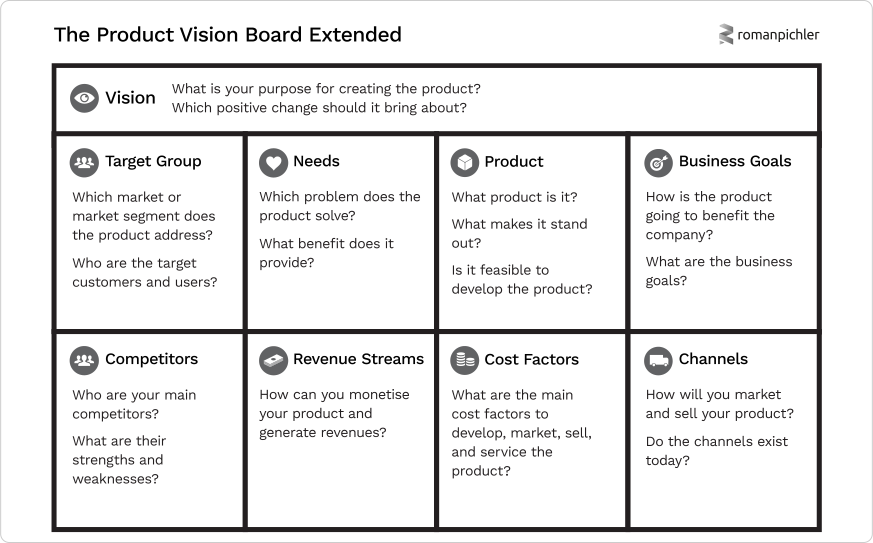
The sub-questions in each section are built to help you communicate your product's value to internal stakeholders. Pichler's model directly addresses competitors, which many canvases skip entirely. One gap worth noting: it doesn't separate user needs into pains and gains. Specific pain points can get lost in the broader "needs" bucket if you're not careful.
Alexander Osterwalder's Value Proposition Canvas
The right pick for PMs with multiple use cases or a diverse user base who want to go deep on customer understanding.
This framework comes from the team behind the Business Model Canvas. It's the most user-centric model here. Osterwalder's canvas digs into customer pains, gains, and jobs to be done (JTBD), then maps those to your product's pain relievers and gain creators.
It visualizes alignment between your product (left side) and your target customer (right side) by showing where the two overlap. More overlap means you're closer to product-market fit.
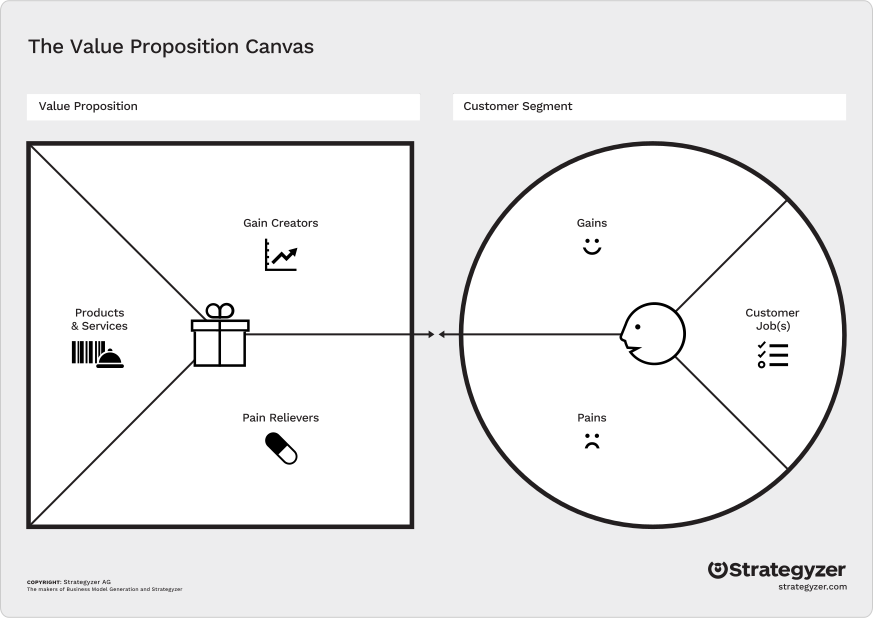
Start with the customer profile on the right. List your user's everyday tasks and problems – including emotional and social drivers, not just functional ones. Then record the specific frustrations users run into while trying to complete those tasks, including pain points from competing solutions. Rank by frequency and severity.
Finally, describe what customers expect or want: better performance, cost savings, social proof, or moments of delight.
Then move to the value proposition side. List everything you offer that the proposition is built around, and map your pain relievers and gain creators to the user's pains and gains. The more your product's outputs match the customer profile's inputs, the stronger the fit.
One catch: Osterwalder's canvas doesn't address competitors directly. Pair it with the Crossing the Chasm template to cover that gap.
Ash Maurya's Lean Canvas
The right pick for PMs who want a single canvas covering the full picture – financials, competitors, and all – in one document for executive review.
Ash Maurya's Lean Canvas adapts the Business Model Canvas with added sections useful for stakeholder presentations: revenue streams, cost structure, and key metrics. There's also a section for "existing alternatives" – how your users currently solve their problems, with or without competitors – which is an indirect but useful way to address the competitive space.
The value proposition gets its own dedicated quadrant. It has two parts: A single, clear, compelling message that states why you're different and worth attention, and a high-level concept explanation – your "X for Y" analogy (e.g., YouTube = Flickr for videos).
Place that next to your user's top problems and your competitor alternatives in the same canvas, and it's easy to see whether your proposition actually addresses those needs in a better way.
Validate and share your value proposition
A value proposition that never gets tested or distributed isn't doing much. Here's how to pressure-test it and get it in front of the people who need it.
Run surveys
Gather customer feedback by talking to real users or running a market survey. Present your product proposition and ask: "How would you feel if you could no longer use this product?"
If 40% answer "very disappointed" to your main benefit, you have the right product-market fit. (Benchmark popularized by Sean Ellis; also cited in Croll & Yoskovitz, *Lean Analytics*, O'Reilly, 2013)
Iterate on the benefit statement
If you're below 40%, adjust your product thesis. Ask your "very disappointed" users what the main benefit they get from you is – or how they'd want you to improve the product. That main benefit needs to show up clearly in your proposition.
First Round Review published a case study on how Superhuman used these four survey questions to pinpoint their core value:
How would you feel if you could no longer use Superhuman? A) Very disappointed B) Somewhat disappointed C) Not disappointed
What type of people do you think would most benefit from Superhuman?
What is the main benefit you receive from Superhuman?
How can we improve Superhuman for you?
Share internally
After doing this work, it's tempting to let the proposition sit in a folder. Don't. Post it on an office wall, pin it in your team's shared workspace, or reference it in planning docs. It only does its job when people actually see it.
Most of these canvases contain competitor information, so they're often kept internal. But use that to your advantage – share them with marketing, sales, and design so everyone works from the same strategic foundation. Your go-to-market strategy, web copy, and customer conversations should all trace back to the same proposition.
Inside the product team, make sure everyone agrees on the value the product delivers. Bring the proposition into roadmap reviews and feature discussions. If a major product decision can't be traced back to it, something's off.
Ready to start planning? Try our ready-to-use product roadmap template.
Sign up for a demo
Request demo
2026 State of SPM report
This is the data you've been looking for
This original research from almost 700 PMO leaders shows you what is working, what is wobbling, and what it all means for SPM in 2026.
Download the 2026 State of SPM reportFrequently Asked Questions
Couldn't find what you need?Go to our documentation
A value proposition focuses on the customer – what they gain from your product and why you’re better than the alternatives. A positioning statement is outward-facing: it defines how you want your product to be perceived in the market relative to competitors. In practice, the two overlap, but value propositions are more useful as internal product tools, while positioning statements drive marketing copy.
At least annually, and any time there’s a significant product pivot, a new competitor entering the space, or a meaningful shift in user feedback. If you’re getting signals that users don’t understand what the product does or why it matters, that’s a sign the proposition has drifted from the product’s actual behavior.
Yes, particularly if you’re serving distinct user segments with different jobs to be done. A project management tool might have one proposition for individual contributors and a separate one for executives who need portfolio visibility. The risk is trying to pack too many propositions into one product experience – at some point, focus is the feature.
The canvas forces you to map product outputs to customer inputs side by side. A bullet-point list of benefits tells you what the product does; the canvas shows whether those benefits actually match what customers care about. The overlap between the two sides is the real signal – and most teams find, when they do the exercise honestly, that the fit is smaller than they assumed.