The Hoshin Kanri matrix helps your organization plan & execute key goals. Learn how to build your own, and guide your team from strategy to execution.
Discover how strategy execution management bridges the gap between planning and doing. Learn tips to ensure your organization achieves its goals.

Project planning brings stakeholders from across the organization together to evaluate resources and set strategic goals. But planning is the easy part. The real work — and where most strategies stall — is turning those plans into measurable results.
Strategy execution management is the discipline that closes that gap. It translates a vision into action while keeping the organization aligned and adaptive to change. Below, we define strategy execution management, cover its benefits, and lay out a step-by-step approach for putting it into practice.
Strategy execution management is the practice of turning a strategic plan into measurable business results. It bridges the gap between a plan on paper and the work that actually delivers on it.
The process involves setting objectives, aligning resources, tracking progress, and making data-driven adjustments. When companies focus on execution, they ensure their initiatives contribute to organizational success rather than drifting into activity for its own sake.
Consider this example: A business aims to improve customer retention. The execution strategy runs personalized outreach campaigns and enhanced customer support. Leaders measure progress by tracking retention rates, adjust the approach as new data comes in, and reallocate resources when initiatives get off track.
Strategy execution management keeps every initiative aligned with your business objectives and adaptive to change. Well-managed execution delivers four clear benefits:
Aligning strategic goals across departments prevents miscommunication and clarifies a shared vision for teams to work toward. This fosters collaboration, eliminates redundancies, and lifts overall efficiency.
A well-defined execution framework streamlines operations and removes bottlenecks. Teams know their priorities, which accelerates progress toward goals.
Tracking key performance indicators (KPIs) and standardized feedback lets organizations see what is working and where improvements are needed. Real-time analytics are how you refine an execution strategy without guessing.
Organizations that prioritize execution management build a culture of accountability. Teams take ownership of their tasks, and leadership adapts to new challenges through structured progress tracking.
A successful execution strategy follows a structured approach for consistency and control. Here is a step-by-step guide to managing execution:
Start by setting organizational goals that align with your company's mission. Goals should be SMART:
Specific: Objectives should cover a narrow, distinct scope of outcomes.
Measurable: Identify metrics to track progress and success.
Achievable: The parameters for success must be realistic for your current capacity.
Relevant: Outcomes should support your company's mission.
Time-bound: A limited time frame gives your team a sense of urgency and accountability.
You cannot execute every goal at once. Identify high-impact initiatives that best align with business priorities. Frameworks like strategic portfolio management help determine which projects will drive the most value.
Execution fails when resources are misallocated. Proper resource management lets your people complete initiatives on time without logging excessive overtime.
Assign clear responsibilities to teams, verifying that each stakeholder understands their contribution to the strategic objective. Planning tools like Tempo's Strategic Roadmaps show relationships and dependencies between project teams, and time-tracking software helps you monitor efficiency and hours worked.
Tracking KPIs in real time lets organizations make informed adjustments as conditions change. This step keeps execution agile and responsive.
Review the success of your execution process at regular intervals. Is your strategy delivering the intended results? If not, refine the approach with data-driven insights. Adaptability is what separates a strategy that survives contact with reality from one that does not.
Successful strategy execution management rests on four essential factors. These elements are what turn strategic plans into measurable outcomes:
Alignment: Keep teams and objectives focused on shared strategic goals to prevent miscommunication.
Ability: Verify teams have the skills, resources, and tools to enact plans.
Architecture: Establish clear roles and governance for structured execution.
Agility: Be prepared to adapt to market changes at a moment's notice.
Organizations that put these four As in place remove execution barriers and improve implementation.
Organizations run into predictable trouble when they try to bridge strategy and execution. Tempo's suite of project management tools supports seamless planning, management, and performance across that gap.
Tempo strengthens strategic execution management across three areas: planning, action, and analytics.
Success starts with a clear vision and structured planning. Two Tempo tools — Strategic Roadmaps and Structure PPM — work together to help your organization define strategic objectives and collaborate to achieve them.
They help you prioritize initiatives based on business impact and improve cross-team collaboration by visualizing dependencies and milestones. Tempo gives you a structured framework for executing strategies with clarity and confidence.
Once strategic goals are set, execution has to be precise. Tempo's end-to-end execution management keeps strategic plans actionable, trackable, and adaptive.
Tools like Structure and Portfolio Manager keep tasks, projects, and teams aligned. They help you allocate resources and assign the right people to each initiative.
Strategy execution depends on up-to-the-minute performance monitoring. Tempo's Timesheets and Custom Charts offer real-time visibility into project performance. Capture data on progress, costs, efficiency, and workload distribution, then generate insights to refine your strategy and optimize execution. Custom Jira dashboards deliver intuitive analytics to inform critical decisions.
When you integrate Tempo's modular solutions into your tech stack, you build a continuous feedback loop between high-level strategic planning and project execution. Structured workflows and careful monitoring keep alignment across your organization intact. Quick, qualified decisions based on accurate data become the default, not the exception.
Get started with Tempo and level up your strategy execution management.
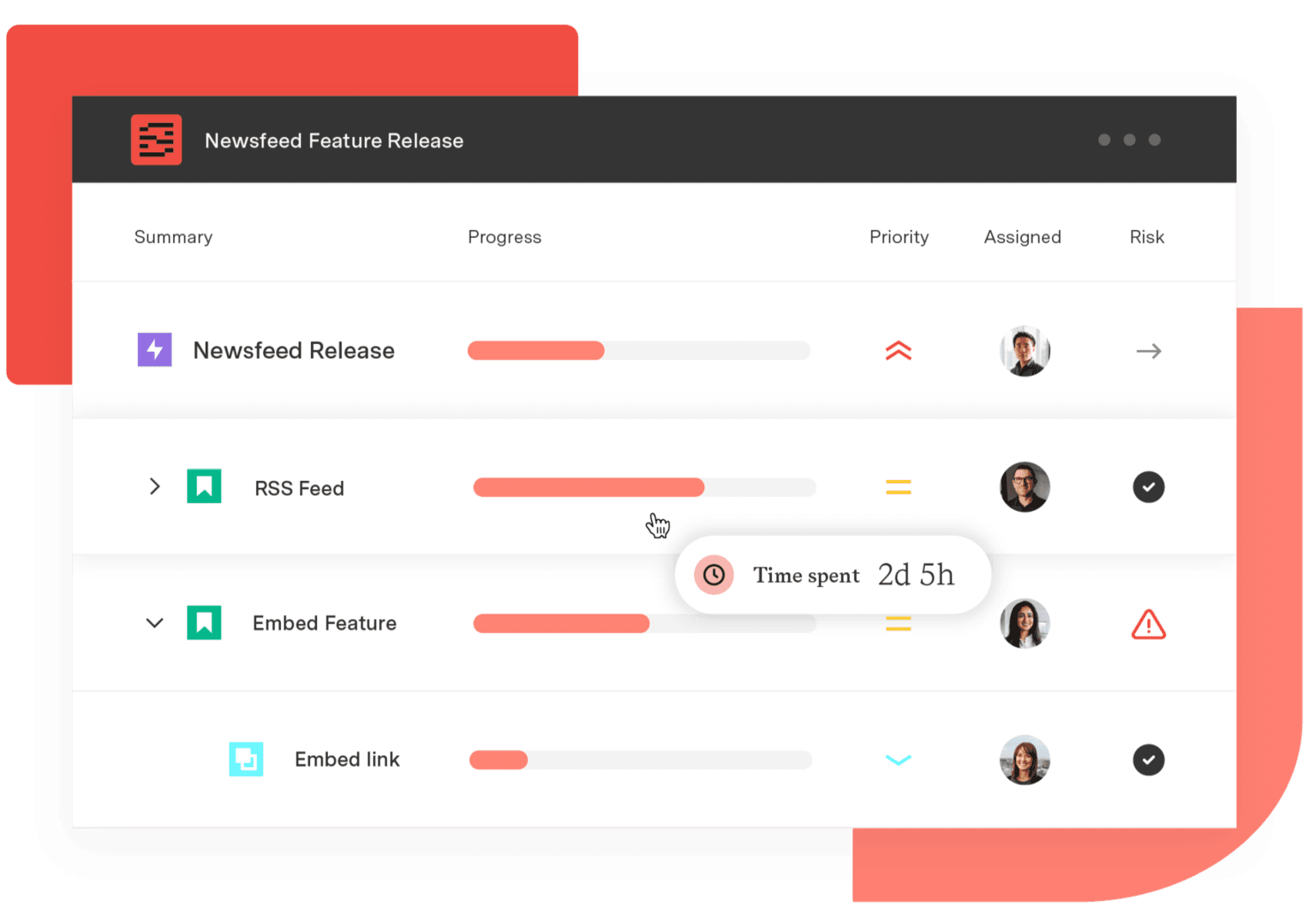
Structure PPM
Manage products, projects, and programs in a single spreadsheet-like view. By providing a clear, real-time view of project progress and resource allocation, Structure helps teams meet deadlines and adapt swiftly to changing priorities.
Start a Free TrialCouldn't find what you need?Go to our documentation
The primary objective of strategy execution management is to turn your organization’s strategic plans into operational successes. The system combines strategic planning and execution by focusing on alignment, accountability, and adaptation.
Clearly define objectives with a tool like Tempo’s Strategic Roadmaps to align your team with a shared vision. Additionally, monitoring and reporting tools like Custom Charts provide vital execution management insights.
Businesses employ strategic portfolio management software, business strategy dashboards, KPI tracking systems, and execution-oriented project management solutions like Tempo to enhance their strategic execution processes.
Five pillars drive successful strategy execution:
1 .Leadership commitment
2. Clear objectives
3. Resource allocation
4. Performance tracking
5. Flexibility
You’ll need all five to consistently achieve strategic goals.
The Hoshin Kanri matrix helps your organization plan & execute key goals. Learn how to build your own, and guide your team from strategy to execution.

Discover how a solid operations strategy drives growth and efficiency, aligning business goals with real-world execution.

Discover how goal-setting software promotes clarity, accountability, and alignment from strategy to execution, helping teams deliver results.

Tempo's Structure PPM, Gantt Charts, and Timesheets close the gap between strategy and shipped outcomes at portfolio scale.

Roadmaps are essential to bridge the gap between planning and action. Learn how to transform your roadmap into a dynamic, decision-ready tool.

Learn how enterprise project management drives success by improving resource utilization and risk management Explore strategies for project execution.
Discover the importance of operational plans, their distinction from other planning approaches, and how to craft your own.

Discover how aligning strategy and execution with integrated roadmaps can enhance portfolio management and boost ROI, based on our latest study.

The Planner team has been bridging the gap between individual and team planning, and helping leaders manage their resources, people, and projects.