Learn how to run the five core agile ceremonies and see how PMO leaders connect them to SAFe and a hybrid portfolio view
Find out if SAFe agile is right for your organization. Discover its principles and benefits and see how it compares to other Agile at Scale frameworks

The Scaled Agile Framework (SAFe) is a knowledge base of workflows, roles, and principles that helps large organizations run agile beyond a single team. It gives enterprises a structured way to coordinate dozens or hundreds of teams around shared cadence, shared planning, and shared value delivery.
Agile itself was built for small groups. Stretching it across a company — Agile at Scale — is where most transformations stall. SAFe is one answer to that problem, and more than 20,000 companies have adopted it. Here is what it covers and why it works.
SAFe is a freely available body of practices for scaling agile inside enterprise organizations. Dean Leffingwell and Drew Jemilo released it in 2011. It provides:
Structured guidance for agile roles and responsibilities
Work planning and management techniques
Values and principles for enterprise adoption
The framework sits on top of Scrum and Lean, and pulls product development, portfolio governance, and program coordination into one operating model.
SAFe applies Lean Portfolio Management to shift how every employee thinks — from leaders to individual contributors — moving the organization off waterfall assumptions and onto a lean-agile footing. Ten principles anchor that shift.
Understand the economic cost of delay so you can deliver the shortest sustainable lead time. That mindset drives frequent, early delivery and pushes teams to sequence work for maximum value inside a lean budget. Decentralized decision-making depends on everyone sharing that economic lens.
Systems thinking treats the whole delivery system as the unit of improvement. Optimizing one component in isolation rarely improves the outcome. SAFe applies the discipline to three areas:
The solutions: Any product, service, or system delivered to internal or external clients
The enterprise: The people and structures building the system
The value stream: The sequence of steps teams complete to deliver a solution
Successful adopters weigh people, management, and process together when they change any part of the system.
Product and software development are uncertain by nature. SAFe uses set-based design to hold multiple requirements and design options open as long as possible. Decisions narrow as evidence accumulates.
Set-based design bakes learning milestones into the lifecycle — checkpoints where the team commits to a choice based on what has been learned, not what was guessed at the start.
Short iterations tied to learning milestones let teams inspect the whole system before locking the next step. A regular cadence accelerates data gathering and shortens the loop between decision and evidence.
Building incrementally also gives customers something to react to. Early versions become prototypes, some become MVPs, and the feedback stream lets teams pivot when the market signals something the plan did not anticipate.
Learning phases produce quantifiable evidence — a stronger basis for decisions than requirements documents or success metrics on paper. Sharing that evidence with stakeholders builds trust.
Integration points act as scheduled pauses in the lifecycle. Teams evaluate the solution against financial, technical, and fitness-for-purpose criteria while there is still time to change direction.
SAFe teams protect flow. They visualize and cap work in progress (WIP), shrink batch sizes, and manage queue length so throughput stays high and delivery stays fast.
Limiting WIP also gives stakeholders a clean view of what is moving. Smaller batches keep the work honest against the plan.
Teams inside SAFe run on shared cadence — sprints or iterations that:
Reduce project complexity
Address solution uncertainty
Enforce quality
Foster collaboration
Cadence sets the rhythm. Synchronization across cross-functional groups turns that rhythm into coordinated delivery, producing:
Harmonious team activities
Better information sharing
Improved sprint planning
Predictable development cycles
Multiple perspectives folded into the solution
SAFe replaces command-and-control with coaching. Teams that own their decisions get:
Autonomy and purpose
Minimized constraints
An environment of mutual influence
Higher engagement
The outcome shows up in the work — better solutions, better retention, better customer results.
Decentralized decisions drain product backlog queues and put economic authority close to the work. Leadership stays focused on the calls only leadership can make; the people closest to the problem handle the rest and often surface the most creative solutions.
SAFe reorganizes the enterprise around value streams instead of functional silos. Collaboration replaces handoffs, dependencies shrink, and delivery speeds up. The business becomes more flexible and more responsive when the market shifts.
Adopting SAFe requires three things up front: executive sponsorship, a real transformational business case, and a working foundation in Scrum. Without those, the rollout stalls before it starts.
With them in place, the organization groups its agile teams into an Agile Release Train (ART) and works through the 13-step SAFe implementation roadmap:
Reach the tipping point
Train Lean-Agile change agents
Create a Lean-Agile Center of Excellence
Train executives, managers, and leaders
Lead in the digital age
Organize around value
Create the implementation plan
Prepare for ART launch
Train teams and launch the ART
Coach ART execution
Launch more ARTs and value streams
Enhance the portfolio
Accelerate
Scaled Agile Inc.'s own studies since 2011 show measurable gains in four areas.
SAFe teams get room to:
Eliminate low-value tasks
Identify and remove roadblocks
Drive continuous improvement
Focus on high-value deliverables
That combination drives 20–50% productivity improvements.
Quality becomes a shared responsibility across every phase instead of a scramble before release. Reported quality improvements land in the 25–75% range.
SAFe organizations ship 30–70% faster than peers. The framework supports:
Rapid, evidence-based decisions
Effective cross-team communication
Streamlined operations
Customer-centric focus
Better workflows produce a welcome side effect. Autonomy and purpose go up, burnout goes down, and engagement improves by as much as 50%.
Tempo has tools and templates built for SAFe transformations.
Structure PPM visualizes projects and portfolios from a single view, aligning the enterprise in real time across teams, ARTs, and value streams. Strategic Roadmaps connects day-to-day sprint planning to broader company strategy so Scrum teams prioritize the work that actually moves the business.
Together, the Jira-native Tempo stack turns the agile mindset into something the whole organization can operate against.
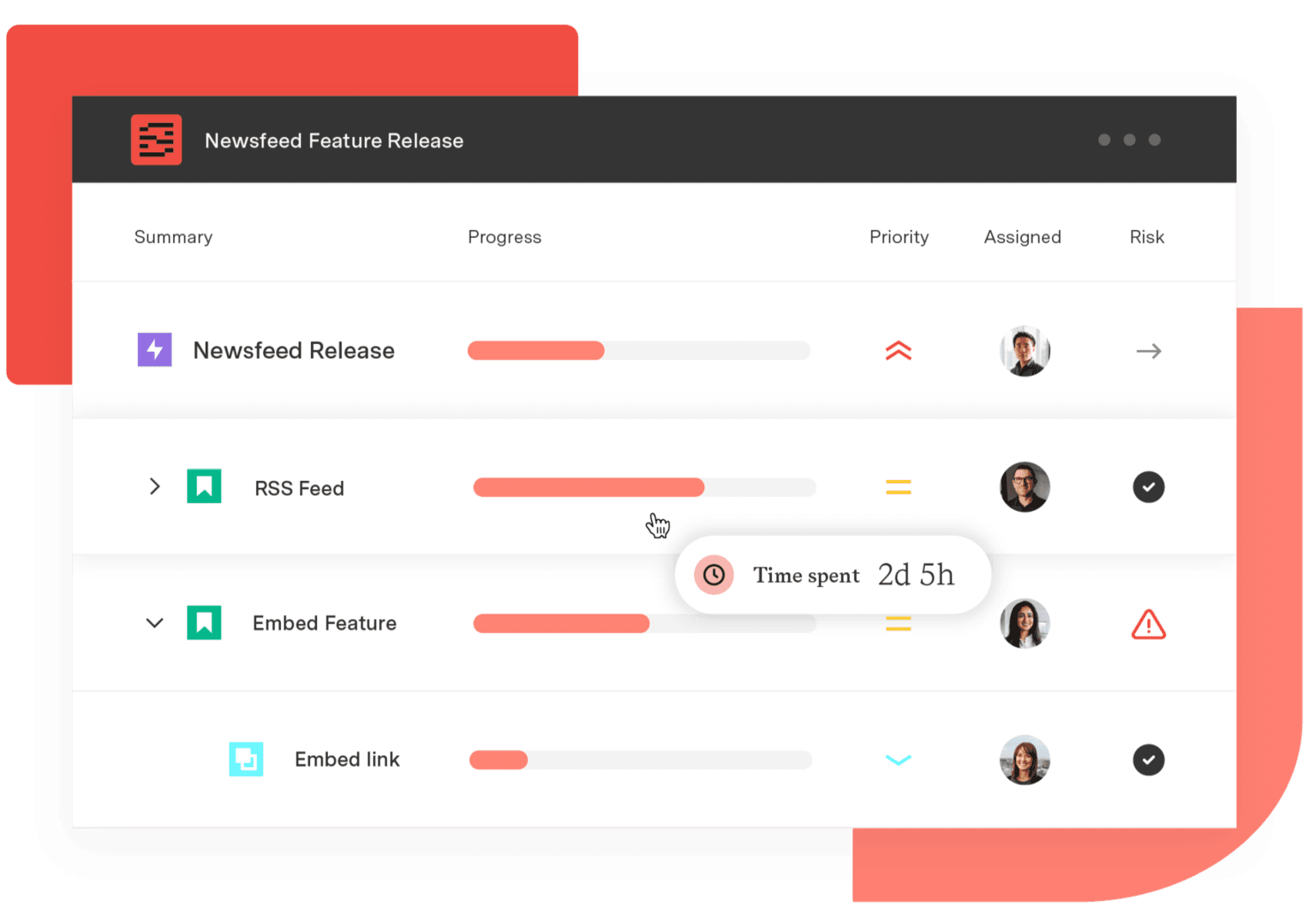
Structure PPM
Manage products, projects, and programs in a single spreadsheet-like view. By providing a clear, real-time view of project progress and resource allocation, Structure helps teams meet deadlines and adapt swiftly to changing priorities.
Start a Free TrialCouldn't find what you need?Go to our documentation
The Scaled Agile Framework (SAFe) is a knowledge base of organizational and workflow practices to implement Agile at Scale.
Scrum is an agile framework that manages iterative development in small teams with a focus on autonomy. The SAFe framework guides large-scale agile implementation by defining roles, events, artifacts, and other constructs.
SAFe offers four configurations supporting business agility across every growth phase:
1. Essential SAFe includes only the components necessary for agile product delivery.
2. Large Solution SAFe supports the transition of numerous or large management teams overseeing complex projects.
3. Portfolio SAFe aligns strategy with execution by expanding Essential SAFe to manage multiple value streams.
4. Full SAFe is the most extensive framework available. Full SAFe supports enterprises building large and complex portfolios.
Learn how to run the five core agile ceremonies and see how PMO leaders connect them to SAFe and a hybrid portfolio view

Don’t be intimidated by Agile at Scale implementation. The SAFe roadmap will help you successfully transition to the agile methodology in five steps.

Agile PI planning is an integral part of the SAFe project management framework. Learn about contributors, inputs & outcomes of a productive session

Discover why agile release trains (ARTs) are necessary to complete cross-departmental and collaborative work.

Try these six Custom Charts reports to measure competency, flow, and outcomes in the Scaled Agile Framework (SAFe).

Whether it’s your first time or you’re a seasoned pro, this guide to SAFe PI planning will help you get the most out of each session.

This guide shares best practices and tips to create a better SAFe program board and improve your Program Increment planning sessions.

While the distinction may seem trivial, there are far-reaching implications to choosing which option is right for your organization.

Would you like an expert to architect your workspace and data structure, train your team, or build out reports? Try our professional services.