RICE score: A prioritization framework for estimating the value of ideas
RICE gives product managers a structured way to compare ideas by reach, impact, confidence, and effort – from the PM who created it at Intercom.


Key Takeaways
Sean McBride built RICE on Intercom's growth team to compare project ideas against a single conversion goal, which is why it works cleanest when the ideas share that kind of common metric.
Confidence is the variable most teams underuse. A low confidence score signals the team needs more research before committing; it does not by itself kill the idea.
RICE score prioritization uses the formula (Reach x Impact x Confidence) / Effort to turn four rough estimates into a single comparable score per idea.
"Impact" is too big a word to argue about productively, and that's why the RICE score prioritization framework exists.
Sean McBride built it on Intercom's growth team to split that single fuzzy estimate into four smaller ones – reach, impact, confidence, effort – each of which a team can put a number on with some data behind it, or admit they can't and go look for more.
RICE forces the disagreement to happen at the variable level instead of the verdict level. Two PMs who can't agree on whether a feature is "high impact" can usually agree on a reach number once they look at the same analytics tab, and the conversation narrows from there. The score on the bottom line matters less than the conversation the framework forces on the way down.
What is a RICE score and where did it come from?
RICE stands for Reach, Impact, Confidence, and Effort. It's a prioritization framework for quantifying the estimated value of a feature or project idea, so ideas can be sorted by potential return before anyone commits to building them.
Formula: RICE score = (Reach x Impact x Confidence) / Effort
Product managers face project prioritization decisions constantly, often with dozens of competing ideas and limited time to evaluate each one. RICE gives them a consistent structure for those decisions.
The framework came out of necessity. Sean was a PM on Intercom's growth team, responsible for turning website visitors into active, paying users. The team needed something that could strip gut feelings out of the conversation when comparing project ideas against a single goal – conversions.
"We wanted to come up with a more structured method of comparing many different project ideas in terms of their potential impact on a single goal," says Sean.
They needed a way to break "impact" into components that could be applied consistently across different projects. RICE was the result.
Intercom first created the RICE model to bring structure to roadmap debates. You can capture the same scores in Jira by adding four custom fields – reach, impact, confidence, and effort – then rolling them up on a Tempo dashboard to spot the highest-value ideas.

Calculating reach
Reach estimates how many relevant users an idea might affect within a given time period. You define who those users are and what the time window is. Reach can apply to new users, existing users, or a specific segment – whatever's relevant to your product goal.
Say your team is building a budget warning feature for a banking app, and it'll be used by the 100 users who log in to check their balance monthly. Over a quarter, that's a reach of 300.
"Reach is about asking yourself: how many customers or people will this project idea affect?" says Sean. "If you have one idea that will affect everyone who comes through your signup process, and another that will only affect 5% of those people, the first idea has a higher reach and a bigger potential outcome."
When the reach score is hard to estimate
Reach can be tricky, especially for B2B products where users aren't equal in value. Clement Kao, PM and co-founder of Product Manager HQ, addresses this by combining Reach and Impact into a projected revenue upside score.
"After all," says Clement, "it doesn't really matter if you'll impact all users positively if it doesn't change retention rates or create an upsell opportunity."
Instead of estimating user count, Clement scores at the account level: which accounts will this hit, and what revenue does it unlock?
"In B2C, reach assumes each user is worth the same," he adds. "In B2B you can't do that. Impacting 10 small customers with $1k contracts may not yield the same revenue as impacting your biggest customer with a $100k contract."
Calculating impact
Impact answers the follow-up question to reach: by how much? It measures how much an idea could affect a specific goal for an individual customer or user.
On Intercom's growth team, impact was measured by how much an idea could affect a potential customer's likelihood to convert into a paying user.
Sean used a multiple-choice scale to standardize impact values:
Impact scoring scale
Score | Label | Meaning |
|---|---|---|
3 | Massive | Transformative effect on the goal for each user the idea reaches |
2 | High | Strong effect on the goal for each user the idea reaches |
1 | Medium | Moderate effect on the goal for each user the idea reaches |
0.5 | Low | Small effect on the goal for each user the idea reaches |
0.25 | Minimal | Barely perceptible effect on the goal for each user the idea reaches |
A simple five-point scale keeps scoring consistent and fast. Impact can also be a weighted score that combines multiple factors – revenue generation, usage rates, adoption – depending on what "impact" means at your organization.
Sean's advice: before scoring anything, spend time with your team to get clarity on the goal for the quarter. A shared understanding of what you're trying to achieve makes every scoring conversation easier.
"When using RICE, it's important to have a single goal in mind as you're comparing project ideas," says Sean. "If one project helps goal A and another helps goal B, it's hard to compare them directly. Which goal matters most right now?"
Calculating confidence
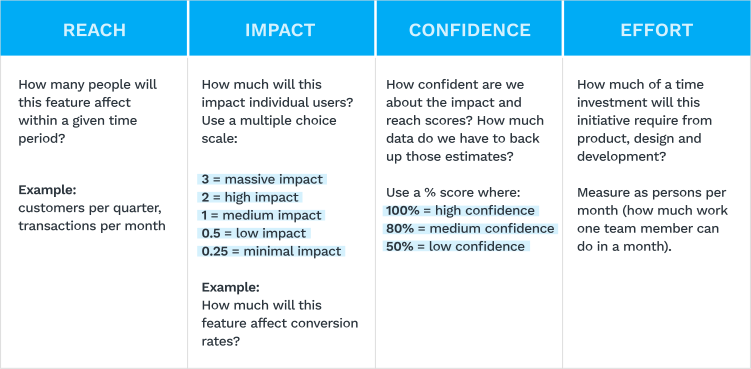
Confidence is the bias brake in the RICE formula. It accounts for the uncertainty in your reach, impact, and effort estimates by asking one thing: how sure are you about those numbers?
Sean's confidence scale:
Confidence scoring scale
Percentage | Meaning | Evidence threshold |
|---|---|---|
100% | High confidence | Strong evidence from user testing or data |
80% | Medium confidence | Solid signal with some unknowns – the dev team flagged cost factors you hadn't accounted for |
50% | Low confidence | Some customer interest but no research to support why they want it |
Below 50% | Wild card | No testing, no data, no validation – a quick sketch on a whiteboard and a gut feeling |
"A project with low confidence might be one where all you have is a quick sketch on a whiteboard and a gut feeling," says Sean. "If you have an idea you think could have huge reach and impact but low confidence, that tells you what kind of research or technical exploration your team needs to do to learn more."
Low confidence scores are useful. They force product managers to ask why – and that question sends them toward the data they need to validate (or rule out) an idea.
Calculating effort
Effort is the one cost factor in the RICE formula. It estimates how much work a project will require, measured in person-months or person-weeks – the amount one team member can produce in that time.
Five people for one week = five person-weeks. One person for five weeks = five person-weeks. The unit stays consistent regardless of how the work is distributed.
Work with tech leads and engineers using proven project estimation techniques to arrive at numbers grounded in reality. Effort estimates are driven by the complexity of the project and the state of the existing technical systems.
"When it came to estimating effort, I would usually sit down with my tech lead," says Sean. "That made the estimates much more accurate than my own sometimes-wishful thinking."
Effort scoring can also surface scope opportunities. "If you have an idea with high reach and impact but really high effort dragging the score down, you might ask whether there's a different version of the project that cuts the effort while retaining most of the value."
Why product managers use RICE for prioritization
RICE isn't a formula for turning uncertain ideas into certainties. It's one tool – alongside frameworks like the impact effort matrix – for organizing ideas based on how expensive they are to pursue relative to the impact they could have.
"It's just a structured framework for breaking down one big estimate into four smaller estimates that are easier for the human mind to think about without getting bogged down," says Sean.
RICE addresses four specific prioritization problems. First, it encourages data-informed prioritization and removes personal opinions from the scoring process. Second, it works for features, projects, product updates, and enhancements – not just one type of initiative. Third, RICE supports stakeholder management by making the reasoning behind product decisions visible and comparable. And fourth, it pushes teams to define which metrics actually define success for their business.
How to start using a RICE score
You can run RICE quarterly, monthly, or at the start of whatever cadence your team works in. At Intercom, Sean's growth team ran it quarterly. Each cycle started with a blank slate: establish the main goal, gather ideas from teams and stakeholders, then score.
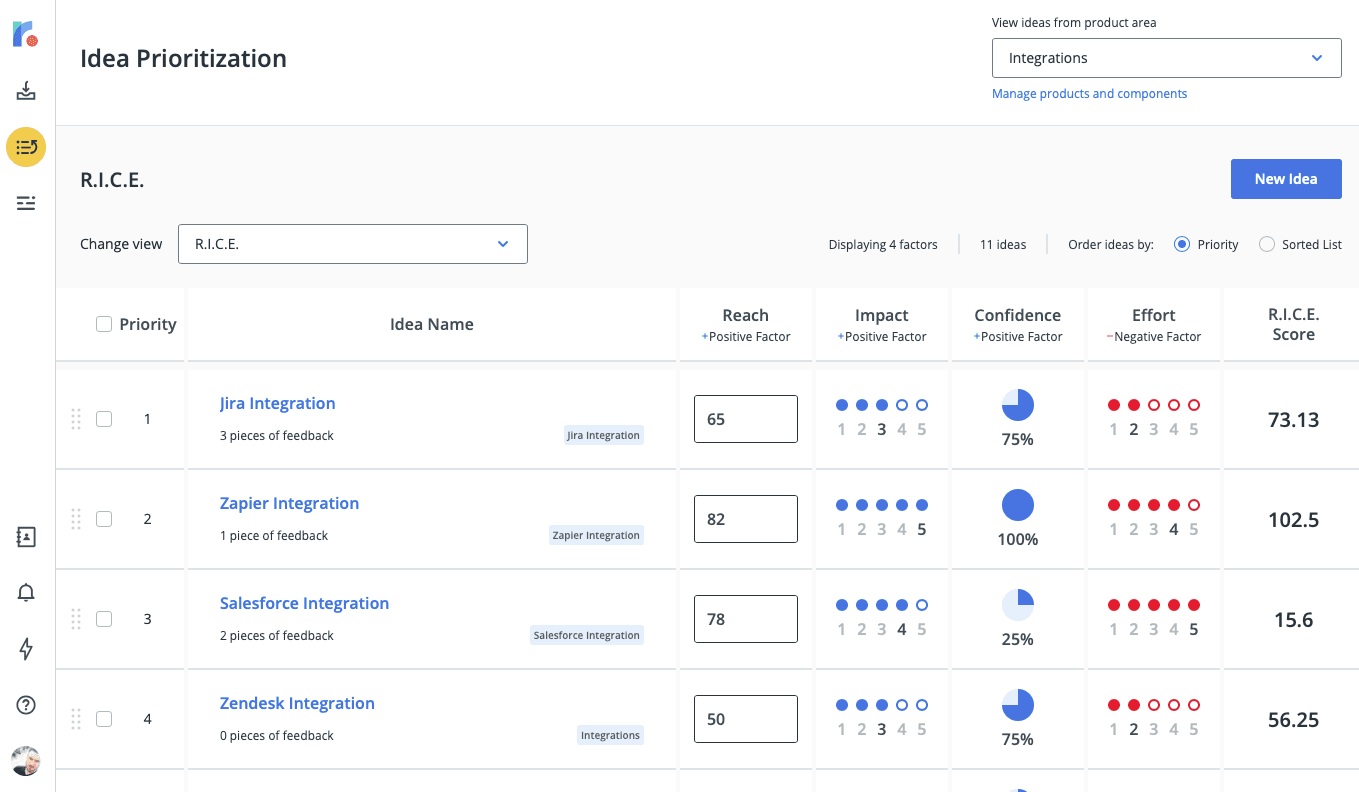
Tempo Strategic Roadmaps makes this easier. Using the Chrome extension, you can invite sales, customer success, and development teams to submit feature requests and feedback directly into a centralized inbox. Ideas can be discussed with a commenting and tagging system before scoring begins.
Once you have a set of ideas, run them through the RICE score. You'll often need to collect additional inputs – effort estimates from the dev team, usage data from analytics – before you can score with confidence.
After scoring, sort ideas from highest to lowest. Then look for surprises. Is there an idea you expected to rank low that scored high? One you were excited about that ranked low? If yes, run that idea through the estimates again. If the score still doesn't match your intuition, ask whether your intuition is right – or whether it's just that: an intuition.
"I would choose a set of things to focus on for the quarter, then discuss them with the rest of the team," says Sean. "The set I chose wasn't always strictly based on the RICE score. Sometimes things were chosen because the team was excited or a stakeholder was pushing for it. But if the score was really low, the RICE framework gave me a tool to push back in a more reasoned and structured way."
Best practices for using RICE
The process should serve your team – not the other way around. If you're spending more time debating the exact numbers than actually doing the work, step back.
Sean's recommendations: focus on one goal. A small team can't push multiple major goals in a single quarter. Pick the most important one. If a quarter feels too long, focus on one goal for a 2–6 week cycle, then reassess. For larger teams, organize by sub-goals – split the team so each sub-group owns one goal. People work better when the objective is clear and within their control. And give your team autonomy. Score the ideas, then let team members choose which projects to pick up first. Nobody builds great things when every decision is made for them.
Putting RICE scoring into practice with Tempo
Tempo Strategic Roadmaps lets you build a customer-driven backlog of product ideas rooted in real user needs. Ideas can be linked directly to the feedback that generated them, so the context never gets lost. Anyone at your company with access to the Chrome extension can submit feedback into the same centralized inbox.
We offer two prioritization scoring templates in Strategic Roadmaps: RICE and Value vs. Effort – plus a guide to eight other frameworks used by experienced PMs. After scoring, ideas rank automatically from highest to lowest, surfacing which work the team should focus on next.
Sign up for a demo
Request DemoSee also: Range.

2026 State of SPM report
This is the data you've been looking for
This original research from almost 700 PMO leaders shows you what is working, what is wobbling, and what it all means for SPM in 2026.
Download the 2026 State of SPM reportFrequently Asked Questions
Couldn't find what you need?Go to our documentation
RICE stands for Reach, Impact, Confidence, and Effort. It’s a scoring formula developed at Intercom to help product managers compare project ideas against a single goal in a structured, data-informed way. The formula is: (Reach × Impact × Confidence) ÷ Effort.
A Value vs. Effort matrix places ideas on a 2×2 grid based on high/low value and high/low effort. RICE uses a numeric formula that produces a score, allowing ideas to be ranked in a list rather than grouped into quadrants. RICE is more precise but takes longer to set up; a Value vs. Effort matrix is faster for quick whiteboard sessions. Both approaches are available as templates in Tempo Strategic Roadmaps.
There’s no universal benchmark – RICE scores are relative. What matters is comparing scores across ideas within the same goal and time period. A score of 100 means very little on its own; a score of 100 versus a competitor idea scoring 30 tells you a lot. Run the formula consistently and sort the results – the highest scores deserve the most attention.
Most product teams run RICE at the start of each planning cycle – quarterly for larger roadmaps, monthly or per-sprint for faster-moving teams. Sean McBride’s growth team at Intercom ran it quarterly. The key is consistency: use the same goal, the same scoring scale, and the same time period each time so results are comparable across cycles.