How to avoid common backlog prioritization pitfalls
Five proven frameworks for product backlog prioritization – with walkthroughs, pitfall fixes, and real scoring examples.


Key Takeaways
Scoring frameworks make prioritization decisions auditable, which matters most when a senior stakeholder pushes back on the sequence.
RICE and Value vs. Effort produce numeric rankings suitable for long backlogs, while MoSCoW and Kano work better for categorical scope triage.
Cost of Delay and WSJF flag items whose value decays over time, which pure impact-effort scoring tends to miss.
Product backlog prioritization is the practice of ordering backlog items so the highest-impact work rises to the top, judged against some mix of value, cost, risk, and strategic fit.
Most product teams have more ideas than capacity, and the backlog is where sales requests, bug tickets, and internal asks pile up against real engineering hours. The hard part is defending the ordering when a senior stakeholder disagrees with it.
A framework gives the conversation a shared artifact. What that means is when two PMs look at the same RICE spreadsheet, they can still argue, but they're arguing about inputs instead of opinions.
1. Value vs. Effort matrix
The Value vs. Effort matrix is the simplest framework on this list. For many teams it's the right starting point. Draw a two-by-two grid. The vertical axis represents customer value – however your team defines it (revenue potential, retention impact, user satisfaction). The horizontal axis represents effort to build (dev time, design complexity, dependencies).
Every backlog item lands in one of four quadrants:
Top left – high value, low effort. Quick wins. Do them first.
Top right – high value, high effort. Strategic bets. Schedule them deliberately.
Bottom left – low value, low effort. Fill work. Slot them in when capacity allows.
Bottom right – low value, high effort. Traps. Cut them or push them to the bottom.
The power of this prioritization matrix is that it forces the team to agree on two dimensions at once. A feature request might score high on value, but when the team sees it also sits in the high-effort column, the conversation shifts. It stops being "should we build this?" and becomes "should we build this now, given what else we could do instead?"
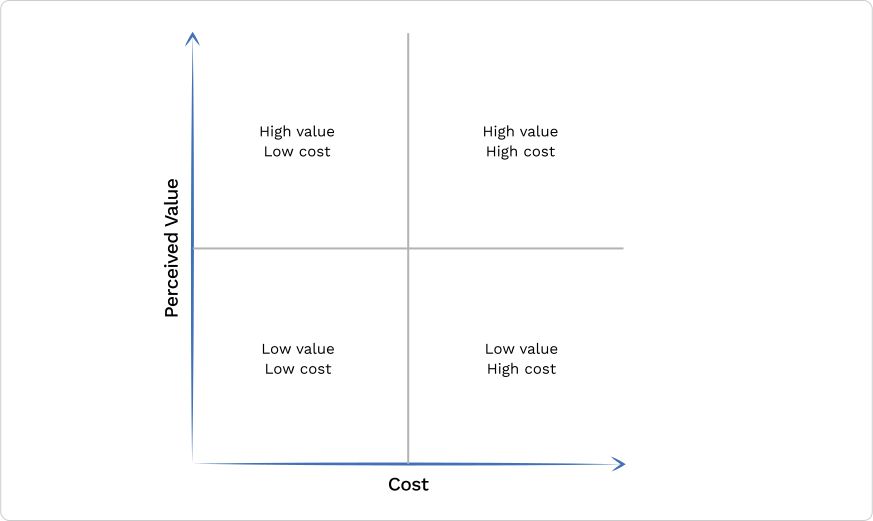
One practical tip: Run the plotting exercise as a team, not in a spreadsheet the PM fills out alone. When people place sticky notes on a whiteboard together, disagreements surface early – and those disagreements are where the real prioritization learning happens.
2. RICE scoring
RICE stands for Reach, Impact, Confidence, and Effort. It produces a numeric score for each backlog item, which makes it easy to sort a long list and compare items that feel very different from one another.
Here's how it works:
Reach: How many users or customers will this affect in a given time period? Pick a consistent unit – monthly active users, new signups, support tickets resolved.
Impact: How much will it move the needle for each person reached? Score on a scale (3 = massive, 2 = high, 1 = medium, 0.5 = low, 0.25 = minimal).
Confidence: How sure are you about your reach and impact estimates? Express as a percentage (100% = high confidence, 80% = moderate, 50% = gut feeling).
Effort: How many person-months (or person-weeks) will it take? Higher effort lowers the score.
The formula: (Reach x Impact x Confidence) / Effort = RICE score.
Here's a concrete example. Say a feature reaches 5,000 users per month, has high impact (2), 80% confidence, and takes 3 person-months to build. That's (5000 x 2 x 0.8) / 3 = 2,667. Now compare it to a feature reaching 500 users at medium impact (1) with 50% confidence and 1 person-month of effort: (500 x 1 x 0.5) / 1 = 250. Ten times lower. The PM now has a number to point to when a stakeholder asks why their pet feature isn't at the top.
RICE works especially well for teams managing large backlogs (50+ items) where gut-feel ranking breaks down. The downside? The inputs are still estimates. Bad inputs produce a false sense of precision. Calibrate reach and impact with real data – usage analytics, customer feedback, and support ticket volume – whenever you can.
3. MoSCoW method
MoSCoW sorts backlog items into four buckets:
Must have: The product doesn't ship or function without these. Think compliance requirements, core workflows, or blockers to product-market fit.
Should have: Important but not critical for this release. Removing them hurts, but the product still works.
Could have: Nice-to-have items that improve the experience but won't delay the release if dropped.
Won't have (this time): Explicitly out of scope for the current cycle. Not killed – just parked.
The strength of MoSCoW is the conversation it forces about trade-offs. When a stakeholder insists their feature is a Must Have, the PM can ask one question: "If we cut this and still shipped, would the release fail?" If the answer is no, it moves to Should Have. That single question cuts through a lot of noise.
MoSCoW is less useful when you need a strict rank order within categories. Five items in Must Have still need sequencing, and MoSCoW won't tell you which one to build first. Pair it with a Value vs. Effort exercise inside each bucket if you need that granularity.
Where MoSCoW shines: Cross-functional planning sessions where engineering, design, and product need to agree on scope for a fixed deadline. It's a triage tool. Fast, clear, and hard to game.
4. Kano model
The Kano model categorizes features by how they affect customer satisfaction. Its key insight is that not all features create value the same way.
Three categories matter most:
Basic (must-be) features: Customers expect these. Having them doesn't create delight, but missing them causes real dissatisfaction. Page load speed. Data export. Login reliability.
Performance features: More is better. Faster response times, more integrations, richer dashboards. Customer satisfaction scales roughly linearly with investment.
Excitement (delight) features: Customers don't expect these and won't miss them if they're absent – but discovering them creates outsized positive reactions. A smart suggestion engine. A one-click workflow shortcut. An unexpected personalization touch.
Before you assign priority, classify each backlog item into one of these categories. Then apply a simple rule – fix all basic feature gaps first, invest steadily in performance features, and sprinkle in excitement features to differentiate.
Kano is especially useful when working with your design team on product experience decisions. Designers think in terms of user delight and pain points; the Kano model maps directly to that mental model. It also gives PMs ammunition to push back on executives who want to fund another excitement feature when basic expectations are still unmet.
The limitation: Kano doesn't tell you how much to invest or in what order within a category. Combine it with RICE or Value vs. Effort for sequencing.
5. Cost of Delay and WSJF
Cost of Delay asks a question the other frameworks skip: What happens if we don't build this now? Some features lose value over time – a competitor launches a similar capability, a regulatory deadline passes, or a seasonal window closes. Other features are equally valuable whether you build them this quarter or next.
Cost of Delay quantifies that urgency. Express it as the revenue, retention, or strategic value lost per week (or month) of delay. A feature worth $50,000 per month in new revenue that can't be recaptured has a much higher Cost of Delay than a backend refactor whose value stays constant.
Weighted Shortest Job First (WSJF) builds on this. It divides Cost of Delay by the job's duration (effort):
WSJF = Cost of Delay / Job Duration
Items with a high cost of waiting and a short build time float to the top. This is the framework that catches time-sensitive items other methods miss – the partner integration that needs to ship before the partner's launch event, or the pricing page update that matters because the sales team is in active deals right now.
WSJF works best at the epic or initiative level, where Cost of Delay is measurable and duration estimates are rough but directional. At the story level, the overhead of estimating Cost of Delay for each item usually isn't worth it.
Framework comparison at a glance
Framework | Output type | Best for | Main limitation |
|---|---|---|---|
Value vs. Effort | 2x2 quadrant placement | Small backlogs, collaborative plotting | Subjective at scale (50+ items) |
RICE | Numeric score (Reach x Impact x Confidence / Effort) | Large backlogs that need defensible sorting | False precision when inputs are guesses |
MoSCoW | Four buckets (Must, Should, Could, Won't) | Fixed-deadline scope negotiation | No rank order within a bucket |
Kano | Category (Basic, Performance, Excitement) | UX-driven products, satisfaction investment | Doesn't sequence items within a category |
WSJF / Cost of Delay | Numeric ratio (Cost of Delay / Duration) | Time-sensitive epics, opportunity cost | Overkill at the story level |
Choosing the right framework
No single framework fits every team or every backlog. Here's a practical guide:
Small backlog, collaborative team: Value vs. Effort matrix. Low overhead, high participation.
Large backlog, data available: RICE scoring. Numeric output makes sorting easy.
Fixed deadline, scope negotiation: MoSCoW. Fast triage under pressure.
UX-driven product, experience investment: Kano model. Maps to customer satisfaction directly.
Time-sensitive initiatives, opportunity cost matters: WSJF. Catches items that depreciate.
Many teams combine two. Kano to categorize, then RICE to sequence within categories, for example. The goal isn't methodological purity; it's a repeatable process that produces defensible decisions.
Tempo Strategic Roadmaps helps teams connect prioritization outputs to visual roadmaps that stakeholders can actually read. Once you've scored and ranked, Strategic Roadmaps lets you map those decisions to timelines, share them across teams, and adjust when priorities shift – without rebuilding a spreadsheet from scratch.
Common pitfalls
Even with a solid framework, teams fall into the same traps. Here are four we see repeatedly.
Pitfall 1: The backlog is a junk drawer
When anyone can add items with no screening criteria, the backlog grows into a 200+ item list where half have no clear owner and no connection to the product vision. PMs spend grooming sessions deleting noise instead of ranking real work.
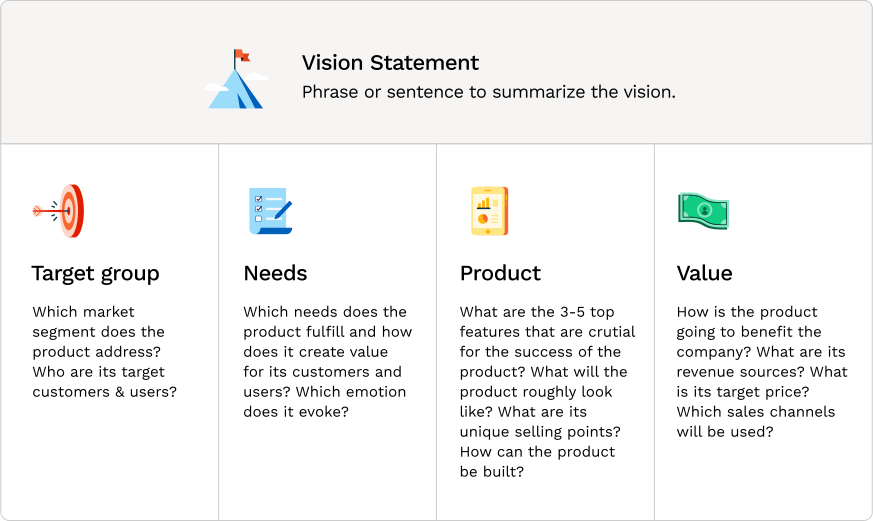
Tie every backlog item to the product vision. If a request doesn't map to a current strategic goal, it doesn't go in. Hold regular purge sessions – anything untouched for three sprints gets archived, not deleted. This keeps the list workable and the signal strong.
Pitfall 2: Personal bias drives the ranking
When one person – usually the PM or a senior stakeholder – ranks the backlog on instinct, the team loses trust in the process. Engineers feel unheard during estimation. The product ships features that don't get the customer response anyone expected.
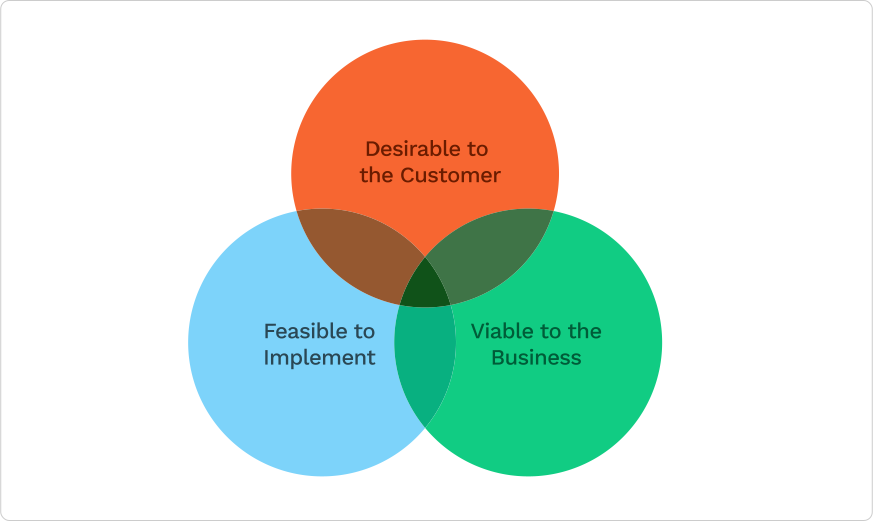
Use one of the frameworks above and run the scoring as a team exercise. The 2x2 matrix or RICE scoring makes criteria explicit. When everyone can see why item A outranks item B, disagreements become productive conversations instead of political fights. This is one of the essential leadership qualities of strong PMs – making the process transparent enough that the team owns the output.
Pitfall 3: No customer validation before committing
Building from internal opinion alone produces features that solve imagined problems, not real ones. Every sprint spent on an unvalidated feature is a sprint not spent on something users would pay for.
Validate before you prioritize. Run lightweight interviews, surveys, or beta tests on high-priority candidates before they enter the sprint. Apply essential design principles to prototype fast and test with real users. Five conversations can shift priorities more than fifty hours of internal debate.
Pitfall 4: Ignoring dependencies
A feature that scores well on every framework can still fail if it depends on another feature that hasn't been built yet. Sequencing errors create rework, missed sprint commitments, and trust erosion with stakeholders.
Bring the development team into prioritization meetings. Engineers see dependency chains that PMs miss. Map dependencies visually before locking the sprint, and flag any item whose prerequisite isn't scheduled yet. This is where technical and product judgment need to meet – and one more reason prioritization can't be a solo exercise.
Sign up for a demo
Request demo
2026 State of SPM report
This is the data you've been looking for
This original research from almost 700 PMO leaders shows you what is working, what is wobbling, and what it all means for SPM in 2026.
Download the 2026 State of SPM reportFrequently Asked Questions
Couldn't find what you need?Go to our documentation
Product backlog prioritization is the process of ordering a list of product ideas, features, and tasks by their relative value, cost, risk, and strategic fit. Teams use frameworks like Value vs. Effort matrices, RICE scoring, MoSCoW, the Kano model, and WSJF to make the process repeatable and reduce opinion-driven decisions. The output is a ranked backlog where the highest-impact items are worked on first.
RICE scoring works well for large backlogs because it produces a numeric score you can sort. When you have 50 or more items, a 2x2 matrix gets crowded and subjective placement becomes inconsistent. RICE forces you to estimate reach, impact, confidence, and effort for each item, which surfaces gaps in your data and makes the ranking defensible. That said, pairing RICE with a Kano classification step keeps you from over-indexing on incremental performance features at the expense of basic gaps or delight opportunities.
Most agile teams reprioritize during backlog grooming, which happens at least once per sprint – roughly every one to two weeks. The goal is to keep the top items well-defined and estimated so planning meetings don't stall. Beyond regular grooming, do a deeper review whenever strategy shifts, after major customer research, or when a key dependency changes. Teams that only prioritize quarterly tend to build against stale assumptions.
Grooming (also called backlog refinement) is about making items clear, sized, and ready to work on – adding acceptance criteria, breaking down large items, and estimating effort. Prioritization is about deciding the order in which items should be built based on value, strategy, and constraints. Both happen regularly and often in the same session, but they serve different purposes. You can groom an item without changing its priority, and you can reprioritize without adding detail.