Determining priority between competing tasks or projects can be difficult. A prioritization matrix offers an objective rationale to back your choices.
Strategic prioritization advances organizational goals by improving resource allocations, scheduling, and project outcomes.

You can't approve every idea that crosses your desk. Each initiative consumes limited time, energy, and money, so leaders have to decide whether the organizational payoff outweighs the cost.
That's the job of strategic prioritization: Pinpointing the projects and tasks that best align with the company's vision and move it toward its goals. Here are the tools to make sure the work you approve actually advances the organization's objectives.
Strategic prioritization is the practice of identifying important initiatives and deciding which to pursue based on their potential corporate value. Importance is judged by a project's outcomes and how well they contribute to the business's strategic objectives.
To rank initiatives, leaders evaluate current market dynamics and the competitive landscape, then weigh the impact and feasibility of one project against another. The result is a priority list that informs decisions about resource allocation, risk, funding, and other project considerations.
A systematic prioritization process gives leaders a view of the big picture and helps them maximize the impact of every choice. It simplifies the following:
Weighing priorities by impact reveals the initiatives that contribute the most value to strategic objectives. Resources can then focus on completing those projects ahead of everything else.
Crises will happen; prioritization tells you when to set other work aside to handle them. Knowing where an issue falls on the list helps you decide whether to work on it now, finish more pressing tasks first, or delegate.
Some tasks are urgent, others are important, and knowing the difference matters. Important work aligns with long-term objectives and produces significant results; urgent work demands immediate attention. A prioritization structure lets you weigh urgency against importance and set deadlines without compromising higher-priority items.
A framework for ranking initiatives lets management skip the guesswork and reduce bias. A formal decision-making process allows leaders to do the following:
Allocate resources and budgets to high-priority initiatives without favoritism
Determine when teams can take on additional tasks and how to adjust schedules
Draft emergency override standards outlining when and why an urgent issue should take priority over another task
Clear priorities put stakeholders on the same page and align their collective efforts toward maximum productivity.
The most reliable way to prioritize projects, objectives, and goals is a structured evaluation process. Here's how:
Consult the organization's vision and value statements to develop objectives for the next three to five years. Long-term goals could include:
Financial goals: Increase total revenue by 10% in the next three years and 15% in the next five.
Operational goals: Decrease the percentage of returned goods by 2% annually over the next three years.
Customer-based goals: Increase market share to 12% within five years.
Internal goals: Increase the yearly PTO usage rate from 65% of days allocated to 85% within four years.
Once the list of organizational goals is finalized, assess proposed projects to determine their contribution to each. Weigh these factors:
Expected impact
Potential risks
Market trends
Customer needs
Staff capacity
Required resources
Feasibility
Then rank the project list in order of priority and fast-track the initiatives that deliver the most valuable outcomes.
Start crossing items off the list by handing top projects to specific working groups with clear expectations. Those teams own the detailed project plan: Steps, timelines, and resources needed to execute.
Vision and goals evolve. Most companies review corporate goals annually, and some more often depending on the industry. Strategic priorities should shift alongside those objectives so team efforts keep advancing the organization's aims.
Once priorities are set, how do you put them to work? A few common scenarios:
Multitasking tends to produce poor execution. When two initiatives with seemingly identical impact land on your desk, prioritization gives you a structure to evaluate them on equal footing — comparing resource use, impact, feasibility, and other criteria. That insight lets you pick the project with the better return and stronger alignment to organizational goals.
Dynamic economic factors can wreck a strategic plan. When conditions shift, priorities have to adapt — reranking projects and reshaping ideas for the new environment.
But what about work already in flight? Updating goals doesn't mean abandoning projects in progress. New priorities give you a framework for adjusting timelines or resources so current work better fits the new objectives. That flexibility lets the company pivot, avoid restarting from scratch, and sidestep major financial loss.
A prioritization framework opens productive discussions on hard topics like resourcing, staffing, and funding, and it sharpens team decision-making. It also creates visibility, tying individual contributions to organizational goals. Together, those forces align teams and stakeholders behind long-term objectives and give them a reason to perform at their peak.
Obstacles to effective strategic planning include a lack of clarity, competing priorities, and limited resources. Poorly defined goals are the biggest issue and usually feed the other two.
Define goals with the SMART framework to refine direction and prevent misunderstandings:
Specific: Describe the goal in precise terms
Measurable: Provide metrics that define success
Achievable: Verify the goal is attainable with the available capacity and resources
Relevant: Ensure the objective contributes to corporate values and vision
Time-bound: Establish a timeline for completion
Clear organizational goals highlight which priorities to pursue and direct resources in the right direction.
Leaders need formal metrics to gauge how well priorities are performing. The following key performance indicators (KPIs) provide useful signal:
Revenue growth
Return on investment (ROI)
Customer satisfaction
Market share
When choosing KPIs, avoid vanity metrics that make the team look good but say little. Focus on measurements that produce meaningful qualitative and quantitative data.
For example, imagine a developer deciding which initiatives to prioritize as part of a website performance strategy. Raw traffic is often a vanity metric, while time on site or product-page conversion rates deliver actionable insight. Those data points drive informed decisions.
If prioritization isn't producing the expected outcomes, the plan hasn't failed — it may just need adjustment. Leadership and stakeholders step in, evaluate the situation, and adjust tactics to move things forward.
Strategic planning and prioritization require a nimble mindset and a bird's-eye view of every factor pulling on organizational goals. You need a tool that consolidates all the initiatives in play so your team's effort points in the right direction.
Tempo provides a project management solution that helps you predict, adapt, and deliver prioritized projects — no matter how complex your portfolio. With real-time scenario modeling, Tempo helps adjust plans, level workloads, and update scheduling whenever priorities change.
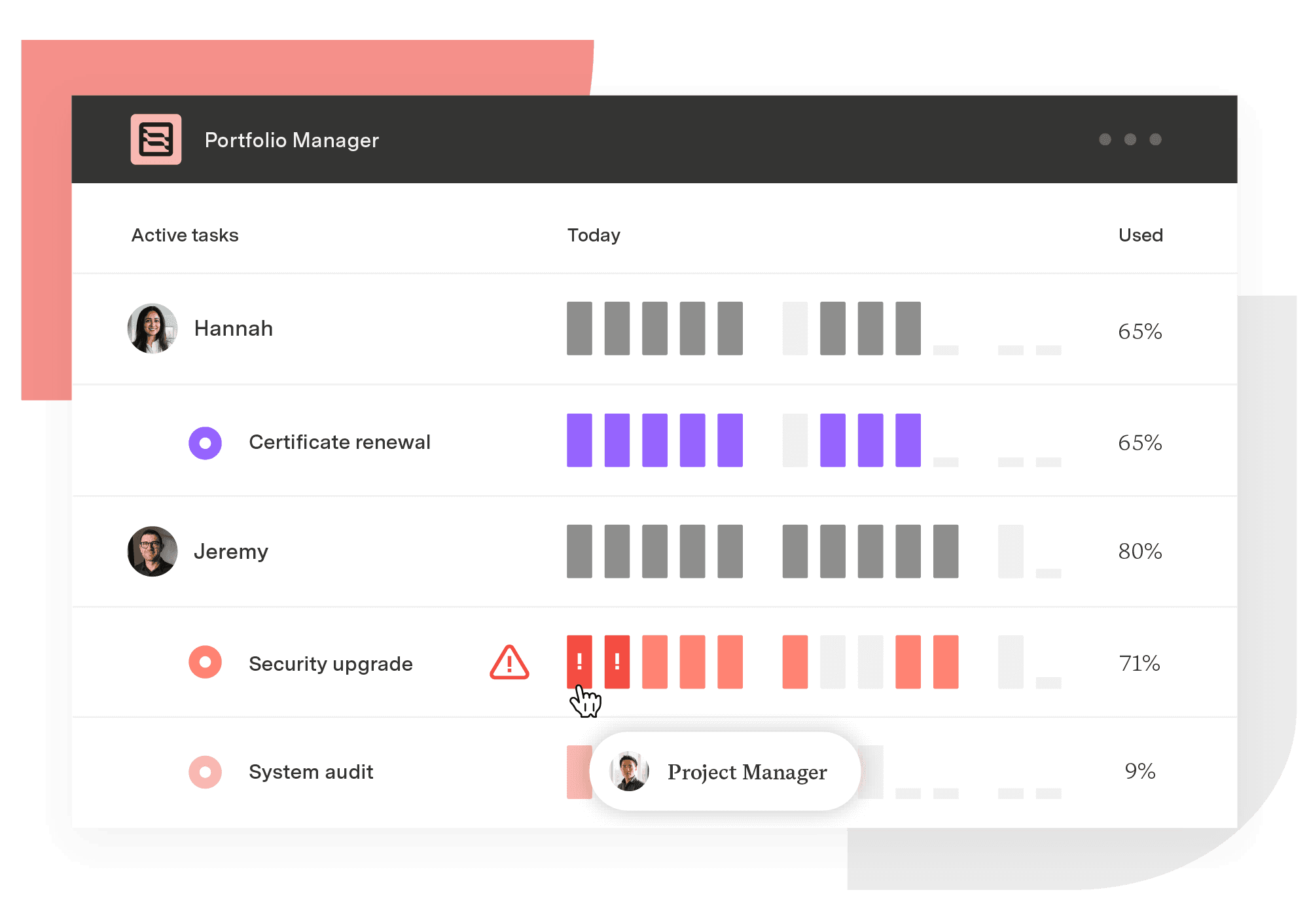
Portfolio Manager
The only project management solution that adapts to change and manages uncertainty to help teams plan, predict, and perform.
Start a Free TrialCouldn't find what you need?Go to our documentation
Many prioritization frameworks exist to help with ranking initiatives:
-SWOT analysis
-MoSCoW
-RICE
-Value versus effort matrix
Most organizations conduct strategic reviews during quarterly check-ins to evaluate prioritizations. However, economic crises or drastically changing markets may cause them to reassess sooner.
Strategically prioritizing risks helps organizations develop productive mitigation strategies. They can allocate resources to address threats with the greatest likelihood of occurrence and highest potential impact.
Determining priority between competing tasks or projects can be difficult. A prioritization matrix offers an objective rationale to back your choices.

Learn about project demand management and how it balances resources with project requests to maximize value and achieve strategic business goals.

Portfolio prioritization is now a continuous discipline. Learn to rank, fund, and re-sequence initiatives against real capacity and delivery data

Got a lot on your plate? Master the art of project prioritization and empower your teams to focus on impactful tasks so you can achieve success.

Manage all of your projects in a prioritized portfolio that builds your organization’s priorities into the schedule from the start.

Discover the difference between project outcomes and outputs and learn how to leverage the correct metrics to gauge impact on organizational goals.

Prioritize your product ideas using Strategic Roadmaps' built-in product management best practices.

Learn how enterprise project management drives success by improving resource utilization and risk management Explore strategies for project execution.

Learn to conduct a needs assessment by following seven simple steps, and gain insights vital to creating an effective and realistic strategic plan.