Learn the basics of the agile methodology and how to help your team adopt an agile mindset. Find out how agile can benefit your organization.
Learn the best ways to adopt the agile leadership model at the organizational level

Agile leadership is a management approach that replaces command-and-control with empowerment, trust, and iteration — borrowing from the Agile Manifesto and pushing those principles up into the executive ranks. When leaders model the philosophy, teams from the C-suite to the front lines get more efficient, more adaptive, and more productive under pressure.
Here's how organizations embed agile leadership principles into their executive practice and put this philosophy to work.
Agile leadership is a hands-off, servant-style approach to management built on three Cs: Communication, collaboration, and commitment. It began in software development as a way for teams to respond quickly to shifting requirements, then expanded into a broader leadership philosophy.
In practice, the project manager communicates organizational goals and vision while the project team — led by a scrum master — self-organizes to deliver. Work moves in iterative sprints with frequent check-ins, which surfaces roadblocks early, improves workflows, and lifts productivity. Team members are encouraged to "fail fast," adapting and learning quicker than workers stuck inside traditional project management frameworks.
Leaders who adopt these principles at the organizational level take the first step toward removing roadblocks and optimizing work. The next step is developing an agile mindset that embraces change and gives employees the security to experiment, learn from failure, and offer honest feedback. That mindset shift is where corporate culture starts to support individual skill development, high-functioning teams, and collective success.
The agile leadership style rests on nine core principles that companies need to bake into their culture.
1. Be the change
Agile leaders don't command and control. They operate with empathy, compassion, and humility, and inspire peers and reports to adopt the philosophy through example rather than mandate.
2. Quality thinking
High-quality thinking leads to meaningful action. Agile managers lead by example, pulling in diverse perspectives and input from the people closest to the problem. They take their time, prioritize decisions, and keep solutions realistic and evidence-based.
3. Value feedback
Agile prizes continuous improvement, and growth doesn't happen in a bubble. The model demonstrates honesty and respect by encouraging meaningful, actionable, timely feedback that travels both ways. Leaders then have to act on those insights to close the loop.
4. Focus and meaning bring fulfillment
An agile leader has to understand what motivates their team and align those values with company goals. Shared understanding and purpose drive inspired action, making even routine tasks more fulfilling.
5. Emotion drives creativity and innovation
An agile leader would never say, "Let's not get emotional." Passion, desire, even anger and frustration are fuel needed to hit full potential. Emotion is part of the human experience, and leaders respect that by being accessible, open, and transparent — and expecting the same in return.
6. Anyone can lead
Investment in leadership potential speeds up an organization's learning and adaptability. The agile approach expands the pool of future leaders by letting team members take the reins and grow their skills. Agile managers also cultivate long-term culture by mentoring future executives in servant leadership.
7. Delegation
Agile practices center on enabled, engaged, and energized individuals. Leadership addresses emerging needs and tensions while trusting team members with the power and authority to do their jobs. It's a balancing act that demands careful risk assessment and a consistent leadership style.
8. Collaborative achievement
An agile leader fosters a collaborative environment built on trust, respect, and meaningful relationships. Management provides everything the team needs to function autonomously inside established boundaries — not just tools and materials but an ethos of forgiveness, positivity, generosity, and gratitude. Healthy work communities produce learning, professional development, and stronger results.
9. Be open
An agile leader welcomes ideas from anyone, regardless of position. Colleagues closest to the problem often have the best solutions, so agile managers stop, listen, and consider their input. They encourage creative thinking and offer feedback that helps others pursue valuable ideas.
Leaders who practice business agility unlock benefits a traditional framework can't deliver.
Iterative development: Agile leadership removes the fear of failure and pushes teams to iterate, learn, and adapt to changing audience requirements — bringing solutions to market faster than the competition.
Timely resolution: Frequent check-ins help leaders spot concerns early. Management can address issues quickly and keep progress uninterrupted.
Experimentation: Agile management skips legacy work processes and encourages experimentation. Teams improve the product incrementally and drive customer value by testing and refining ideas.
Ownership: Employees feel more motivated when they know their work matters. Open communication between team members and management makes success criteria and individual contribution clear.
Maximized potential: Motivated team members self-manage to find the most productive workflow, then help others do the same and lift group performance.
Positive mindset: Agile leaders treat change and failure as learning opportunities, spreading enthusiasm for experimentation that produces better results.
Agile transformation is hard, in part because it's ongoing. Beyond a strategic plan and effective implementation, the transition asks leaders to shepherd a cultural mindset shift so agile principles take hold in the workplace.
Three things a company has to do to support agile leadership development:
1. Foster continuous learning
Sustain motivation by encouraging employees to learn from challenges, successes, and failures. Break down departmental silos to make cross-functional cooperation and knowledge sharing routine. HR can support this with training workshops, lunch-and-learns, and continuing education.
2. Promote feedback and adaptability
The agile approach runs on iteration. Leaders should push teams to gather data from consumers, investors, colleagues, and other stakeholders to improve products or ship new features. That information also drives evidence-based decision-making and innovation.
3. Establish autonomy
Agile leadership empowers project teams. Management outlines objectives and provides the materials, but scrum teams organize the work and deliver the results. Leaders who let teams self-manage and make collective decisions signal trust, which raises the group's sense of ownership and improves outcome quality.
Agile management relies on more than process. Leaders have to shift their thinking from a top-down chain of command to a bottom-up model where teams and individuals make their own workflow decisions.
That doesn't mean executives are no longer needed — the opposite is true. By giving up day-to-day control, management can focus on setting corporate strategy and driving profitability.
The agile leadership style leans on familiar soft skills applied in new ways. Agile leaders should sharpen the following habits.
Most leaders are comfortable with an "open door" policy where employees come to them. Agile leadership takes an active approach — encouraging team members to voice thoughts, concerns, and ideas openly and often.
Employees have to feel safe speaking up for this to work. Leaders build that safety with strong communication skills and structured feedback-gathering — anonymous surveys, regular check-ins — and then act visibly on the input they get.
A successful agile leader knows the value of listening. They run feedback conversations and one-on-ones, and they structure communication channels to make sure team members' contributions actually get heard.
They also practice empathy to understand opposing viewpoints and respond respectfully to what others need.
An agile team is attuned to itself. They also monitor external forces driving marketplace shifts — customer preference, industry advances, the broader economy. Leadership uses those observations to reassess priorities while staying grounded in agile principles of fast, innovative action and customer focus.
Agile leadership training should build observational skills through mentoring, coaching, and industry guidance.
Whether your team runs Kanban or scrum, Tempo has tools built for the leadership style you want to run. Strategic Roadmaps gives visibility by turning strategies and priorities into intuitive project roadmaps. Tempo Timesheets helps teams manage tasks and timelines while surfacing places to optimize.
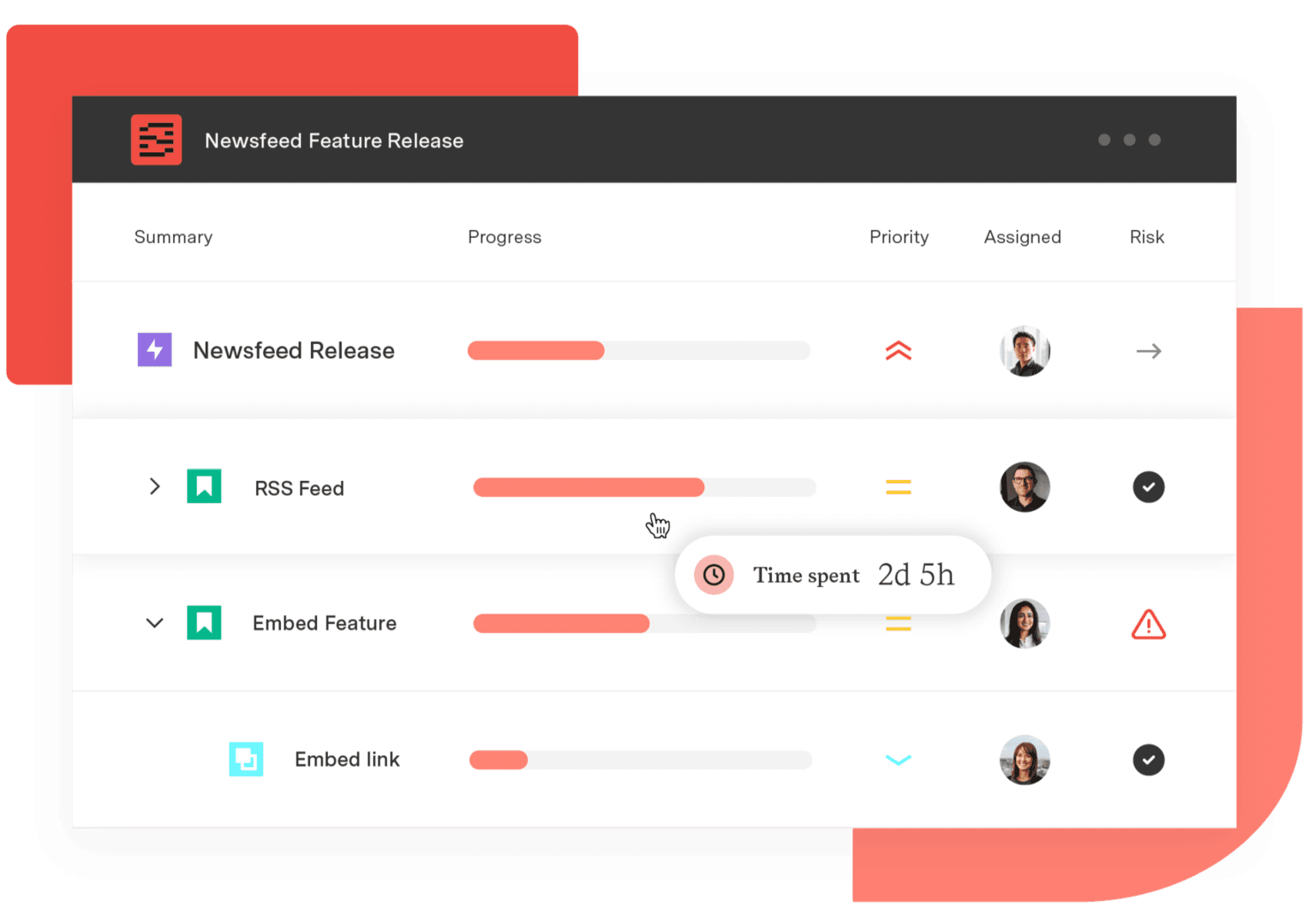
Structure PPM
Manage products, projects, and programs in a single spreadsheet-like view. By providing a clear, real-time view of project progress and resource allocation, Structure helps teams meet deadlines and adapt swiftly to changing priorities.
Start a Free TrialCouldn't find what you need?Go to our documentation
Agile leaders are adaptable and flexible. They go beyond inspiration to empower teams to do their best work. They understand that, as a leader, they don’t have all the answers, so they encourage employees to challenge assumptions, even the boss’, and think outside the box.
There are many characteristics of an agile leader, but the top three are:
- Courage: A great agile isn’t afraid to roll up their sleeves and do the work necessary to bring a vision to life. They fearlessly invest in new ideas, even if it means making mistakes.
- Curiosity: Anyone who takes time to ask questions to thoroughly understand an idea is an agile leader.
- Caring: Agile leaders are servant leaders. They surround themselves with brilliant people and provide everything they need to succeed.
Agile leadership embodies a collaborative, curious, and flexible thought process. This perspective enables team members to adapt to change instead of struggling against it.
Learn the basics of the agile methodology and how to help your team adopt an agile mindset. Find out how agile can benefit your organization.

Learn about transactional leadership, its benefits and drawbacks, and how to use it to achieve clear, measurable goals.

Discover how Scrum values strengthen agile teams. Learn to apply Scrum values in the workplace to encourage collaboration, transparency, and respect.

A matrix organizational structure blends project experts with leadership teams, enabling agile resource use and better cross-functional collaboration.

The agile practices that actually work – Scrum, Kanban, Lean, XP – plus the mistakes that turn agile teams into waterfall with stand-ups.

Spotify’s agile model propelled the company to become the world’s most popular music streaming service. But should other companies follow its example?
Discover how adopting kaizen principles can unlock a culture of continuous improvement and excellence through small, interactive changes.

Facing leadership challenges head-on is a part of being a good leader. No matter the challenge, there’s always a solution waiting to be discovered.

According to Human Needs Psychology, a theory developed by leadership psychology expert Tony Robbins, there are six fundamental needs that govern us.