Ranged estimation gives your project schedule a realistic window instead of one fixed date. Learn how to apply PERT, risk, and uncertainty in 5 steps.
Ranged estimates compare logged progress against the initial forecast, making estimates better than ever before.

Ranged estimates give each task a best-case and worst-case duration instead of a single fixed number. That range flows into your schedule, so finish dates are predicted as a window rather than a false-precision point-in-time. The result is a plan that admits what it doesn't know, and gets sharper as real work rolls in.
Forecasting exactly how long every item in a work breakdown structure will take is impossible. Uncertainty in project work is constant, and fixed schedule dates with finite durations belong to a planning era that never really worked.
People are optimistic, and they hand in low fixed estimates because they don't want to disappoint managers. Framing forecasts as best-case and worst-case ranges takes that pressure off. Logged progress can then be compared against the initial forecast of effort, so estimating gets better over time. Change history is captured from portfolio level down to individual team members and task detail.
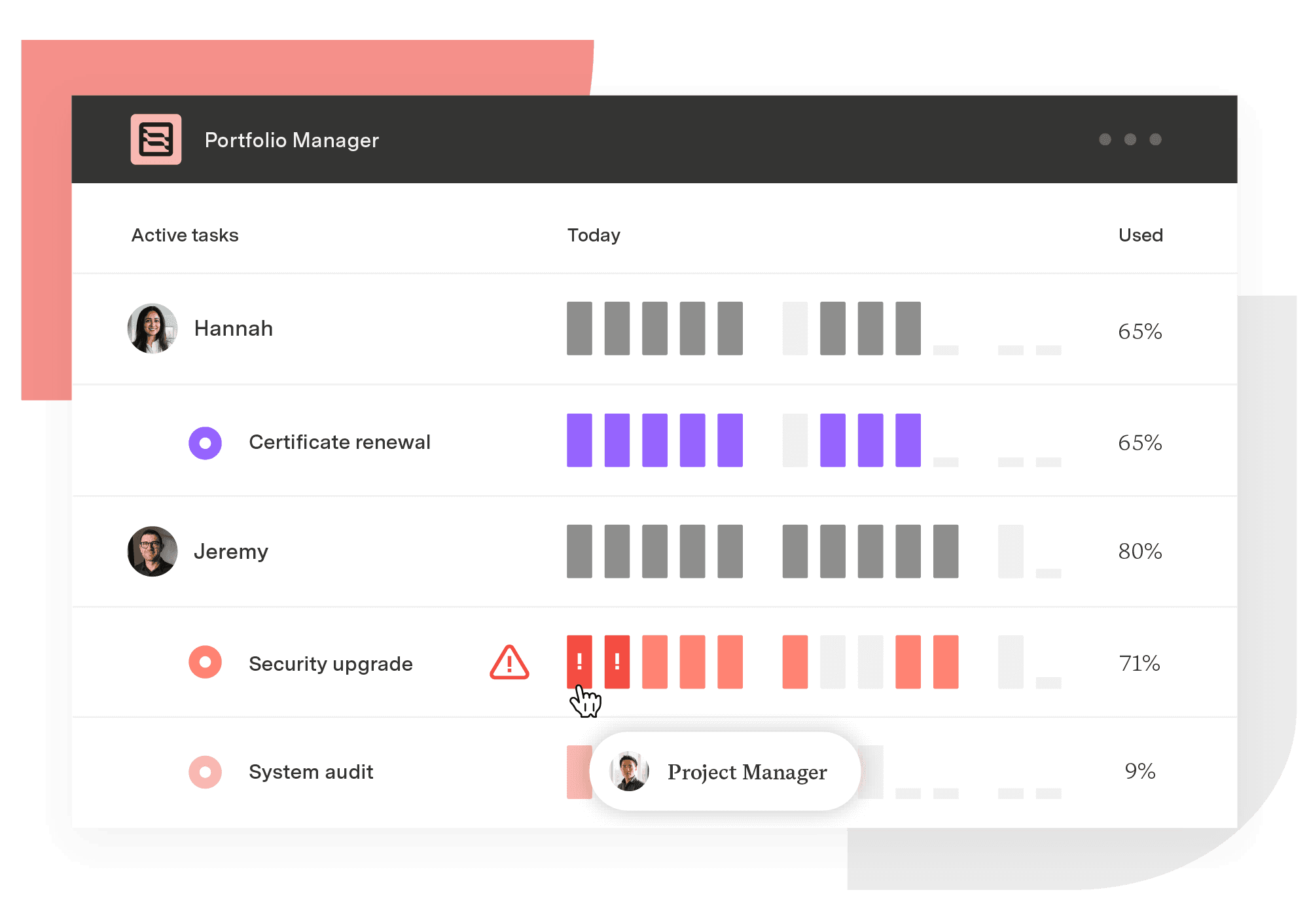
A ranged estimate, for example 3 to 5 days, accounts for uncertainty in the plan from the start and is visible in every schedule bar. The wider the white bar, the more uncertainty left to wrangle. Ranges let the scheduling engine surface that uncertainty before it becomes a problem downstream.
Because estimates are entered as a range, finish dates are predicted as a range too: Expected Finish (best case) to Latest Finish (worst case). Ranges are set on assignments, which roll up to the task. Task estimates roll up to the project and package to build the schedule. It's a statistically correct roll-up that uses probability to weigh one outcome against another, factoring in everything else moving through the portfolio.
Portfolio Manager
The only project management solution that adapts to change and manages uncertainty to help teams plan, predict, and perform.
Start a Free TrialRanged estimation gives your project schedule a realistic window instead of one fixed date. Learn how to apply PERT, risk, and uncertainty in 5 steps.

In project management, there will always be uncertainty and change. This is why making ranged estimates for your projects is more realistic.

Improve project accuracy with three-point estimating that finds best, likely, and worst-case scenarios. Learn the formulas and how to apply them.

Accurately estimating time is essential to successful project management. These time estimation strategies will start your project off right.

A ROM estimate gives you a rough order of magnitude before a project scope is locked. Here's what it is, when to use it, and how to build one.

Don’t let skyrocketing expenses come between you & project success. Learn fundamental project cost management to create realistic estimates & budgets.

Uncertainty and change are inherent in all project plans but if you adopt an agile methodology, you can embrace any changes in your project.

Tempo helps manufacturing teams prioritize tasks, predict results, and perform with confidence using the power of planning intelligence.

With a deep understanding of your team’s activity, you’ll be better equipped to make the decisions that matter.