SAFe scales better with Tempo
Align strategy to outcomes at scale with the flexibility to move faster as your organizational agility matures.


Key Takeaways
Tempo Structure PPM traces a SAFe portfolio's strategic themes down to live Jira work throughout the Program Increment, so alignment doesn't reset to a guess between quarterly reviews.
Coordinating value streams and Solution Trains works best when Tempo's hierarchy stays methodology-agnostic, giving hybrid delivery teams shared visibility without a mandated process.
Tempo Financial Manager and Tempo Custom Charts turn Program Increment execution into the budget and dashboard evidence a PMO director needs to defend the portfolio.
A Program Increment (PI) plan holds up for exactly as long as it takes one Agile Release Train to hit a dependency nobody flagged during PI planning. Strategy gets set at the portfolio level. The work that proves or breaks that strategy happens across dozens of Jira boards, months later, owned by teams who never sat in the same planning room. The Scaled Agile Framework (SAFe) exists to close that gap between strategic intent and team-level delivery. Whether it closes the gap depends less on how well an organization runs PI planning and more on whether its tools show what's happening between one Program Increment and the next.
Scaled Agile Inc.'s 2025 State of SAFe Report found that 68% of organizations saw a real gain in employee satisfaction after adopting the framework – evidence that closing the strategy-to-delivery gap pays off when the framework holds up under real conditions, not only on the training slides. Tempo's suite runs natively inside Jira and gives Portfolio Management Office (PMO) and Lean Portfolio Management leaders a way to trace strategic themes through value streams, Program Increments, budgets, and dashboards without forcing every team onto the same delivery method.
Build a portfolio vision that holds under pressure
Most Lean Portfolio Management failures don't look like a disagreement about strategy. They look like a portfolio epic that technically ships, technically closes, and still has no clear line back to the strategic theme that justified funding it in the first place. That gap shows up when the portfolio hierarchy lives in a slide deck and the delivery hierarchy lives in Jira, and nobody keeps the two in sync.
Tempo Structure PPM closes that gap with a customizable hierarchy that spans strategic themes, portfolio epics, features, and stories, all inside Jira. Because the hierarchy pulls from live Jira data instead of a deck rebuilt every quarter, a PMO Director can see which epics still trace back to which theme and which ones have drifted into work nobody asked for, without reconciling a roadmap tool, a spreadsheet, and Jira into one story before every business review. That roll-up view updates itself: When a team re-scopes an epic mid-PI, the change shows up in the portfolio view the same day.
Coordinate value streams and Solution Trains without losing the thread
A same-day view of a re-scoped epic is only as useful as the number of teams it covers, and SAFe scales that coverage question up at every level, because one configuration doesn't fit every organization:
Configuration | Scope | What it coordinates |
|---|---|---|
Essential SAFe | One Agile Release Train (ART) | Teams and roles delivering against a shared Program Increment |
Large Solution SAFe | Multiple ARTs building one large, complex solution | A Solution Train, plus supplier and compliance work outside the ART structure |
Portfolio SAFe | The strategy layer above one or more value streams | Strategic themes, Lean budgets, and investment funding through Lean Portfolio Management |
Full SAFe | The largest, most complex organizations | Team, program, large solution, and portfolio layers combined |
The coordination problem gets harder at every level up, because the teams inside a Solution Train rarely run on the same clock. Whether an organization's teams are fully agile or running a hybrid model – waterfall-paced hardware or compliance work mixed in alongside software sprints – the coordination need is identical: One place where every team's actual progress rolls up against a shared Program Increment objective. Structure PPM's hierarchy is methodology-agnostic by design, which is why it doubles as value stream management in Jira: It rolls up sprints from one team and phased milestones from another into the same dependency view, so a Program Increment objective that touches three teams has one place to check progress instead of three exports stitched together the night before a sync.
Plan and execute Program Increments with real capacity data
A Release Train Engineer walks into PI planning with a capacity spreadsheet that's three weeks old. Two developers have since been pulled onto a production incident, and nobody's updated the numbers, so the team commits anyway because the room needs a plan and the spreadsheet is the only capacity data anyone has. That's the same dependency-visibility gap Solution Trains run into at a larger scale, and it's what Tempo Capacity Planner exists to close.
Capacity Planner gives Release Train Engineers and Scrum Masters a live view of who's available for the PI, by role or by skill, so planning starts from real numbers instead of a spreadsheet built the week before. Paired with Tempo Timesheets, that same view compares planned time against actual time spent once the PI is underway, turning “we think we're on track” into evidence a PMO Director can bring to a Lean Portfolio Management review. Tempo Gantt Charts for Structure PPM lays those PI-level epics against a calendar view, so a Release Train Engineer can see how a slip in one feature ripples into the features scheduled after it across a full quarter. For a PMO running several ARTs at once, that combination is what keeps a PI plan accurate for the full length of the increment, not only on the day it was approved.
Control the budget behind the backlog
Capacity data answers whether a team can physically do the work. It doesn't answer whether the portfolio can afford it.
SAFe's Lean Portfolio Management pillar treats budget as a continuous governance mechanism, and this is where scaling efforts quietly run out of runway: A portfolio can have airtight strategic alignment and still get shut down because nobody can show, in real time, whether a value stream is running over budget.
Tempo Financial Manager pulls billable hours, labor costs, and CapEx versus OpEx classification directly from Timesheets data, so budget tracking doesn't depend on a project manager re-entering numbers that already exist somewhere else in Jira. Group projects into portfolios and a PMO gets the aggregated view Lean Portfolio Management asks for: Total cost, remaining budget, and expenses rolled up by value stream. Set milestones against the budget itself, and a PMO Director sees a value stream approaching its ceiling while there's still time to redirect spend.
SAFe's own prioritization method, Weighted Shortest Job First (WSJF), sequences work by Cost of Delay divided by job size. A WSJF score built on a guessed cost figure is no more reliable than the guess itself, so real-time budget and expense data gives portfolio teams an actual cost basis for that scoring rather than a placeholder number.
SAFe calls the underlying discipline lean budget guardrails: Spending limits set at the value stream level, revisited on a regular cadence rather than locked for the fiscal year. A guardrail is only enforceable if someone can see a value stream approaching its ceiling before the quarter closes. Financial Manager's portfolio-level budget rollups turn that guardrail from a policy on paper into something a PMO can act on while there's still runway left to redirect spend.
Turn SAFe metrics into portfolio decisions
Budget guardrails only work if someone's watching them alongside everything else SAFe generates.
SAFe produces its own volume of metrics: PI predictability, flow metrics, portfolio Kanban status, sprint burndown, and cumulative spend. Most of that data already lives in Jira. Getting it in front of a Release Train Engineer, a Product Manager, and an executive sponsor, in a format each of them can use, is a separate job that PMOs end up doing by hand in slide decks.
Tempo Custom Charts builds dashboards directly from Jira, Structure PPM, and Timesheets data, without a data team or a business intelligence license to configure. Three views carry the most weight for a SAFe portfolio:
Portfolio Kanban status. Where every epic sits in the funnel, from backlog to deployed, at a glance.
PI predictability and flow metrics. How consistently ARTs deliver against what they committed to at PI planning.
Cumulative spend and age of issues. Budget burn and stale work, surfaced before either becomes a PI review surprise.
Because a Scrum Master and a PMO Director can build charts from the same underlying data, a sprint-level view and a portfolio-level view stay consistent. When the ART's dashboard and the executive dashboard read the same numbers, PI reviews stop being an argument about whose data is right and become a conversation about what to do next.
Scale SAFe at your own pace
None of the five capabilities above requires standardizing every team onto the same process before it works.
Tempo's suite is modular by design: Start with Structure PPM for portfolio visibility, add Capacity Planner and Timesheets when resource planning gets harder, and bring in Financial Manager and Custom Charts once the PMO needs to defend the numbers. Tempo has been part of the Atlassian ecosystem since 2009 and is a top Atlassian partner, with Capacity Planner counting hardware-scale manufacturers like Airbus among its enterprise customers.
The rest of the SAFe-ready suite handles the parts of SAFe that PMO Directors get graded on: Whether the portfolio's strategy survives contact with a Program Increment, and whether anyone can prove it did. For the wider operating model behind scaling agile beyond SAFe specifically, see Tempo's agile at scale playbook.
Strategic Roadmaps
Strategic roadmapping
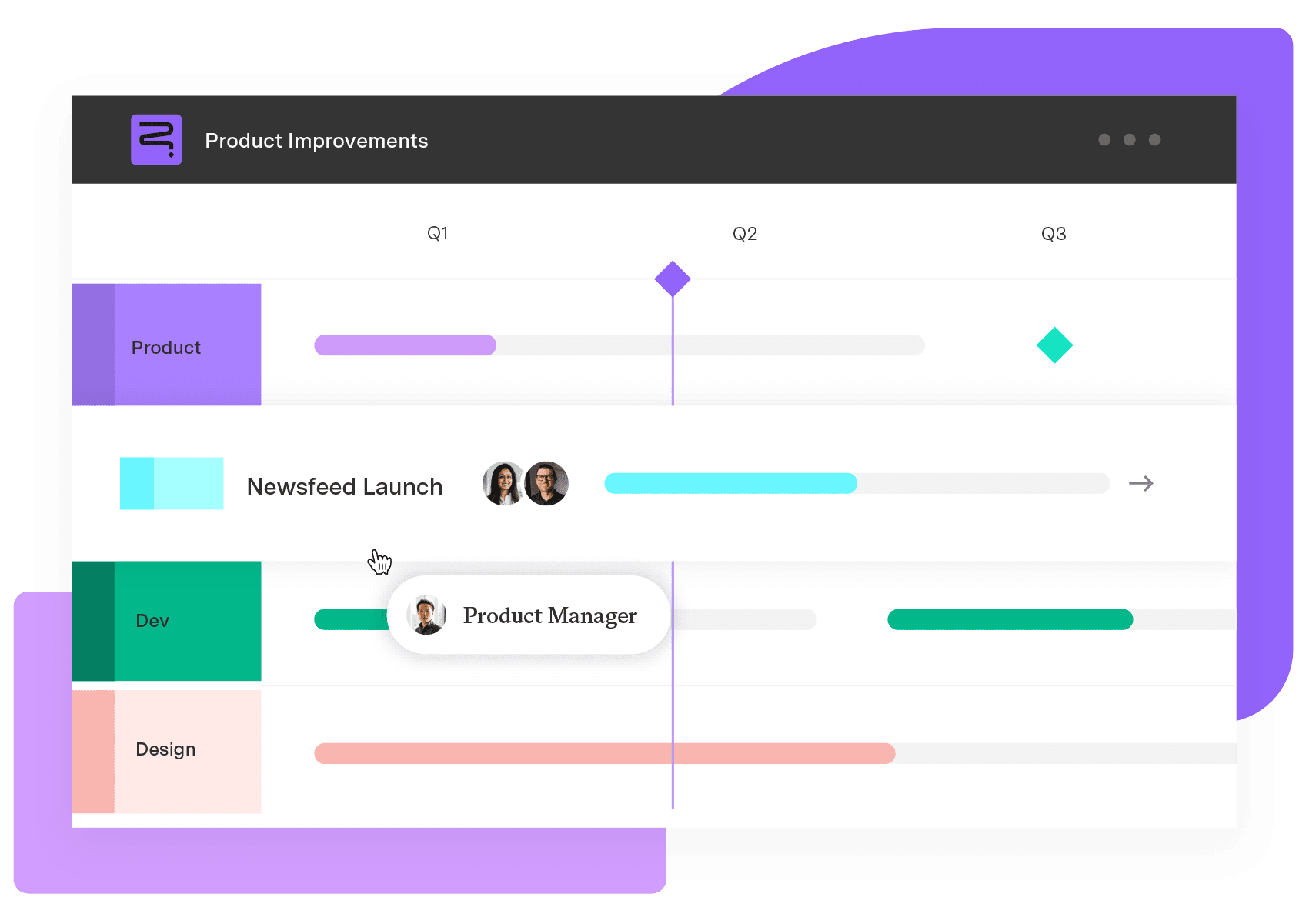
Build your portfolio vision with Strategic Roadmaps. With powerful visualization capabilities, you can communicate strategy to the entire organization and gain alignment around strategic objectives, product goals, and milestones.
Start a Free TrialFrequently Asked Questions
Couldn't find what you need?Go to our documentation
PI predictability and flow metrics tell you whether Agile Release Trains deliver against what they committed to. They don't tell you whether the rollout is paying off for the PMO. That answer comes from a different set of numbers: How much of the portfolio stays mapped to a current strategic theme, how far dependency aging trends have to fall before someone acts on them, and how long it takes to produce a leadership-ready portfolio view.
With Tempo Structure PPM and Tempo Custom Charts feeding live Jira data, that last number is measured in hours. Without them, it's measured in days or weeks of manual assembly. If time-to-exec-report hasn't dropped within a couple of quarters of a SAFe rollout, the framework may be running, but the tooling underneath it isn't.
Timelines vary by organization size, but tooling is rarely the bottleneck. A Program Increment typically runs eight to twelve weeks under the Scaled Agile Framework itself, and most of the ramp-up time before the first PI goes into training Release Train Engineers and running the first Big Room Planning session, rather than configuring the underlying Jira hierarchy.
Tempo Structure PPM configures against the Jira instance an organization already has, so the tooling doesn't add its own separate rollout timeline on top of the framework training.
Advanced Roadmaps in Jira Premium gives cross-project timelines, but SAFe portfolio management needs more: Configurable hierarchies from strategic theme down to story, resource capacity by role or skill, and financial roll-ups by value stream. Tempo's suite runs alongside standard Jira or Jira Premium and adds the portfolio hierarchy, capacity planning, and financial governance a full Lean Portfolio Management implementation requires.
A sprint is a single team's short, fixed-length iteration, usually one to four weeks. A Program Increment is the SAFe-level planning and delivery cycle that contains several sprints, typically four to six, across every team on an Agile Release Train, and closes with a System Demo and an Inspect and Adapt workshop. A sprint belongs to one team; a PI is what lets multiple teams commit to and measure progress against the same objectives.
Tempo Structure PPM and Tempo Custom Charts report at both altitudes without collapsing one into the other, which is why a Scrum Master and a Release Train Engineer can each pull a view that matches the level they're accountable for.