Primavera P6 vs. Tempo: Project portfolio management comparison
Tempo delivers delivery-system-native portfolio operations in Jira – no separate scheduler universe and no Oracle infrastructure required.


Key Takeaways
Primavera P6 brings CPM scheduling discipline to capital programs. Tempo is a modular alternative to Primavera for IT and digital portfolios governed in Jira.
Tempo updates portfolio data automatically as teams log work in Jira because it extends Jira's data model directly – no swivel-chair updates between a scheduling system and the delivery system.
Tempo's modular path lets IT PMOs start with time tracking or capacity planning and grow from there, without a big transformation project. CapEx/OpEx reporting comes from Jira time entries directly.
For internal IT and product delivery teams, Primavera adds specialized overhead that Tempo skips by design.
Primavera P6 built its reputation on capital programs – construction, oil and gas, infrastructure – where CPM scheduling is a contractual discipline. IT PMOs and product delivery organizations face a different kind of portfolio: software initiatives, engineering programs, and digital products tracked in Jira, not WBS hierarchies in a standalone Oracle platform. Tempo is built for that second context.
Oracle Primavera P6 is the industry standard for capital program planning and scheduling. It's excellent at what it's built for. The question is whether that specialist discipline fits organizations whose portfolios are software initiatives, internal IT programs, and digital products rather than multi-year capital projects. This page compares the two.
How do Primavera P6 and Tempo compare?
Tempo provides a Jira-native strategic portfolio management (SPM) suite and works with 30,000+ companies across technology, financial services, professional services, and the public sector. Tempo Structure PPM, Tempo Timesheets, Tempo Capacity Planner, Tempo Financial Manager, Tempo Custom Charts, and Tempo Gantt Charts for Structure PPM share Jira's data model. There's no separate planning repository to maintain. Tempo ships through the Atlassian Marketplace.
Oracle Primavera P6 EPPM is a project and portfolio management platform with deep roots in construction, engineering, and infrastructure delivery. It is presented as "the standard for planning and scheduling" for capital programs – organizations where CPM (critical path method scheduling), cost/schedule integration, scenario and what-if modeling, and cash flow governance are contractual requirements.
Primavera treats project planning as a specialized function: dedicated schedulers own the schedule as an authoritative artifact, and delivery teams feed updates into it. On-premises deployments are the default, so cloud migration means real transformation work.
Tempo takes a different starting point: governance from the delivery system itself. Every Jira issue, epic, and project is already a portfolio object. Tempo adds time, capacity, and financial intelligence directly to those objects – no separate scheduling layer.
What each solution is best for
Dimension | Tempo | Primavera P6 |
|---|---|---|
Best-fit buyer | IT PMOs and product/engineering leaders where Jira is the delivery system | Project controls organizations running capital programs in construction, engineering, or infrastructure |
Primary workflow | Portfolio governance that updates as Jira delivery work updates | CPM scheduling, cost/schedule integration, and earned value management |
Deployment style | Modular Jira app, Atlassian Marketplace install | Standalone Oracle platform, on-premises or Oracle Cloud |
Financial management | Real-time labor costs, CapEx/OpEx, and budget vs. actuals from Jira time entries – plus revenue and cost forecasting and project profitability | Cost-loaded schedules, earned value, cash flow forecasting for capital budgets |
Delivery relationship | Native – Jira is the source of truth | Not native to Jira – Primavera is a standalone platform |
Foundational differences between Tempo and Primavera P6
Dimension | Tempo | Primavera P6 |
|---|---|---|
Primary purpose | Jira-native SPM – time, capacity, financial, and portfolio governance | CPM scheduling discipline for capital programs |
Portfolio management | Custom issue hierarchies across projects and programs | WBS (work breakdown structure) → activity → resource assignment maintained in Primavera |
Financial management | Budget vs. actuals, labor costs, CapEx/OpEx, expenses – plus revenue and cost forecasting and project profitability | Cost-loaded schedules and cash flow forecasting for capital budgets |
Capacity planning | Individual + team dashboards, planned vs. actual | Resource loading against cost-loaded schedules, managed by schedulers |
Time tracking | AI-powered (Rovo agents), with approvals and CapEx/OpEx accounts | Activity progress updates captured in Primavera by schedulers or delivery teams |
Primary buyer | PMO, finance, Portfolio Managers, Engineering leadership | Project controls directors and schedulers in capital-project industries |
Jira integration | Native – Jira is the system of record | Not native – Primavera is a standalone Oracle platform |
The architectural split is about where planning discipline lives. Primavera puts it in a dedicated scheduling function, staffed by specialists who maintain the schedule as its own system. Tempo puts it in the delivery system those teams already use. For IT and digital delivery organizations, that's the real tool decision.
How Tempo and Primavera P6 approach AI and integrations
Tempo's Rovo agents run across the whole suite inside the delivery surface. Structure View Builder assembles portfolio views from a plain-language prompt and Structure Formula Assistant writes the formulas behind rollups; Custom Charts Assistant builds Jira dashboard charts from prompts. On the Timesheets side, Timesheets Worklog Assistant, Timesheets Summary Analyzer, and Time Insights for Jira power natural-language time logging, allocation reads, and user-level summaries against native Jira worklogs. A human still approves before time hits a CapEx or OpEx account, and every Rovo-assisted entry is auditable line by line.
Tempo Financial Manager uses that time data for CapEx/OpEx; Capacity Planner uses it for planned vs. actual analysis. AI-assisted logging has downstream financial consequences, not just convenience value. Because Tempo reads Jira directly, Rovo suggestions come from real-time delivery activity.
Architecturally, Tempo Structure PPM creates custom Jira issue hierarchies and persists view configurations in its own data store while reading Jira issue data live at query time. On Data Center deployments, Structure supports up to ~100,000 issues per structure across unlimited structures. Tempo Timesheets writes worklog records to Jira's worklog API; account types, rates, and approvals live in Tempo's app data store and reference Jira issues by ID. Financial Manager calculates labor cost from those worklogs against rate tables it owns, surfacing budget vs. actuals at the project and portfolio level.
Cloud and Data Center deployments use different data stores but the same architectural pattern. Tempo extends Jira's data model – it doesn't duplicate or replace it. Primavera, by contrast, owns its WBS, activity, and resource data inside the Oracle platform, with delivery activity flowing in via scheduler updates or integration.
Oracle has added agentic AI in Primavera Unifier, its capital-project product – including AI-driven workflow and process summaries, work prioritization, and audit-ready change chronologies for capital programs – announced in 2026. Those capabilities target the capital-project controls Primavera is built for, distinct from the Jira-delivery governance Tempo focuses on.
For integrations, Tempo connects natively to the Atlassian ecosystem – Jira, Confluence, and Atlassian Analytics. BI reach comes from Tempo's BI Connector modules (Power BI Connector for Jira, Tableau Connector for Jira, BigQuery Connector for Jira, and Oracle Analytics Connector for Jira), available as separate modules of the Tempo SPM suite. Primavera, as a standalone Oracle platform, lives in the Oracle ecosystem. For IT PMOs already running on Atlassian, Tempo adds no new infrastructure. For capital project teams that need an Oracle-integrated project controls environment, that context matters.
Top Primavera P6 strengths
Primavera has decades of authority in capital program delivery, and its strengths sit squarely in that world. Here's what it does well when the work is capital-intensive and schedule-driven.
The "standard for planning and scheduling" positioning, backed by decades of authority in capital program delivery.
Deep CPM scheduling, cost/schedule integration, and resource loading built specifically for capital projects.
Scenario and what-if modeling at the activity level for schedule risk analysis.
Cash flow governance and earned value reporting for capital program budgets.
Established usage in construction, engineering, oil and gas, utilities, and defense.
2026 agentic AI in Primavera Unifier – AI-driven workflow summaries, work prioritization, and audit-ready change chronologies for capital programs
What is Tempo's strength vs Primavera P6?
Tempo is built for IT and digital delivery portfolios where Jira is the system of record, not capital projects that need CPM-grade scheduling. That changes the governance posture top to bottom.
In regulated industries with capital programs, Tempo has scaled in production. OTP Bank Group uses Tempo Structure PPM, Tempo Capacity Planner, and Tempo Timesheets together across regulated banking operations.
Portfolio data updates as Jira delivery work updates. No swivel-chair updates from a separate scheduling tool.
No specialist scheduling staff needed. Tempo is built to be accessible to PMO, finance, and engineering leaders without specialized training.
Modular adoption with concrete triggers. Start with Tempo Timesheets. Add Tempo Financial Manager when finance asks for CapEx reporting. Add Capacity Planner when planning conversations need real numbers, not headcount estimates.
Financial intelligence flows from real Jira time entries into CapEx/OpEx, budget vs. actuals, and labor cost reporting. Tempo Financial Manager also runs forward-looking forecasts – Projected Profit, Projected Labor Cost, and Projected Labor Revenue, all pulled from Capacity Planner planned time – and Budget milestones break a project's budget across its timeframe. Primavera's strength is cost/schedule integration and cash flow governance for capital programs. Tempo covers the forecasting piece inside the Jira-native stack, without standing up a separate CPM scheduler.
Built for IT and digital delivery portfolios where a CPM-grade scheduling system is overkill.
Ideal customer for each tool
Choose Tempo if...
Your delivery teams work in Jira and you want portfolio intelligence that comes out of that work automatically.
Your PMO or finance team needs CapEx/OpEx, time approvals, and labor-cost reporting at project or portfolio level.
You want Gantt-style timeline views for programs without deploying a separate scheduling platform.
Modular adoption matters – start with one capability and expand as you prove ROI.
Choose Primavera P6 if...
You manage capital programs where CPM scheduling, cost/schedule integration, and EVM (earned value management) are foundational requirements.
Your portfolio is construction, engineering, oil and gas, utilities, or defense.
Dedicated project controls staff own and maintain the schedule as an authoritative artifact.
Oracle platform alignment is a current or planned architectural direction.
Most enterprise IT delivery doesn't run on Jira alone. CTOs run Jira alongside Azure DevOps, GitHub, and increasingly monday.com or Linear for specific teams. Tempo offers separate Power BI Connectors for Jira and for ServiceNow, an explicit acknowledgment of that: portfolio data consolidates in BI, sourced from multiple delivery systems. For Primavera, heterogeneous delivery means another integration to feed schedule and progress data into the Oracle platform. Tempo's position is that portfolio data should consolidate in BI, not inside any single delivery tool.
Honest about implementation cost: Tempo's modular adoption means Timesheets can be productive in 2–4 weeks (Jira admin time, account taxonomy setup, user enablement). Financial Manager adds finance change management – building cost rate tables, mapping account hierarchies, integrating with the GL where needed – which typically runs 6–12 weeks. Capacity Planner depends on team modeling maturity.
Compared to a Primavera rollout – Oracle platform standup, scheduler training, and WBS modeling work – Tempo's path is modular: each module carries a real implementation cost, but you can sequence them so each one lands without blocking the next.
When should you choose Tempo vs. Primavera P6?
Choose Tempo | Choose Primavera P6 |
|---|---|
Jira is your delivery system and you want portfolio intelligence sourced from it | Capital programs require CPM scheduling, cost-loaded baselines, and earned value |
finance needs CapEx/OpEx and labor-cost tracking tied to Jira time entries | Dedicated schedulers manage the portfolio as a specialized discipline |
Modular rollout and in-weeks time-to-value matter | Oracle ecosystem alignment is a current or future requirement |
Non-specialist team members need portfolio dashboards without Primavera training | Activity-level scenario modeling is central to how you manage schedule risk |
Recap
Primavera P6 is the right tool when CPM scheduling is a discipline, not a preference – when earned value, cash flow governance, and schedule compression analysis are contractual requirements. Few tools match its planning rigor for capital programs.
IT and product delivery organizations have a different problem: portfolios managed in sprints, tracked in Jira, governed by PMO and finance teams that need capacity and cost visibility without waiting on scheduler updates. If that describes your portfolio, start with Tempo Timesheets – it's the fastest path to delivery-to-cost traceability, and every subsequent module builds on the same data.
Sign up for a demo
Request DemoTempo starts from where work happens. If delivery teams work in Jira, portfolio intelligence should come from Jira. Tempo Timesheets, Tempo Capacity Planner, Tempo Financial Manager, and Tempo Structure PPM each add governance to native Jira data, which gives you delivery-to-cost traceability accurate in real time.
Compare Tempo to other solutions
See Comparisons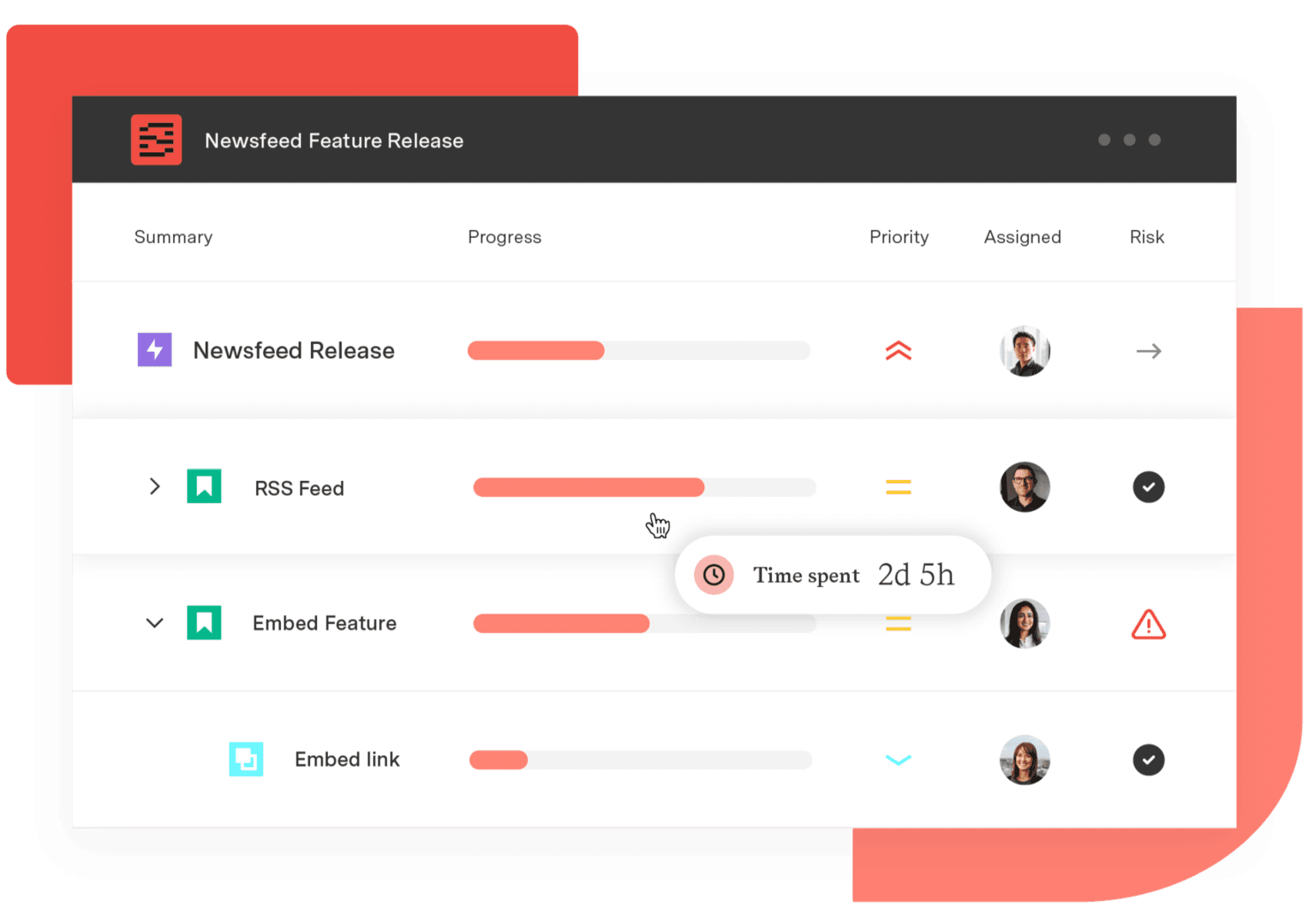
Structure PPM
Align your entire organization
Manage products, projects, and programs in a single spreadsheet-like view. By providing a clear, real-time view of project progress and resource allocation, Structure helps teams meet deadlines and adapt swiftly to changing priorities.
Start a Free TrialFrequently Asked Questions
Couldn't find what you need?Go to our documentation
Primavera handles resource loading against cost-loaded schedules, which works for capital programs run by dedicated schedulers. It's not built for live capacity planning across Jira-based engineering and product squads. Tempo Capacity Planner extends Jira's data model directly, planning availability-based capacity for individuals and teams – accounting for working hours, holidays, PTO, and existing commitments – and reports utilization and planned vs. actual without a scheduler in the loop.
Not as a native Marketplace app. Primavera P6 is a standalone Oracle platform sold through Oracle direct and partner channels, available on-premises or through Oracle Cloud. Tempo, by contrast, is distributed through the Atlassian Marketplace, which is part of why Atlassian-standardized buyers reach productive use in weeks.
Tempo is priced per product on tier-based plans through the Atlassian Marketplace, so PMO and finance leaders can model spend before engaging sales. Primavera is licensed through Oracle on enterprise terms – contact-for-quote, with implementation and support typically scoped into the agreement. The honest comparison is transparent self-serve pricing vs. an Oracle enterprise contract.
Tempo Gantt Charts for Structure PPM provides timeline visualization for programs managed in Jira, including dependencies and milestone tracking. These views are appropriate for IT and digital program management. They don't replicate Primavera's full CPM scheduling capabilities, which are purpose-built for capital project controls.
Because Tempo is Jira-native, there's no delivery system migration. The transition involves mapping portfolio structures into Tempo Structure PPM, configuring Tempo Accounts for financial tracking, and training PMO and finance teams on Tempo's reporting surfaces. For organizations already using Jira for delivery, implementation is typically measured in weeks.
Yes. Tempo Financial Manager classifies time logged in Tempo Timesheets as CapEx or OpEx, supporting software development capitalization reporting at the project or account level. It also calculates labor cost from those hours against rate tables, tracks budget vs. actuals, and runs revenue and cost forecasts that surface project and portfolio profitability – so capitalization sits inside a fuller financial picture rather than standing alone.
Yes. Tempo holds SOC 1, SOC 2 Type 2, ISO 27001/27701, and PCI DSS certifications, plus CSA STAR Level 1, DORA alignment, and a VPAT, with GDPR and CCPA covered via standard DPA for Tempo Cloud, covering procurement requirements for most regulated industries including financial services and government. Data Center deployments operate under their own compliance posture.