Planisware vs. Tempo: Strategic portfolio management comparison
Planisware centralizes enterprise SPM in a separate platform. Tempo is a modular alternative to Planisware that embeds governance inside Jira.


Key Takeaways
Tempo provides a modular, Jira-native SPM suite that adds portfolio governance, financial management, and capacity planning on top of the delivery system engineering teams already use.
Planisware is a centralized enterprise strategic portfolio management platform and a Leader in the 2025 Gartner Magic Quadrant for Adaptive Project Management and Reporting, serving complex programs in engineering, pharma, and financial services.
For Jira-standardized organizations, Planisware's centralization model implies a significant implementation burden. Tempo can deliver financial governance starting in the current quarter.
Tempo's AI, through Atlassian Rovo agents, ties to operational outcomes that flow directly into CapEx/OpEx and PvA reporting.
Buyers evaluating a modular alternative to Planisware are usually weighing two different models of strategic portfolio management: Centralize governance in a dedicated enterprise platform, or embed governance where delivery happens.
Planisware's pitch is centralization – a separate system of record where portfolio planning, scenario analysis, and investment decisions live above the delivery layer. Tempo's pitch is delivery-fidelity: portfolio governance pulled directly from Jira worklogs, capacity plans, and account classifications.
Large enterprises running multi-industry program portfolios will find real depth in centralization. For Jira-standardized organizations that need financial governance, capacity accuracy, and PvA reporting this quarter, that same centralization carries a transformation cost the business case may not support.
This page compares the two products on purpose, financial depth, capacity planning, time tracking, AI, and Jira integration – so enterprise buyers can match the tool to the unsolved problem.
How do Planisware and Tempo compare?
Planisware is a dedicated enterprise Strategic Portfolio Management (SPM) and project portfolio management (PPM) platform with roots in engineering-intensive industries including aerospace, pharma, and financial services.
A Leader in the 2025 Gartner Magic Quadrant for Adaptive Project Management and Reporting, Planisware provides a centralized repository for portfolio planning, resource management, financial governance, scenario modeling, and executive decisioning. The platform is designed to "drive all your projects in one place."
Tempo offers a Jira-native SPM suite and serves 30,000+ companies. The suite – including Tempo Structure PPM, Timesheets, Capacity Planner, Financial Manager, and Custom Charts – gives PMO directors, finance/FP&A, and engineering leaders a governed view of portfolio cost, capacity, and delivery pulled directly from Jira. There's no separate system to build and maintain.
Planisware and Tempo solve the problem on different timelines – one as a transformation investment, one as an extension of the Jira infrastructure organizations already run.
What each solution is best for
Use case | Tempo | Planisware |
|---|---|---|
Jira-native governance from delivery data | Purpose-built on Jira data | Not native to Jira; integration-based |
Executive scenario modeling and investment optimization | Not Tempo's focus | Strong fit – Planisware's public positioning centers on executive decisioning |
CapEx/OpEx and budget vs. actuals from worklogs | Dedicated Financial Manager with Jira worklog-based actuals | Financial governance is native to Planisware's own repository |
Modular time-to-value (weeks to first reporting) | Strong fit – Timesheets, Financial Manager, etc. deploy incrementally | Typically multi-month centralized platform implementation |
Multi-industry enterprise SPM (aerospace, pharma, financial services) | Broadly applicable where Jira is the delivery system | Strong fit – industry depth is a Planisware differentiator |
Foundational differences between Tempo and Planisware
Dimension | Tempo | Planisware |
|---|---|---|
Primary purpose | Jira-native SPM – time, capacity, financial, and portfolio governance | Centralized enterprise SPM platform for strategy, scenario modeling, and executive decisioning |
Portfolio management | Custom issue hierarchies across projects and programs via Structure PPM | Configurable portfolio and program hierarchies within Planisware's centralized model |
Financial management | Budget vs. actuals, labor costs, CapEx/OpEx, expenses via Financial Manager – plus revenue and cost forecasting and project profitability | Financial governance, scenario modeling, and investment planning within Planisware |
Capacity planning | Individual + team capacity from availability (holidays, PTO, existing commitments), with roles, generic resources, utilization, and planned vs. actual via Timesheets | Resource management and utilization within Planisware's centralized repository |
Time tracking | Suggested entries via Atlassian Rovo agents, with human approvals and Tempo Accounts (Capitalized, Operational, Billable, Internal) | Robust time governance built into Planisware's centralized repository; operates via Jira integration rather than sitting directly inside the Jira native interface |
Primary buyer | PMO, finance, Portfolio Managers, Engineering leadership | EPMO, corporate strategy, finance, and executive stakeholders in large enterprises |
Jira integration | Native – Jira is the system of record | Not native – Planisware is a standalone enterprise SPM platform with integration capabilities |
The split is centralization versus embeddedness. Planisware assumes strategic portfolio management should live in a dedicated EPMO-grade platform above delivery systems. For organizations running complex, multi-program portfolios that span multiple delivery systems and industries, that depth is purpose-built.
Tempo assumes governance is most accurate – and most trusted – when it comes from the same system where delivery happens, with CapEx/OpEx tied directly to logged work.
How Tempo and Planisware approach AI and integrations
Planisware has added AI aimed at executive portfolio analysis and scenario support. For organizations running multi-billion-dollar program portfolios, a misallocated strategic investment is expensive enough that AI-assisted scoring of portfolio options does real work.
Tempo's AI sits closer to the work, and it runs across the suite, not just time logging. On Structure PPM, Structure View Builder configures portfolio views from natural-language prompts and Structure Formula Assistant builds the rollup formulas; on Custom Charts, Custom Charts Assistant turns natural-language prompts into Jira dashboard charts. On Timesheets, Timesheets Worklog Assistant, Timesheets Summary Analyzer, and Time Insights for Jira suggest entries from Jira activity, flag variance between planned and logged hours, and surface workload patterns. Each suggestion runs through Tempo's standard approval flow before it lands against a CapEx or OpEx account, and every entry is auditable line by line. The human approver owns the timesheet that goes to finance, not the agent.
Architecturally, Structure PPM creates custom Jira issue hierarchies and persists view configurations in its own data store while reading Jira issue data live at query time. Tempo Timesheets writes worklog records to Jira's worklog API; account types, rates, and approvals live in Tempo's app data store and reference Jira issues by ID. Tempo Financial Manager calculates labor cost from those worklogs against rate tables it owns, surfacing budget vs. actuals at the project and portfolio level. At enterprise scale, Structure PPM supports up to 30,000 issues per structure on Cloud and 100,000 on Data Center across an unlimited number of structures – giving large portfolio organizations the headroom to model complex hierarchies without consolidating everything into a single structure.
Tempo extends Jira's data model – it doesn't duplicate or replace it. Planisware, by contrast, maintains its own centralized repository for portfolio, financial, and resource data, with delivery systems feeding it via integration.
The workflow philosophies diverge sharply on transformation cost. Planisware deployments are significant organizational projects – platform configuration, process redesign, data migration, and change management across PMO and finance functions. Tempo's modular deployment is built to avoid that cost and enable teams to adopt the tools they need at their own pace: Start with Timesheets or Structure, add Capacity Planner, expand to Financial Manager – each step delivering value before the next begins.
Top Planisware strengths
Planisware's enterprise SPM credentials run deep: long-standing footprints in aerospace, pharma, and financial services, with advanced scenario and financial modeling built for programs where investment decisions carry nine-figure stakes.
Deep enterprise SPM for R&D-intensive portfolios in pharma, aerospace, and engineering, with advanced roadmap, scenario, capacity, and financial modeling at scale
Executive decisioning and scenario modeling narrative at the portfolio layer
Cross-industry depth across engineering, pharma, and financial services
Centralized enterprise repository for strategic portfolio management
What is Tempo's strength vs Planisware?
Tempo extends rather than transforms. Governance is built on the Jira investment an organization already has, rolled out modularly rather than as a multi-month centralized platform project.
"No rip-and-replace – start in Jira this quarter." Tempo is an extension of the Jira investment via the Tempo SPM suite rather than a new centralized platform to build and maintain.
Modular rollout: Timesheets, Capacity Planner, Financial Manager, and Structure can be adopted incrementally.
Financial Manager handles CapEx/OpEx, labor costs, and budget vs. actuals pulled from Jira worklogs – operationally grounded, not plan-level. Project portfolios roll cost, revenue, budget, and scope up to the portfolio, and projected profit, projected labor cost, and projected labor revenue (with Capacity Planner integration) forecast financials from planned time without a dedicated enterprise platform.
Timesheets with Rovo agents tighten time fidelity, and that flows through the governance stack.
SOC 1, SOC 2 Type 2, ISO 27001/27701, and PCI DSS certifications, plus CSA STAR Level 1, DORA alignment, and a VPAT, with GDPR and CCPA covered via standard DPA for enterprise procurement.
Tempo at enterprise scale isn't theoretical. OTP Bank Group provides a blueprint for transparency using Structure PPM, Capacity Planner, and Timesheets – a regulated-industry outcome that demonstrates Jira-native governance can serve the kind of enterprise depth Planisware buyers expect.
Ideal customer for each tool
Choose Tempo if:
Your engineering and product organization runs on Jira and you need portfolio governance without a parallel platform
Finance and PMO teams need CapEx/OpEx tracking and budget vs. actuals starting in weeks, not quarters
The deployment must be modular – starting with time governance and expanding incrementally
You need governance-grade time records, approvals, and account classifications tied to Jira work items
Choose Planisware if:
Your organization manages large, complex program portfolios that span multiple delivery systems and require centralized strategic governance
The primary stakeholder is corporate strategy or the C-suite, and the core need is scenario modeling and investment portfolio optimization
You operate in an industry – aerospace, pharma, financial services – where Planisware's domain depth is well-matched
The organization has budget and timeline for a multi-month centralized SPM platform implementation with dedicated change management
Enterprise delivery rarely runs on Jira alone. CTOs run Jira alongside Azure DevOps, GitHub, and increasingly monday.com or Linear for specific teams. Tempo's BI connector portfolio reflects that reality:
Power BI Connector for Jira
Power BI Connector for ServiceNow
Power BI Connector for monday.com
Tableau Connector for Jira
BigQuery Connector for Jira
Looker and Looker Studio integration and SQL data warehouse exports
Portfolio truth ends up in BI anyway, sourced from multiple delivery systems. Planisware's answer to heterogeneity is to centralize portfolio data in its own repository, which means more sync, more integration debt, and more reconciliation work. Tempo consolidates portfolio data in the BI layer rather than locking it inside any single delivery tool.
Honest about implementation cost: Tempo's modular adoption means Timesheets can be productive in 2–4 weeks (Jira admin time, account taxonomy setup, user enablement). Financial Manager adds finance change management – building cost rate tables, mapping account hierarchies, integrating with the GL where needed – which typically runs 6–12 weeks. Capacity Planner depends on team modeling maturity.
Compared to a centralized Planisware implementation, which is a multi-quarter platform program with dedicated change management, the CTO version of "productive in weeks" is: Each Tempo module has a real implementation cost, but you can sequence them so each lands without blocking the next.
When should you choose Tempo vs. Planisware?
Choose Tempo | Choose Planisware |
|---|---|
Jira is the engineering delivery standard and governance must come from Jira actuals | Multi-system program portfolio requires a centralized strategic governance platform |
Time to value is a constraint – financial governance is needed this quarter | Executive-level scenario modeling is the primary governance requirement |
Modular adoption is required – starting with time governance and expanding incrementally | Industry-specific SPM depth (aerospace, pharma, financial services) is a requirement |
Compliance certifications and Jira-native delivery fidelity are selection criteria | Centralized portfolio, financial, and resource governance for complex, multi-program environments is the primary draw |
Recap
The decision turns on what already exists. Planisware suits organizations where strategic portfolio governance sits at the corporate level – where investment decisions, scenario modeling, and cross-industry program management require a dedicated platform and the change management that comes with it. Planisware's Gartner Magic Quadrant placement reflects that enterprise depth, earned over years in R&D-heavy industries.
Tempo suits organizations where Jira is already the delivery system of record. Adding portfolio governance means extending what teams run today – not building a second platform alongside it. OTP Bank Group's experience shows what that looks like in a regulated enterprise: Structure PPM, Capacity Planner, and Timesheets running together, with every cost and capacity figure traceable to a Jira work item.
When governance comes from the same Jira data that records delivery, financial reports are more accurate and CapEx/OpEx classifications hold up in an audit.
Sign up for a demo
Request DemoIf your organization is ready to treat portfolio governance as a dedicated platform investment with multi-quarter implementation, Planisware is a credible choice. If Jira is already running delivery and the goal is financial governance this quarter, start with Timesheets and a cost rate taxonomy – Structure PPM and Financial Manager follow the same data.
Compare Tempo to other solutions
See Comparisons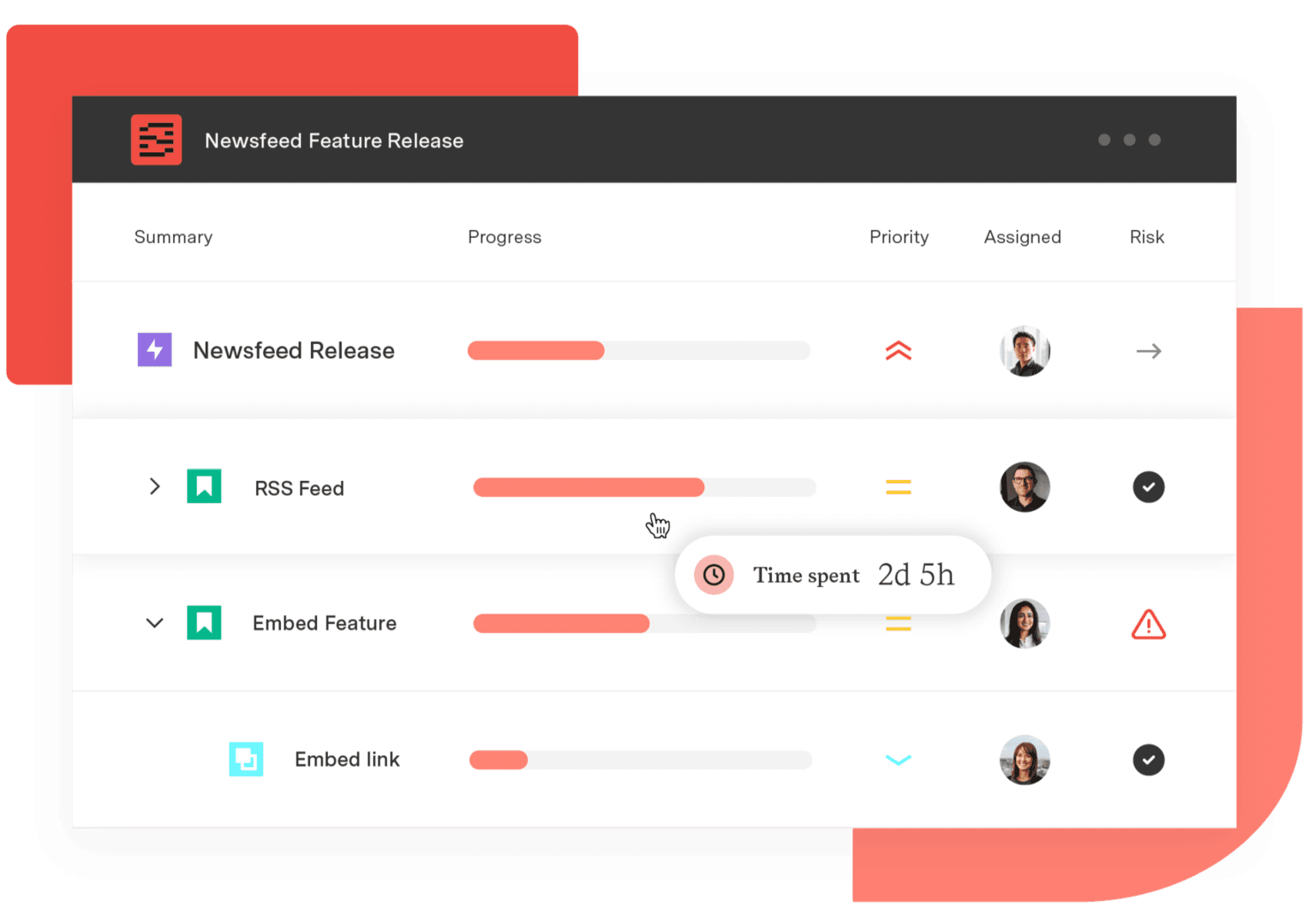
Structure PPM
Align your entire organization
Manage products, projects, and programs in a single spreadsheet-like view. By providing a clear, real-time view of project progress and resource allocation, Structure helps teams meet deadlines and adapt swiftly to changing priorities.
Start a Free TrialFrequently Asked Questions
Couldn't find what you need?Go to our documentation
In principle, yes. Some enterprises use a centralized SPM platform for executive-level scoring and scenario modeling while using Tempo for delivery-layer governance inside Jira. The value depends on whether the two tools' financial views are kept in sync.
Tempo Financial Manager provides real-time labor cost tracking, CapEx/OpEx classification, budget vs. actuals, and expense management pulled from Jira worklogs. Tempo's financial governance is operationally grounded – tied to actual work records, not plan-level estimates. Planisware's financial layer is built for enterprise SPM at the executive level, including scenario modeling and investment optimization. Buyers should match the layer to the primary need.
Tempo is broadly applicable wherever Jira is the delivery system of record. Its primary customer concentration is in software, technology, and product-driven organizations. Planisware has purpose-built depth for engineering-intensive industries. Organizations in those industries with Jira-standardized teams can benefit from Tempo's financial and capacity governance, but should evaluate whether Planisware's industry-specific capabilities address additional requirements that fall outside Tempo's scope.
Not as a native Marketplace app. Planisware is a standalone enterprise SPM platform with its own commercial channel and isn't distributed through the Atlassian Marketplace as of our review. Tempo's SPM suite is on the Atlassian Marketplace.
Planisware features robust time governance built into its centralized repository, operating via Jira integration rather than sitting directly inside the Jira native interface. Tempo Timesheets takes a different architectural approach: time entries live on Jira issues themselves, with four account types – Capitalized, Operational, Billable, and Internal – tied directly to those issues for CapEx/OpEx classification. For Atlassian-standardized organizations, that distinction shapes where the audit trail lives.
Tempo's pricing is per-product and tier-based on the Atlassian Marketplace. Planisware's pricing is sales-only as of our review – buyers contact the vendor for enterprise quotes. The more useful comparison isn't sticker price: Planisware spend buys a centralized enterprise SPM platform; Tempo spend buys Jira-native governance modules adopted incrementally.