Driving success in automotive: A playbook for planning leaders
Hitting delivery dates requires careful execution across a complex network of suppliers, regulatory hurdles, and evolving consumer demands.


Key Takeaways
Automotive delivery risk is systemic, so forecasting has to run continuously instead of as a quarterly exercise.
Flexibility has to be designed into the plan and the review cadence itself from the outset.
On-time delivery depends on shared visibility and clear ownership across every team and supplier touching the line.
PMI's 2026 Pulse of the Profession report carries a blunt subtitle: Driving success in complex projects. The data inside explains why PMI needed to say it. 55% of complex projects now report a delivery disruption such as a missed deadline, and within that group, 35% miss the delivery date outright. Teams that manage complexity well hit an 88% success rate. Teams that manage it poorly land at 14%. That difference is a planning-system failure.
Some would call that a staffing or culture problem: hire better, hustle harder, communicate more. That read holds for a single project, where a strong team can out-work a weak plan once. It breaks down across a full portfolio of concurrent vehicle programs, where four or five compounding risks can surface in the same week, and no amount of individual effort scales fast enough to catch them all. At that scale, the fix has to live in the system, not in any one person's hustle.
Nowhere does that difference cost more than automotive production. A single missed supplier delivery can halt an assembly line, and idle line time is widely estimated to cost thousands of dollars a minute. A missed regulatory milestone can push a launch back a full model year. A misjudged capacity call can leave a plant staffed for a demand curve that shifted three months earlier. Automotive program management carries more moving pieces, tighter tolerances, and less room for error than almost any other planning discipline in enterprise software.
The pressure keeps building. The shift to electric vehicles is rewriting bills of materials mid-program. Automation is changing headcount and skill requirements on the line. Emissions rules are tightening on a rolling basis across regions, and any one of them can move a program's critical path. None of that is new information to a PMO director running automotive portfolios. What's changed is how much of it can now be predicted, absorbed, and delivered against, if the planning system is built for it.
This guide breaks that system into three disciplines. Predict risk before it reaches the line. Adapt the plan without losing control of it. Deliver against commitments without burning out the teams responsible for them.
Why automotive delivery keeps slipping
Three forces make automotive one of the hardest environments in which to hit a delivery date. The supplier network is deep and multi-tiered, so a shortage two or three tiers down can surface as a line stoppage weeks later with almost no warning. Regulatory timelines move on a government calendar that has no obligation to the program's deadlines, and a missed compliance milestone can gate an entire launch. Consumer demand shifts faster than annual planning cycles can track, particularly across the EV transition, where a single competitor launch can reset what the market expects within a quarter.
These three pressures usually live in three different places on the org chart. Forecasting sits with an analytics team. Adaptability sits with delivery leads. Execution sits with plant operations. A PMO director is one of the few roles positioned to own all three as one system, reconciling them when the org chart doesn't, instead of running three initiatives that occasionally compare notes at a steering committee meeting.
Most guidance on this topic treats predictive forecasting and AI-assisted risk detection as something to consider eventually, a future-state capability rather than a current practice. For a PMO director accountable for a portfolio of concurrent vehicle programs, eventually is not a plan. Every discipline below already has enough available capability to change how a program handles risk this quarter, not in some future planning cycle.
Predict – catch schedule risk before it reaches the line
Static, once-a-quarter scheduling can't keep pace with a program that has hundreds of supplier dependencies, evolving regulations, and a demand curve that moves every quarter. A schedule built on assumptions from six months ago is not a plan. It is a guess with better formatting. Four habits separate teams that see risk coming from teams that find out about it after the line stops, and dependency visibility, surfaced early enough to act on, is the advantage most programs claim to have and few programs have.
Build scenarios before you need them. Map two or three plausible futures for each major program milestone, including the ones you're not hoping for. If a battery supplier misses a shipment, what happens to the line in week one, and who absorbs the shortfall? Teams that answer that question in a planning meeting move faster than teams answering it during a live outage.
Mine your own program history for patterns. Every automotive program leaves a trail, in the suppliers who run late, the change requests that always arrive after code freeze, and the regulatory reviews that take twice as long as scheduled. Pull that history into the next schedule instead of starting from a blank template each time.
Catch schedule slippage as it happens. Predictive analytics can flag a slipping task while there's still time to redistribute the work, instead of after the report goes out. Tempo Structure PPM's planned-vs-actual comparisons surface that drift automatically, without waiting for someone to notice it in next week's status deck. A risk that surfaces on Monday costs less to fix than the same risk discovered on Friday.
Keep a risk register with a named owner on every line. A risk without an owner is a rumor. Pair the register with an action plan so that when a likelihood shifts from possible to happening, the response is already written down, not improvised in the moment.
Adapt – build flexibility into the plan itself
Naming an owner for every risk only pays off if the plan itself can move once that risk turns real. A plan that stops updating the moment it's published is already a liability, not an asset. A rigid plan meets change the way a windshield meets a stray rock at highway speed: it holds, until it doesn't, and then the crack runs the length of the glass. Supplier terms shift. Regulations move. A competitor launches early and resets what customers expect. The plan has to absorb that motion instead of shattering under it.
Build adaptive plans, not fixed ones. Give teams room to adjust task sequencing and resourcing inside clear guardrails, with a continuous feedback loop back to stakeholders so the plan stays aligned with what they need now, not what they asked for eight months ago.
Shorten the planning cycle. Quarterly reviews, not annual ones, let a PMO catch drift while it's still cheap to correct. Wait a full year to rebaseline a program, and the correction, when it finally comes, is proportionally larger and more disruptive to every team downstream.
Put a real process around scope change. Scope creep on an automotive program is rarely one dramatic decision. It's a hundred small requests that never went through review. A defined intake process for change requests stops that accumulation before it derails the critical path.
Give every team the same real-time data. Cross-team collaboration usually fails on a data problem, not a communication problem: Engineering, procurement, and manufacturing are working from different snapshots of the same program. Consolidating tasks and dependencies from every Jira project into a single hierarchy, the way Structure does, closes that disconnect without asking anyone to change how they work day to day.
Build the muscle to respond fast. A resource shortage or a sudden priority shift shouldn't require an emergency meeting to process. When the plan already has decision rights and contingency options built in, the response is a decision, not a scramble.
Deliver – turn the plan into on-time execution
A plan built to absorb change on paper still has to prove that in the plant. Execution is where a good plan earns its keep, or gets exposed. Delivering on schedule in an automotive program comes down to five disciplines, and the PMOs that treat any one of them as optional are usually the ones explaining the delay afterward.
Consolidate scattered tasks into a single hierarchy. Tasks spread across a dozen Jira projects create the appearance of visibility without the substance of it. Structure gives a PMO one hierarchy to work from, whether the underlying teams run agile, waterfall, or a mix of both, which cuts the coordination tax that eats into schedule buffer.
Revisit resource allocation on a rolling basis. Workloads shift as a program moves through its phases, and resource allocation only holds up if it's revisited on a rolling basis. Capacity planning tools that show who's overcommitted in real time flag a bottleneck before it forms, not after a task has already started slipping.
Assign one accountable owner to every task. Pair clear ownership with real-time visibility into program status for every team touching the line. That combination lets a PMO catch a problem while it's still small enough to fix quietly, instead of escalating it in a steering committee meeting after the fact.
Use predictive analytics to get ahead of bottlenecks. A model that flags a likely delay two weeks out is worth more than a dashboard that confirms it happened yesterday. Capacity Planner's overallocation view works the same way: it flags a team drifting past planned capacity while there's still time to redistribute the work, not after the deadline is already gone.
Anchor every check-in to business value, not only the date on the calendar. Hitting a deadline with a product the market doesn't want doesn't fix anything. It moves the failure downstream and adds paperwork to it. Regular stakeholder check-ins keep the program honest about which outcome matters.
Metrics that catch schedule drift early
None of the five delivery disciplines above are worth much if the PMO can't tell whether they're working. A PMO drowning in dashboards is not the same thing as a PMO with visibility. A PMO that turns into a reporting factory before every steering committee meeting is optimizing for the volume of metrics, not the signal in them, and the more numbers leadership has to sort through, the slower it reacts to the one number that moved. Four numbers tend to catch drift early enough to matter.
Metric | Cadence | Why it matters |
|---|---|---|
Schedule variance at the program level | Weekly | One project running two days ahead means little if it's masking a dependency running three weeks behind on a different team's board. |
Supplier on-time delivery rate, by tier | Weekly | Most automotive delay root causes sit two or three tiers down the supply chain, where visibility is thinnest and warning signs surface latest. |
Resource utilization against planned capacity | Weekly | For example, a team quietly running at 115% of capacity for a month is a bottleneck that hasn't been named yet. |
Overdue risk-register items | Every 1-2 weeks (sprint cadence) | Structure's dependency view makes an aging register visible automatically. Consider one nobody has touched in six weeks: it isn't a risk-management tool anymore. It's an archive. |
None of these numbers require a new tool to produce. They require someone with the standing to ask for them consistently, and a portfolio view that can surface them without a week of manual roll-ups.
The automotive programs that hit their dates this year aren't the ones running the most optimistic schedule. They're the ones that put one PMO director in charge of forecasting, flexibility, and execution as a single system, instead of leaving those three disciplines to report up through three different boxes on the org chart that occasionally compare notes at a steering committee meeting. Build that system once, under one owner, and the plan absorbs the next stray rock instead of cracking. The deadline stops being something you hope for. It becomes something the plan stays connected to.
Strategic Roadmaps
Strategic roadmapping
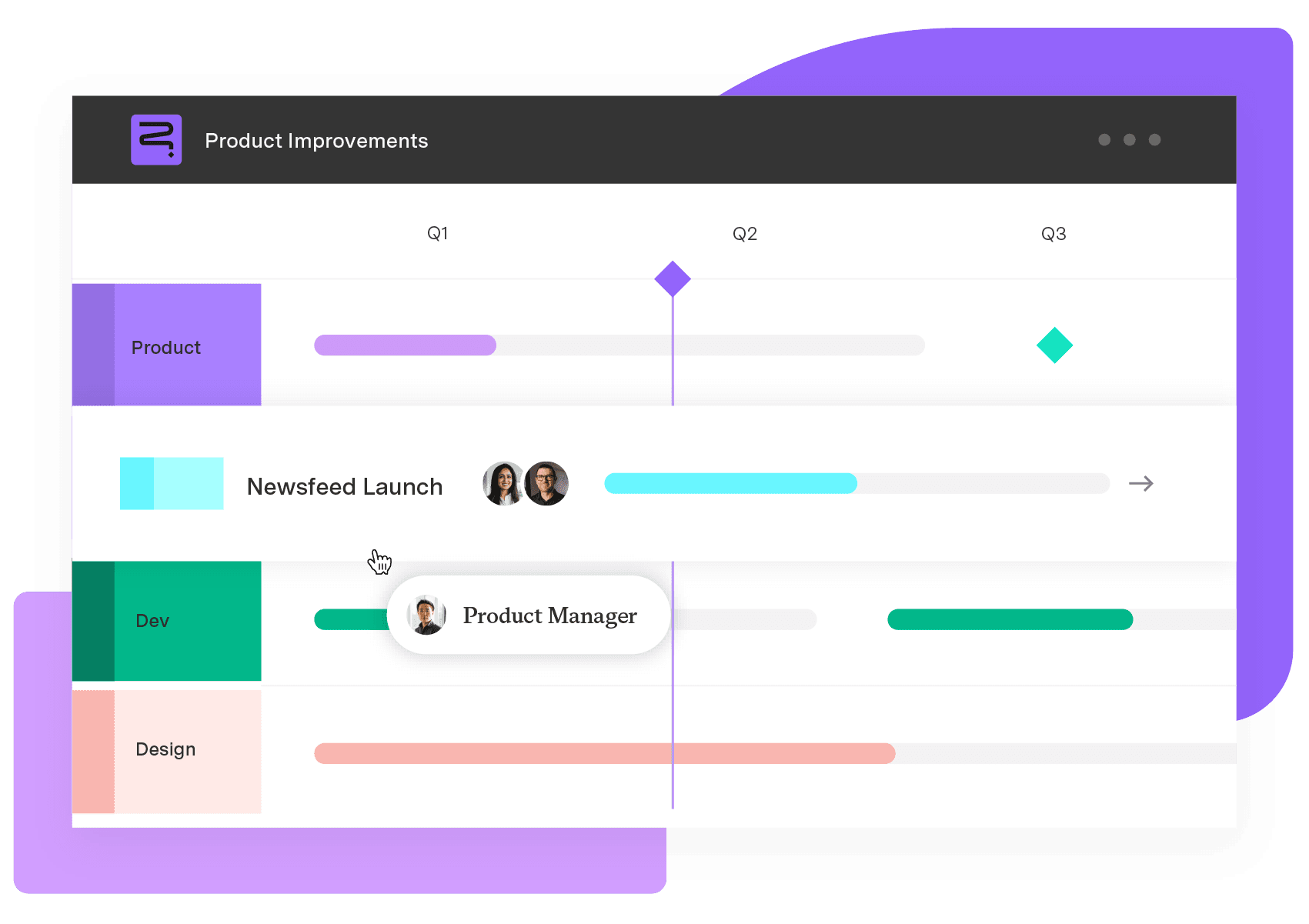
Build your portfolio vision with Strategic Roadmaps. With powerful visualization capabilities, you can communicate strategy to the entire organization and gain alignment around strategic objectives, product goals, and milestones.
Start a Free TrialFrequently Asked Questions
Couldn't find what you need?Go to our documentation
A project has a defined start and end tied to one deliverable, such as launching a single vehicle trim. Program management coordinates several interdependent projects, such as multiple vehicle programs, supplier transitions, and plant retooling, that draw on the same pool of resources and share the same portfolio-level risk. In automotive, program management is the discipline that decides which projects get resources first when they compete for the same suppliers, engineers, or plant capacity.
Start with burdened labor cost for every role on the line, calculated per minute rather than per hour, since idle time gets measured in minutes. Add the fixed overhead allocated to that line for the same window: facilities, equipment financing, and utilities keep accruing whether the line is moving or not. Add contractual exposure next, including dealer commitment penalties and expedited-shipping fees that kick in once a recovery plan starts. Then stress-test the total against your last two or three real stoppages, because assumptions about labor mix and overhead allocation rarely survive contact with an actual incident.
No. Scenario planning maps out multiple possible futures before you know which one will happen, so the team can compare trade-offs across different demand curves, supplier outcomes, or regulatory timelines in advance. Contingency planning is the fallback response for one specific, already-identified risk on the register. A strong risk register uses scenario planning to decide which risks are worth building a contingency plan for in the first place.
A RAID log tracks four categories, risks, assumptions, issues, and dependencies, in one shared document, which makes it useful as a general program-hygiene tool but not built for prioritization. A risk register is narrower and more actionable: each entry carries a likelihood, an impact estimate, a named owner, and a response plan, ranked so the PMO knows which three or four risks deserve attention this week. Programs that maintain both usually feed the register from the RAID log's risk category, then add the ownership and prioritization structure that a general log doesn't provide on its own.