Crafting success in 2026: A playbook for manufacturing planning leaders
Hitting delivery dates requires precise coordination across the supply chain, but disruptions like material shortages, changing demand, and labor constraints often cause delays.


Key Takeaways
Dynamic forecasting – scenario planning, historical data analysis, and real-time tracking – catches schedule risk before it becomes a missed deadline.
Building flexibility into project plans, shortening planning cycles, and giving teams shared real-time data keeps a portfolio adaptable when priorities or resources shift.
Streamlined workflows, clear task ownership, and predictive analytics turn on-time delivery into a repeatable outcome rather than a lucky one.
The real cost of a missed production deadline
A single late shipment of copper coil can cascade through a production schedule for weeks. One missed delivery window turns into a handful of reworked task assignments, then a portfolio review that arrives after the damage is already done. PMI's 2018 Pulse of the Profession research found that roughly 48% of projects miss their original deadlines, and manufacturing feels that number more than most industries do.
A missed deadline on a production line does not just move a date on a calendar – it halts the line, creates a stockout or an overproduction problem nobody budgeted for, and hands a competitor the market window you were supposed to fill. Inefficient planning, unrealistic timelines, and a lack of real-time visibility do not cause a single failure. They compound, so the same three problems show up again on the next project, and the one after that.
2026 is not making any of this easier. Supply chains remain unstable, automation is moving faster than most planning processes can absorb, and cross-functional collaboration is now the default rather than the exception. Static schedules and after-the-fact status reports cannot keep pace with any of it, and program directors who wait for a quarterly review to catch drift are finding out how expensive that lag has become.
This guide breaks the response into three disciplines – predict, adapt, and deliver – and shows what each one requires in practice, not in theory.
Predict: Build forecasting that catches risk before it becomes a delay
As projects grow more complex, predictions get exponentially harder to make. Traditional methods built on static scheduling cannot keep up, and planning leaders are leaning harder on technology to forecast timelines and get ahead of risk before it turns into a missed date. Four tactics do most of the work.
Embrace scenario planning. Map out multiple potential outcomes so the team can adjust the moment conditions change. If a key resource becomes unavailable, a contingency plan already exists to redistribute the workload and keep the project on track, instead of the team improvising one on the spot.
Use historical data. Analyzing past projects surfaces the patterns that repeat: which changes cause overruns, which suppliers slip their lead times, which changeovers run long. If late-stage changes consistently blow up your timeline, build more flexibility into the plan up front instead of hoping this project is the exception.
Invest in real-time tracking. Predictive analytics flags a slipping task early enough to redistribute the work before the deadline arrives. Scenario modeling – running the best case, the worst case, and the range in between – turns that early warning into a specific decision about who picks up the slack.
Build a risk register and pair it with an action plan. Document potential risks, assess how likely each one is, and assign an owner to watch it. A risk register nobody updates after the kickoff meeting is decoration, not risk management. Pair it with an action plan so the team has a rehearsed response the day one of those risks materializes.
For a program director managing interdependent supplier and production schedules, this discipline is about lead time: enough warning to redirect resources before one project's delay becomes a program failure instead of a line item on next week's status report.
Key takeaway: a risk register only earns its place when someone owns each entry and rechecks it on a set cadence – decoration otherwise, no matter how detailed the initial list.
Adapt: Build flexibility into the plan before you need it
Change is inevitable, and how well your organization adapts can be the difference between a project that recovers and one that spirals. For planning leaders, the ability to adjust to shifting priorities, market demand, and the unknowns nobody put in the original plan is what keeps a portfolio on track when a single project goes sideways. Five practices build that flexibility in.
Build adaptive project plans. Trade rigid timelines for plans that give teams room to adjust task sequencing and resourcing as conditions change. A continuous feedback loop keeps the plan aligned with both stakeholder expectations and whatever new requirement just landed.
Prioritize organizational agility. Agility that stops at the team level does not hold up under real pressure. Shorter planning cycles, such as quarterly or even monthly reviews, let teams adjust fast without losing sight of the program's long-term direction.
Manage scope creep before it manages you. Establish a clear process for scope changes – one owner, one turnaround time, no exceptions – so a new request does not quietly reshape the delivery date without anyone deciding it should.
Foster cross-team collaboration. Shared, real-time data does more for collaboration than another status meeting ever will. Teams working across multiple Jira instances or business units need one place to see how their work connects to everyone else's, which is exactly what Tempo Structure PPM is built to do: it rolls tasks from every instance into a single hierarchy, so a delay in one place shows up against the master schedule the same day it happens.
Respond quickly when conditions change. Build the systems and the authority for real-time decision-making now, before a resource shortage or a new executive priority forces the decision to get made badly, under pressure, by whoever happens to be in the room.
None of this replaces planning. It accepts that the plan you approved in January will not survive contact with a shifted supplier ship date in March, and builds the muscle to update it without a crisis.
Key takeaway: agility that lives only at the team level will not hold – a program director needs that same flexibility built into the review cadence and the tooling, or the plan breaks the first time a supplier date moves and nobody outside one team notices for a week.
Deliver: Turn execution discipline into on-time delivery
Execution is where planning meets reality. Getting there on schedule takes streamlined workflows, resources that are available when the plan says they are, and accountability that survives contact with a bad week.
Streamline workflows. Consolidate tasks scattered across multiple Jira instances into one workspace instead of five, so coordination happens in one place instead of five separate status calls. Structure does this by giving every project, program, and portfolio a single, real-time roll-up.
Optimize resource allocation. Dynamic resource views, built on tools like Tempo Capacity Planner, show who is overbooked and who has room before a bottleneck forms – enough lead time to reassign work before three people end up quietly double-booked across the same shift or changeover.
Foster accountability and communication. Clear ownership of every task, paired with consistent updates, keeps everyone aligned without another meeting. Real-time visibility into status lets a team catch a problem while it is still small enough to fix quietly.
Use predictive analytics. Forecasting tools that model schedule risk in real time flag a bottleneck before it forms, giving a program lead enough lead time to shift a resource or resequence a task while the fix is still cheap.
Keep the focus on delivering value, not the date alone. A project that lands on time but misses the business outcome it was funded for still counts as a program failure – the date was never the actual goal. Regular check-ins with stakeholders confirm the work in flight still matches the goal it started with.
Put together, these five practices are what separate a team that hits dates by accident from one that hits them on purpose.
Key takeaway: a project that lands on the date but ships the wrong scope is a program failure wearing a green status light – check the outcome at the same cadence you check the date.
Where Structure and Capacity Planner fit
Every tactic in this guide works with a spreadsheet and enough discipline. It works faster, and holds up better under real pressure, with the right tooling behind it. Structure and Capacity Planner do different jobs, and the value is in how they connect: Structure shows a program director where the schedule has already drifted, and Capacity Planner shows who has room to absorb the fix – without switching between disconnected spreadsheets or waiting for the next steering committee meeting to compare notes.
Tool | Discipline it supports | What it shows |
|---|---|---|
Predict & Adapt | Every task, dependency, and status from every Jira instance, rolled into one hierarchy | |
Deliver | Who is overbooked, who has room, and where a reassignment fixes a bottleneck before it becomes a missed date |
Download the full guide for the tactics, the checklists, and the specific moves each discipline requires, and start closing the distance between the schedule you planned and the schedule you are running.
Strategic Roadmaps
Strategic roadmapping
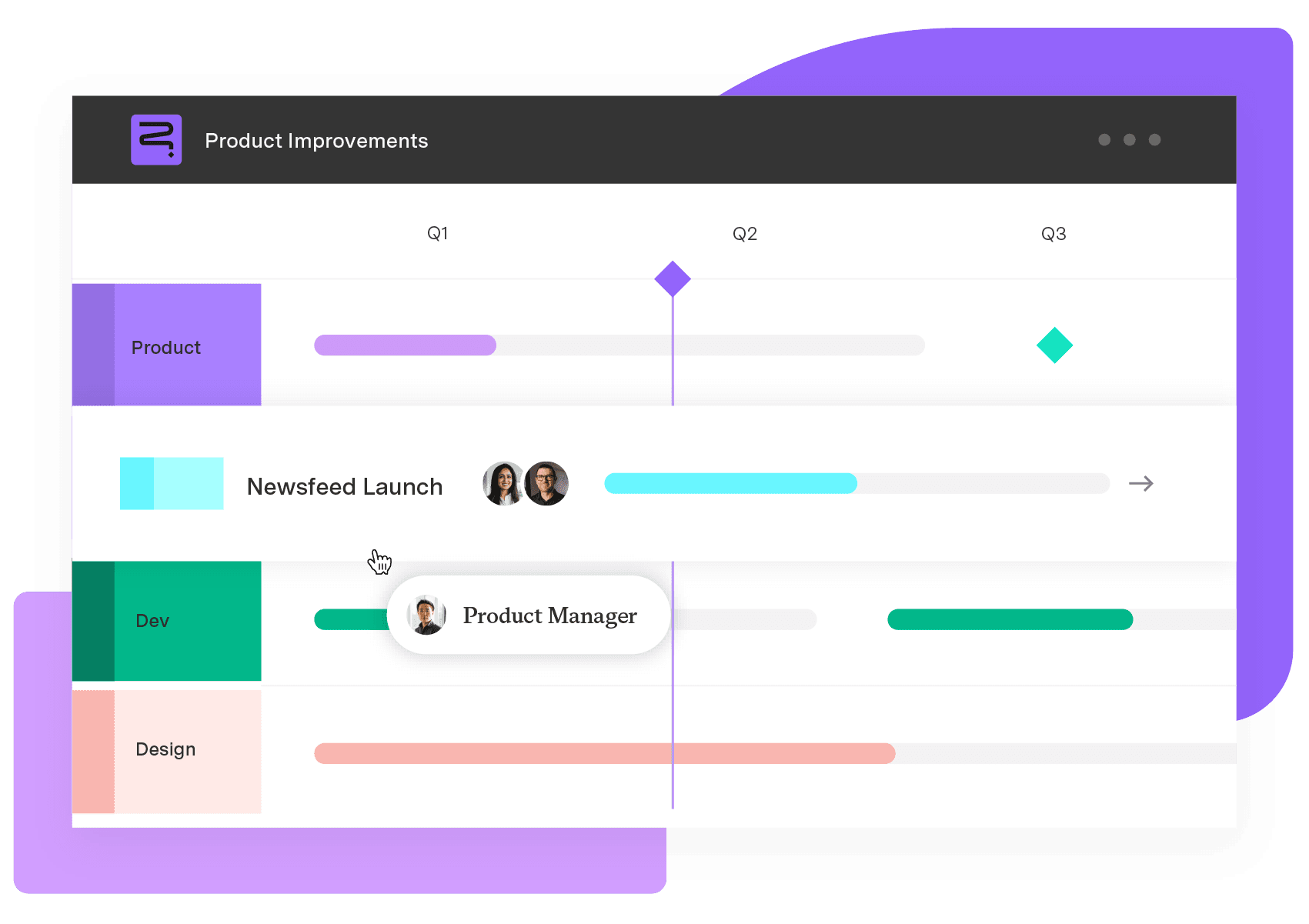
Build your portfolio vision with Strategic Roadmaps. With powerful visualization capabilities, you can communicate strategy to the entire organization and gain alignment around strategic objectives, product goals, and milestones.
Start a Free TrialFrequently Asked Questions
Couldn't find what you need?Go to our documentation
Production planning sets the longer-horizon decisions: what to build, in what quantity, and with which resources over the coming weeks or months. Production scheduling is the shorter-horizon execution layer that sequences specific tasks, machines, and shifts to carry that plan out day by day. A program director needs both working together; a plan without a schedule never gets executed, and a schedule without a plan optimizes the wrong work.
Supplier lead times are rarely stable for an entire production run, and a single-digit percentage swing in lead time can shift an entire changeover schedule downstream. Treat lead-time variance as its own risk-register entry, separate from the demand or labor risks already on the list, and update it whenever a supplier confirms or misses a delivery window rather than waiting for the next scheduled review. Programs that track lead-time drift on its own catch a scheduling risk days or weeks before it shows up as a missed date on the shop floor.
Most risk registers get built once, at kickoff, and reviewed only after something has already gone wrong. A register that protects the schedule needs a standing review – weekly for a project under active disruption, biweekly or monthly for one running smoothly – so likelihood and impact scores get updated before a risk becomes the day's emergency, not after it.
Scenario planning is only as good as the inputs behind it. At minimum, a team needs historical task-level durations rather than just planned dates, current resource capacity by skill or shift, and a live view of in-flight work status; without those three, a scenario model is a guess with a nicer interface. Teams starting from spreadsheets alone often need two to three completed project cycles of clean historical data before the scenarios it produces are worth acting on.