Smartsheet vs. Tempo: Strategic portfolio management comparison
Smartsheet syncs your tools. Tempo is a modular alternative to Smartsheet for teams that want Jira-native financial and operational truth.


Key Takeaways
Tempo offers a Jira-native SPM suite that pulls portfolio governance, financial management, and capacity intelligence directly from Jira data.
Smartsheet is a collaborative work management platform built around a familiar grid interface and a broad integration ecosystem – and a Leader in the 2024 Gartner Magic Quadrant for Collaborative Work Management.
For Jira-standardized enterprises, Smartsheet's "sync your tools" model adds latency and mapping overhead. Tempo avoids that by operating natively in Jira.
For PMO and finance teams that need CapEx/OpEx classification and audit-ready financial records, Tempo provides a purpose-built governance stack.
Smartsheet and Tempo approach portfolio reporting differently, and for Jira-standardized enterprises the distinction matters. Buyers evaluating a switch want portfolio governance somewhere it can hold up over time.
Underneath, it's a data philosophy question. Sync your tools, or pull truth from one system of record. Smartsheet built around the first approach: Connect Jira, Salesforce, Microsoft 365, and other systems into unified grids and dashboards. Tempo built around the second. If Jira is where delivery happens, governance comes from Jira directly – without piping data through a separate aggregation platform first.
For mixed-tool environments, Smartsheet’s aggregation surfaces signals that would otherwise demand manual reporting. For Jira-standardized enterprises, syncing Jira into Smartsheet to report on work that already lives in Jira adds data replication overhead – a tradeoff that can grow with portfolio size as that sync layer replicates an expanding project footprint.
This page compares the two products on financial depth, purpose, capacity planning, time tracking, AI, and Jira integration.
How do Smartsheet and Tempo compare?
Smartsheet offers a familiar grid and spreadsheet-style interface that scales to large process and work management, with a broad integration ecosystem, dashboards, and automation.
Tempo offers a Jira-native strategic portfolio management (SPM) suite and serves 30,000+ customers. The suite – including Tempo Structure PPM, Timesheets, Capacity Planner, Financial Manager, and Custom Charts – gives PMO directors, finance/FP&A, and engineering leaders a governed view of portfolio cost, capacity, and delivery performance pulled directly from Jira.
The products are complementary for some organizations and competing for others. For Jira-standardized enterprises, the relevant comparison is whether portfolio governance should live inside the delivery system or require a separate platform to aggregate it.
What each solution is best for
Use case | Tempo | Smartsheet |
|---|---|---|
Cross-tool dashboards across Jira, Salesforce, MS 365 | Not Tempo's focus | Strong fit – Smartsheet's core positioning |
PMO/Finance governance in Jira-standardized orgs | Purpose-built on Jira data | Not the primary focus; aggregates rather than pulls from Jira |
CapEx/OpEx and budget vs. actuals | Dedicated Financial Manager; worklog-based actuals | Budget columns and cost fields; not foregrounded as CapEx/OpEx governance |
Grid-based planning for non-technical users | Not Tempo's focus | Strong fit – Excel-like grid interface across departments |
Capacity planning with PvA | Individual + team dashboards, PvA from time logs | Resource tracking via Smartsheet grids |
Foundational differences between Tempo and Smartsheet
Dimension | Tempo | Smartsheet |
|---|---|---|
Primary purpose | Jira-native SPM – time, capacity, financial, and portfolio governance | Collaborative work management platform connecting tools across departments |
Portfolio management | Custom issue hierarchies across projects and programs via Structure PPM, with formula-driven roll-ups scaling to tens of thousands of issues per structure | Row hierarchy within sheets; portfolio rollups via Smartsheet Control Center |
Financial management | Budget vs. actuals, labor costs, CapEx/OpEx, expenses via Financial Manager – plus revenue and cost forecasting and project profitability | Budget columns and resource cost tracking; not foregrounded as CapEx/OpEx governance |
Capacity planning | Individual + team dashboards, planned vs. actual, with availability-based plans accounting for holidays, PTO, roles, and utilization | Resource tracking within Smartsheet grids |
Time tracking | Suggested entries via Atlassian Rovo agents, with human approvals and CapEx/OpEx accounts | Time logging can be configured within Smartsheet grids |
Primary buyer | PMO, finance, Portfolio Managers, Engineering leadership | Program managers, ops leads, IT project managers, business analysts |
Jira integration | Native – Jira is the system of record | Native two-way Jira Connector with field mapping and OAuth 2.0 authentication |
The reframe between Tempo and Smartsheet is about what "connecting your tools" delivers. Smartsheet's integrations are useful when platforms are legitimately diverse.
For Jira-standardized enterprises, a sync-based model can add replication overhead without adding governance fidelity; Tempo’s approach pulls governance directly from Jira instead. CapEx/OpEx tracking in particular benefits from staying close to the source, where logged hours map to actual project spend without an intermediate step.
How Tempo and Smartsheet approach AI and integrations
Smartsheet has added AI capabilities including formula generation, content summarization, and workflow automation suggestions. These reduce manual effort within Smartsheet's grid and process management workflows. Smartsheet's AI runs on its own data model, so the value depends on how much of the organization's work lives in Smartsheet.
Tempo's Rovo agents span the suite rather than one workflow. On Structure PPM, Structure View Builder configures portfolio views from natural-language prompts and Structure Formula Assistant writes the rollup formulas; Custom Charts Assistant turns natural-language prompts into Jira dashboard charts. On Timesheets, Timesheets Worklog Assistant logs time in Jira from natural-language prompts, Timesheets Summary Analyzer gives project and team leads a read on where hours are going, and Time Insights for Jira provides time analysis, suggesting entries from Jira activity, flagging variance between planned and logged hours, and surfacing workload patterns.
Each suggestion runs through Tempo's standard approval flow before it lands against a CapEx or OpEx account, and every entry is auditable line by line. The human approver owns the timesheet that goes to finance, not the agent. When the hours are right, CapEx/OpEx classifications are defensible, PvA variance is actionable, and labor cost rollups reflect actual spending. Tempo Cloud holds SOC 1, SOC 2 Type 2, ISO 27001/27701, and PCI DSS certifications, plus CSA STAR Level 1, DORA alignment, and a VPAT, with GDPR and CCPA covered via standard DPA. Data Center deployments operate under their own compliance posture.
On integrations, Tempo has an array of BI connectors:
Power BI Connector for Jira
Power BI Connector for ServiceNow
Power BI Connector for monday.com
Tableau Connector for Jira
BigQuery Connector for Jira
Oracle Analytics Connector
SAP Analytics Cloud Connector
Looker and Looker Studio integration, plus SQL and data warehouse exports
This set of Tempo SPM suite modules pipes Jira and adjacent platform execution data directly into preferred BI environments. (The Power BI Connector for ServiceNow installs on the ServiceNow Store; the Power BI Connector for monday.com installs on the monday.com App Marketplace.)
Instead of staging data through a grid platform, those connectors land portfolio reporting where the decisions get made.
Both products are built around an assumption about where work happens. Smartsheet plans for a multi-tool environment where no single platform has all the data. Tempo treats Jira as the authoritative delivery system and builds governance native to that data.
Top Smartsheet strengths
Smartsheet plays the breadth game: Wide enterprise adoption, a large integration ecosystem, and a grid interface non-technical users already know. For multi-tool environments, that combination is hard to beat.
Leader in the 2024 Gartner Magic Quadrant for Collaborative Work Management
Broad departmental solution paths across IT, marketing, operations, HR, and professional services
Native Jira Connector with two-way sync and field mapping, plus a broad integration ecosystem across Salesforce, Microsoft 365, and other systems
Grid-based planning interface familiar to Excel users
What is Tempo's strength vs Smartsheet?
Tempo flips Smartsheet's aggregation model. Instead of syncing Jira data into another platform to report on it, pull governance directly from Jira. For Jira-standardized enterprises, that cuts the sync overhead sitting between raw work data and the PMO's view of it.
"Don't sync your truth – pull it from Jira." Planned vs. actual comes from Capacity Planner plus Timesheets and Financial Manager, all reading from Jira via the Tempo SPM suite.
Financial Manager provides CapEx/OpEx, labor costs, budget vs. actuals, plus revenue and cost forecasting and project and portfolio profitability, tied to Jira worklogs and account codes.
Timesheets with Rovo agents (Worklog Assistant, Summary Analyzer, and Time Insights for Jira) tightens time fidelity, and that flows through financial and capacity reports.
Modular deployment: Start with Timesheets or Structure. Add Tempo Financial Manager when finance asks for CapEx reporting. Add Capacity Planner when planning conversations need strengthening.
SOC 1, SOC 2 Type 2, ISO 27001/27701, and PCI DSS certifications, plus CSA STAR Level 1, DORA alignment, and a VPAT, with GDPR and CCPA covered via standard DPA.
Pluxee's deployment demonstrates Tempo at enterprise scale: Pluxee scaled governance and visibility across 29 countries using Tempo Timesheets, Structure, and Power BI Connector for Jira – a Jira-native BI outcome delivered at the source, saving teams from the parallel data replication cycles required by external grid networks.
Ideal customer for each tool
Choose Tempo if:
Your engineering and product org uses Jira as its delivery system, and financial governance must come from that same data
Finance and PMO teams need CapEx/OpEx tracking and budget vs. actuals without a parallel system
Capacity planning needs to surface PvA variance grounded in actual time logs, not task completion estimates
Audit-ready time records, approvals, and account classifications are compliance requirements
Choose Smartsheet if:
Your work spans multiple non-Jira systems and you need a unified operational view across tools, teams, and departments
Resource tracking and process management span non-engineering functions where Jira isn't the delivery platform
Broad departmental adoption across marketing, operations, HR, and IT is a goal for the platform
A grid-based planning interface bridging technical and non-technical users is a usability requirement
When should you choose Tempo vs. Smartsheet?
Choose Tempo | Choose Smartsheet |
|---|---|
Jira is the engineering delivery standard and governance must come from Jira actuals | Work spans multiple tools across departments that aren't Jira-native |
PMO and finance need CapEx/OpEx tracking from Jira worklogs | Cross-functional process management and resource tracking across platforms |
Capacity planning requires PvA from actual time logs | Unified dashboards aggregating data from Jira, Salesforce, MS 365, and others |
Compliance certifications are required from portfolio management vendors | Grid-based planning familiar to non-technical business users is a priority |
Recap
Smartsheet and Tempo represent two coherent but distinct philosophies for portfolio governance. Smartsheet is integrative – connect the tools, aggregate the signals, and surface unified dashboards that give stakeholders a common view across departments. For organizations with genuine tool diversity, this model delivers real value.
Tempo is derivational – start with Jira, where delivery happens, and make portfolio intelligence native to that system. Tempo extends Jira's data model directly rather than copying it into a parallel platform. Capacity plans inform workload, time logs confirm actuals, and financial reports reflect real labor costs rather than estimates. For Jira-standardized enterprises, a native governance model cuts the sync layer and gives PMO and finance a single authoritative source.
Sign up for a demo
Request DemoThe decision turns on how the organization's delivery data is structured. When Jira is the system of record, Tempo gives PMO and finance teams the governance depth they need without requiring a parallel platform to hold a second copy of the truth.
Compare Tempo to other solutions
See Comparisons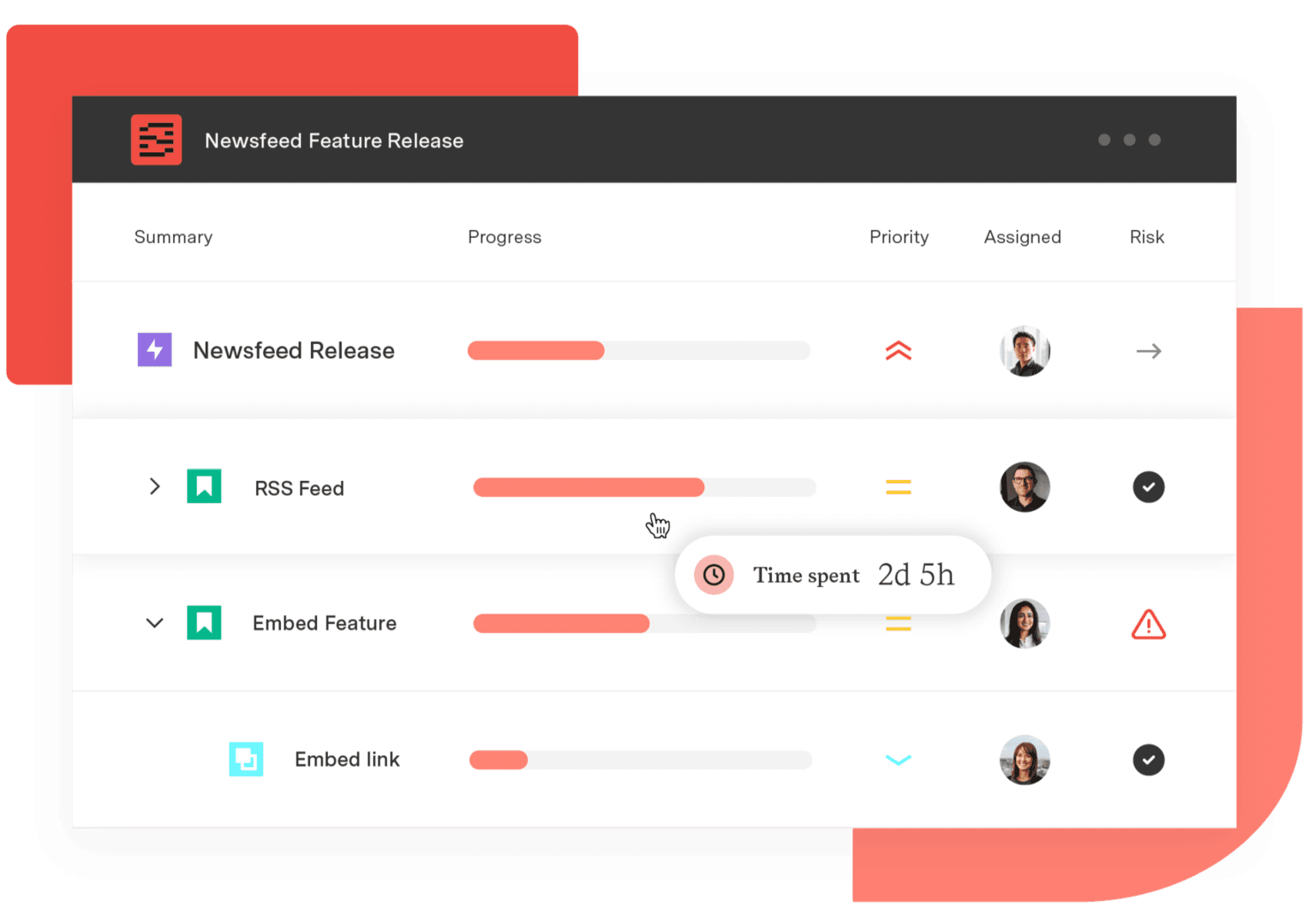
Structure PPM
Align your entire organization
Manage products, projects, and programs in a single spreadsheet-like view. By providing a clear, real-time view of project progress and resource allocation, Structure helps teams meet deadlines and adapt swiftly to changing priorities.
Start a Free TrialFrequently Asked Questions
Couldn't find what you need?Go to our documentation
Yes, with intentional scope separation. Some organizations use Smartsheet for cross-functional program coordination across non-Jira teams, while using Tempo for engineering portfolio governance inside Jira. Each platform should have a clear ownership domain so financial governance data isn't duplicated.
Smartsheet provides budget columns, resource cost rates, and project financial tracking within its grids. Tempo Financial Manager provides real-time labor cost tracking, CapEx/OpEx classification, budget vs. actuals, and expense management pulled from Jira worklogs and account codes. The key difference is data origin: Smartsheet's financial data is entered or imported; Tempo's comes from actual time logged in Jira.
Smartsheet's broadest adoption is in non-engineering functions – marketing, operations, HR, PMOs, and professional services. In organizations where engineering runs on Jira, Smartsheet often serves as a reporting or coordination layer for adjacent functions, not as a replacement for Jira-native portfolio governance.
Tempo holds SOC 1, SOC 2 Type 2, ISO 27001/27701, and PCI DSS certifications, plus CSA STAR Level 1, DORA alignment, and a VPAT, with GDPR and CCPA covered via standard DPA. Buyers should verify current certification and compliance documentation from both vendors against organizational requirements during procurement.
Not as a native Marketplace app. Smartsheet is a standalone work management platform with its own commercial channel and isn't distributed through the Atlassian Marketplace as of our review. Tempo's SPM suite is on the Atlassian Marketplace.
Not from Jira worklogs. Smartsheet's budget columns and cost fields live inside its own grids, populated by entry, formula, or import. CapEx/OpEx classification pulled directly from Jira worklogs isn't part of Smartsheet's positioning. Tempo Timesheets handles this with four account types – Capitalized, Operational, Billable, and Internal – tied to Jira issues.
Tempo's pricing is per-product and tier-based on the Atlassian Marketplace. Smartsheet's pricing is published on its own site with paid tiers and an enterprise tier requiring sales engagement, as of our review. The more useful comparison isn't sticker price: Smartsheet spend buys cross-tool aggregation; Tempo spend buys Jira-native portfolio governance.