ServiceNow SPM vs. Tempo: Strategic portfolio management comparison
Tempo governs portfolios natively in Jira – it extends Jira's data model directly, without a separate system of record or replatforming.


Key Takeaways
Tempo is a modular alternative to ServiceNow SPM built natively on Jira. Portfolio data updates as delivery work updates because Tempo extends Jira's data model directly.
ServiceNow SPM treats Jira as an integration target, not a source of truth. That means mapping overhead, sync latency, and dual-truth risk.
Tempo's suite covers time tracking, capacity planning, financial management, and custom reporting without asking Jira-first teams to adopt a new operating platform.
For Jira-standardized enterprises, Tempo puts portfolio governance, CapEx/OpEx tracking, and planned vs. actual reporting inside Atlassian – not beside it.
Portfolio leaders evaluating enterprise SPM tools face the same fork: run governance on a broad enterprise platform, or run it inside the delivery system teams already use. Tempo offers a modular alternative to ServiceNow for Jira-first organizations that don't want to replatform just to get portfolio governance.
ServiceNow pitches strategic portfolio management (SPM) as part of a single enterprise system of action covering IT, HR, and risk. Tempo makes a narrower, deeper claim – portfolio truth pulled straight from Jira work items, with no migration and no second planning system. Tempo ships through the Atlassian Marketplace, which is part of why install-to-value is measured in weeks.
How do ServiceNow and Tempo compare?
Tempo provides a Jira-native strategic portfolio management suite used by 30,000+ companies across technology, financial services, professional services, and the public sector. Tempo Structure PPM, Timesheets, Capacity Planner, Financial Manager, Custom Charts, and Tempo Gantt Charts for Structure PPM share Jira's data model. Teams do the work in Jira, and Tempo surfaces portfolio, time, capacity, and financial intelligence from that work.
ServiceNow Strategic Portfolio Management is a module within the broader ServiceNow platform, an enterprise workflow system used mostly for IT service management, HR, risk, and operations. SPM adds portfolio and demand management on top of that, positioned as a unified control plane across the enterprise.
Jira-based delivery teams connect to ServiceNow SPM through a bidirectional integration. ServiceNow holds the system of record for portfolio governance; Jira stays the system of record for delivery. A connector bridges the two.
Tempo reverses that relationship. Because the product runs inside Jira, every project, epic, and issue is already a portfolio object. Tempo extends Jira's data model directly, so there's no second platform to stand up.
What each solution is best for
Dimension | Tempo | ServiceNow SPM |
|---|---|---|
Best-fit buyer | Jira-standardized organizations where PMO, finance, and engineering need shared portfolio truth | Enterprises consolidating IT, HR, risk, and portfolio on a single ServiceNow platform |
Primary workflow | Portfolio governance derived from Jira delivery work in real time | Cross-functional enterprise workflow automation with portfolio governance as one component |
Deployment style | Modular Jira app, Atlassian Marketplace install | Platform transformation tied to ServiceNow standardization, generally as part of broader ServiceNow adoption |
Financial layer | Real-time labor costs, CapEx/OpEx, budget vs. actuals from Jira time entries – plus revenue and cost forecasting and project profitability | Cost plans, labor and non-labor cost plans, and expense lines managed within ServiceNow platform tables |
Delivery relationship | Native – Jira is the source of truth | Integrated – Jira syncs into ServiceNow via connector |
Foundational differences between Tempo and ServiceNow SPM
Dimension | Tempo | ServiceNow SPM |
|---|---|---|
Primary purpose | Jira-native SPM – time, capacity, financial, and portfolio governance | Enterprise platform consolidation across IT, HR, risk, and portfolio |
Portfolio management | Custom issue hierarchies across projects and programs | Demand and investment hierarchy maintained inside ServiceNow |
Financial management | Budget vs. actuals, labor costs, CapEx/OpEx, expenses tied directly to Jira work items – plus revenue and cost forecasting and project profitability | Cost plans, labor and non-labor cost plans, and expense lines managed within ServiceNow platform tables; without configuration, these tables operate separately from native Jira work items |
Capacity planning | Availability-based individual and team planning with roles, utilization, and planned vs. actual | Resource management inside ServiceNow, synced from delivery tools |
Time tracking | AI-powered (Rovo agents), with approvals and Tempo Accounts spanning Capitalized, Operational, Billable, and Internal types | Time capture inside ServiceNow; depth depends on platform configuration |
Primary buyer | PMO, finance, Portfolio Managers, Engineering leadership | CIO, COO, and enterprise PMO leading ServiceNow consolidation |
Jira integration | Native – Jira is the system of record | Bidirectional sync – not native to Jira |
The difference is architectural. ServiceNow asks you to put the operating model on its platform and have Jira feed it through an integration. Tempo goes the other way: the delivery system is the system of record and governance layers in on top. No migration, no reconciliation gap.
How Tempo and ServiceNow SPM approach AI and integrations
Tempo's Rovo agents run across the whole suite inside Jira. On the Structure PPM side, Structure View Builder builds portfolio views from a plain-language prompt; Structure Formula Assistant writes the rollup formulas a PMO would otherwise hand to a power user; Custom Charts Assistant turns natural-language prompts into Jira dashboard charts. The companion Custom Charts for Confluence app embeds those charts as macros on Confluence pages. On the Timesheets side, Worklog Assistant handles natural-language time logging, Summary Analyzer gives leads a view of time allocation, and Time Insights for Jira covers user-level summaries. A human approves before time hits a CapEx or OpEx account, and every Rovo-assisted entry is auditable line by line.
CapEx/OpEx reporting, billable-hour analysis, and planned vs. actual dashboards stay accurate at the source because Tempo reads Jira directly, so Rovo's suggestions come from live delivery activity.
Tempo and ServiceNow solve different problems. Tempo's Power BI Connector for ServiceNow pulls ServiceNow ticket and CMDB data into the same Power BI model as Jira delivery data. Enterprises already running ServiceNow can add Tempo's portfolio governance layer from Jira without displacing ServiceNow – use Tempo for portfolio governance in Jira, keep ServiceNow for enterprise workflows, and reconcile both in BI.
ServiceNow brings generative AI to portfolio work through Now Assist for Strategic Portfolio Management – its SPM-specific AI expanded in the Zurich release. It handles conversational demand intake, AI-forecasted goal status, project and Docs summaries, user-story generation, and epic-health risk scoring across dimensions like blocked stories, dependencies, progress, and timeline. The breadth across IT, HR, and risk is real. For software delivery portfolios specifically, the quality of those outputs still depends on how faithfully the Jira sync captures what delivery teams are doing.
For integrations, Tempo is Atlassian-native – Jira, Confluence, and Atlassian Analytics. BI reach comes from Tempo's BI Connector modules (Power BI, Tableau, BigQuery, Looker Studio, Oracle Analytics, and SAP Analytics Cloud connectors, plus a SQL connector), installed as separate modules of the Tempo SPM suite.
Most enterprise delivery doesn't run on Jira alone. CTOs run Jira alongside Azure DevOps, GitHub, and increasingly monday.com or Linear for specific teams. Tempo's separate Power BI Connectors for Jira and for ServiceNow reflect a practical reality: portfolio data consolidates in BI, sourced from multiple delivery systems, not in any single one. ServiceNow itself reaches further into HR platforms, ERP, and CMDB (Configuration Management Database). That reach helps organizations consolidating cross-functional operations, and it adds cost for organizations that only need governance over software delivery.
Architecturally, Tempo Structure PPM creates custom Jira issue hierarchies and persists view configurations in its own data store while reading Jira issue data live at query time. Tempo Timesheets writes worklog records to Jira's worklog API; account types, rates, and approvals live in Tempo's app data store and reference Jira issues by ID. Tempo Financial Manager calculates labor cost from those worklogs against rate tables it owns, surfacing budget vs. actuals at the project and portfolio level. On Cloud, Structure supports up to 30,000 issues per structure; on Data Center, up to 100,000 issues per structure, across unlimited structures.
Cloud and Data Center deployments use different data stores but the same architectural pattern. Tempo extends Jira's data model – it doesn't duplicate or replace it. ServiceNow SPM, by contrast, holds portfolio data inside its own platform, with Jira delivery data flowing in through a bidirectional connector.
Top ServiceNow SPM strengths
ServiceNow has earned its position as an enterprise-wide system of action, and its portfolio module inherits that footprint. For buyers consolidating IT, HR, and risk under one platform, the strengths are real.
A strong CIO and COO consolidation story – one enterprise system of action across IT, HR, risk, and portfolio.
Enterprise breadth that goes beyond portfolio management into adjacent domains like IT service management and risk.
Now Assist for SPM – generative AI embedded in the ServiceNow SPM workflow, covering demand intake, goal-status forecasting, and project summaries
Cross-functional footprint for organizations centralizing on a single vendor.
CMDB as a data backbone for understanding infrastructure-to-project relationships.
What is Tempo's strength vs ServiceNow SPM?
Tempo's take is narrower and more direct. Portfolio governance comes from Jira itself, with no replatforming project in the way. That changes what the buyer has to commit to.
Tempo runs at enterprise scale where ServiceNow plays. SiriusXM unified 3,000+ users – the kind of footprint that lands on a CFO desk.
Portfolio truth comes from Jira work items, not from a separate platform. Governance dashboards reflect what's happening in delivery right now, not a sync window ago.
No replatforming. Tempo installs from the Atlassian Marketplace and configures in weeks, not quarters.
Financial intelligence sits inside the delivery system. Financial Manager pulls labor costs, CapEx/OpEx, and budget vs. actuals straight from Jira time entries, and extends to revenue and cost forecasting and project and portfolio profitability.
Modular adoption with concrete triggers. Start with Timesheets. Add Financial Manager when finance asks for CapEx reporting. Add Capacity Planner when planning conversations need real numbers, not headcount estimates.
Compliance coverage (SOC 1, SOC 2 Type 2, ISO 27001/27701, and PCI DSS, plus CSA STAR Level 1, DORA alignment, and a VPAT, with GDPR and CCPA covered via standard DPA) clears enterprise procurement without extra configuration. Rovo features and these certifications apply to Tempo Cloud; Data Center deployments operate under their own compliance posture.
Ideal customer for each tool
Choose Tempo if...
Jira is your delivery system of record and you want portfolio truth sourced from it directly.
finance needs CapEx/OpEx, time approvals, and labor-cost reporting tied to Jira activity.
Modular rollout matters and a platform-level transformation isn't on the table.
Your organization is committed to Atlassian and wants governance that builds on that investment.
Choose ServiceNow SPM if...
ServiceNow is already the platform of record for IT service management, HR, and risk.
Portfolio management is part of a bigger push to consolidate enterprise workflows on one vendor.
Governance spans IT operations, HR initiatives, and risk programs, not just software delivery.
CMDB-backed infrastructure visibility is a portfolio requirement.
Tempo's modular adoption is real but not frictionless. Timesheets is productive in 2–4 weeks – Jira admin time, account taxonomy setup, user enablement. Financial Manager adds finance change management: building cost rate tables, mapping account hierarchies, integrating with the GL where needed – typically 6–12 weeks. Capacity Planner depends on team modeling maturity.
A ServiceNow SPM rollout is a platform-level program tied to broader ServiceNow adoption. Each Tempo module has a real implementation cost, but you can sequence them so each lands without blocking the next.
When should you choose Tempo vs. ServiceNow?
Choose Tempo | Choose ServiceNow SPM |
|---|---|
Jira is your delivery system of record | ServiceNow is already your enterprise workflow platform |
You want portfolio governance in the Atlassian stack | You want SPM alongside ITSM, HR, and risk on one platform |
Modular rollout and in-weeks time-to-value are priorities | Platform-level consolidation is the goal and implementation budget is available |
Real-time planned vs. actual and CapEx/OpEx matter | CMDB-backed portfolio governance is a requirement |
Recap
ServiceNow is a capable enterprise platform. If you're consolidating IT, HR, risk, and portfolio governance on one system of action, the story holds together. A shared data model and enterprise-wide automation is a legitimate value proposition for a CIO managing a sprawling tech estate.
The question for Jira-first organizations is what that consolidation costs. ServiceNow SPM doesn't replace the delivery system. It sits beside it, connected through a connector, and governance travels the gap between the two. That's where mapping configuration and reconciliation work shows up whenever the systems drift.
Tempo starts from the other direction. The delivery system is the portfolio system. Timesheets, Capacity Planner, Financial Manager, and Structure PPM each build on Jira’s native data – cost traceability, capacity visibility, and budget vs. actuals are available at the moment of decision, not after the last sync.
Compare Tempo to other solutions
See Comparisons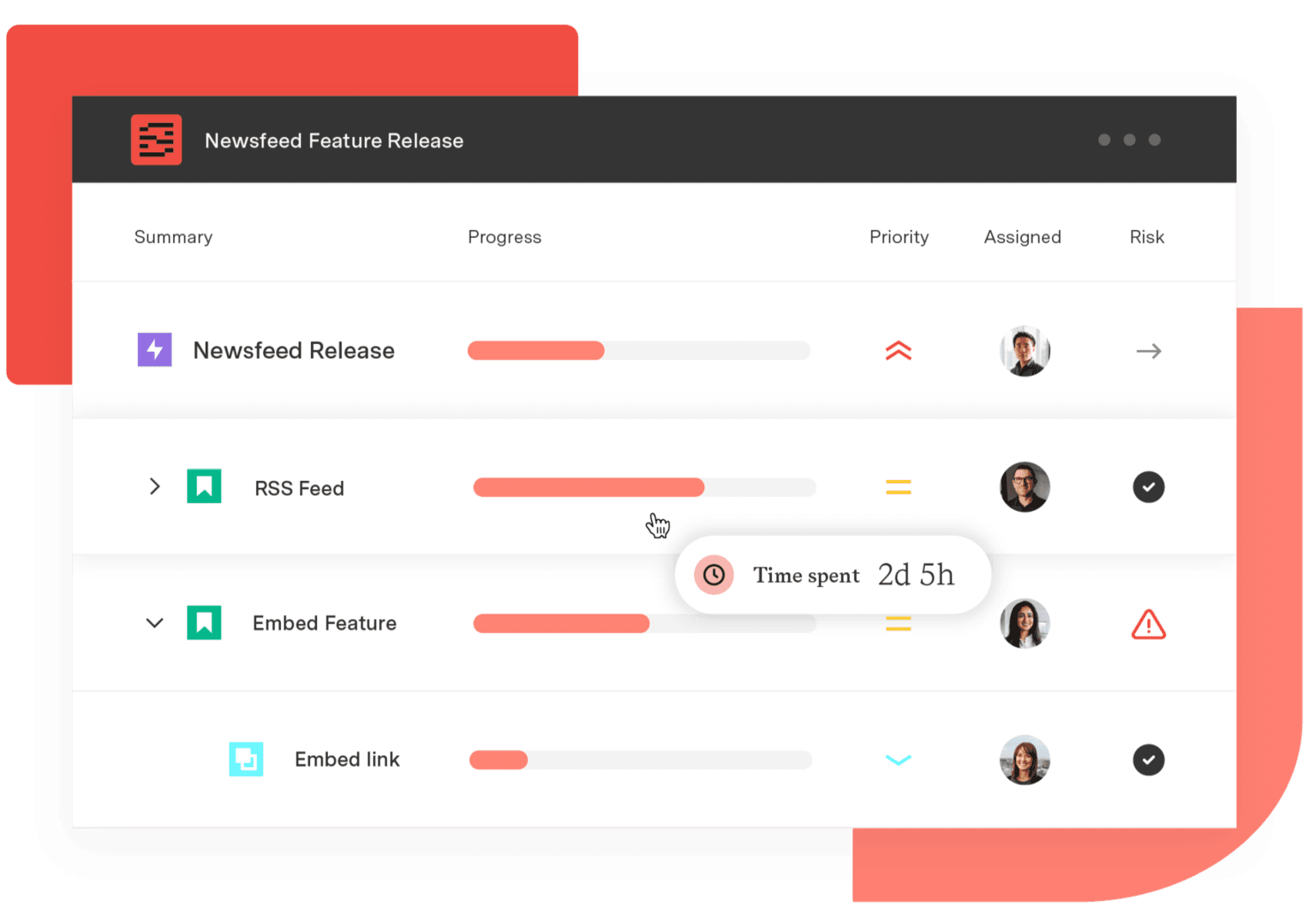
Structure PPM
Align your entire organization
Manage products, projects, and programs in a single spreadsheet-like view. By providing a clear, real-time view of project progress and resource allocation, Structure helps teams meet deadlines and adapt swiftly to changing priorities.
Start a Free TrialFrequently Asked Questions
Couldn't find what you need?Go to our documentation
ServiceNow captures time inside its platform, but the depth depends on how faithfully the Jira sync reflects what delivery teams are actually doing. For Jira-based delivery, time logged in ServiceNow is downstream of the connector, which means CapEx/OpEx and billable-hour reporting inherit any sync drift. Tempo Timesheets logs time on the Jira issue directly, so financial reporting reads from the source.
Not as a native Marketplace app. ServiceNow is a standalone enterprise platform sold through ServiceNow's direct sales motion and partner network, not the Atlassian Marketplace. Tempo, by contrast, is distributed through the Atlassian Marketplace.
Tempo is priced per product on tier-based plans through the Atlassian Marketplace, so PMO leaders can model spend before talking to a sales team. ServiceNow SPM is priced as part of an enterprise platform agreement – contact-for-quote, typically tied to broader ServiceNow standardization. The comparison is less line-item and more architectural commitment.
Tempo's deepest data fidelity is for Jira-native work. For delivery outside Jira, Tempo's separate Marketplace connector apps – Power BI Connector for Jira, Tableau Connector for Jira, and BigQuery Connector for Jira – let organizations aggregate reporting across systems at the analytics layer, though time, cost, and capacity depth is specific to Jira-based work.
Because Tempo is Jira-native, there's no delivery system migration. The transition involves mapping portfolio hierarchies into Tempo Structure PPM, configuring Tempo Accounts for financial tracking, and training PMO and finance teams on Tempo's reporting surfaces. Most implementations reach productive use in weeks.
Tempo holds SOC 1, SOC 2 Type 2, ISO 27001/27701, and PCI DSS certifications, plus CSA STAR Level 1, DORA alignment, and a VPAT, with GDPR and CCPA covered via standard DPA. These meet enterprise procurement requirements for regulated industries. Documentation is available during evaluation.
Yes. Tempo is licensed as a Jira app through the Atlassian Marketplace and is independent of any ServiceNow contract. Organizations running ServiceNow for non-delivery workflows can adopt Tempo without disrupting that investment.
Related comparisons: - Tempo vs Jira Align - Tempo vs Planisware - Tempo vs SAP EPPM